The Little Tin That Changed the Supper Table

And the Quiet Idea That Made It Possible

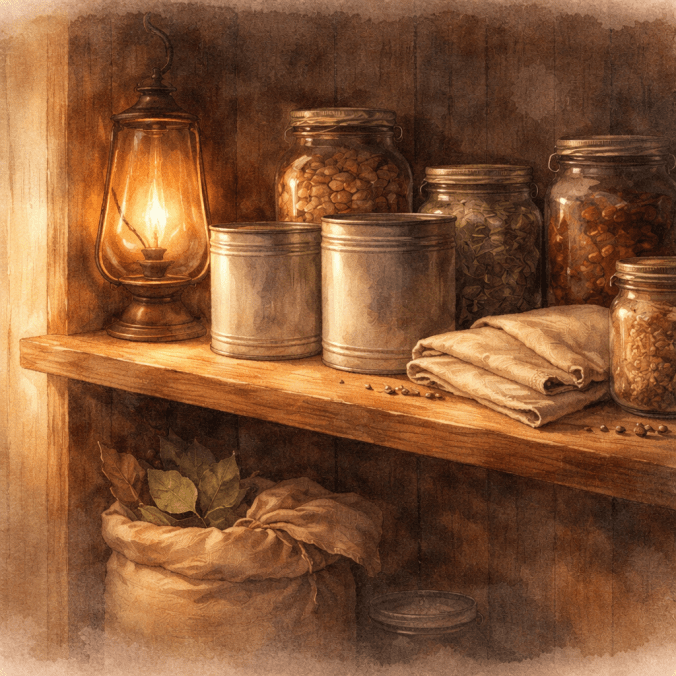
There are certain things that sit so plainly on a shelf, one might pass them by without a second thought.

A small tin, for instance.

Nothing remarkable in its appearance — no flourish, no fuss — merely a label, a lid, and the promise of something warm inside.

And yet, now and again, a closer look reveals that even the simplest things carry a story worth telling.


In the closing years of the last century, a company began offering what was then considered a rather fine and hearty dish — Beefsteak Tomato Soup.

By all accounts, it was a very good soup. Filling, flavourful, and welcome on the table.

But like most foods of that time, it came with its share of inconveniences — its weight, for one, made the cost of transport high, along with the need to prepare it fully before it ever reached the home.

Then, in 1897, someone had a different sort of idea.

Not louder. Not grander.

Just . . . . better, in a practical way.

A chemist by the name of Dr. John T. Dorrance developed a method of condensing soup — removing much of the water content before it was sealed in its tin.

What this meant, in practical terms, was rather remarkable:

Smaller tins
Lower cost to ship
Longer keeping

And the ability for families to prepare a warm meal simply by adding water or milk at home.

It was not merely a new product — it was an all together new way of thinking about food on the household table.


A smaller tin meant less cost, so more could be carried.
A lower price meant more could afford it.
A simpler preparation meant less time at the stove after a work-filled day, and more time at the table.

And before long, what was once a new and occasional thing became part of everyday life.


By these early years of the new century — including our own Gazette year of 1904 — such tins were beginning to appear more regularly on the shelves of mercantiles and general stores, often for around ten cents apiece.

A modest price at the time.

But one that placed a warm, dependable meal within easy reach.


There is something worth noticing in that.

Not every improvement arrives with great fanfare.

Some come quietly — set down on a wooden shelf, waiting to be tried.

And once tried, they have a way of staying.


You may notice something familiar on the shelves in this week’s “Hearth & Holler Gazette.”

And should you do so, you will now know a little more of the story behind it.

‘Til next time then, and hoping to see you on Saturday . . . .

— Jim  (and Red!)

P.S. from Little Red Bear —After a long day roaming the hills up and down in search of honey, a warm supper that asks only for water, a pot, and a little good sense sounds to me like one of mankind’s better ideas.

Pen-and-ink illustrations created with the assistance of AI and lovingly styled for Little Red Bear Land.

Fresh Ink & Hot Coffee — Tomorrow, It Begins

A quiet word before Saturday morning arrives  . . . .

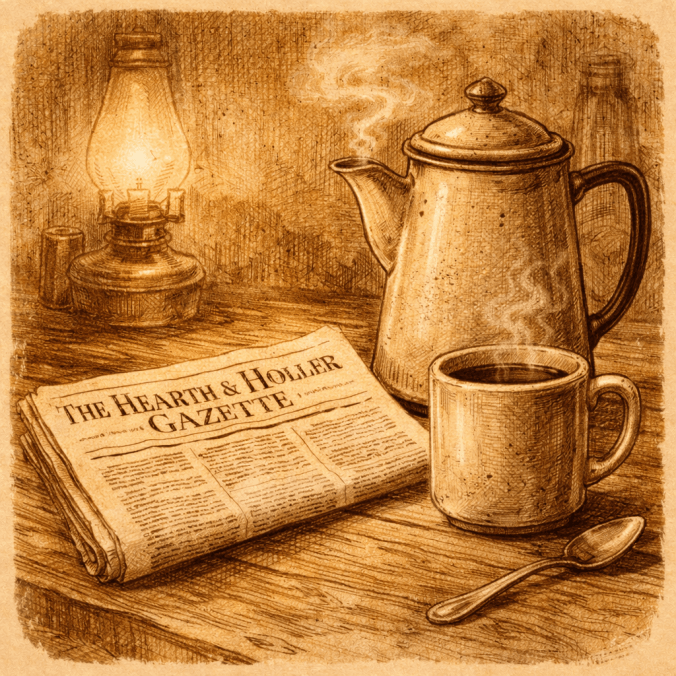
The press is warming, the quill has been freshly dipped, and in this neck of the woods the air smells faintly of biscuits and printer’s ink.

By lamplight, Little Red Bear is checking the final lines, pages stacked neat and waiting. Rusty and Percy are chasing down the last good headline, and somewhere nearby a kettle is whistling — the patient kind that knows its moment is almost here.

The very first issue of The Hearth & Holler Gazette is ready to roll — full of neighbourly news, small-town happenings, a little laughter, and a bit of country comfort to carry with you.

Tomorrow is the day.
The Gazette arrives.
Are you ready?

— Jim  (and Red!

A small note for new readers:
Receiving The Hearth & Holler Gazette is as simple as being registered for this blog. There is nothing more to do.

Something New Is on the Way

An invitation, quietly extended.

Over the past several weeks, I have mentioned a new project taking shape just over the hill — something written carefully, assembled slowly, and meant to be read at ease.

With the first issue now nearly ready to be set before you, it felt right to let the editor speak for herself.

🖋 A Note from Clara Thimblewick, Editor

For some time now, a small staff has been at work — gathering items of interest, setting type, sharing a pot of coffee, and preparing a paper meant to be read slowly and kept close at hand.

We have taken care to make it worthy of your time.

The Hearth & Holler Gazette was created for readers who still find pleasure in neighborly news, in small observations, and in stories that do not hurry you along.

It is not meant to be exhaustive.
It is not meant to be loud.
It is meant to feel familiar.

If you care to join us, we would be glad to have you.

The first issue will be set before you this Saturday.

Clara Thimblewick, Editor

Before we close, one small thing for clarity.

The Hearth & Holler Gazette is a make-believe newspaper from a make-believe place in Little Red Bear’s Honey Hill Country, staffed by characters who do not exist anywhere outside these pages.

The things they practice, however, most certainly do.

Kindness.
Compassion.
Looking out for one another.
Stopping long enough to notice.

Those are as real as it gets — and what it is all about.

If this sounds like something you might enjoy, the first issue will be waiting for you this Saturday.

We hope you will join us.

— Jim  (and Red!)

A small note for new readers:
Receiving The Hearth & Holler Gazette is as simple as being registered for this blog. There is nothing more to do.

A Fresh Stack of Mornings

A quiet New Year arrives in Honey Hill Country, bringing stillness, reflection, and the promise of days yet to be read.

The New Year has come quietly to Honey Hill Country.

A cold winter morning has settled in. Snow lies clean and unbroken beneath the trees, save for a line of rabbit tracks stitching their way across the yard and disappearing into the brush. Frost rests easy on the fence rails, and the woods hold the kind of silence that only follows a good snowfall — deep, listening, and kind.

No fanfare, no fuss — just the slow turning of the calendar page, with a fresh stack of new mornings waiting to be opened on the kitchen table. The old year folded itself away politely, and the new one stepped in like a neighbour removing their hat at the door.

Out here, the year always begins the same way — with a pause.

There is time to look back at what was carried, what was learned, and what, perhaps, is ready to be set down. There is time to stand a moment longer at the window and consider what might yet come walking up the lane. And there is time — always time — to say, You Are Welcome Here.

Honey Hill Country remains much as you left it — and Little Red Bear is still right where he has always been.

The paths are familiar. The front porches are swept. The kettle is warm — Little Red Bear is keeping it so. Your choice, coffee or tea. Fresh biscuits, always. The stories continue — some by the fire, some on the page, and some quietly, heart to heart.

As the new year unfolds, there will be small kindnesses, ordinary miracles, and a few good surprises tucked between the days. There will be laughter that arrives unannounced. There will be reflections that linger. And there will be new rhythms settling gently into place, one week at a time.

Later this month, something long-planned and much-loved will find its way into the light — The Hearth & Holler Gazette, a weekly visit of tales, tidings, and old-time country comfort, shared from Little Red Bear’s corner of Honey Hill Country and meant to be read slowly, like the morning paper at the table.

But for now, there is no rush.

This first week of January is for standing still just long enough to take a breath, to look around, and to remember that beginnings do not need to be loud to be meaningful.

So welcome — to the New Year, to Little Red Bear’s Honey Hill Country, and to whatever good may yet come.

The gate is open. The light is on.
Come in when you are ready.

— Jim  (and Red!)

“A new year does not ask us to be different people,”
Clara Thimblewick once wrote,
“only to listen a little more closely to the better parts of ourselves.”

Pen-and-ink illustrations created with the assistance of AI and lovingly styled for Little Red Bear Land.