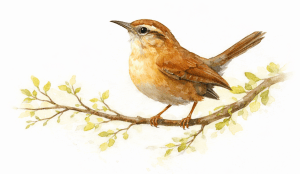
Out on a branch of the Honey Locust tree just beyond the window, a Carolina Wren had taken up position and was delivering his familiar seven-note song — over and over and over again — with the bright confidence of a creature that believes the whole world ought to hear it.
And the remarkable thing is that the world usually does.
It never ceases to amaze how such a tiny bird can produce a voice large enough to fill the yard, echo across the nearby trees, and make itself known to anyone within reasonable listening distance.
The little fellow sang as though he were warming up for something important.
Spring, perhaps.
Somewhere in the quiet workings of the seasons, preparations are already underway. The light shifts a little. The ground softens. Birds begin testing their voices again.
And this particular wren seemed determined that nobody should overlook the moment.
There is probably a lesson hidden somewhere in all that — the old reminder that sometimes it takes only one voice to make a difference.
But that is a subject for another day.
This morning, the message felt simpler.
He was reminding me — It might be time to open the window.
The view out the window grows smaller. Daylight slips away early, like it has someplace else to be. Air sharpens, carrying that clean, honest cold that wakes you up if you let it.
I noticed that this week while sitting in my rocking chair by the bedroom window, tea cooling nearby because I had forgotten to drink it, as usual. The predicted snow had come in overnight — the kind that smooths everything over and makes the world look newly ironed. No tracks yet. No hurry. Just quiet.
A flash of red landed briefly in the bare branches across the way — a cardinal, bright as a dropped mitten against the snow. He stayed just long enough to make his point, then moved on.
A flicker of motion caught my eye.
A red-headed woodpecker worked his way up and down the branches of the honey locust outside my window, tapping, pausing, tapping again, as if checking a long list of winter responsibilities. His bright head flashed against the pale morning, all business and purpose.
Below him, the mourning doves were already at work.
They are always there — steady, unassuming, moving along the ground beneath the feeders just as they always do. While other birds dart and flutter, the doves walk rather than hop, heads bobbing gently, as if keeping time to a tune only they can hear.
Near the base of the feeder, the chipmunk made a brief appearance — a quick inspection, a pause, and then gone again, carrying on as if winter were merely an inconvenience.
The feeder itself soon filled — sparrows first, then juncos in their tidy grey coats, and finally the chickadees, darting in and out as if late for an appointment. It swayed slightly with their comings and goings, a small sign of life in an otherwise still morning.
Later, it was time to bundle up and take my little chihuahua outside. She approached the snow with caution, as if it might suddenly do something unexpected, then set about her business with dignity intact. I lingered longer than necessary after we finished, breathing in the winter air. I have always loved this season — the way it clears things out, the way it feels honest and bracing, the way it asks you to be present and alive.
But winter asks a lot of us. Patience, for one. A willingness to slow down whether we want to or not. Sometimes it asks us to stay put, to wait things out, to trust that what looks dormant is not finished — only resting.
And in return, winter offers these quiet gifts — a cardinal passing through, a determined woodpecker at work, the steady presence of mourning doves beneath the feeder, the clean breath of cold air that fills your lungs and reminds you that you are still very much here.
The world, it seems, has not stopped. It has simply lowered its voice.
Somewhere nearby, a bird called out — sharp and clear — and for a moment it felt like an answer, though I had not asked a question.
Winter will pass. It always does. But while it is here, it offers this small, steady reassurance — life continues, quietly and faithfully, right outside the window.
Hey, y’all — how is your new year going so far? Wait ’til you hear about the week I had…
My new year started off with a Bang the past week! I’d be surprised if you hadn’t heard it. (Not a literal but rather a figurative “Bang!”, of course.)
What a fantastic week and auspicious start to the new year here! Hope yours went as well, and as always, please don’t be shy and feel free to share in the Comments. We would all love to hear about it!
Here is a quick recap of my past week . . . . .
Monday —
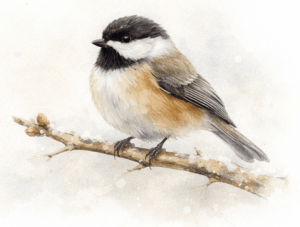
I have always been an avid bird lover and watcher. One of my most favorite little birds is the Black-capped Chickadee. Despite recognizing all of their various songs and “dee-dee-dee-dee-dee” alarm calls, I had never actually seen one live and in person.
Until Monday! Walking my little chihuahua, Allie, I paused at a spot to let her do her ritual sniffing of the fallen leaves and grass routine when all of a sudden I heard two Chickadees.
I looked up and there they were, a pair of Black-capped Chickadees no more than four feet away in a small tree above my head. I was able to watch them go about their business for several minutes.
Then, walking a little further ahead, I again paused near a friend’s bird feeders to let Allie roam about on the lawn. Within two minutes, I saw a pair of Bluebirds, more Black-capped Chickadees, a pair of Cardinals, and numerous Purple and House Finches, capped off by a White-breasted Nuthatch going up and down the tree beside me, again mere feet away. What an amazing winter walk we had that morning!
Tuesday —
The most amazing, red-letter day —
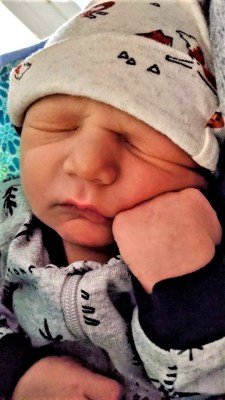
I became a “Grandpa” for the first time!
Having had four children of my own including a set of twins, I have always joked and kidded around that I have been training all of my life to be a “Grandpa.” And now, looky here — I am one!!
Tuesday saw the birth of my first grandchild! Little Pendleton Robert Milson was welcomed into the family, firstborn of my son Matthew and his delightful wife Samantha. Marvelous kids who will make outstanding parents! I could not imagine a baby being blessed with more wonderful parents.
(Of course, I am biased! But please grant a proud Grandpa a little leeway and license to brag, yeah?)
Way to go and most sincere, heartfelt congratulations to Matthew, Samantha, and baby Pendleton!!
Wednesday —
On Wednesday morning, I received a lovely note from a “Little Red Bear” stories reader, enjoying “The Adventures of Little Red Bear: The First Holler!” and apparently not even finished yet, (Wait ’til she gets to the story about the Woodboogers!) —
“Dear Jim — I just wanted to sit a spell and tell you how much I am enjoying “The Adventures of Little Red Bear”. Although I am a city slicker, my husband grew up around the Ozarks areas of the stories and is well acquainted with hollers and criks. Reading your book is such a delight, as I become engrossed in Little Bear’s adventures. I just had to smile as I leaned back and fell into Little Red Bear’s world. The stories and voice of Little Red Bear are so needed for kids and adults and I am so appreciative that you share these stories!! Thank you so much!” — L.H.
Thank you, L.H., for your kind and generous note! Little Red Bear even put down the honey jar and broke into a Happy Dance across the kitchen floor. Wish you could have seen it! When Red breaks into a dance, it rattles the cabin floors in such a way as to rival a small earthquake. And he rattled them for quite a spell after reading your kindhearted and thoughtful note!
Having eliminated all royalties on my Little Red Bear books at the beginning of the COVID Pandemic to make the books and stories as affordable as possible for everyone, reader notes such as this touch my heart. If you would like to see what others have had to say about the stories, check out “Little Red Bear Book Reviews & Reader Comments!”
With my primary mission this year to get back to regular writing, the new post got the ball rolling right on schedule.
Friday —
On Friday morning, I had another follow-up visit with the doctor for the recent Rotator Cuff Surgery on my right shoulder. Thanks to the amazing work of Dr. Spitzfaden, the orthopedic surgeon, and the efforts of Marla B., my physical therapist, I passed all movement and strength examinations with flying colors. All of the therapy work and at-home exercises paid off in grand fashion and I was granted an early release.
So, I am most happy to report that while continued healing and strength training work will continue for the next year (and maybe two, the doctor said), my right shoulder is now functioning amazingly well, with it being only eleven weeks, less than three months out from surgery.
And, not to overlook, the feeling has returned to around 90% in all of my fingers, following the bilateral carpal tunnel and trigger finger surgeries on both hands in June. So, though still nursing along an irreparably damaged left shoulder which may result in a future shoulder replacement at some point, other areas are definitely trending up.
Saturday —
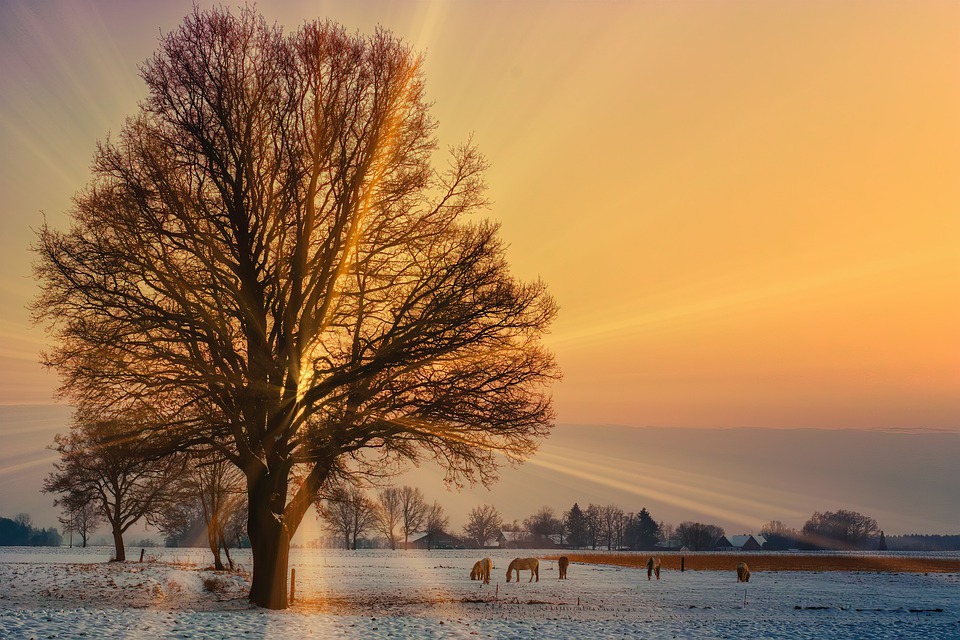
Living on the outskirts of St. Louis and the nearby Ozarks Mountains region, we received our first measurable snowfall of the winter season on Saturday morning. It was only about a little less than an inch, but so beautiful.
With snow on the ground and gorgeous pink sunsets framed by bare tree branches out my windows in early evenings, winter always holds its own very special beauty for me.
“Winter is the time for comfort, for good food and warmth, for the touch of a friendly hand and for a talk beside the fire: it is time for home.” – Edith Sitwell
What do you enjoy most about the Winter Season? Please share in the Comments.
Sunday —
It is early on Sunday morning as I write this, so who knows what special event or happenstance later today may cap this amazing week?
Maybe it is simply the fact that I am once again typing away at nearly full-speed on the laptop with my newly rehabbed shoulder and hand surgeries, working on new Little Red Bear adventure stories, and getting ready to share yet another new writing piece with you already in the new year!
And that in itself is pretty special all on its own, isn’t it?
So, what an amazing week, don’t you think?!? Feeling truly blessed in so many ways, not the least of which is having you reading along to share it.
Thank you so much for stopping by today! I hope your upcoming week is very special for you, too. And the coming new year for us all, as well.
Sometimes we can pick up on the dark clouds hanging over someone and the struggles they may be going thru, but oftentimes not. That is when a simple kind word or gesture may serve to turn someone’s entire day or life around, a kindness freely shared and shining thru the darkness.
We all go thru turmoil and issues in our lives that are frequently not visible to others, and perhaps that is when an unexpected kindness counts the most.
Will you shine your special light and help to brighten someone’s day today? And again tomorrow? I invite you to join “The Smile & Compliment Club” and allow kindness to become a regular practice in your life. It will make a world of difference for others, and for yourself, as well.
‘Til next time! — Jim (and Red!) 🤠 🐻
“Kindness is the language which the deaf can hear and the blind can see.” – Mark Twain
“In music, in the sea, in a flower, in a leaf, in an act of kindness . . . I see what people call God in all these things.” – Pablo Casals
“I think a hero is any person really intent on making this a better place for all people.”
– Maya Angelou
This is a purposefully non-monetized, ad-free site to be able to offer the most enjoyable reading and viewing experience for everyone, with all content freely shared, and generates no income to offset the costs of maintaining and operating.
If you enjoy your visits and time with us, I invite you toJoin our new Patron Communitytoday, because together we can do so much!
With the help of patrons, we are able to donate free print copies of “The Adventures of Little Red Bear: The First Holler!” to Senior Citizens, School Libraries and Classrooms, and to those who could otherwise not obtain a copy.
Patrons also help my friend Little Red Bear and me to continue this as a Non-Monetized site free of distracting advertisements, dedicated solely to entertainment and educational purposes while sharing positive messages of Happiness, Inspiration, Kindness, Environmental Awareness, and Conservation with everyone.
“Some believe it is only great power that can hold evil in check, but that is not what I have found. It is the small everyday deeds of ordinary folk that keep the darkness at bay. Small acts of kindness and love.” – Gandalf, “The Hobbit” by J. R. R. Tolkien
Thank You for visiting with us!
Please feel free to share with family and friends. Likes, Shares, & Comments are truly appreciated and help expand our reach and encouraGE new readers to visit!
Happy Hummer Season! Soon the buzzing and whirring sounds of rapidly beating wings and flashes of color will be filling the air in our backyards once again. The hummingbirds return!
My earliest memories of hummingbirds from many years ago recall the stern admonition and warning from my Mother, taking a page from the ‘Mother’s Guide to Eyes & BB Guns’ — “Don’t go anywhere near the hummingbirds or bother them. They’ll poke your eye out with that bill of theirs!”
This has always seemed out of character with my Mother’s deep love for all things ‘nature’, but she nevertheless firmly stood by it all thru the years. Maybe she knew someone from her past that had an unfortunate run-in with a disgruntled hummingbird. But I tend to doubt it.
Despite the “Eye Poke” warning, we planted a never-ending stream of flowers and butterfly bushes over the years to attract them, and it was always a special time celebrating new arrivals each Spring. It seemed that Summer would not really be Summer without Hummingbirds buzzing around our flower gardens!
Hummingbirds are a joy to observe in the backyard as they hover, flit and fly about, and will very soon be arriving back to summer homes in North America from winter stays in Southern Mexico, Costa Rica, Panama and other regions of Central America. Hanging a nectar feeder to greet their arrival in Spring will help immensely as they arrive thirsty and in quick need of nourishment following their long migrations northward.
To find out when to expect the arrival of regional hummingbirds in your area, check out the Audubon Guide. Residents in the South and along the Gulf shores should expect them first and have feeders out, available, and at the ready. When the tiny hummingbirds arrive after long journeys across the Gulf of Mexico from Central and South America they are famished, exhausted, and in need of quick energy resupply!
I invite you to enjoy this slow-motion “Moment of Chill — The Hum of Wings”, sponsored by The Orvis Company —
Providing a hummingbird feeder in your yard helps to renourish the little hummers quickly and get them off to a healthier start for the coming breeding season after their arduous travels northward, and can be both a source of entertainment and a healthy learning experience for the children in your family as they learn more about nature.
If unprepared in the Spring, not to worry. It is never too late during the season to put your first feeder out for hummingbirds, and extra feeders in the fall are very important for both local birds to prepare for southern migrations and for those passing thru from up north on their way south. It’s never too late to start.
Hummingbirds need to consume several times their body weight in food intake each day and are necessarily always on the lookout for flowering plants to quench their thirst and maintain energy. Flowering plants for the hummingbirds are much more numerous and available during the summer months, so providing an early supplementary food source with a hummingbird feeder can help them get thru leaner spells in springtime when flowers and natural food sources are not yet as numerous.
There is no need to worry about supplementing their diet with a feeder and distracting hummingbirds from natural food sources, as they will continue to seek out and consume plant nectar, small insects, and tree saps to prepare for the breeding season, and then later feeding their young in the nest. And later still, preparing for fall southern migrations back to their winter homes.
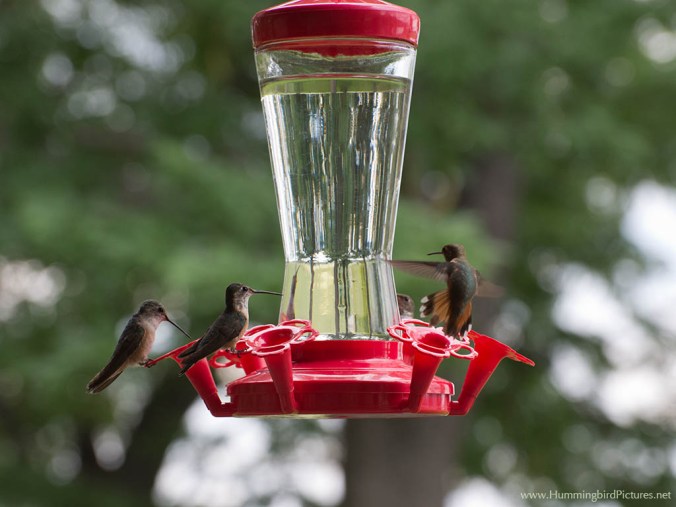
To select the best feeder, choose one that can be easily cleaned on the inside to prevent contamination and illness for the birds, and one that is brightly colored with lots of red to get their attention and attract them to your feeder.
If you have few hummingbirds in your area, completely filling the feeder is not necessary, to not waste the nectar mixture. As the season progresses, filling the feeder to the brim may be more advisable as the birds will be visiting more often to drink and the feeders will probably be even busier with greater numbers in the summer heat and growing families.
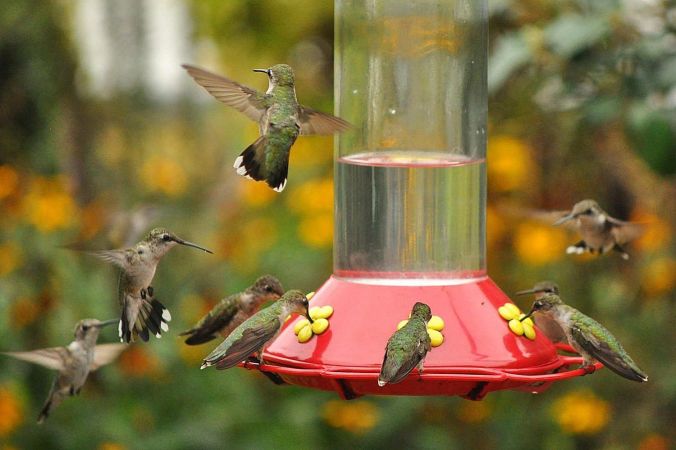
If there are a large number of hummers in your area, a larger feeder with a greater number of feeding ports can help to reduce territorial conflicts brought about by the hummingbirds’ natural territoriality and competitiveness to guard the feeding source by allowing more birds to access the feeder. Everyone enjoys a little elbow room.
Feeders can be inexpensive and plain, or very decorative and ornamental. The hummingbirds only care about the nectar and happily leave design and decor choices to the humans’ personal tastes. But it is important for any feeder to contain a good deal of bright red coloration. Hummingbirds are naturally attracted to brightly colored flowers, including yellows, oranges, pinks, and purples, but are drawn to the color red much more than any other color as it signals a food source to the tiny bird, so they naturally associate the color red with food.
Wearing a bright red shirt one hot day last summer, a hummingbird approached and examined me closely before sadly moving on, clearly disappointed after determining that the giant flower he thought he had joyfully discovered was not in fact, a flower.
There is no need to purchase pre-packaged hummingbird food mixes in the store, as a perfect nectar mix can be easily and inexpensively prepared in your home kitchen using only sugar and water as the ingredients.
It is important to prepare the nectar supplement mixture using only Refined White Sugar, as honey can promote dangerous and harmful fungal growth and should never be used. In addition, organic, natural and raw sugars may all contain excessive levels of iron which can be harmful to the birds. Plain, white refined sugar is sucrose, which when mixed with water comes the closest to matching the chemical composition of naturally occurring nectar in the wild.
With a brightly colored red feeder, there is no need to add red food coloring to the nectar mixture, as the chemicals in food coloring can be harmful to the hummingbirds.
Homemade Hummingbird Nectar Recipe
To prepare the nectar mixture, simply mix 1/4 Cup of Refined White Sugar in 1 Cup of Boiling Water until the sugar is all dissolved, or a ratio of 1 part sugar to 4 parts water if preparing a larger amount. Let the mixture cool and then fill the feeder and hang it outside for the birds. Simple as that.
For best results, hang the feeders preferably about head high so you do not need a ladder to reach it for cleaning and refilling, and also in the shade to keep the nectar from spoiling as quickly as it would in the full sun. The nectar will serve as a healthy and beneficial supplement to the birds’ natural nectar diet in springtime, and then all summer long as well, providing the birds with an extra and welcome energy boost at the end of long, hot, and dry summer days.
Keeping the feeders freshly filled and available for the birds when fall arrives and having the extra nectar nourishment available will help your little neighborhood hummingbirds restrengthen after the breeding season is finished, boosting energy and helping them to prepare for their long migration back to southern wintering grounds.
Autumn feeders will also provide welcome and needed nourishment to hummingbirds in winter migration passing back thru on their way south. Because of the influx and numbers of migrating birds, putting additional hummingbird feeders out in the fall can actually be very helpful in providing needed migration energy for all who stop by to visit.
Extra nectar mix may be stored covered in the refrigerator for up to two weeks in a clean glass or plastic container. If the mix in the feeder becomes cloudy or mucky, it should be discarded and the feeder cleaned. The feeder should be cleaned regularly every few days, especially during hot weather to keep it free from mold and mildew, as nectar is a food and will spoil. We usually clean ours every other day just to be safe.
Feeders can be cleaned using various sized bottle brushes and by soaking them in a mixture of 1 part plain white vinegar and two parts hot water, then thoroughly rinsing to keep the birds healthy.
If black mold is detected, soaking for an hour in a bleach mixture of 1/4 cup bleach to a gallon of water can be done, followed by very thorough rinsing. Mold should not be an issue if the feeders are cleaned regularly.
To control and keep away uninvited wasps and bees which may visit hummingbird feeders, avoid choosing a feeder with the color yellow on it, as yellow is known to attract them. Some feeders have built-in water moats which protect against ants contaminating the nectar, and some have screens over openings which only allow the hummingbird’s long tongue to enter, keeping bees and other insects out.
For additional tips to prevent the problem of unwanted insect visitors, visit Control All Insects On Nectar Feeders. In years of feeding hummingbirds with different types of feeders, we have never really had a problem with either mold or uninvited guests.
Hummingbirds can be territorial, especially during breeding season, so there is no harm in hanging out more than one feeder, which may result in even more visitors to your yard. If possible and for the best results, hang additional feeders out of the line of sight from one to another to attract more birds and to diminish conflicts over territory.
Adding native plants for your regional area and growing them in your garden and yard will also help the hummingbirds by providing natural shelter and food, including a healthy environment for insects. Many are surprised to learn that insects provide an important part of the hummingbird’s diet, especially during the breeding season.
For help in selecting the best native plants for not only hummingbirds but all birds, a great resource to check out is Audubon’s Native Plant Database. Simply enter your zip code to find the recommendations of local experts in your area for your yard. Then you can narrow down the search by the type of birds and/or plants you have in mind.
So, happy Hummer Season! Little Red Bear and I hope this guide to helping the hummingbirds was helpful, and that both you and your family are able to experience the joys and delights of watching the amazing aerial displays and acrobatics of hummingbirds all summer long. Teaching children about the wonders of Mother Nature can never begin too early, and hummingbirds are fascinating and captivating to watch for all ages.
Likes, Comments, and Shares are always appreciated, in addition to sharing with family and friends to help spread the word to others about Mother Nature and helping to make the world a better place for everyone. Including the Hummingbirds!
Thanks as always for visiting and spending part of your day with us. A small gesture or kind word can brighten someone’s day or change a whole life around. Join us in the “Smile & Compliment” club and help brighten someone’s life today! — Jim (and Red!)
(And if a new visitor — Welcome! To find out what we are all about here, please check out — “Welcome To My Writing Pages!”— and sign up to follow and be notified of every new post!)
“Kindness is the sunshine in which virtue grows.” — Robert Green Ingersoll
~ Every Day is Earth Day. Think Globally — Act Locally. ~
“The woods hold not such another gem as the nest of the hummingbird. The finding of one is an event.” – John Burroughs
This is a purposefully non-monetized, ad-free site to be able to offer the most enjoyable reading and viewing experience for everyone, with all content freely shared, and generates no income to offset the costs of maintaining and operating. If you enjoy your visits and time with us,Join our new Patron Communitytoday, because together we can do so much!
With the help of patrons, each month we are able to donate free print copies of “The Adventures of Little Red Bear: The First Holler!” to Senior Citizens, School Libraries and Classrooms, and to those who could otherwise not obtain a copy.
Patrons also help my friend Little Red Bear and me to continue this as a non-monetized, ad-free site, dedicated solely to entertainment and educational purposes while sharing positive messages of happiness, inspiration, and kindness with everyone. We invite you to join us in making a positive difference in the world!
“If you truly love nature, you will find beauty everywhere.” — Vincent van Gogh
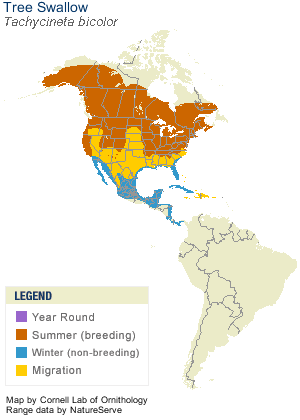
Tree Swallows are among my favorite birds, always delighting in observing their aerial acrobatics in fast pursuit of insects, rapidly twisting and turning thru the air dashing here, there, and everywhere on late summer afternoons and evenings.
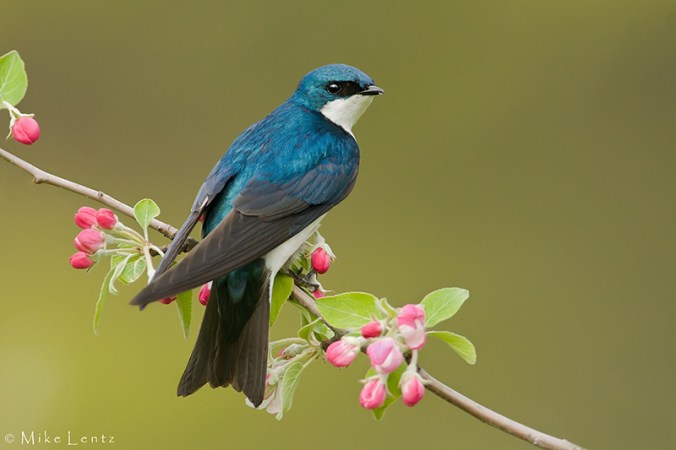
The Tree Swallow (tachycineta bicolor) is one of the most beautiful of the swallow family, with deep-blue, iridescent backs and clean white fronts. With their steely, bluish-green feathers flashing in the sunlight, Tree Swallows make a most striking appearance and display as they chase thru the air in pursuit of insect food for their families.
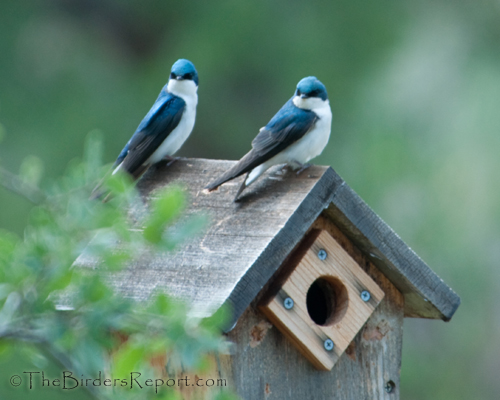
Tree Swallows do not build open, free-form nests of dead grass, leaves, sticks and twigs like many birds, but rather only nest inside cavities, such as old woodpecker holes in trees. With such natural places in limited supply, nesting sites like these are scarce and at a premium in the spring, on a first-come, first-served basis, with intense competition with everyone looking for a home in which to raise a family. But fortunately, Tree Swallows also adapt readily to nesting boxes.
You can help the Tree Swallows in your neighborhood by putting out nesting boxes in your backyard. The birds are a great addition to a backyard or field and will reward you, as many birds and bats do, by regularly patrolling and keeping insects under control and at bay all summer long.
The average adult Tree Swallow consumes 2,000 insects each day during the 45 day nesting period, while also catching approximately 6,000 insects per day to feed to their nestlings over their twenty day stay in the nestbox. Overall, this adds up to about 300,000 insects per family over the 45 day span. Since most of their hunting takes place under a height of 39 feet, that is potentially a lot of insects not pestering you in the backyard over the summer.
That is a good return on the purchase, or for a few boards and time invested in building a nest box. And then you and your family will also be able to enjoy observing these beautiful birds going about their business darting and dashing thru the air and raising their young thru the whole season.
Thanks as always for visiting. If you have stories or experience with these beautiful birds or helping them with nest boxes at your home, please feel free to share with us in the comments. — Jim (and Red!)
Family Times — Together Times — The Best Times!
Children + Nature + Outdoors = Happy, Healthy Balanced Kids
We most often think as the spring months as being the nesting season for birds. And it is, for the Cardinals, Sparrows, Robins, Finches and such. But not for the raptors, birds of prey. Young raptors, because they are much larger, take a much longer time to grow up and need a head start on the season. So raptors nest in winter.
Young Barred Owl
Young Barn Owls (Photographer Paul Sawer)
Barred Owl and Owlet
Remember the images of the nesting Eagles dutifully tending their nest and eggs covered over in the snow? It takes very dedicated parents to go thru an ordeal like that. Why the rush? Why start nesting so early before the weather has changed for the better, we wonder? Most other birds wait until April or later to arrive at their summer breeding grounds and start to build nests.
Nesting Bald Eagle in Snow- Codorus State Park in Pennsylvania, 2015
Nesting Bald Eagle with Eggs in Snow- Codorus State Park in Pennsylvania, 2015
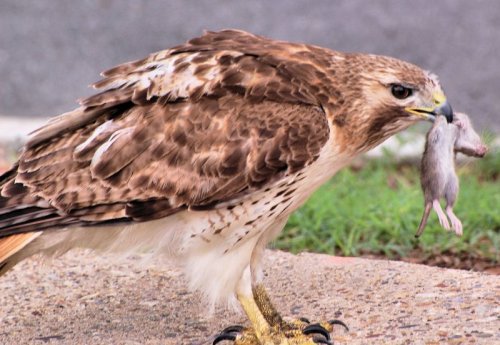
Turns out, there’s a very good reason. It’s all about rodent and other prey animal population control and giving the baby birds of prey an easier start in life. It takes a long time for large raptors to grow big enough to be independent and hunt on their own. An early start in the nest allows them the required time to grow and develop, while also insuring that when they are fledged and on their own, there will be a plentiful supply of prey animal babies emerging from their nests and running about at the same time to help make the raptors’ initial hunting forays a little easier and more successful. Nevertheless, 60% to 70% of Red-tailed Hawks, Owls and other raptors do not survive their first year. Life is hard for young raptors still trying to figure it out, so being ready early gives them the best chance of survival, while also helping to keep the world from being overrun by mice and other voles.
Great Horned Owl feeding Nestlings
Red-tailed Hawk and Hatchlings
Red-tailed Hawk Feeding Nestlings
So while the other birds and small animals are just getting started with nest building and babies now, the raptors are already well on their way to being able to greet them when they emerge later. The early bird gets the, ummm– baby mouse shall we say. Birds of Prey have a very important role to play in population control and the grand scheme of things as Mother Nature designed, and early nesting gives them the needed head start to make it all work.
Thanks as always for dropping in to visit! — Jim (and Red!)




 kidded around that I have been training all of my life to be a “Grandpa.” And now, looky here — I am one!!




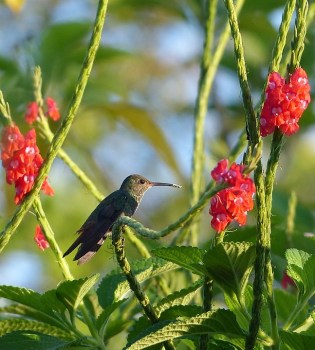 My earliest memories of hummingbirds from many years ago recall the stern admonition and warning from my Mother, taking a page from the ‘Mother’s Guide to Eyes & BB Guns’ — “Don’t go anywhere near the hummingbirds or bother them. They’ll poke your eye out with that bill of theirs!”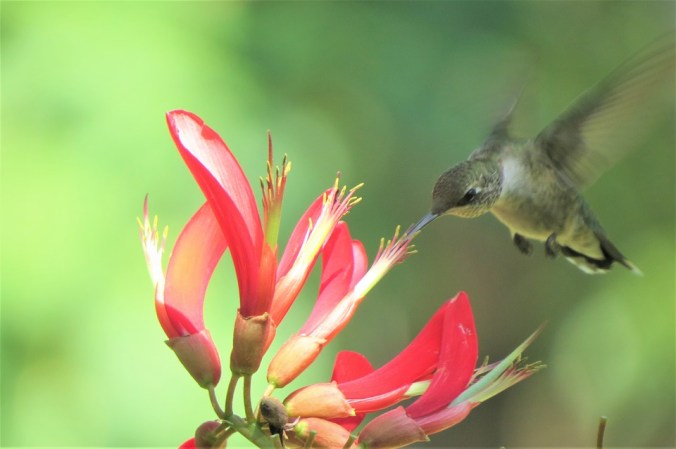


 thirst and maintain energy. Flowering plants for the hummingbirds are much more numerous and available during the summer months, so providing an early supplementary food source with a hummingbird feeder can help them get thru leaner spells in springtime when flowers and natural food sources are not yet as numerous.
 lots of red to get their attention and attract them to your feeder.




 attract them. Some feeders have built-in water moats which protect against ants contaminating the nectar, and some have screens over openings which only allow the hummingbird’s long tongue to enter, keeping bees and other insects out.







 James Milson - The Writing Pages