On Soil, Arrogance, and the Loss of Good Shoes
A struggle older than fences . . . .
Older than porches.
Older than the first confident step taken in good shoes.
It is the ancient feud.
Mud vs. Man.
And Mud remembers.

A struggle older than fences . . . .
Older than porches.
Older than the first confident step taken in good shoes.
It is the ancient feud.
Mud vs. Man.
And Mud remembers.

Welcome!
It is shaping up to be a lively week in Honey Hill Country, as March Madness Days begin in earnest and the Square fills once more with banners, brass, and bright expectation.
As always, The Hearth & Holler Gazette is a work of fiction set in a place that exists most clearly in the imagination — though from time to time it may resemble somewhere you have known. But for first time visitors, it may help to know where — and when — we are, and what I am talking about
The Hearth & Holler Gazette hails from Honey Hill Country, a small, rural corner of the Missouri Ozarks, as it might have been known in the year 1904 — a time of front porches and wagon roads, oil lamps and handwritten letters, when news traveled at a human pace, where animals and humans interact and live side-by-side, and a Saturday paper was meant to be read slowly, with coffee close at hand. This is not a paper of breaking news or loud headlines. It prefers instead to notice it — the small, human-sized moments that once filled a morning without asking much in return.
The Hearth & Holler Gazette is a work of fiction — a made-up paper from a made-up place, written in the spirit of an earlier time. Any resemblance to real towns, people, or events is entirely coincidental, though we do our best to make it feel otherwise.
This must be understood at the beginning — the towns, fields, and citizens described here exist only within these pages. With that firmly agreed, the small and ordinary wonders of the week may unfold as they will. That is the way of things here. That is all we need to know, and that ought to be enough.
With that understood, come along — the Square is lively, the rabbits are ready, and there is a place waiting along the rail.

March 1st has always been the first day of Spring for me.
Not astronomically. Not technically. Simply.
March, April, May — three months. One Season.
June, July, August — Summer.
September, October, November — Autumn.
December, January, February — Winter.
Four Seasons. Three equal months each. Clean. Understandable. No misunderstandings. No negotiating with it.
That calendar has served well for a very long time.
There was a time — and it does not seem so very far away — when the rest of life followed that same rhythm without effort.

February can feel long.
Not dramatic. Not tragic. Just . . . . long.
The trees are bare. The color has drained from the fields. The air moves a little slower.
And yet — there is motion.
A flutter in the honey locust.
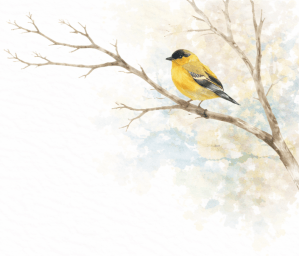
A finch on the ledge.
A woodpecker arriving like he owns the place.
February is National Bird Feeding Month.
And it is not only about enjoying the view.
It is about helping birds make it through winter — and preparing the ones who are about to arrive after journeys that stretch farther than we can easily imagine.

Welcome!
It’s been a week of preparation in Honey Hill Country.
As always, The Hearth & Holler Gazette is a work of fiction set in a place that exists most clearly in the imagination — though from time to time it may resemble somewhere you have known. But for first time visitors, it may help to know where — and when — we are, and what I am talking about
The Hearth & Holler Gazette hails from Honey Hill Country, a small, rural corner of the Missouri Ozarks, as it might have been known in the year 1904 — a time of front porches and wagon roads, oil lamps and handwritten letters, when news traveled at a human pace, and a Saturday paper was meant to be read slowly, with coffee close at hand. This is not a paper of breaking news or loud headlines. It prefers instead to notice it — the small, human-sized moments that once filled a morning without asking much in return.
The Hearth & Holler Gazette is a work of fiction — a made-up paper from a made-up place, written in the spirit of an earlier time. Any resemblance to real towns, people, or events is entirely coincidental, though we do our best to make it feel otherwise.
This must be understood at the beginning — the towns, fields, and citizens described here exist only within these pages. With that firmly agreed, the small and ordinary wonders of the week may unfold as they will. That is the way of things here. That is all we need to know, and that ought to be enough.
Winter loosens its hold by degrees. In St. Louis, great halls rise in anticipation of the Louisiana Purchase Exposition. Here at home, neighbors measure beams, set buckets beneath persistent drips, and begin planning how best to raise a roof before spring rains press their case.
Maple sap runs quietly. Rabbits consult schedules and polish sashes. Markets shift. Coin jars gather weight.
The county is not yet in motion — but it is readying itself.

Welcome!
It has been a mud bound week in Honey Hill Country. Another marked by delays, detours, growing shortages of everyday staples, and the steady work of getting on with things anyway.
Regular readers may recall that last week we introduced period-style illustrations, offering a visual record of events alongside the printed words of selected stories. This week, we take another big step forward — introducing our new staff editorial cartoonist, Clarence “Clary” Moss. Clary will be introducing his first editorial cartoon in the pages of the Gazette today, and will be a featured weekly contributor going forward.
But before we go any further, for first time visitors, it may help to know where — and when — we are, and what I am talking about
The Hearth & Holler Gazette hails from Honey Hill Country, a small, rural corner of the Missouri Ozarks, as it might have been known in the year 1904 — a time of front porches and wagon roads, oil lamps and handwritten letters, when news traveled at a human pace, and a Saturday paper was meant to be read slowly, with coffee close at hand. This is not a paper of breaking news or loud headlines. It prefers instead to notice it — the small, human-sized moments that once filled a morning without asking much in return.
The Hearth & Holler Gazette is a work of fiction — a made-up paper from a made-up place, written in the spirit of an earlier time. Any resemblance to real towns, people, or events is entirely coincidental, though we do our best to make it feel otherwise.

 James Milson - The Writing Pages