Cinnamon Charlie had checked the cake table three times before there was a cake on it.
He was taking no chances.
October 15th was his birthday, and Little Red Bear’s cabin on Honey Hill was getting ready for company.
For readers meeting him for the first time, Charlie is a young yearling bear whom Red took under his wing, giving him a home and helping him find his way in the world. He has curiosity, enthusiasm, and a growing interest in anything happening near the kitchen.
He also enjoys one of the finer arrangements available to fictional characters — a birthday every year while remaining a yearling.
We do find it keeps the cost of candles down.
The cake, however, still needs to be substantial. Cinnamon Charlie will have no other than that.
Outside, Autumn leaves gathered along the path to Red’s cabin. Inside, a few colorful branches and strings of paper leaves made the room festive. Small pumpkins stood near the hearth, and extra chairs had been brought in wherever a chair would fit.
Charlie inspected the table again.
“Is this where it goes?”
“Yes,” Red said.
“Just making sure.”
“You’ve made quite sure. Several times already.”
Charlie straightened a napkin.
There was always something useful a birthday bear could do while waiting.
Jeffrey the Rabbit and his wife, Jolene, were among the first to arrive, bringing their youngsters up from their home beneath Red’s cabin. The little rabbits studied the decorations, then joined Charlie in studying the table.
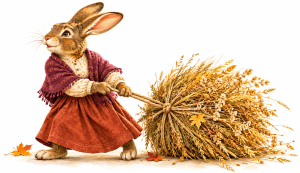
Mrs. Nettie Clover, an elderly rabbit down the way, followed with a small parcel wrapped in brown paper and tied with string.
“I see you’ve finished your carrying of grass bundles for the week,” she told Charlie.
“I could carry the cake,” Cinnamon Charlie offered.
“I expect someone has that attended to,” she replied.
Bobo and Lily, Little Red Bear’s best friends and former circus performers, arrived together. The two black bears brought cheerful greetings and helped settle the growing company without making much fuss about it.
Before long, Albuquerque Red, the self-appointed Fox Sheriff of the Backwoods, was visiting near the doorway. Swinestein, the little genius mini pig who also made Little Red Bear’s homestead his home, examined the paper decorations with interest, while Rusty the Fairydiddle found a place where a squirrel could see most of what was happening. Up in the rafters.
Cooter, the old Leader of the Hopper’s Holler Raccoon Platoon, came in with a question.
“Am I late?” he inquired.
“For visiting? No,” Red said.
Cooter glanced at the empty cake table.
“For the cake?” Cooter questioned again, a little more anxiously.
“No again,” Little Red Bear answered.
“Good.”
Stanley the Cardinal and Will the Whip-poor-will added their greetings as more neighbors gathered. Farmer Turner and his wife and children came up the path, followed by Alma Mason, Aunt Ivy Willoughby, and Red’s Cherokee friend John Forester. Myra Cookson, of Myra’s Pie Pantry & Goodies Shoppe in Butterfield, brought a covered plate that found a welcome place among the refreshments.
Soon, conversations filled the cabin and spilled onto the porch. Someone moved a chair. Someone else made room on a bench. There were greetings to exchange, parcels to set down, and children to keep gently clear of the serving table.
Then Joanelle arrived.
Charlie noticed immediately. Perhaps it was his little bear nose kicking in.
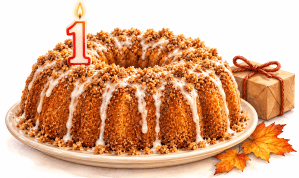
Joanelle Williamson, proprietor of Joanelle’s — Cakes & Specialty Baking on Main Street in Butterfield, arrived with a Cinnamon Streusel Bundt Cake. White powdered sugar glaze ran in pretty drizzled streaks down its golden ridges.
Her experienced assistant, Agnes Ovenburn, carried it to the table. A sturdy, silver-haired woman who knew her way around a wood-fired baking oven, Agnes also knew when a young bear was getting a little too close to a cake.
“After the candle, Charlie,” she instructed. “Not before, young bear.”
He took a small step back. A little one.
Then he leaned forward slightly to admire it from there.
The cake smelled of cinnamon and warm sugar. Across the room, Autumn treats brought by the neighbors added their own pleasant scents — pumpkin spice, baked apples, and the sort of goodness that makes people ask who brought what.
I have a particular affection for Cinnamon Streusel Bundt Cake. It was one of my favorite cakes to make back in the day, and one of my children’s favorites, too. I always finished it with powdered sugar glaze drizzled over the top and down the sides, and I don’t recall one ever seeing the next morning.
It seemed just the cake for a bear named Cinnamon Charlie, don’t you think?
Of course, a Bundt cake has a hole in the middle, which presented a small question when it came time for the candle.
Swinestein considered the matter.
Red placed the large “1” candle securely in the cake’s ring, on the side facing Charlie.
Swinestein nodded his approval. A satisfactory solution, he concluded.
Charlie’s attention was fixed on the cake as he watched Agnes light the candle’ wick.
The room gradually quieted. Friends leaned nearer, the rabbit youngsters found places where they could see, and someone at the back stepped aside so someone shorter could have a look.
For once, Charlie did not ask about cutting the cake.
He looked around the room.
There was Red beside him. Bobo and Lily smiling nearby. Nettie with her paws folded over her shawl. Jeffrey and Jolene keeping their little ones close enough to see and far enough from the table.
So many neighbors had come.
Cinnamon Charlie smiled.
Then the birthday song and wishes began, and the cabin was full of voices again.
When the singing ended, Red bent toward him.
“Ready?” he whispered in Charlie’s ear.
Charlie nodded. Of course he was. He had been ready since he got out of bed in the morning.
He drew a deep breath . . . . and . . . . Blew!
The little flame twisted around, flickered once, and went out.
For a moment, a thin curl of smoke rose above the white glaze.
Then everybody applauded and cheered —
“Happy Birthday, Charlie!”
Charlie looked at Agnes.
“Now?” he asked.
“Now,” she said.
That was an excellent word, he thought.
Plates began making their way around the room. There was cinnamon streusel to admire, glaze to enjoy, and more than one request for a small additional piece.
Cooter the Raccoon appeared quite willing to help prevent leftovers.
On the porch, neighbors settled into conversation while the children compared their portions and the afternoon light moved across the floorboards.
Charlie opened his parcels slowly enough to enjoy them, though now and then he looked back toward the cake.
Red noticed.
“There’ll be some more for later,” he reassured.
Charlie relaxed.
A birthday ought to have a later, don’t you think?
There is something especially pleasant about an Autumn birthday.
The leaves help with the decorating. Cinnamon belongs in the air. A warm kitchen feels like an invitation, and gathering together gives an ordinary afternoon something to remember.
Charlie’s party had all of that.
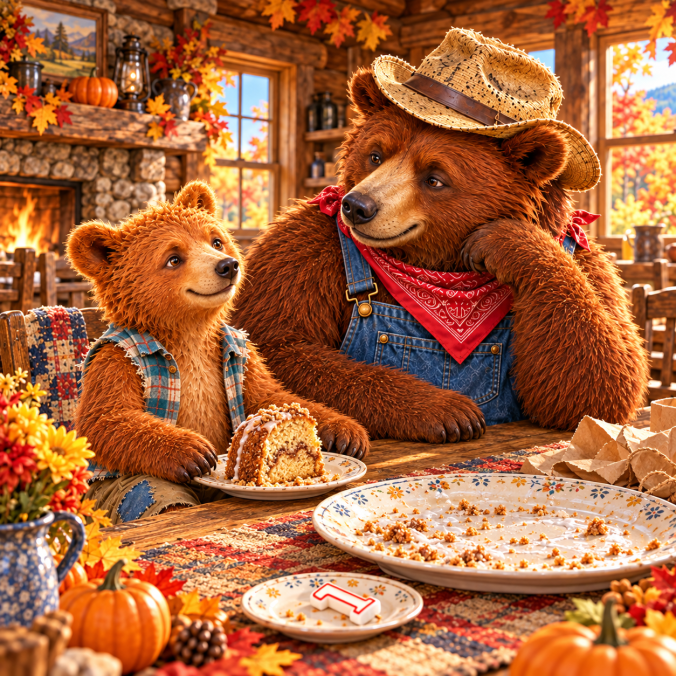
By the time the plates were cleared, there were crumbs on the table, paper wrappings to gather, and borrowed chairs that needed to find their way back home.
Cinnamon Charlie stood beside Little Red Bear as the last guests called out their goodbyes.
“Can they come again?” Charlie asked.
“I expect they can,” Little Red Bear responded.
“Before my next birthday?”
Red smiled.
“We needn’t wait that long,” he laughed.
That pleased Charlie almost as much as the cake.
Till next time then —
Jim (and Red!)
A Little Red Bear P.S.
Charlie asked whether being the birthday bear meant he could have the last piece of cake.
I told him we ought to see whether anyone else wanted it first.
He is now considering how early next year’s guests should go home.
— Red 🐾
More Visits with Little Red Bear
If you enjoyed celebrating with my story friends Cinnamon Charlie and Little Red Bear, you can meet more of their neighbors in The Adventures of Little Red Bear, a collection of short stories from Honey Hill Country. The first collection includes “Sir Snapsalot,” the story in which Red meets and takes young Cinnamon Charlie under his wing.
For yourself, for someone who enjoys a good story, or for a little reading together as the evenings grow cooler — you are welcome to Explore the Little Red Bear Books! here.

A note about images — Original artwork throughout The Front Porch has been created from my concepts and creative direction with the assistance of AI.