A Gentle Orientation for New Friends and Longtime Neighbours

There is a certain quiet that settles over the hollers when December takes hold — a quiet you can almost feel, the way you might feel the weight of a warm quilt laid gently across your shoulders. The wind comes down off the ridges a little sharper this time of year, slipping between the bare branches and rattling the porch boards just enough to remind you that winter has indeed arrived. And if you happen to look out across the valley at dusk, you may notice a lantern glowing in a window here and there, yellow and soft against the early dark, as though each home were setting out a small welcome for travelers on the road.
It seemed to me, while watching one of those lanterns bobbing along the path the other evening, that it might be time to offer a word of welcome myself — especially for anyone new wandering into The Writing Pages, or for long-time friends who may be wondering about this place we so often visit together and the changes you have been seeing. I realized that the sights and sounds we describe — these lantern-lit evenings and soft-spoken neighbours and wood smoke rising in the hollows — may not make much sense without knowing where — and when — we are standing.
So let me pull back the curtain just a little.

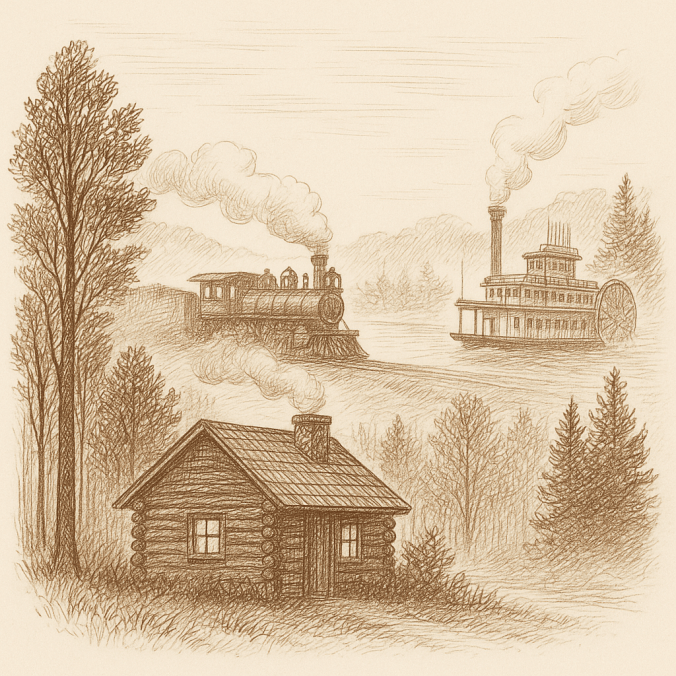
In these pages, when we speak of Honey Hill Country, we are stepping into the world and time of my main story character, Little Red Bear, as it was in December of 1903, and soon, as we come to the gentle turning of the calendar page from 1903 into 1904. Automobiles exist but remain a curiosity; electricity flickers in the cities but has scarcely reached the countryside.
Here in Honey Hill Country, life is still measured by the seasons, not the seconds. Lanterns guide our evenings. You can hear locomotives huffing and chuffing through the countryside, ribbons of smoke unfurling behind them clear to the horizon. And along the wide rivers, the old steamboats travel slow and steady, paddlewheels turning like great clocks while calliopes lift their bright notes over the water. Folks talk face-to-face because there is no other way worth mentioning. A pot of beans on the stove counts as good hospitality, and neighbourliness is something you do, not something you merely talk about.
Why 1904, you might ask?
Well, it is a year standing right on the threshold between the old and the new. The St. Louis World’s Fair, “The Louisiana Purchase Exposition,” is on the horizon, promising wonders from every corner of the globe, yet here in the hills and hollers of Missouri, daily life remains close to the soil — simple, practical, familiar. There is a charm in that moment of balance, a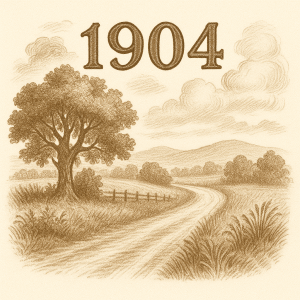 gentleness, as though the whole world were taking a long breath before rushing onward. It feels like the right place to set down our stories — far from the noise of modern life, but close enough to recognize ourselves in the faces around the hearth.
Honey Hill Country isn’t on any map, of course. It lives somewhere between memory and imagination — a small, steadfast corner of southern Missouri and the  Ozarks Mountain Region, where the kettle always seems to be singing, the porch is always open for settin’ a while, and kindness hasn’t yet gone out of fashion. And yes, it is “settin’,” and not “sitting,” around these parts. Settin’ is something folks in the Ozarks and Honey Hill Country do — we “set.” City and modern-day folks “sit.” And there is a difference. Many readers have told me they come here for a bit of comfort, a chance to slow down, to reconnect with a gentler pace of living. And truth be told, I write for the very same reason.

Now, as to the neighbours who populate these parts — Little Red Bear most of all — I should confess that I never quite know when he’s going to show up. Sometimes he arrives with a story to tell, sometimes with a question, and sometimes just because the cookies and biscuit tin are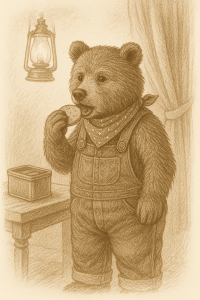 within easy reach.
In fact, as I was here writing this welcome, there came the sound of boots — well, paws — on the porch, followed by a brisk knock. The door swung open and in stepped Little Red Bear himself, brushing snowflakes off his fur and carrying a lantern that threw warm light across the room.
Red leaned over my shoulder like he owned the place.
“Whatcha writin’ there, Jim?” he asked. “Looks serious. One of those times when you’re tryin’ to sound like that Mark Twain fella again?”
“Red,” I said, “Mark Twain had more wit and wisdom in his little finger than I’ve got in my whole body. I’m just trying to say hello to the good folks stopping by.”
He squinted at the page. “Mmm. Coulda fooled me. That line there’s got a little twang to it. You plannin’ to grow yourself one of those big mustaches like his? Get a white suit, too? ’Cause if you do, I’m headin’ straight back to my cabin till spring.”
 “Don’t worry,” I said. “The holler’s barbers have nothing to fear from me.”
Little Red Bear teasingly pulled my ponytail and nodded in agreement.
Red then mumbled something good-naturedly about poor starving barbers and hung his lantern on the peg. “Long as you don’t start smokin’ cigars or tellin’ riverboat stories, we’re probably safe.”
“No cigars, so safe with that,” I replied. “But the riverboat stories… well, we’ll see.”
He settled into the chair across from me, paws spread toward the warmth of the stove. “So what are you tellin’ the folks?”
“Well,” I said, “I thought they might like to know that it’s December 1903 in our world, and that we’re headed into 1904 together.”
Red nodded, satisfied. “That’s good. Clara will like that. She’s been fussin’ over the Gazette press like a hen over a single chick. Wants folks to know what they’re steppin’ into. We’re all steppin’ into 1904. ”
Ah yes — the Gazette.
Beginning toward the latter part of January — Saturday, January 24th, to be exact — the very first edition of the Hearth & Holler Gazette will be inked, folded, and carried out into Honey Hill Country, dated January 24, 1904. Clara Thimblewick, our esteemed editor, has been preparing diligently, sharpening pencils, straightening proofs, and setting type with all the quiet efficiency of a woman who has newspaper ink running in her veins.
Between now and then you will likely catch glimpses of her at her desk by lamplight, hunched over columns and headlines. The Gazette will bring stories from around the holler, local doings, humour, recipes, sketches, and whatever else the week happens to blow in over the ridge — a weekly visit meant to offer a little comfort, a little company, and perhaps a smile or two along the way. It is 1903 stepping soon into 1904 here, remember, and things are about to get exciting as the “Louisiana Purchase Exposition” is scheduled to open in St. Louis soon!
Clara has already begun assembling a most curious and capable little staff for the Gazette — a cast of neighbours whose talents are as varied as the holler itself. A collection of characters so diverse and unexpected that even Little Red Bear shakes his head sometimes. You’ll be meeting them soon enough.
And here, in the modern world where we share these tales, it will arrive each week as a gentle reminder that not everything has to be fast, loud, or fraught with urgency. Some things — the best things, perhaps — are meant to be savored. A story. A kind word or gesture. The rise and fall of seasons. A lantern in the window. A visit with an old friend. A little bear named Cinnamon Charlie, who asks hard questions at the most inconvenient times.
So, whether you’ve been following along for years or have only just wandered in, please know you are welcome here. Truly welcome. Honey Hill Country is meant to be a resting place, a quiet corner in a noisy world, a weekly ramble down a simpler path. And if you choose to subscribe to the Gazette when it launches, you will be joining us not only in reading the stories, but in living a little with us each week — stepping into 1904 with Clara Thimblewick, Little Red Bear, Cinnamon Charlie, and all the neighbours who call this place home.
All of this — Honey Hill Country, the Gazette, the neighbours you will meet — is fictional storytelling through and through, shared freely every Saturday morning to offer a little rest for the mind, a gentler way to breathe at week’s end, and to ease you into the quieter hours of the weekend. All that’s necessary is a little imagination and the willingness to wander along with us each week — a small gift from our corner of the holler to yours.
Little Red Bear rose from the chair and took up his lantern again. “Well,” he said, “I best be goin’. Snow’s pickin’ up and I promised Jeffrey, my rabbit gardening friend, that I’d help him cover the herb patch.” Then he turned back with a small smile. “Just be sure you tell the folks they’re welcome here anytime. You can do that without soundin’ too much like Mark Twain, can’t ya?”
“I’ll do my best,” I said.
And so I will.
Welcome, friend. The lantern is lit, the door is open, and the path into Honey Hill Country lies just ahead.
So please consider this your invitation to join us each week. And if you haven’t already, please feel free to tap that little ‘Subscribe’ button over on the right so our weekly visits from Honey Hill and the Hearth & Holler Gazette find their way straight to you every Saturday morning. We’d be honored to have your company.
Thanks for settin’ a spell with us.
— Jim (and Red!)








 James Milson - The Writing Pages