After the Steamboat Turned the Bend — When Stories Take Their Time

A reflection on Mark Twain, the long reach of story, and where Little Red Bear first found his voice.

On February 18, 1885, The Adventures of Huckleberry Finn was published.

More than a century later, the river is still moving.

I first read Tom Sawyer and Huckleberry Finn years ago — long before I understood what they were doing to me as a writer. Later came Life on the Mississippi, and more besides. At the time, I simply loved the stories. The raft. The sparks in the dark. The sound of the river settling back into itself.

Years later, walking through EPCOT at Walt Disney World, I wandered into a special exhibit of personal items belonging to Mark Twain. Behind glass sat a simple fountain pen he had once held in his own hand.

Not a monument.
Not a statue.

A pen.

I remember standing there, thinking about the ordinary act of writing — the scratch of nib against paper, the slow forming of sentences, the patience of revision. That pen had once rested between his fingers while he shaped rivers, boys, steamboats, sparks.

And I felt, in a very quiet way, connected.

There is a passage from Huckleberry Finn that has stayed with me all these years . . . .

“Once or twice of a night we would see a steamboat slipping along in the dark, and now and then she would belch a whole world of sparks up out of her chimbleys, and they would rain down in the river and look awful pretty; then she would turn a corner and her lights would wink out and her powwow shut off and leave the river still again; and by and by her waves would get to us, a long time after she was gone, and joggle the raft a bit, and after that you wouldn’t hear nothing for you couldn’t tell how long, except maybe frogs or something.”

It is not dramatic. It is not moralizing. It is simply noticing.

The sparks.
The bend in the river.
The long delay before the waves arrive.

There is something in that river passage that has followed me all these years — the way the sparks fall, the way the steamboat disappears around the bend, the way the waves arrive long after she is gone. Those gentle waves are still reaching me. Without my fully realizing it at the time, they found their way into Little Red Bear. He would not make a speech about it. He would simply watch the sparks, listen to the frogs, and notice how the raft rocks a little after the noise has faded. Red has always trusted the quiet aftermath more than the loud arrival. In many ways, I suspect that is where he was born — somewhere between Twain’s river and the stillness that follows.

Stories turn the bend.

The sparks fade.
The whistle grows faint.
The river grows still.

And years later, the waves arrive.

Some of them began their journey in February of 1885, though it would take many years before they reached a desk of my own. Some reached me standing in EPCOT, looking at a fountain pen once held in Mark Twain’s hand. And some are still arriving, rocking the raft just enough to remind me why I began writing in the first place.

If Little Red Bear ever feels steady beneath you, if his voice ever sounds like it trusts the quiet more than the noise, you now know where that began.

Somewhere on a river.
Somewhere after the steamboat turned the bend.

‘Till next time, then — Jim  (and Red!)

P.S. from Little Red Bear

Sometimes the river seems still, but the current is moving steady and sure beneath the surface. Stories are like that. They keep shaping us quietly — and then one day, we notice the raft has carried us farther than we realized.

“The Adventures of Little Red Bear: The First Holler!”

These illustrations were created with the assistance of AI.



Tuesday, After the Paper Arrived

A quiet word about Tuesdays, and the work they do here.

The morning after a paper comes out is usually quieter than the one before it.

The ink is already dry. The papers delivered where they were meant to go. A deep breath. A satisfying sigh after a job well done.

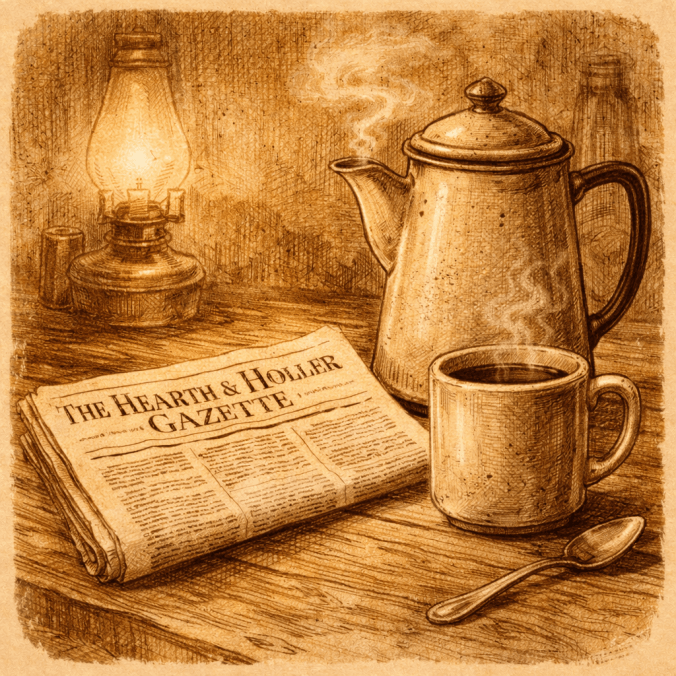
Somewhere, a cup of coffee has been poured and forgotten for a moment while a headline was read twice, or a paragraph lingered longer than expected. Or when someone paused for a laugh. Somewhere else, a paper has been folded and set aside, ready to be picked up again later in the day.

Life, as it turns out, keeps right on going.

There is something comforting in that.

That the world, for the most part, knows how to carry on.

On Saturday morning, the first issue of The Hearth & Holler Gazette arrived. And then Sunday came, and Monday followed close behind. And now here we are on Tuesday — the morning a little different and things settling again into their usual rhythm.

That is how these things are meant to work.

Once a week is enough for a newspaper. Once a week gives it room to breathe — room to notice, to remember, to arrive without knocking too loudly. It is not meant to rush or crowd the days around it. Or to demand center stage. It is meant to take its place and then let the rest of the week do what it always does in turn.

Tuesdays, for their part, will keep doing Tuesday things here.

They will keep returning us to the quieter work — kindness noticed in small places, moments of grace we almost missed, the steady presence of family, memory, and the natural world doing what it has always done, whether we are watching closely or not — and to the small, steady work of remaining hopeful and finding happiness within, even when the wider world seems determined that we not. These are the themes that have lived here a long while now, and they remain, unchanged by the arrival of anything new. That feels right, and as it should be, don’t you think?

A newspaper can come and go once a week, and still leave the lamp on. A story can be read and folded away, and still be there when needed again. Nothing more is required of it — or of us — than to show up, and carry on.

And so we do.

We will be here with The Hearth & Holler Gazette again on Saturday, and we hope you will be too.

— Jim (and Red!)

P.S. — Little Red Bear here.
I read through the “Hearth & Holler Gazette” twice on Saturday, but the second time I mostly just smiled and nodded like I already knew how it ended.

Pen-and-ink illustrations created with the assistance of AI and lovingly styled for Little Red Bear Land.


Fresh Ink & Hot Coffee — Tomorrow, It Begins

A quiet word before Saturday morning arrives  . . . .

The press is warming, the quill has been freshly dipped, and in this neck of the woods the air smells faintly of biscuits and printer’s ink.

By lamplight, Little Red Bear is checking the final lines, pages stacked neat and waiting. Rusty and Percy are chasing down the last good headline, and somewhere nearby a kettle is whistling — the patient kind that knows its moment is almost here.

The very first issue of The Hearth & Holler Gazette is ready to roll — full of neighbourly news, small-town happenings, a little laughter, and a bit of country comfort to carry with you.

Tomorrow is the day.
The Gazette arrives.
Are you ready?

— Jim  (and Red!

A small note for new readers:
Receiving The Hearth & Holler Gazette is as simple as being registered for this blog. There is nothing more to do.

Why Small Stories Last

Why the Little Things Stay With Us

Small stories. Small moments. Small actions that reverberate through the years, often in ways we never fully realise at the time.

My own writing life — if one can call it that — began in the fourth grade, with a teacher named Mrs. Drew. I do not recall her first name, if I ever knew it at all. Back then, adults were simply Mr., Mrs., or Miss, and that seemed sufficient. (You need not bother doing the arithmetic — I am seventy-six.)

One afternoon near the end of the school day, Mrs. Drew propped a landscape painting against the blackboard for all of us to see. Our assignment was simple enough — write a short story inspired by the scene in the painting. It showed a family in a wagon, travelling along a dirt road that wound through woods and farmland, headed somewhere beyond the frame.

We began writing in class and were sent home to finish. A few days later, Mrs. Drew returned our papers, handing them back one by one. All except mine. Mine, she kept.

When she finally explained why, it was because she intended to read it aloud to the class. And when I eventually received it back, there at the top of the page were words I have never forgotten:

“A++      Jim — You will be a writer someday.”

I was painfully shy at the time. I did not know what to do with such encouragement. But I carried it with me — quietly, steadily — for the rest of my life.

There are moments like that — small at the time, almost unnoticed — that stay with us long after louder things have passed. They do not announce themselves. They do not demand attention. And yet, years later, they are often the ones we remember most clearly.

Perhaps it is because they arrive without agenda. Or because they involve people rather than events. Or because they ask nothing of us except that we notice.

Continue reading

Once A Week, and Close To Home

How a paper told you what happened — and reminded you who lived nearby

There was a time when the paper did not arrive every morning.

It came once a week — sometimes folded neatly, sometimes creased and softened by many hands — and it usually ended up on the kitchen table, beside a coffee cup or under a pair of reading glasses. You did not rush through it. There was no need to. It would still be there after supper, and often the next day, and sometimes the day after that alongside the easy chair or rocker.

Before you reached the end of the first page, you had already seen names you knew.

Someone had a new baby. Someone else was celebrating a long-awaited anniversary. There would be a church supper on Saturday, a school program midweek, and a notice about a lost dog that everyone hoped would turn up before the next issue came out. Someone’s daughter had been mentioned for her playing at the spring recital, and the high school team had won on Friday night. And sometimes — quietly, respectfully — there would be a name you recognized for a different reason, and the house would grow a little still as you read.

Those small-town papers were not trying to impress anyone.

They did not shout. They did not hurry. They did not pretend that every day was historic. What they did, instead, was tell people what mattered right here — the kind of news that lived just down the road, in their own streets, their own schools, and their own kitchens. Who needed help, who was being celebrated, who would be missed, and what the coming days might hold. News and events close enough to touch, and familiar enough to care about.

They gave ordinary lives a place to be seen.

A person did not have to be famous to appear in print. You only had to belong. A spelling-bee ribbon, a new porch, a good harvest, a bad winter — all of it counted. The paper did something quiet but important: it slowed time just enough for people to recognize one another and remember that they belonged to the same place.

Somewhere along the way, those kinds of papers grew thinner — or quieter — or disappeared altogether.

It did not happen all at once, and it did not come with ceremony. One week there was a paper, and then one week there wasn’t. Or there was one, but it felt different. Faster. Louder. Less familiar. And without anyone quite meaning for it to happen, a small and steady way of keeping track of one another slipped out of reach.

This winter, I found myself missing that kind of paper.

Not the headlines — but the notices. Not the urgency — but the presence. Not the noise — but the quiet. Not the crowd — but the community.

The kind of paper that does not hurry, does not shout, and does not forget the small things. The kind that assumes you will sit with it awhile, maybe pass it across the table, maybe read a bit aloud.

So, missing all that, I decided to create one.

Not to recreate the past exactly — but to borrow its patience. To gather stories the way they used to be gathered. To leave room for observations, oddments, wanderings, and the sorts of things that never make headlines but somehow make up a life.

There are always stories circulating around a town, after all — if someone is willing to go looking for them. Some are found by a roving squirrel reporter with a knack for being in the wrong place at the right time. Others are sniffed out by a good-natured news hound who never missed the scent of a good story.

If this feels familiar, that is no accident.

Some things were worth keeping. And we’re in Little Red Bear’s “Honey Hill Country,” after all.

— Jim  (and Red!)

In the days ahead, I will be sharing more of the people and small happenings that make a paper like this feel alive — the kinds of names and notices that once filled the margins and gave a town its own sense of place and to know itself a little better.

There’s more to come — not all at once, and not in a hurry.

P.S. from Little Red Bear —
Little Red Bear says if a paper feels close to home, it probably is. It tells you what happened and reminds you who lives nearby.

Pen-and-ink illustrations created with the assistance of AI and lovingly styled for Little Red Bear Land.

My Year-End Reflection & Looking Ahead

On Writing, Story, and the Road Ahead

As the year draws to a close, I find myself less inclined to sum it up than to simply set it down — like a coat hung by the door at the end of a long day. Some years ask for that. Not a tally, not a verdict, just a moment to breathe before turning toward whatever comes next.

Earlier this week, I shared a few thoughts meant simply to steady the heart as the year turns. This piece is something a little different. Less about what has been weathered, and more about what has quietly taken shape along the way.

Continue reading