Winter has a way of slowing the world just enough for a person to notice things that usually pass unseen. Not the grand sort of things — nothing you would mark on a calendar or read about in the paper — but the smaller, steadier ones that tend to show up when days grow shorter and folks move a little more deliberately. It is a season that rewards paying attention. If you step outside and stand still for a moment, you may discover there is more going on than the quiet first suggests.
One of the first things one notices is wood smoke. It drifts low and unhurried, slipping between houses and along fence lines, carrying with it the sense that someone, somewhere, has settled in for the evening. It does not announce itself so much as it reassures you. Fires have been laid, kettles set on, and the day has found a comfortable place to rest. On winter nights, that smell lingers, as if the air itself has decided to hold onto it just a little longer.
On certain evenings, when the air lies heavy and keeps every sound close, there is something else worth listening for. Long before you ever see it, you may hear the train. At first it is only a low rumble — so far off you might take it for weather, or wind working its way slowly thru the hollers. But if you stand still and listen, it keeps coming. Minutes pass and the sound gathers itself as it travels, rounding distant bends, slipping along the lay of the land, growing clearer without ever seeming in a hurry. Folks who live within reach of the tracks come to know this kind of listening. It is not something you rush toward. You let it come to you — steel and motion carried on cold air, mingling with the smell of wood smoke — until, for a little while on a quiet winter night, you are reminded that even in the stillness, the world is finding its way along.
By morning, the snow has stories of its own to tell. Tracks crisscross yards and paths where wandering critters passed thru while most folks were asleep. Small prints hop and pause, then disappear beneath hedges or brush piles. Others wander more boldly, heading straight across open ground as if nothing in the world had reason to hurry them along. From the tracks, it looks like a porcupine left them for us to discover. But one does not need to know exactly who made the tracks to appreciate them. It is enough to know that life moved along quietly thru the night, leaving behind just enough evidence to be noticed.
Daylight brings its own set of noticings. Winter birds seem to understand the season better than most, wearing their colors proudly against the pale background. A bright red cardinal perched on a snow-dusted evergreen looks as if it was placed there on purpose, perhaps waiting for an artist with their paints and canvas passing by. Chickadees move quickly, darting and bobbing, as if they have errands to run and very little time to waste. Many folks keep watch for the dark-eyed juncos — the little “snowbirds” that seem to arrive right on cue — hopping and skittering along the ground and fence lines. And then there are the red-bellied woodpeckers, working steadily up and down bare trunks, tapping out a rhythm that feels as much a part of winter as breath in cold air.
There is a different kind of noticing that comes with taking a walk thru the woods on a snowy late afternoon. Sound is deadened as it seems to settle into the ground, and you find your own footsteps feel as though they belong there.
Light behaves differently then — sunlight catching the snow in one moment, moonlight taking its turn not long after — each making the world glisten in its own way. It is the sort of stillness that does not ask anything of you. You walk, you look, you breathe, and for a little while the quiet feels complete, as if nothing is missing at all. And, just for the moment, it is as if all the world is at peace.
Myrtle Mae Meadowbloom, our Farm & Home editor for the “Hearth & Holler Gazette” coming soon, reminds us that winter noticing often comes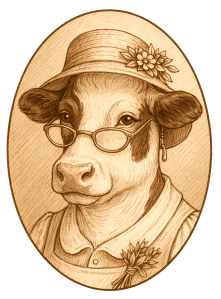 with small responsibilities of its own. Birds need full feeders when the ground stays hard, and fresh water matters even more than seed when everything else is frozen solid. A shallow pan set out and checked often can make all the difference.
She is the sort who never forgets the squirrels and chipmunks either, setting out a little something for them well away from the house. These are not grand gestures, Myrtle Mae says, just the ordinary kind of care that keeps a place feeling lived in and looked after. It is the kind of Farm & Home wisdom that never asks for credit, and here at the Gazette, we have learned that those are often the things most worth passing along.
In the end, winter does not demand much of us. It asks only that we slow down enough to notice — the drift of wood smoke at dusk, the far-off sound of a train finding its way thru the hollers, a flash of red against the snow, the quiet stories written overnight in tracks, the calm of the woods when snow glistens and light rests gently on the ground.
These are the kinds of things that never make headlines — but somehow matter most. They have a way of steadying a season, and the people moving thru it, reminding us where we are and what matters still, if we merely take the time to look and listen.
Thanks for walking along with me for a while. Safe steps until next time.
— Jim (and Red!)


And before you go — a small note from the Gazette.
Something new is nearly ready here, and we will share a first look this Saturday, January 17th. It will be the last quiet preview before The Hearth & Holler Gazette officially opens its doors the following week.
P.S. from Little Red Bear — Red would like it noted that he has been noticing winter too — mostly from indoors, with a warming cup of tea and hot biscuit drenched with honey nearby, which he feels is the sensible approach, after all.

 James Milson - The Writing Pages