Tabby Tales — “Tabby Lends a Hand”

From the critters near home . . . . to the wildlands beyond.

Tabby Tales are small, gentle stories — meant to be read in a few quiet minutes, enjoyed with a smile, and written and shared simply for the fun of it.

By the time Tabby discovered Mr. Wilks’s pasture gate needed fixing, she and Big Muddy, the giant Duroc boar she rode everywhere, had already passed it.

They might have kept going if the gate had kept quiet.

Instead, it gave a long wooden creak, followed by a scrape and a clunk.

Tabby turned on the folded blanket across Big Muddy’s broad back.

A brown-and-white cow stood behind the gate with her nose between two boards. A bell beneath her neck clanked softly as she pushed. Three more cows waited behind her. Farther up the pasture, others had begun coming down the worn path.

The brown-and-white cow pushed again.

Scrape.

Clunk.

“That doesn’t look good,” Tabby said.

Big Muddy stopped walking. He had discovered a tuft of grass growing beside his front foot and was willing to consider the matter from there.

The gate hung crooked between its posts. Its outer corner rested in the dirt, and the wooden latch caught only the very edge of its keeper.

One more good push might do it.

Tabby looked toward Mr. Wilks’s barn. Nobody stood in the yard. No hammer sounded from the shed.

“Well,” she said, sliding down from her blanket. “Somebody ought to do something.”

Big Muddy finished the grass.

Tabby took this for agreement.

She approached the gate and laid a hand on its top board.

“You ladies just wait a minute.”

The brown-and-white cow breathed warmly over her fingers.

Tabby lifted the low end. The gate rose an inch, and the latch settled properly into place.

“There. See? It only needs holding up.”

A short block of wood lay beside the fence post. If she could slip that beneath the corner, the gate would stay level.

But she needed both hands to lift it.

Tabby looked at Big Muddy.

“Come here, Muddy.”

He came.

“Beside the gate. Right here.”

She guided him along the lane side of it, his broad shoulder close to the boards.

“You keep it steady. I’ll do the lifting.”

Big Muddy stood patiently.

Tabby lifted the sagging end and nudged the block toward it with her boot.

Almost.

She pulled a little higher.

At that moment, Big Muddy noticed a fallen apple beneath the fence. He stepped forward, pressing his shoulder against the gate.

At the hinge post, the upper iron pin shifted in its hole.

Tabby did not see it. She was watching the block.

The gate moved sideways in her hands.

She gave a quick upward tug to keep her grip.

The loose upper pin pulled free of the post. As the gate tilted, its lower hinge strap slipped off the remaining pin.

Then the whole gate leaned toward her.

“Oh!”

She held tight to the outer upright while the hinge end dropped into the pasture with a thump.

Big Muddy continued toward the apple.

Tabby stared at the hinge post. One iron pin still stuck up from it. The other lay in the grass, beside the fallen gate.

Behind it, four cows raised their heads.

The brown-and-white cow stepped forward.

“No, ma’am.”

Tabby pulled on the gate. It dragged sideways a few inches.

The cow took another step.

“Muddy!”

Big Muddy crunched.

“Muddy, I need you over here.”

He swallowed, turned, and came back. Tabby pointed into the opening.

“Across there. Sideways.”

He understood sideways. There were several comfortable ways to stand in the world, and sideways was one of them.

His enormous body filled most of the gap.

The brown-and-white cow stopped, a puzzled look on her face.

Tabby leaned against the gate and let out her breath.

“Thank you.”

Big Muddy gave a low grunt.

While he held the opening, Tabby inspected the hinges.

Nothing appeared broken. The gate’s straps were whole, and the loose pin had simply pulled out of its hole.

“All we have to do is put it back.”

She lifted the hinge end.

It rose a little.

She lifted harder.

It rose a little more.

The far end remained firmly on the ground.

Tabby lowered it again and considered.

A short length of fence rail lay beside the post. She fetched it and laid it across a stout stone, with one end beneath the gate. When she pushed down on the other end, the gate rose.

Tabby smiled.

Then Big Muddy caught the scent of another apple.

This one had rolled beneath a clump of grass several feet down the fence.

He turned his head.

“Muddy,” Tabby warned.

He turned his shoulders.

“Muddy.”

The brown-and-white cow moved into the space opening behind him.

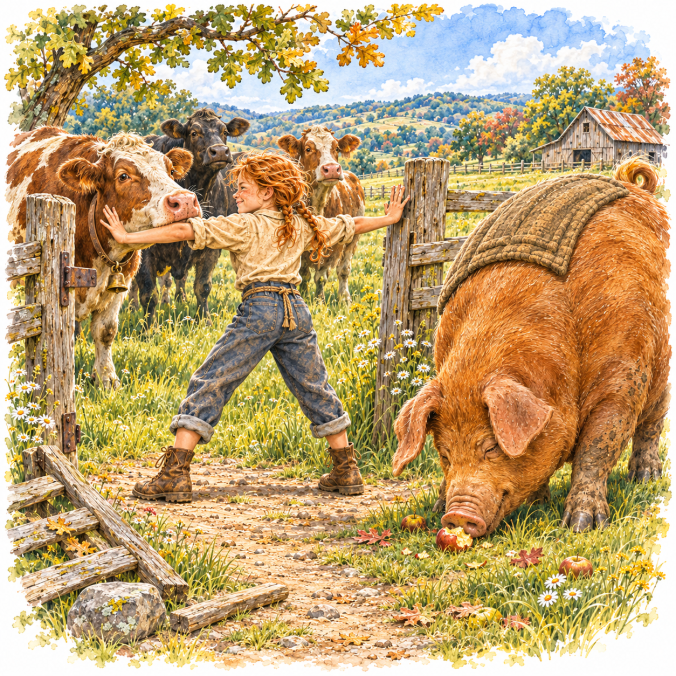
Tabby dropped the rail and hurried into the gap, spreading both arms.

“Whoa!”

The cow stopped with her broad nose almost against Tabby’s shirt.

Behind the first, a second cow leaned forward to see what was taking so long.

“You have to stay in.”

The brown-and-white cow advanced one foot.

Tabby stepped back.

The cow advanced another foot.

Tabby stepped back again.

“No. That isn’t what I meant.”

A black cow began edging toward the other side of the opening.

Tabby stretched her left arm out farther.

The brown-and-white cow lowered her head to inspect Tabby’s right elbow.

For a moment, Tabby wished she had been made wider.

“Muddy!”

He had found the second apple.

“Muddy, you come back here and help me this minute!”

He raised his head at the sound of her voice.

Tabby stood with her boots planted in the dirt, arms spread, facing several hundred pounds of increasingly impatient cows.

Big Muddy slowly ambled back.

She pointed beside her.

“Here.”

He stepped into place.

The brown-and-white cow backed up.

Tabby waited until the opening was full of pig again before lowering her arms.

“We are keeping them in,” she told him. “That’s the job.”

This time, she checked both sides of the fence for apples.

There were none she could see.

Hurrying to Mr. Wilks’s shed, she found a coil of rope hanging from a peg and a stout block of wood beside the door. She carried both back to the gate.

She pushed the loose hinge pin into its hole, tapping it farther in with the block.

Then, working with the rail, the stone, and much effort, she raised the hinge end of the gate. She propped it with the block while she lined up the straps.

It took three tries.

At last, the gate dropped onto both pins.

Tabby stood still, breathing hard.

Big Muddy flicked an ear.

The brown-and-white cow pushed.

The gate sagged, and the upper pin began working outward again.

“Oh, no, you don’t,” Tabby warned.

She wedged the first block beneath the dragging corner. Then she threaded rope around the gate’s upright and the latch post.

She pulled it tight.

The gate held.

She added another turn.

The brown-and-white cow pushed harder.

Tabby added a knot.

The black cow crowded closer.

Tabby added another knot.

For good measure, she used the remaining rope to lash the hinge end to its post, too.

By the time she finished, the rope passed around both posts, between two boards, over the top rail, back between two lower boards, and twice through a place that defied explanation.

But the gate was upright.

The latch was seated.

The cows were in.

Tabby dusted her hands.

“There,” she sighed. “We did it, Muddy.”

Behind her, someone cleared his throat.

Mr. Wilks stood in the lane carrying a toolbox, a small jack, and a new length of timber.

He looked at Tabby.

He looked at Big Muddy.

Then he looked at the gate.

“I fixed it,” Tabby explained, pointing to the gate, now firmly secured in a tangle of ropes and knots.

Mr. Wilks set down the timber.

“I see you’ve been working.”

“It was dragging, and that latch barely held. Then the cows started coming.”

“They surely did.”

“The hinges came off, but nothing broke,” she said proudly.

Mr. Wilks examined the hinge post.

“That upper pin’s been working loose. Came out altogether, did it?”

Tabby nodded.

“I put it back, but it wouldn’t stay. So I tied that end, too.”

He followed the rope with his eyes.

“I see.”

“And Muddy helped.”

Big Muddy had settled beside the fence. One hind leg stretched comfortably into the lane.

Mr. Wilks rested a hand on the top board.

The brown-and-white cow promptly put her nose through beneath it.

Tabby nodded toward her.

“That one’s been trying the hardest to get out.”

“That’s Bess. She’s my bell cow. The lead cow of the herd. Where she goes, the others follow.”

“She’s very determined,” Tabby said.

“She knows where she’s going. Or where she’s supposed to be going, anyway.”

Tabby glanced down the lane.

“Where’s she going?”

Mr. Wilks pointed toward an open gate farther along, beyond which a fresh pasture spread green beneath the November sunshine.

“Over there. This grass is about grazed down. I came to move them this morning and found this gate dragging so badly I couldn’t swing it clear.”

Tabby looked at his tools.

Then at the rope.

Then at Bess.

“You wanted them out?” she asked, puzzled now.

“Yes, ma’am.”

“All of them?”

“That was the plan.”

For a little while, the only sound was Big Muddy breathing through his nose.

Tabby studied her knots.

“Well,” she said at last, “they’re all here.”

Mr. Wilks rubbed his chin.

“They certainly are.”

“And nothing broke,” she reasoned.

“No,” he agreed. “Nothing is broke. Tied up a little. But not broke.”

She looked up at him.

“I could help you fix it so it opens.”

Mr. Wilks smiled.

“I’d be obliged, and thankful for the help.”

Getting the rope off took longer than Tabby expected.

Mr. Wilks held the gate steady while she worked backward through her knots. Twice, she had to stop and discover which piece of rope belonged to which loop.

Bess watched everything very carefully.

With the rope finally coiled, Mr. Wilks set the jack beneath the gate and showed Tabby how to raise it just enough. He reset the loose upper pin securely, then together they fitted the new diagonal brace and fastened it in place.

Tabby handed him nails and held the timber where he marked it. When he asked for the hammer, she had it ready.

At last, he lowered the jack.

The gate stayed straight.

He lifted the latch.

It swung clear of the ground.

Tabby swung it back again, just to see.

Then she opened it wide.

Bess walked through immediately, glancing back at her with a look only a disgruntled and hungry cow could give.

The others followed with the steady purpose of cows who had been ready for quite some time.

Tabby stood beside Mr. Wilks as the last one passed.

“They really were hungry.”

“Yes, ma’am. They were indeed.”

“I thought they were escaping.”

“Looked that way from your side.”

She considered this while the herd turned into the fresh pasture. Bess put her head down and began grazing without another glance behind her.

Mr. Wilks closed the repaired gate, lifted its latch, and opened it once more.

“A gate’s got two jobs,” he said. “Keeping in, and letting out.”

Tabby nodded.

She knew both of them now.

Big Muddy rose when she came to fetch him. He lowered himself enough for her to climb onto the blanket, then waited while she settled.

Mr. Wilks picked up his toolbox.

“Thank you for stopping to help out and keep my herd safe, Tabby.”

“Thank you for helping to get it fixed right.”

They waved, and Big Muddy started down the lane.

At the bend, he stopped beside another fallen apple.

Tabby looked back at the green pasture, where every cow had her nose in the grass.

Then she patted Big Muddy’s broad shoulder.

“All right,” she said. “Take your time and enjoy this one.”
A note about images — Original artwork throughout The Front Porch has been created from my concepts and creative direction with the assistance of AI.  

Why do I write these? Aw, I don’t know. Just thought it might make you smile.
Critter Tales — “The Bright & Shiny Fuss”

From the critters near home . . . . to the wildlands beyond.

Critter Tales are small, gentle stories — meant to be read in a few quiet minutes, enjoyed with a smile, and written and shared simply for the fun of it.

His morning began as most crow mornings in Honey Hill Country did —
with a stretch that felt longer than necessary,
a short flight over three fields and two fences,
and a satisfying early visit to Farmer Turner’s cornfield.

After that, he returned to his usual oak branch to observe the countryside,
because that is what crows do.
They observe.
They notice.
They remember.

That was when he saw the shine.
Not just any shine.
“The” shine.

Down by the roadside, a picnic blanket lay spread in the grass.
A young man and woman sat nearby, occupied with the sort of business that causes humans to forget small but important things on a picnic blanketed sunny day.
Set down to the side, for only a moment and catching the sun just so,
was a Silver Hair Comb.

It glimmered brightly in the sunlight — catching the light in a way that felt entirely unnecessary, the shine sliding along its silver teeth in a way the crow found beguiling and difficult to ignore.

The crow did not hesitate.

He swooped —
He swiped —
and immediately discovered that the comb had opinions of its own about being suddenly airborne.

It twisted in the air.
Caught the breeze in a totally wrong way.
Tugged at his grip and clanked softly against a metal fence post as he passed.

As he flew, the wind caught the comb just right, and its teeth let out a thin, reedy whistle —
a sound the crow did not like at all.
The annoying whistle made him sound like a songbird.
Something a crow is most definitely not.

There was a brief and undignified wobble.
He veered.
He swerved.
He corrected.
He veered again.
He swerved again.
He sheared off his intended path.

But a crow is nothing if not determined, and after several momentary struggles over three fields and two fences, he carried it home.

Back at his nest, he chose the best wall —
the one where the afternoon light lingered longest —
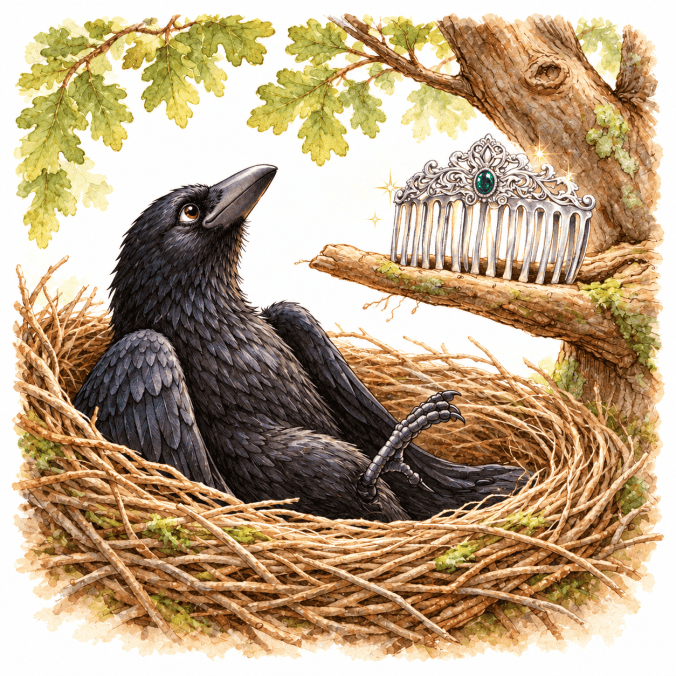
and mounted the comb carefully between two sturdy branches.

He stepped back to admire it, folding his wings as comfortably as a crow ever could,
one leg tucked, head tilted.

It was, he thought, a very fine thing.
A very shiny thing . . . .
And it was his.
All his.

He admired it and thought then to himself in a Crowsian rhyme —
“Now it’s all mine,
This very fine shine.
To admire when I dine,
By my shiny comb shrine.”

He was proud of his heist.
And felt it looked nice.
There on his wall,
When friends came to call.

The trouble, as it can, began the next morning.

The rising sun struck the comb at precisely the wrong angle,
and not seeking permission flashed straight into his eyes,
waking him from a pleasant dream involving corn, a sleeping scarecrow,
and uninterrupted peace while he feasted in the field.

But then the shine. In his eyes. Oh, that shine!
He blinked.
He squawked once.
He glared at the comb.
He shook a disapproving wing at its misbehaving.

But that was only the beginning.

By midmorning, others had noticed the shine.
Far and wide, they’d noticed the shine.

A pair of squirrels arrived first — polite and hopeful — asking to borrow the comb for a moment.
“Just a moment, please,” they implored.

Then came raccoons, who took longer than necessary
and admired themselves far too much in its reflection.

Soon a line formed along the branch, orderly at first,
then less so, as tempers rose and patience wore thin between hopeful visitors.

The comb chimed softly in the breeze.
It flashed.
It gleamed for all to see.

It beckoned.

Now and then, when the wind shifted just so, the comb answered with a faint whistle —
sharp and far-reaching,
adding sound to an already noisy visitor affair.

Before long, mother possums appeared,
each with a tidy row of babies clinging along her back.

The babies carried on as little ones will —
squeaking, squirming,
reaching for the comb at all the wrong times.

One slipped and had to be scooped back into place.
Another tried to chew on the comb
and was gently scolded.

The line grew longer.
And then longer still.

It stretched down the branch,
around the trunk,
around the trunk again,
onto the ground below,
and on out into the meadow.

There were disagreements.
There were accusations.
Someone tried to skip ahead.
Someone else refused to give the comb back on time.

A pair of chipmunks argued over who would get the extra acorn,
the one shining so noticeably in their reflection.

The crow watched from his perch,
his pride slowly giving way to unease.

By afternoon, a steady rain had begun to fall.
Yet the line did not shorten.
It grew.

When a porcupine waddled out of the bushes
and took his place at the end of the line,
now across the meadow,
the crow felt his feathered hackles rise.

He stared.
He turned away.
He paused.
And turned back to stare again.
Rain drops rolled off his beak.

He paced along the branch.
He glared at the comb.
He looked down at the line,
which showed no sign of shortening
and every sign of still growing longer.

The porcupine did not hurry.
He did not speak.
He merely looked up expectantly,
his quills catching the raindrops
in a way that suggested this was, to him,
an entirely reasonable request.

The crow looked at the porcupine.
He looked at the comb.
And then back at the porcupine.
Then once more at the comb.

And that was that.

The crow took the comb down,
gripped it firmly with his black crow feet,
and launched himself into the wet sky.

The wind tugged hard.
The rain soaked through his feathers.
More than once, the comb threatened to slip —
and as he flew, its teeth whistled sharply,
thin and accusing,
until even the sound itself felt like more fuss and guilt than he could bear.

Five miles is a long way in the rain.

When he finally returned to his nest,
soaked thru and tired,
the comb was gone.

His nest was quiet again.
The light was gentle.
The disquieting line dispersed.
The fuss had ended.

Unburdened, he shook out his feathers
and settled onto his branch,
wings heavy with rainwater —
yet feeling ever the lighter nonetheless.

For crows, you see, remember people.
And faces.
And places.

Places where things were found.
Places where then to return.

But to put it more simply —

Crows know.

A note about images — Original artwork throughout The Front Porch has been created from my concepts and creative direction with the assistance of AI.  

Why do I write these? Aw, I don’t know. Just thought it might make you smile.


October in Honey Hill Country — A Few Things You Might Have Missed

October kept folks fairly busy around Honey Hill Country.

There were apples to gather, pumpkins to consider, roads to wander, and squirrels conducting business according to rules known only to themselves.

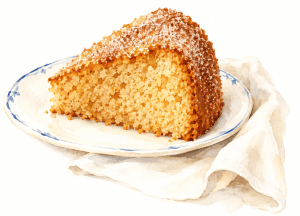
Somewhere in the middle of all that, Myrtle Mae baked a cake.

That last part deserves your attention.


Continue reading →

Tommy Tales — One More House

From the critters near home . . . . to the wildlands beyond.

Tommy Tales are small adventures with big plans — meant to be read in a few happy minutes, enjoyed with a smile, and written and shared simply for the fun of it.

Tommy Tales — One More House

By the time the porch lamps began making little golden puddles along the streets of Butterfield, Tommy Jenkins had already visited most of the town.

Most was not all.

Tommy was ten years old, a country farm boy with a good heart, a lively imagination, and more plans than there were daylight hours to carry them out. He generally began things with considerable confidence. The necessary details usually caught up with him somewhere along the way.

For Halloween, however, he had prepared.

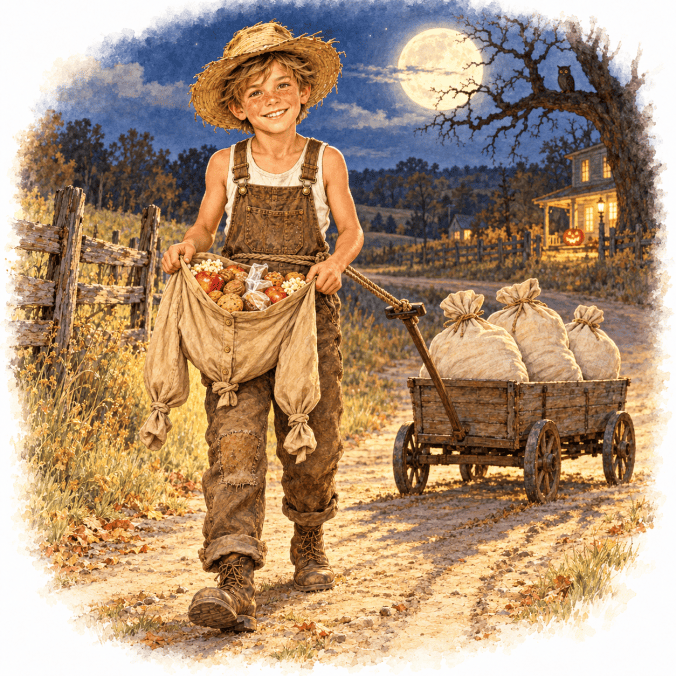
Behind him rattled a little wooden wagon carrying three flour sacks full of treats. A fourth sack hung over his shoulder.

There were still houses with their lamps lit.

At the next porch, a woman opened her door before he reached the top step.

“There you are, Tommy. I baked this molasses cookie especially for you.”

She held up a cookie nearly as wide as her saucer.

Tommy removed his hat.

“Thank you, ma’am!”

“I thought a boy your size might appreciate a substantial cookie.”

“Yes, ma’am. I surely would.”

He studied it with proper admiration before settling it carefully inside his sack.

“Happy Halloween!”

“And to you, dear. Mind that cookie.”

Tommy intended to.

At the following house, a jack-o’-lantern grinned from the porch rail, its candle shining through a crooked assortment of teeth.

“That is a mighty fine pumpkin,” Tommy told the woman at the door. “I made one with bigger teeth, though. To scare my little sister.”

“Did it?”

Tommy’s face fell a little.

“She put flowers in it.”

“Well, that sounds pretty.”

“It wasn’t supposed to be pretty.”

Then he brightened.

“I put some old dead ones in there when she wasn’t looking. Brown ones. They rattle.”

“And what did she say?”

“She hasn’t seen ’em yet.”

The woman pressed her lips together for a moment before reaching into her basket.

“You know what they say, Tommy. An apple a day keeps the doctor away. Here you go. A fresh, ripe, red apple for you.”

Tommy accepted it, polished it once against his shirt, and lowered it into the sack.

“Thank you, ma’am. Happy Halloween!”

He went down the steps feeling better about the pumpkin.

His sister had not won anything yet.

Two doors farther along, a man brought out a tray of popcorn balls and looked past Tommy toward the wagon.

“Gathering provisions for the winter?”

“No, sir. Just tonight.”

“Just tonight?”

“Yes, sir. I couldn’t get everywhere last year.”

The man nodded gravely.

“Well. We mustn’t have that happen twice.”

He chose a large popcorn ball.

Tommy found a place for it beside two small paper parcels of cookies and a little cake wrapped in a square of clean cloth.

The fourth sack was becoming a very satisfactory sack indeed.

He thanked the man, wished him a happy Halloween, and started toward the next light.

Halfway down the road, something tapped his heel.

Tommy stopped.

An apple lay behind him.

He picked it up and glanced toward the wagon. All three sacks sat where he had put them.

“Huh.”

He returned the apple to the sack over his shoulder and continued.

A few steps later, a walnut rolled past his shoe.

Then another.

Tommy watched the second walnut settle into a wagon rut.

He looked down.

A small hole had opened near the bottom seam of his sack.

“Oh, now.”

He shifted the sack into both arms.

The seam made a soft tearing sound.

Tommy stood very still.

The seam continued without him.

Down went the apple. Down went the walnuts. Down went the popcorn ball, the paper parcels, and the little wrapped cake.

The molasses cookie landed on top.

For a moment Tommy remained in the road holding a sack that had become, for practical purposes, a sleeve.

He looked through it.

Then he looked at the treats.

“Well, that won’t do.”

He hurried to gather everything onto the clean upper part of the fallen sack. The apple needed another polish. One paper parcel had come untucked. The special molasses cookie had lost a small piece from its edge.

Tommy ate the piece.

There was no sense losing that, too.

He examined the three sacks in the wagon. Each was full to the gathered neck. He pressed experimentally against one.

A popcorn ball rose out of another.

He put it back.

Tommy looked toward the next house.

Its porch lamp was burning. Someone was moving about inside.

He considered his hat.

Too small.

He considered the broken sack.

Still broken.

Then he looked down at his shirt.

Tommy smiled.

A little later, he stood in his white undershirt, working steadily beside the wagon.

He buttoned his outer shirt all the way up, tied the collar opening closed with a piece of string from his pocket, and knotted each cuff. Then he turned the whole arrangement upside down.

He held it open by the shirttail.

It was an excellent sack.

The sleeves offered additional room that he had not even counted on.

In went the apples and walnuts. In went the popcorn balls and parcels. He eased smaller things down into the sleeves and laid the large molasses cookie safely on top.

Tommy lifted his invention.

Both hands were required.

He looked at the wagon handle.

Another detail.

Fortunately, he had brought a length of rope to keep the sacks from tumbling off on the road home.

He tied one end to the wagon handle and the other around his waist. Then he gathered up his shirtful of treats and took an experimental step.

The wagon followed.

So did another step.

Behind him, the wheels began their familiar rattle. In front, the stuffed sleeves swung low, their knotted cuffs brushing the dirt.

Tommy’s country-boy smile spread clear across his face.

Everything was working.

Ahead, a woman appeared in a lighted doorway.

“Tommy Jenkins! Are you still out?”

“Yes, ma’am!”

“Well, come along, then. I saved something for you.”

Tommy leaned forward, the rope tightened, and the wagon rolled after him.

There was room yet.

One more house.

A Little Red Bear P.S. — 

Folks celebrated Halloween a little differently back in 1904. We borrowed a bit from later years for Tommy’s evening rounds. We couldn’t very well let him miss out on those popcorn balls.

A note about images — Original artwork throughout The Front Porch has been created from my concepts and creative direction with the assistance of AI.  

Why do I write these? Aw, I don’t know. Just thought it might make you smile.
Wilder Tales — “The Zebra Who Was Always There”

From the critters near home . . . to the wildlands beyond.

Wilder Tales are small, gentle stories — meant to be read in a few quiet minutes, enjoyed with a smile, and written and shared simply for the pleasure of observing animals a little less settled, and the wider, wilder world they move through.

Having walked with the herd for as long as anyone could remember, the zebra moved once again along the same paths worn smooth by many hooves, stopping where the grass was sweetest and the ground held just enough firmness under foot. There was nothing unusual in the way the herd traveled together — the same easy spacing, the same unspoken understanding of when to pause and when to go on. In the bright, open light of the plain, the zebra’s stripes appeared as they always had, clean and familiar, and no one gave them more thought than the passing breeze or the sky overhead.

Slipping behind a drifting cloud, as it sometimes did, softening the sharp edges of the plain and drawing colors closer together, the sun withdrew for a moment. The air cooled just a little, and shadows loosened their hold on the ground. In that gentler half-light, the stripes on the zebras no longer looked quite the same — not changed, exactly, but revealed differently, as though the sun’s brightness had been doing more work than anyone realized.

At the edge of the plain, where grass rose tall enough to keep secrets, a lioness lay watching. This herd was familiar to her — their number, their movement, the way they held together — but in the softened light her gaze settled longer than usual on one place among them. She did not move, did not crouch or advance. She only watched, with a stillness that carried weight.

Somewhere within the herd, a zebra lifted its head, not in alarm, but in response to a feeling as old as grass and sky — the sense of being watched. That lifting of the head passed lightly from one to another, a ripple rather than a signal, until several pairs of eyes turned, almost without knowing why, toward the tall grass at the edge of the plain. They did not see the lioness at first. They felt her attention before they discerned her shape.

One zebra, standing slightly apart only by the length of a step, followed the lioness’s gaze a moment longer than the others. It was not curiosity exactly, nor fear, but something closer to alignment — the sense of looking where one is being looked through. In the softened light, with shadows loosening and edges no longer sharp, that zebra saw itself reflected faintly in the lioness’s attention, as though singled out without having been chosen.

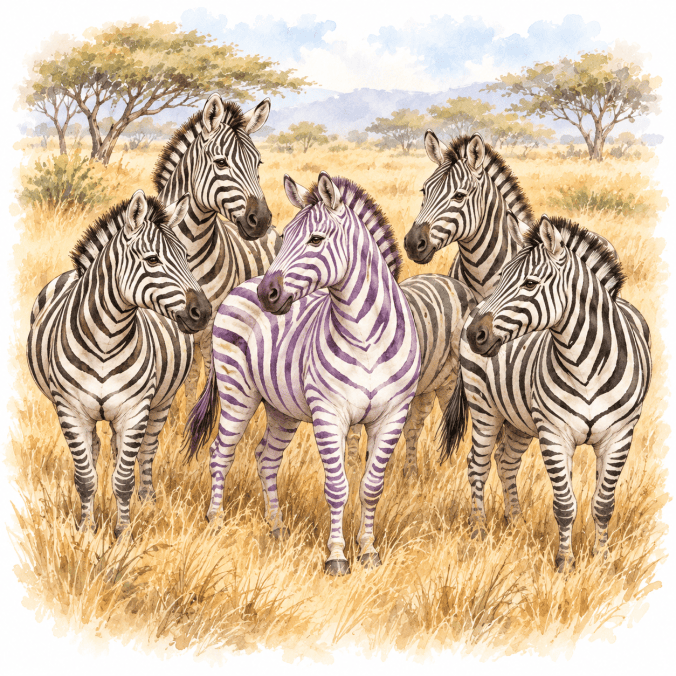
Only then did the difference appear, and even so it did not announce itself. In the half-light, where shadow softened contrast and the sun no longer flattened every surface into certainty, the zebra’s stripes were no longer quite the same black they had always seemed. Along the curve of the shoulder and down the long slope of the flank, a deeper hue emerged — muted, dusty, almost mistaken for shade at first, until it held. Purple, quiet and undeniable, as though it had always been there, waiting for the light to step aside.

The zebra did not move. There was no reason to. The grass was the same beneathfoot, the air unchanged, the herd still close enough to feel without looking. Yet something had shifted all the same. A space opened — not in distance, but in attention — as though a line had been drawn that no one meant to draw, simply by noticing.

One by one, other zebras began to see it too. Not all at once, and not with any agreement. A glance held a moment longer. A head tilted. A pause where there had never been one before. The purple did not grow brighter. It did not spread. It simply remained — unchanged — but newly noticed, now named in the mind even if no one spoke of the difference aloud.

Just as quietly as that awareness had arrived, it began to do its work.

And that work began with something so small it might not have been noticed at all, had anyone been watching for it. When the herd shifted to graze, a familiar space was left unfilled — no more than the length of a shoulder, perhaps — and no one stepped into it. The line adjusted around the absence without comment, the way water moves around a stone.

The purple-striped zebra remained where it had always stood, neither closer nor farther away than before. Yet when the herd moved again, the gap moved with them, keeping its quiet place. Nothing had been said. Nothing had been decided. Still, the shape of togetherness had changed, altered not by action, but by hesitation.

At the edge of the plain, the lioness watched on, her attention unbroken. Waiting. The herd, occupied with its own subtle rearranging, did not notice how much more clearly she could see them now.

The change came all at once.

At the sight of the lioness shifting her weight, lowering her head, the herd’s scattered attention snapped back into alignment. Instinct moved faster than thought. Bodies turned. Hooves thundered against the ground as the line folded inward, closing the space that should never have been left open.

The purple-striped zebra found itself no longer alone at the edge of anything. Warmth pressed in from both sides, familiar and firm. A flank brushed its own. A shoulder settled where the gap had been. The herd did not pause to consider what they were doing or why. They simply remembered how to be together.

Faced with a wall of movement and sound, the lioness halted. She watched for a moment longer, measuring the cost, then eased back into the tall grass, the opportunity gone.

Only after the danger passed did the herd settle again, its collective breath evening. Their shape returned to what it had always been. The purple-striped zebra stood exactly where it always had — no closer to the center than before, no farther away — and the grass beneathfoot felt the same as it always had.

Nothing had changed about the zebra.

Something had changed about the herd.

Original artwork throughout The Front Porch has been created from my concepts and creative direction with the assistance of AI.  


Why do I write these? Aw, I don’t know. Just thought it might make you smile.


Wilder Tales — “A Giraffe In A Hurry”

From the critters near home . . . . to the wildlands beyond.

Wilder Tales are small, gentle stories — meant to be read in a few quiet minutes, enjoyed with a smile, and written and shared simply for the pleasure of observing animals a little less settled, and the wider, wilder world they move through.

Nobody could remember exactly who spotted the tree first.

It might have been one of the older giraffes, the kind who noticed things quietly and mentioned them only after being certain. Or it might have been a younger one, hesitant and unsure, keeping it to themself. But once the breeze shifted, word traveled fast thru the herd.

That tantalizing breeze carried with it the clean, green scent of new leaves — the kind that made every giraffe lift their head and take notice.

And such a fine tree it was — broad-limbed, leafy, and standing just far enough away in the distance to feel like a small victory once reached, its newly sprouted leaves tender and bright, bursting with a green, juicy sweetness no giraffe could ignore.

Most of the herd set off at an easy pace, necks swaying gently, steps unhurried. Leaves, after all, were not known for running away. All things in time.

One giraffe, however, had other ideas.

He decided that if he took the narrow path — the one that dipped beneath a few low-hanging branches — he could arrive first, select the most tasty branch, plant his hooves, and begin munching before anyone else even came into view. The thought pleased him greatly.

He lowered his head, picked up speed, and slipped beneath the trees.

Now, it should be said that giraffes are tall for a reason — to reach the highest leaves other grazers cannot — and not, as it turns out, to go rushing about.

As he ran, he turned his head slightly to see how close the others were behind him.

That was when it happened.

BAM!

The sound echoed just enough to make the birds pause and reconsider their opinions of giraffes altogether.

The branch did not move.
The giraffe did.

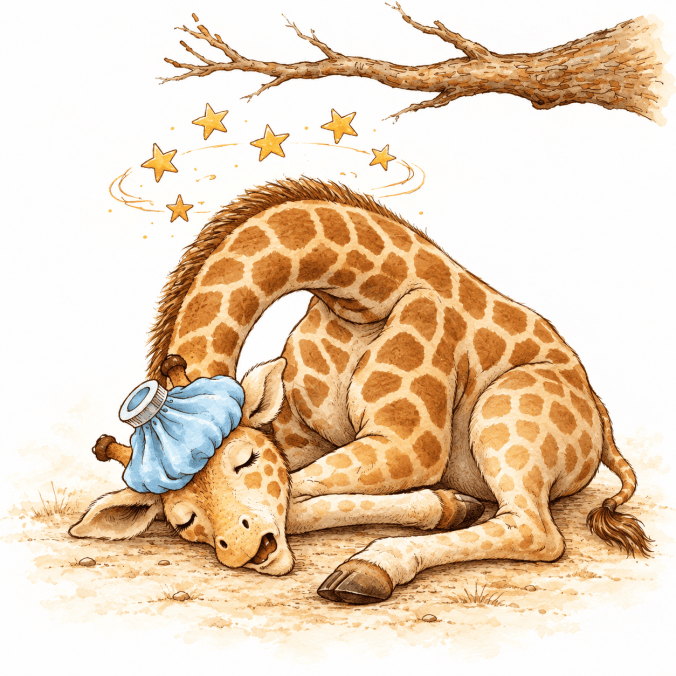
He sat down hard, legs folding beneath him in a way legs were never meant to fold, stars swirling somewhere near the clouds. When the dizziness settled, he remained exactly where he was, eyes crossed just enough to be concerning.

Someone fetched the large blue ice pack — the one normally reserved for enthusiastic antelope mishaps — and placed it carefully atop his head.

It took a while.

Eventually, it stayed.

The herd arrived shortly after, calm as ever. They passed him by one at a time, unhurried, on their way toward the tree that had started all the trouble.

No one laughed.

One giraffe tilted her head and said, kindly,
“Well… you did get here first.”

The concussed giraffe with the headache sighed, adjusting the ice pack with one careful hoof.

“Yes,” he said. “But I cannot recommend the route.”

They stood together for a time, leaves rustling softly in the distance, the sun warming backs and branches alike. After a while, the headache eased. The ice pack slid off and landed with a gentle thump at his feet.

He rose slowly, and after a few measured steps joined the others. He proceeded then to eat at the same unhurried pace as everyone else.

The leaves tasted just as good.

Maybe better.


Images have been created for this piece with the assistance of AI . . . .  lovingly prepared and styled for Honey Hill Country and the world of Little Red Bear.

Why do I write these? Aw, I don’t know. Just thought it might make you smile.