Wilder Tales — “The Zebra Who Was Always There”

From the critters near home . . . to the wildlands beyond.

Wilder Tales are small, gentle stories — meant to be read in a few quiet minutes, enjoyed with a smile, and written and shared simply for the pleasure of observing animals a little less settled, and the wider, wilder world they move through.

Having walked with the herd for as long as anyone could remember, the zebra moved once again along the same paths worn smooth by many hooves, stopping where the grass was sweetest and the ground held just enough firmness under foot. There was nothing unusual in the way the herd traveled together — the same easy spacing, the same unspoken understanding of when to pause and when to go on. In the bright, open light of the plain, the zebra’s stripes appeared as they always had, clean and familiar, and no one gave them more thought than the passing breeze or the sky overhead.

Slipping behind a drifting cloud, as it sometimes did, softening the sharp edges of the plain and drawing colors closer together, the sun withdrew for a moment. The air cooled just a little, and shadows loosened their hold on the ground. In that gentler half-light, the stripes on the zebras no longer looked quite the same — not changed, exactly, but revealed differently, as though the sun’s brightness had been doing more work than anyone realized.

At the edge of the plain, where grass rose tall enough to keep secrets, a lioness lay watching. This herd was familiar to her — their number, their movement, the way they held together — but in the softened light her gaze settled longer than usual on one place among them. She did not move, did not crouch or advance. She only watched, with a stillness that carried weight.

Somewhere within the herd, a zebra lifted its head, not in alarm, but in response to a feeling as old as grass and sky — the sense of being watched. That lifting of the head passed lightly from one to another, a ripple rather than a signal, until several pairs of eyes turned, almost without knowing why, toward the tall grass at the edge of the plain. They did not see the lioness at first. They felt her attention before they discerned her shape.

One zebra, standing slightly apart only by the length of a step, followed the lioness’s gaze a moment longer than the others. It was not curiosity exactly, nor fear, but something closer to alignment — the sense of looking where one is being looked through. In the softened light, with shadows loosening and edges no longer sharp, that zebra saw itself reflected faintly in the lioness’s attention, as though singled out without having been chosen.

Only then did the difference appear, and even so it did not announce itself. In the half-light, where shadow softened contrast and the sun no longer flattened every surface into certainty, the zebra’s stripes were no longer quite the same black they had always seemed. Along the curve of the shoulder and down the long slope of the flank, a deeper hue emerged — muted, dusty, almost mistaken for shade at first, until it held. Purple, quiet and undeniable, as though it had always been there, waiting for the light to step aside.

The zebra did not move. There was no reason to. The grass was the same beneathfoot, the air unchanged, the herd still close enough to feel without looking. Yet something had shifted all the same. A space opened — not in distance, but in attention — as though a line had been drawn that no one meant to draw, simply by noticing.

One by one, other zebras began to see it too. Not all at once, and not with any agreement. A glance held a moment longer. A head tilted. A pause where there had never been one before. The purple did not grow brighter. It did not spread. It simply remained — unchanged — but newly noticed, now named in the mind even if no one spoke of the difference aloud.

Just as quietly as that awareness had arrived, it began to do its work.

And that work began with something so small it might not have been noticed at all, had anyone been watching for it. When the herd shifted to graze, a familiar space was left unfilled — no more than the length of a shoulder, perhaps — and no one stepped into it. The line adjusted around the absence without comment, the way water moves around a stone.

The purple-striped zebra remained where it had always stood, neither closer nor farther away than before. Yet when the herd moved again, the gap moved with them, keeping its quiet place. Nothing had been said. Nothing had been decided. Still, the shape of togetherness had changed, altered not by action, but by hesitation.

At the edge of the plain, the lioness watched on, her attention unbroken. Waiting. The herd, occupied with its own subtle rearranging, did not notice how much more clearly she could see them now.

The change came all at once.

At the sight of the lioness shifting her weight, lowering her head, the herd’s scattered attention snapped back into alignment. Instinct moved faster than thought. Bodies turned. Hooves thundered against the ground as the line folded inward, closing the space that should never have been left open.

The purple-striped zebra found itself no longer alone at the edge of anything. Warmth pressed in from both sides, familiar and firm. A flank brushed its own. A shoulder settled where the gap had been. The herd did not pause to consider what they were doing or why. They simply remembered how to be together.

Faced with a wall of movement and sound, the lioness halted. She watched for a moment longer, measuring the cost, then eased back into the tall grass, the opportunity gone.

Only after the danger passed did the herd settle again, its collective breath evening. Their shape returned to what it had always been. The purple-striped zebra stood exactly where it always had — no closer to the center than before, no farther away — and the grass beneathfoot felt the same as it always had.

Nothing had changed about the zebra.

Something had changed about the herd.
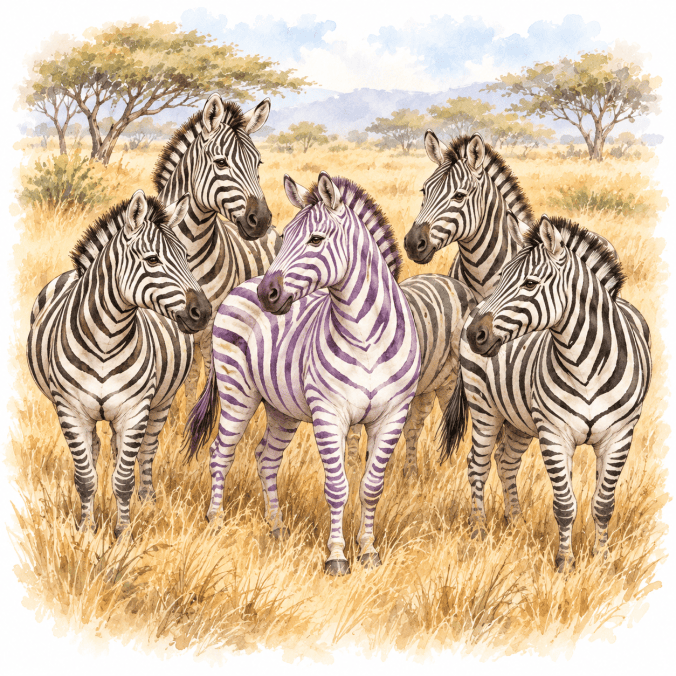
Original artwork throughout The Front Porch has been created from my concepts and creative direction with the assistance of AI.  


Why do I write these? Aw, I don’t know. Just thought it might make you smile.
 

Fresh Ink & Hot Coffee — Tomorrow, It Begins

A quiet word before Saturday morning arrives  . . . .

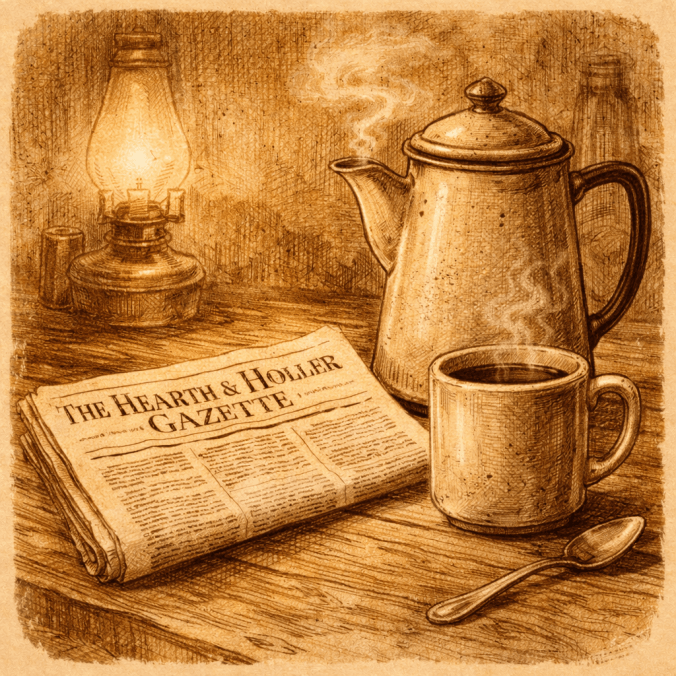
The press is warming, the quill has been freshly dipped, and in this neck of the woods the air smells faintly of biscuits and printer’s ink.

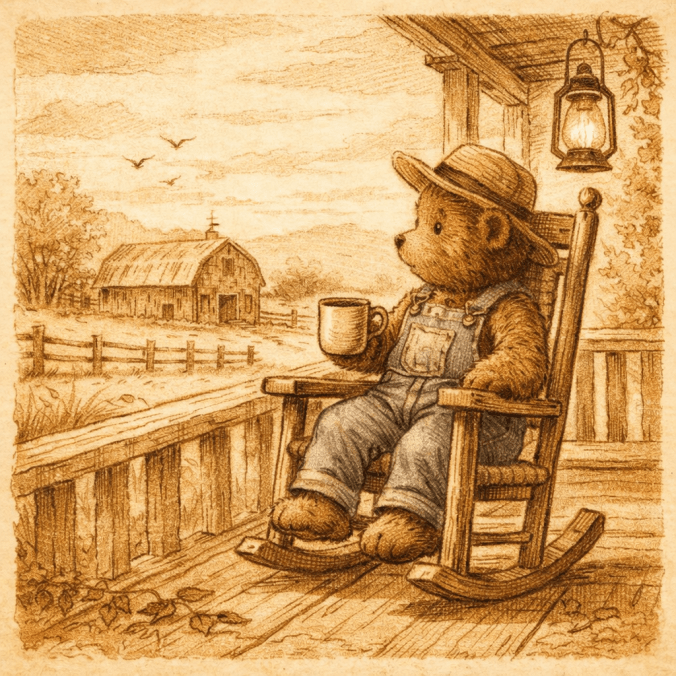
By lamplight, Little Red Bear is checking the final lines, pages stacked neat and waiting. Rusty and Percy are chasing down the last good headline, and somewhere nearby a kettle is whistling — the patient kind that knows its moment is almost here.

The very first issue of The Hearth & Holler Gazette is ready to roll — full of neighbourly news, small-town happenings, a little laughter, and a bit of country comfort to carry with you.

Tomorrow is the day.
The Gazette arrives.
Are you ready?

— Jim  (and Red!

A small note for new readers:
Receiving The Hearth & Holler Gazette is as simple as being registered for this blog. There is nothing more to do.

Porch Notes From Little Red Bear

Hey, folks —

Jim is up to his ears with work on the Gazette right now, so asked me to fill in for him today. And I’ve got a few minutes so thought – “Sure. Why not?” Hope you don’t mind.

Farmer Turner dropped by earlier for no particular reason. That’s what folks do around these parts. Stopping by to visit. Just bein’ neighborly, is all.

As usual, we got to talkin’ about the weather. Lately it’s been like riding a seesaw. We seem to go from way above normal one day to way below normal the next. We set a record for both a record all-time high temperature and another record 62-degree temperature drop all in the same day last week. From 80F to 18F. I started the morning in my overalls and ended up wearing three different coats by the end of the day, each one heavier than the one before. I hear the birds down south are flyin’ in circles, not knowing whether to migrate back up north or stay put where they are. They can’t figure it out either, it seems.

Anyway, that’s what Farmer Turner and I were talking about — the weather. I will say, if ever you feel like talking about the weather with someone, just go find yourself a farmer. Farmers love talking about the weather. For them, it’s not just small talk, of course. It’s an important discussion about crop yields, planting schedules, and their very survival. Weather determines a farmer’s livelihood, after all.

Well, I see Aunt Ivy coming up the way, probably coming to trade some cookies for some of the fresh herbs we still have growin’ alongside the cabin. So, I’ll be going now. She may need my help gettin’ to some of the herbs. That, and I don’t want Jim spottin’ her coming and dashin’ out the door to beat me to any fresh cookies.

‘Til next time then.

— Little Red Bear (and Jim!)

If you’d like to spend a little more time in Little Red Bear’s world, Jim has gathered some of the stories and books together on his Author’s Page. You’re always welcome to stop by.

You’re Welcome Here

Some Sundays end the way they should.

A good meal. Plates pushed back. Folks sitting around a little longer than planned. Nobody watching the clock. The talk wandering from one thing to the next, easy and unimportant in the best way. Somebody pours another cup of coffee or tea. Slices of pumpkin and pecan pies are served. Or maybe a slice of cake. Or two. And no one says much about it.

Those moments matter more than we sometimes realize at the time.

Continue reading →

Introducing “The Hearth & Holler Gazette”

A Small-Town Paper from Little Red Bear’s Honey Hill Country

Before we get too far along, there is one small thing I would like to settle right from the start.

These days, the moment someone hears the words “weekly” and “email,” a little voice pipes up:

Oh no… not JAN.

Just Another Newsletter.

You know the kind.
Crowded inbox. Loud subject lines. Endless self-promotion.
More noise than nourishment.

And if that is what The Hearth & Holler Gazette were going to be — I would not blame you one bit for steering clear.

But here is the thing —
This is not JAN. Not even close.

The Gazette is not a newsletter.
There will be no book pitches.
No launch announcements.
No character reveals dropped like bait.
No “Pre-order Now!” or “Don’t forget to buy!” reminders elbowing their way into your morning.

Instead, think of it this way —

The Hearth & Holler Gazette is a fictional small-town paper, delivered once a week on Saturday mornings, the way such things used to be — its pages set in the early years of the twentieth century, beginning in January of 1904.

A place for:

  • Short Stories and Sketches
  • Bits of Humour
  • Kind News
  • Happenings and Events from Little Red Bear’s Honey Hill Country
  • Old-fashioned Advertisements that Exist Only for the Smile
  • And the sort of Gentle Company you might enjoy with a cup of coffee while the house is still quiet

It exists for one reason only —

To offer a pause.
A smile.
A little warmth.

That is the why.
Everything else grows from that.

One might think of The Hearth & Holler Gazette as something closer to Garrison Keillor’s Prairie Home Companion —
without the live music, and without needing to go buy a radio.

A familiar voice.
A small town and folks you come to know.
Stories and observations that take their time, and trust you to do the same.

Or perhaps it brings to mind Charles Osgood’s quiet pieces — the kind that never shouted for attention, yet somehow always earned it.

If you ever found comfort in evenings spent with The Andy Griffith Show, The Waltons, or Little House on the Prairie, then you already understand the spirit at work here.

Not because those stories ignored the wider world —
but because, for a little while, they set a different table.

That is the neighbourhood the Gazette hopes to live in.

Continue reading →

A Year’s Worth of Little Good Things

As the year begins to slow down and we edge closer to Christmas, I have found myself thinking less about what was accomplished and more about what quietly mattered — the small moments, the kindnesses that did not make headlines but made days a little better.

A few evenings ago, Little Red Bear asked if he might stop by the Writing Pages for a few minutes to share some of the things that stayed with him this year. Not the grand events, but the everyday goodness he noticed along the way. I was glad to say yes — and this is his note.

Continue reading →