A Weekly Visit of Tales, Tidings, and Old-Time Country Comfort
Welcome!
It’s been a full and eventful week in Honey Hill Country, and one worth talking about.
As always, The Hearth & Holler Gazette is a work of fiction set in a place that exists most clearly in the imagination — though from time to time it may resemble somewhere you have known. But for first time visitors, it may help to know where — and when — we are, and what I am talking about
The Hearth & Holler Gazette hails from Honey Hill Country, a small, rural corner of the Missouri Ozarks, as it might have been known in the year 1904 — a time of front porches and wagon roads, oil lamps and handwritten letters, when news traveled at a human pace, and a Saturday paper was meant to be read slowly, with coffee close at hand. This is not a paper of breaking news or loud headlines. It prefers instead to notice it — the small, human-sized moments that once filled a morning without asking much in return.
The Hearth & Holler Gazette is a work of fiction — a made-up paper from a made-up place, written in the spirit of an earlier time. Any resemblance to real towns, people, or events is entirely coincidental, though we do our best to make it feel otherwise.
This must be understood at the beginning — the towns, fields, and citizens described here exist only within these pages. With that firmly agreed, the small and ordinary wonders of the week may unfold as they will. That is the way of things here. That is all we need to know, and that ought to be enough.
So, with that said — Please come on in. Your paper awaits . . . . . .

And would you prefer Coffee or Tea with your newspaper?
THE HEARTH & HOLLER GAZETTE
Sharing Stories and Smiles from Little Red Bear’s World
— A Weekly Visit of Tales, Tidings, and Old-Time Country Comfort —
Serving Honey Hill, Hopper’s Holler, and Beyond | Est. 1904
Saturday Morning Edition
April 04, 1904
Honey Hill Country • Cricket Hollow County
Vol. I — No. 11
Price: Five Cents (If You Have It) • Free to Read (If You Do Not)
Published Weekly on Saturday Mornings
From the Front Porches, Back Rooms, Kitchens, Workshops, Hillsides, and Quiet Corners of Honey Hill Country
A STIRRING WEEK ACROSS HONEY HILL COUNTRY — A NEW BUSINESS OPENS ITS DOORS, CONCERNS ARISE, AND WORK AWAITS
Local News from Around the Holler —
Filed by Percival “Percy” Puddlesniff, News-Hound
With Field Notes from Rusty the Fairydiddle, Roving Reporter
BAD BOB’S OPENS AMID PUBLIC CONCERN AND OUTCRY
Crowds Gather, Bandits Appear, and Bank Officials Offer Reassurances
Round Corners, April 1 —
A considerable crowd gathered yesterday in Round Corners for the long-anticipated opening of Bad Bob’s Bandit Bandanas, an establishment whose arrival has been the subject of equal parts curiosity and concern in recent weeks.
The doors were opened shortly after mid-morning, following a brief ribbon-cutting  ceremony attended by townsfolk, visitors, and several individuals described by event organizers as “formerly of interest to the law.” The storefront, located within clear view of the town’s central business district, was decorated with bunting and display tables featuring a wide assortment of bandanas in varying patterns, colors, and materials.
A line formed soon thereafter, not for merchandise alone, but for the opportunity to meet several visiting figures whose reputations appeared to precede them. Among those present were Two-Tooth Calhoun, Lefty Briggs (Retired), and Miss Delilah Quickstep, each of whom participated in a public meet-and-greet with attendees.
Autographs were offered upon request, with signatures being placed—somewhat notably—upon reproductions of their own former wanted notices, which were made available for the occasion.
One attendee was heard to remark that the likenesses remained “remarkably accurate,” though whether this was intended as praise or concern could not be determined. The posters, it was confirmed, were not current.
While the atmosphere remained orderly throughout the proceedings, a number of citizens expressed unease regarding the nature of the establishment and its proximity to other businesses. Of particular note was its location within reasonable distance of the Round Corners National Bank, whose officers have fielded several inquiries in recent days.
“It’s not the round-ups we’re concerned about,” one resident was heard to say. “It’s the hold-ups.”
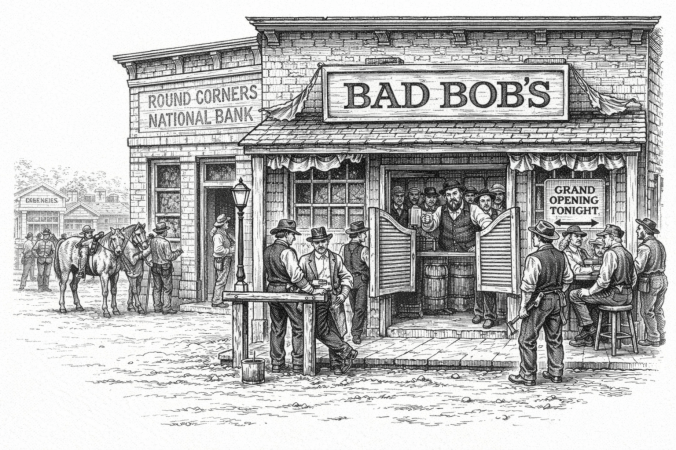
In response to such concerns, a representative speaking on behalf of Bad Bob’s stated that the goods offered were “of practical and respectable use to working men across the region, including those engaged in ranching, riding, and general outdoor labor,” and that any alternative interpretation “rests more in imagination than in intent.”
Officials at the bank issued a brief statement of their own, noting that deposits remain secure and that measures currently in place—along with certain recent additions—are considered more than sufficient for the needs of the community. While no further details were provided, it was observed that a uniformed watchman was present on the premises after dusk.
Meanwhile, a petition has begun circulating among residents calling for the relocation of the establishment to a site “more suitably distant from financial and civic institutions,” though no formal action has yet been taken.
For the present, the doors of Bad Bob’s remain open, the bandanas remain available, and the matter—much like the crowd itself—shows no immediate sign of dispersing.

RAIL EXTENSION RUMORED FOR PACKET’S LANDING — BLUSTERVILLE VOICES OBJECTION
Survey Activity Noted as River Traffic Continues to Increase
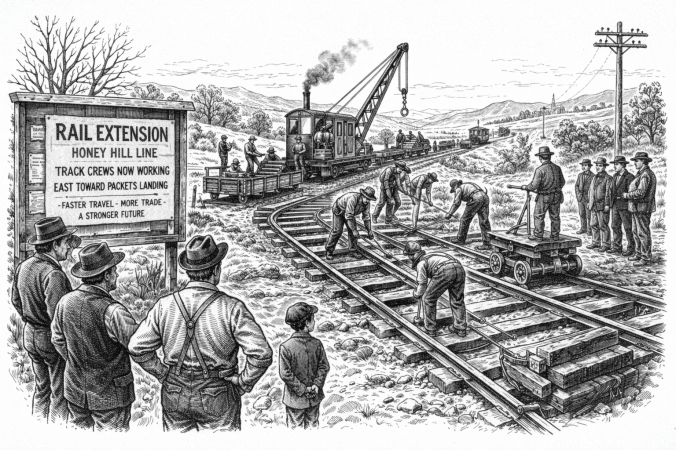
Reports have begun to circulate throughout the region suggesting that the St. Louis, Iron Mountain and Southern Railway is considering the addition of an extension line to serve Packet’s Landing, a development that would provide direct rail access to one of the busiest river points in Honey Hill Country.
While no formal announcement has been issued, several residents have reported the  presence of surveyors along the approaches to the Landing, particularly in areas where freight roads presently connect river traffic to inland routes. These sightings, though unconfirmed, have been widely interpreted as an early indication of planning activity.
Packet’s Landing has seen a steady increase in riverboat traffic in recent seasons, with goods, passengers, and provisions moving through the docks in growing volume. At present, all such traffic must be transferred by wagon for inland distribution, a process that has been described by some as “reliable, though increasingly strained.”
A direct rail connection would be expected to ease that burden considerably, allowing freight to move more efficiently between river and rail and reducing delays during periods of high activity.
Reaction to the rumor has been mixed across the region.
In Blusterville, Mayor Barnaby Blusterall issued a statement expressing what he described as “profound astonishment” that such consideration might be given elsewhere.
“Blusterville,” the Mayor declared, “remains a town of standing and significance, second to none in the region—and frequently first, depending upon the measure applied. Any oversight in this matter would be both noticeable and, I dare say, correctable.”
No response to the Mayor’s remarks has been issued by railway officials.
For their part, residents of Packet’s Landing have adopted a more measured tone, noting that while the prospect of a rail connection would be welcomed, the matter remains, at present, a subject of observation rather than certainty.
One dockhand, when asked for comment, was heard to remark:
“If they lay track to the Landing, we’ll use it. If they don’t, we’ll keep hauling same as we always have.”
Until such time as official word is given, the question remains unsettled, though the sight of measuring stakes along the roadways has done little to quiet speculation.
SPRING RAINS ARRIVE — FIELDS HELD IN WAITING
Needed Moisture Brings Delay as Farmers Watch Conditions Closely
Honey Hill Country, April 3 —
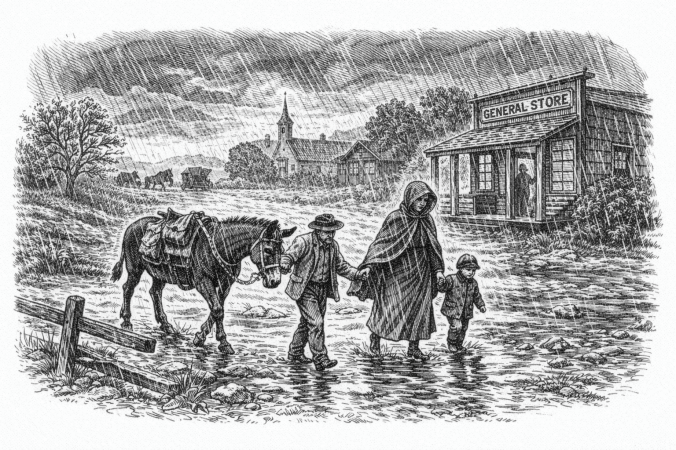
A series of steady rains has settled across Honey Hill Country this week, bringing much-needed moisture to fields and pastures, though not without consequence to those preparing for the early work of the season.
The ground, long in want of softening after the close of Winter, has taken the water readily. Low places have filled, wagon tracks have deepened, and fields that only days ago showed signs of readiness now lie quiet beneath a firm, damp hold.
Farmers throughout the region report that while the rain is welcome, it has come in such a manner as to delay the first passes of plow and planting. Teams remain hitched but idle in many cases, with work postponed until the soil settles and dries sufficiently to be turned without undue strain.
“It’s good rain,” one farmer was heard to say. “Just not the kind you can work through.”
Creeks and smaller waterways have risen modestly, with crossings at lower points requiring added care. Along Stillwater Creek, the water has broadened along its banks in places, though no significant flooding has been reported.
Garden plots, particularly those nearer to homes and already turned, are said to be holding the moisture well. Some have taken the opportunity to set early plantings where the ground allows, though most are choosing patience over haste.
The sound of frogs returning at dusk has been noted in several hollers, and bird activity has increased noticeably between showers, offering small signs that the season continues its advance despite the delay.
For now, the fields wait.
And those who work them wait as well—watching the sky, testing the soil, and measuring their next steps against conditions that will not be hurried.
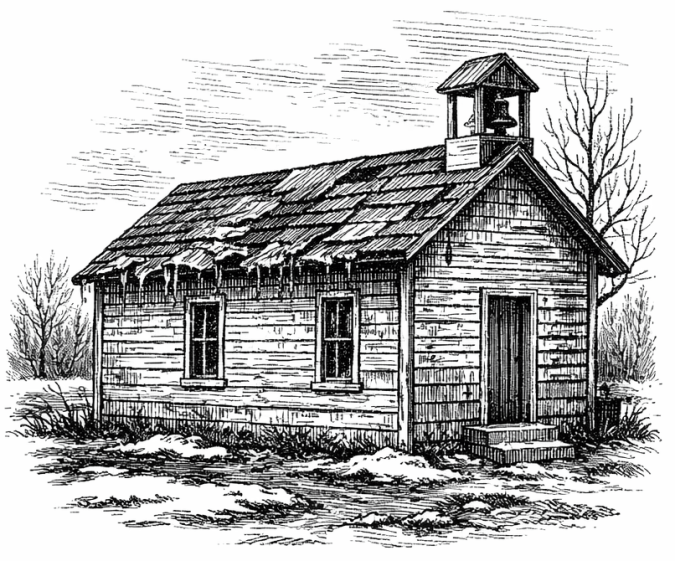
BUTTERFIELD SCHOOLHOUSE MATTER GROWS — FULL REPAIRS NOW IN QUESTION
Further Findings Suggest Work May Extend Beyond Original Estimates
” . . . . it ain’t a patch job, that’s for sure.”
Butterfield, April 3 —
The matter of repairs to the Butterfield Schoolhouse, first believed to involve a limited patching of the roof, has taken a more serious turn following additional examination of the structure in recent days.
Individuals familiar with the inspection have indicated that concerns now extend beyond the roof itself, with several supporting elements of the building found to be in a condition that may require more extensive attention than originally anticipated. While no formal report has yet been issued, the situation has been described by more than one observer as “considerably larger in scope” than first understood.
As a precaution, the schoolhouse remains closed, and arrangements for temporary instruction are said to be under consideration, though no final decisions have been announced.
Discussion among residents has begun to shift accordingly. What was, at the outset, regarded as a matter of repair is now being spoken of in broader terms, including the possibility that more substantial work—potentially extending beyond repair alone—may be required.
Questions of cost, materials, and labor have naturally followed.
At present, no single course of action has been agreed upon. Conversations continue among town leaders and interested parties, with the understanding that a clearer path forward will need to be established in short order.
One resident, when asked for comment, offered only:
“Well . . . . it ain’t a patch job, that’s for sure.”
No date has yet been set for a formal public meeting, though it is expected that further developments will be shared with the community as soon as they are available.
For now, the matter remains under review—though few appear to expect it will remain so for long.

Editor’s Desk —
— Clara Thimblewick, Editor
There are weeks when a town finds itself occupied in more directions than it had planned.
This appears to be one of them.
The opening of a new establishment has drawn attention, discussion, and no small amount of opinion. Elsewhere, the matter of the Butterfield Schoolhouse has revealed itself to be more involved than first believed, and the work of the fields has been delayed by rains that are, at once, both needed and inconvenient.
In addition, there are those who speak of rail lines, and those who measure such things with greater enthusiasm than certainty.
Taken together, these developments may give the impression of disorder. It is worth remembering that such moments are not uncommon where people live and work in earnest. Matters rarely present themselves one at a time, nor do they wait patiently for neat arrangement.
What is required, then, is not haste, but steadiness.
The concerns now before the community will be addressed, as such concerns always are—through discussion, effort, and the willingness of neighbors to take part where they are able. It is not necessary that every answer be known at once, only that the right questions continue to be asked.
In the meantime, the ordinary work of the town continues.
And that, more often than not, is what carries things forward.
— C.T.

Letters to the Editor —
Our readers are invited to share their thoughts, observations, and neighbourly remarks. Letters may be shortened for space, but never for spirit.
To the Editor,
I do not object to commerce, nor to a man making his way by honest trade. However, I find myself uncertain as to whether the present establishment qualifies as either.
There is, to my mind, a difference between supplying a need and encouraging an appearance. I should prefer not to see our town become a place where such distinctions are made lightly.
Respectfully,
A Concerned Citizen
Round Corners
To the Editor,
A bandana is a bandana.
A man who means trouble does not require assistance in finding it, and a man who does not mean trouble is unlikely to begin simply because he has purchased a piece of cloth.
I have worn one myself on long rides and in dust enough to blind a mule. It did not change my character then, and I do not expect it will change anyone else’s now.
Yours,
J. T. Rawlins
Cedar Ridge County
To the Editor,
Kindly advise whether burying one’s savings in the yard is to be considered premature or merely prudent under present circumstances.
I have no objection to remaining a customer of our local bank, provided I may also remain in possession of my peace of mind.
If both cannot be guaranteed simultaneously, I should be grateful to know which is to be sacrificed first.
Sincerely,
M. E. Pritchard
Round Corners
To the Editor,
I have conducted my banking business at the Round Corners National Bank for twenty-three years and have never found cause to doubt its soundness.
It has stood through lean seasons, strong seasons, and every manner of rumor in between. I do not intend to be unsettled now by a shop window and a bit of noise.
Those who are inclined toward alarm may do as they see fit. I, for one, intend to remain where I am.
Respectfully,
Samuel D. Whitaker
Butterfield
To the Editor,
I attended the opening out of curiosity and found the proceedings orderly, if somewhat… unusual.
The gentlemen present conducted themselves with a degree of politeness that I confess I did not expect, and I received no harm from observing them at a reasonable distance.
That said, I see no pressing need to repeat the experience.
Yours truly,
Miss Eleanor Finch
Round Corners
To the Editor,
I write not so much in objection as in an effort toward understanding, though I cannot say with confidence that I have made much progress on either front.
If a man may purchase a bandana from a shop, and that bandana may then be worn in such a way as to conceal his face, it follows that he might be less readily recognized than he would otherwise have been. This, I believe, is not in dispute.
However, if that same man is already known to be the sort of fellow who would conceal his face, then it would seem he might be recognized by that very inclination, bandana or no.
In this way, it becomes unclear whether the bandana assists in concealment or merely confirms it.
I have attempted to consider the matter from several angles, including standing in front of my own mirror with a handkerchief, but found the results inconclusive.
My wife has advised that I am thinking too much on it, which I do not deny, though I cannot say that thinking less has yet improved matters.
I therefore submit the question for wider consideration:
Does a bandana make a man harder to recognize, or does it make him more so?
I remain,
Respectfully uncertain,
Orville P. Dunn
Far ’Nuff
The Gazette prints letters of interest to the community and does not inquire overly into the private identities of correspondents.– The Editor
Editorial Cartoons —
by C. “Clary” Moss
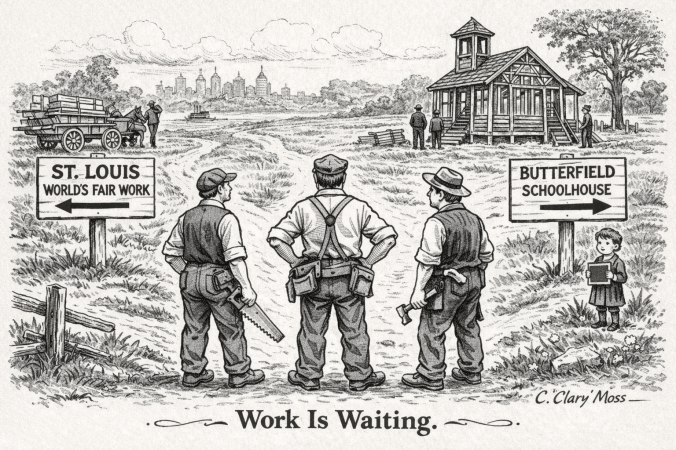
Each week, Mr. Moss offers a pen-and-ink observation of life in Honey Hill Country.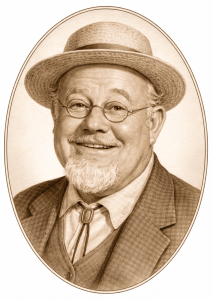
Mr. Moss brings a practiced eye for the small ironies of civic life and a steady hand in their illustration.
His drawings appear regularly, offering visual commentary on matters of local interest — with due regard for both humor and fairness.
We trust our readers will receive his work in the spirit in which it is offered.

Crops & Markets Report —
By Virgil Stone
Seasonal Field & Farm Notes
The past week’s rains have come in steady and sufficient measure across Honey Hill Country, bringing the ground into a condition more favorable for the season ahead, though not yet ready for immediate working in most places.
Low fields are holding water longer than desired, and wagon tracks have cut deeper than expected where travel could not be avoided. Higher ground is beginning to come around, though it would be well advised to give it a day or two more before putting plow to it in earnest.
There is no gain to be had in working soil before it is ready. It will tell you when it is.
Garden & Planting Updates
Garden plots that were turned early are said to be holding moisture well. Those inclined to begin small plantings may do so where the ground allows, though widespread planting will likely wait until conditions settle.
Early clover and grass are beginning to show in patches, particularly along fence lines and in fields that carried well through Winter.
Those planning oats or early seedings are encouraged to keep watch and be ready, as the window will open quickly once the ground firms.
Forward-Looking Guidance
When the soil does come right, it will do so all at once.
Teams should be kept in readiness, tools in order, and seed at hand. There will be little time between waiting and working, and it is best not to spend that time searching for what ought already to be in place.
Patience now will save effort later.
Market Notes
Market conditions remain steady, though certain goods—particularly tin, hardware, and manufactured items—continue to reflect the influence of the upcoming Louisiana Purchase Exposition in St. Louis.
Supplies are available, though not always in the quantities or at the prices some have been accustomed to.
Livestock movement has been modest due to weather conditions, with more activity expected once roads improve.
Market Prices (Approximate Ranges)
- Corn: 48¢ – 55¢ per bushel
- Oats: 32¢ – 38¢ per bushel
- Hay: $9.00 – $12.00 per ton
- Eggs: 14¢ – 18¢ per dozen
- Butter: 18¢ – 24¢ per pound
(Prices vary by condition, distance, and arrangement.)
Closing Note
A week of waiting is not a week lost.
It is only the ground taking its turn.
— Virgil Stone

Hillside Chronicles —
By Silas Thorne
There are days in early spring when the season does not seem fully decided.
Yesterday held a warmth that suggested one thing.
Today, something else entirely.
The air has turned again, and by nightfall there is reason to expect a return of cold — not the deep cold of winter, but enough to remind us that it has not yet fully withdrawn.
Such changes are not uncommon this time of year.
But they are still noticed.
Of Warmth, and Then Not
A few days of sun will bring things forward.
Grass begins to show.
Branches take on a different shade.
And there is, for a moment, a sense that the season has made up its mind.
Then the air shifts.
The ground tightens again overnight.
And what had begun to move pauses, as if reconsidering.
A Small Finding
It was in such a stretch of days that I came upon a small bird lying still along the edge of a path.
A song sparrow, by appearance.
There was no sign of struggle.
No disturbance of the ground around it.
No clear reason to account for its being there.
Only stillness.
What We Are Left to Consider
It is not always given to us to know how such things come about.
There are many possibilities:
- a misjudged flight
- a moment of weakness
- a life that had simply reached its natural close
Or something else entirely, unseen and now beyond knowing.
What remains is not the cause, but the presence.
And then, shortly after, the absence.
The Season As It Is
Spring is often spoken of in terms of beginning.
And rightly so.
There is growth.
Return.
Renewal.
But it is not made only of those things.
There are also endings.
Quiet ones, most often.
Unremarked, unless one happens upon them.
A Balance Kept
The warmth returns, and with it, movement.
The cold follows, and then eases again.
Birdsong carries across the morning.
And, somewhere along the way, one voice falls out of it.
None of this alters the season.
It simply completes it.
The Day Ahead
By tomorrow, the air may have shifted once more.
The ground will take it as it comes.
And so, in time, do we.
— Silas

Farm & Home — Notes From the Farm & Field . . . .
By Myrtle Mae Meadowbloom
Setting Things Right Again
Well now… if your place looks anything like mine did at the start of this week, you’ll understand why I set aside a full day—and then most of another—to put things back where they belong.
March brought a fine stretch of liveliness across the country, and I wouldn’t trade a bit of it. But liveliness has a way of leaving itself behind in small, quiet ways once it’s gone on.
A chair pulled out and not set back.
A basket left where it was last needed.
A table that’s seen more use than wiping.
And in some cases… a horn or two that ought not to be indoors at all.
There’s a difference between a house that’s lived in and one that’s been visited through.
The past month brought folks in and out, and reasons enough to leave things as they 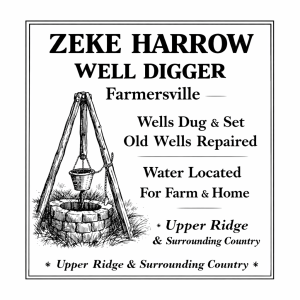 were “for the time being.” Well, the time being has passed, and now is when a body takes things in hand again.
Floors swept proper.
Shelves set straight.
Windows opened when the weather allows.
It’s not hard work—but it is steady work, and it asks to be done all the way through once you begin.
It isn’t only the house that feels it.
Barns, sheds, and corners of the yard have taken their share of coming and going as well. Tack hung where it landed, tools set aside instead of put away, feed bins opened more often than usual.
A little time spent there now saves a good deal of looking later.
And if you find something you thought was lost, best to be grateful for it and not ask too many questions about how it came to be where it was.
There’s a quiet satisfaction in seeing a place come back to itself.
Not different—just right again.
You don’t notice it all at once. It’s more that things stop catching your eye for the wrong reasons.
That’s when you know you’re near finished.
A Closing Thought . . . .
Put things back as they belong, and they’ll serve you well when you. need them again
— Myrtle Mae

Where Folks Gather in Good Company —
By Felicity Grace Merriweather
Picnic Weekend — A Gentle Beginning to April
There is a particular kind of promise that belongs only to the first weekend of April.
It does not arrive with fanfare, nor does it insist upon itself. It simply appears—somewhere between the last chill of morning and the first warmth that lingers past midday—and invites those who notice it to step outside and make a little something of it.
Around our way, that invitation has come to be known, quite simply, as Picnic Weekend.
No grand arrangements are required.
A basket gathered from what is already at hand. A blanket—sometimes well-folded, sometimes not. A place chosen less for its distinction than for its suitability.
 A patch of grass. A quiet rise. The edge of a field not yet ready to be worked.
It is not the setting that makes the occasion—it is the choosing of it.
Some arrive with family. Others with neighbors. A few, now and again, with no one in particular and find that they are not alone for long.
There is a pleasant way in which such gatherings form.
A greeting offered. A place made. A plate passed without much ceremony.
And before long, it becomes difficult to recall who brought what, or when exactly everyone came together.
There is no fixed bill of fare, though certain things appear with reliable regularity:
Sandwiches wrapped in paper
Fruit carried in small tins or baskets
A pie, if one has been wisely set aside for the purpose
And always something shared that was not originally intended to be.
It is, perhaps, the only kind of meal that improves the more it is added to.
Time moves differently on such afternoons.
What begins as a short visit has a way of stretching, quietly and without objection, into something longer. Conversations drift. Laughter comes and goes. The sun lowers just enough to be noticed.
There is no urgency in it, and none is needed.
Picnic Weekend asks very little.
Only that a person notice the day, take a moment, and step outside long enough to enjoy it in the company of others—or in the quiet company of the place itself.
And in doing so, mark the beginning of a season not by the calendar alone, but by the simple act of being present within it.
If you should find the time this weekend…
You might consider it.
— F.G.M.

FROM THE ENTERTAINMENT DESK
The Gazette has, in what may prove either a bold decision or a complete surrender to momentum, welcomed an Entertainment Correspondent to its pages. Groovy Gary the Grey Fox arrives with a voice, a rhythm, and a manner of expression that does not appear to answer to any known convention. Readers are advised to try to keep up as best they can.
YOU DIG? — A SOUND ROLLIN’ OFF THE WATER LIKE IT DON’T INTEND TO STOP
By Groovy Gary the Grey Fox
Now hold on—hold on just a second . . . .
You hear that?
No, not the wagons.
Not the talk.
Not even all that carryin’-on up in Round Corners this week—
I mean underneath it.
That little slip of sound that don’t quite sit still.
Down along Packet’s Landing, when the lanterns get low and the boards start talkin’ back to your boots…
That’s where it finds you.
Or maybe—
you find it.
They call ’em:
THE ALLEY CATS
…and I’ll tell you this straight—
They don’t start playin’.
They’re already playin’ when you arrive.
First time I caught ’em, I wasn’t lookin’.
Nobody is.
You turn a corner, or drift a little too far past where you meant to stop, and there it is—
Piano rollin’ like it’s got somewhere to be,
strings leanin’ into it like they don’t quite agree,
and somethin’ in the middle keepin’ time just loose enough to make you wonder if it’s gonna hold.
(It does. Don’t you worry. It holds.)
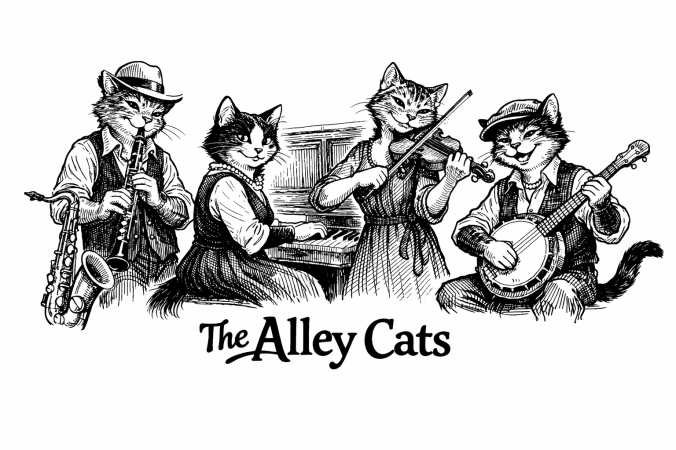
Now listen—
These ain’t porch players.
Ain’t stage folks neither.
This is river music.
Moves like water—
don’t ask permission,
don’t repeat itself,
and don’t much care if you understand it right away.
You got:
A set of keys that don’t sit still long enough to be told what to do—
A fiddle that slides past the note and smiles about it—
A rhythm man keepin’ the whole thing from floatin’ off into the dark—
And a horn that shows up when it feels like it and leaves the same way.
And the singin’?
Oh now…
That ain’t singin’ for you.
That’s singin’ because it’s there.
If you happen to hear it—
well… that’s just good fortune.
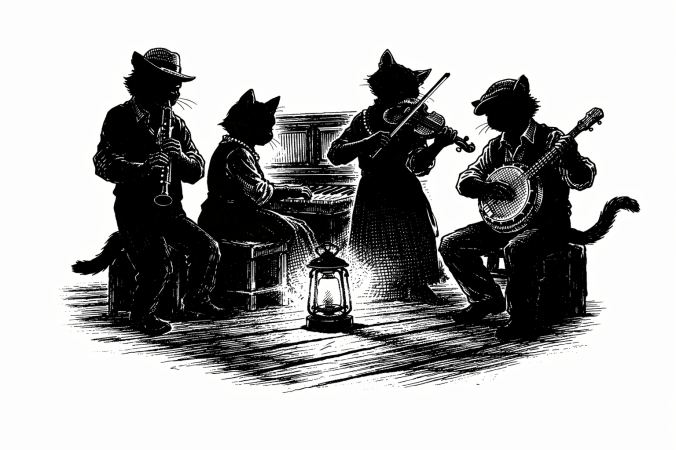
I seen folks stand there not sayin’ a word,
like they’re waitin’ for somethin’ to make sense—
and then somebody taps a foot,
and somebody else leans in,
and before long the whole place is movin’ like it meant to all along.
No posters.
No announcements.
No “now playin’.”
Just sound.
Now I ain’t tellin’ you to go lookin’ for ’em—
Some things don’t care to be found that way.
But if you’re down near the Landing…
and the night’s settled just right…
and you hear somethin’ that don’t belong to the road you’re on—
Might be worth followin’ it a little ways.
See ya later, daddy-o,
— Groovy Gary (You dig?)
(Editor’s Note)
The Editor notes that while the language employed above may not conform to standard columnar practice, the enthusiasm appears genuine and has therefore been permitted.

From Around Our Way —
By Lillian Harper
A Month Well Spent Together
It has been remarked more than once this week, in passing and without much ceremony, that things feel a little quieter now.
Not empty—just quieter.
March carried with it a great deal of movement across Honey Hill Country, and not all of it expected. Folks who might otherwise have kept to their usual routines found themselves stepping out, staying longer, and taking part in things they had not previously thought to try.
And in doing so, something rather fine took place.
It was not uncommon over the past month to find oneself among neighbors not often gathered in the same place at the same time.
There were those who came for a single event and stayed for another. Those who meant only to watch and found themselves joining in. And those who, having once taken part, returned again with a different sort of ease.
Names were learned. Then remembered. Then called out without hesitation.
That is no small thing.
Meals, too, seemed to take on a different character.
Dishes were shared more freely, recipes discussed more openly, and tables—whether  in homes, cafés, or out-of-doors—were set to accommodate just one more chair than had been planned.
It is a simple gesture, but one that leaves a lasting impression.
There were new sounds heard, new foods tasted, and more than a few occasions where a person found themselves doing something they might not have done a month prior.
Not everything was mastered, of course—but that was never quite the point.
The trying of it was enough.
Now that the month has passed, and the signs of it have begun to settle back into their usual places, what remains is not the noise or the activity, but the sense that the distance between folks has, in some small way, been shortened.
That is not something easily measured, nor quickly forgotten.
There is already talk in some quarters of journeys to St. Louis in the coming weeks, where the great Exposition is said to be nearing readiness. Whether many will go or only a few remains to be seen.
But it may be that what was practiced here—gathering, sharing, and stepping a little beyond one’s usual path—will travel along with them.
There are quieter days ahead, as there always are.
But they may feel a little different now.
— L.H.

The High Brush Chronicles —
Hickory Pinenut of High Brush Farm
Hickory Pinenut
The Telephone Comes to High Brush Farm
It has come to pass that High Brush Farm is now in possession of a telephone.
This development, which has been spoken of for some time in other parts of the county, arrived at last by way of a line run along the road and fastened to poles of a determined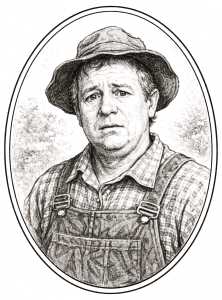 but somewhat uneven character.
The instrument itself hangs in the front room, mounted upon the wall at a height that suggests it was placed with confidence rather than measurement.
It is, by all accounts, a marvel.
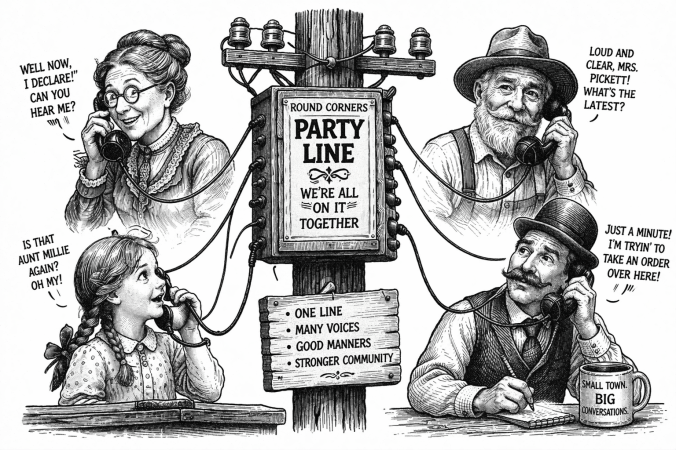
On the Nature of a “Party Line”
It should be noted, for those unfamiliar with the arrangement, that not every  household maintains a separate wire of its own.
In many cases, several homes are connected along a single line, each distinguished by a particular ring or pattern of rings meant to indicate for whom the call is intended.
This is known as a party line.
In practice, it is a system of shared communication, mutual patience, and—when circumstances allow—limited privacy.
First Impressions
Mrs. Pinenut is said to have taken to the instrument with a degree of care and curiosity, while Mr. Hickory Pinenut approached it with confidence bordering on certainty.
“I reckon I understand it,” he was heard to say, shortly before lifting the receiver for the first time.
An Unintended Conversation
It was on the second day that matters took a turn.
Mr. Pinenut, having heard the line produce a sound he believed to be meant for him, lifted the receiver and found himself listening to what appeared to be a conversation already underway between two other parties.
These individuals, engaged in a discussion regarding the whereabouts of a missing crate of preserves, did not at first appear aware of his presence.
Mr. Pinenut, after a period of listening sufficient to form an opinion, elected to assist.
An Effort to Be Helpful
Clearing his throat in a manner he later described as “respectful but firm,” Mr. Pinenut offered his thoughts on the matter, suggesting that the crate in question might reasonably be located “wherever it was last set down, provided it had not since been moved.”
This contribution was met with silence, followed by a brief exchange between the original parties, neither of whom addressed him directly.
Undeterred, Mr. Pinenut elaborated.
“If it was preserves,” he continued, “it stands to reason somebody meant to keep ’em. So I’d begin with whoever had the most to gain from their bein’ kept.”
At this point, one of the voices inquired, with noticeable caution, as to who had joined the line.
Clarifications and Complications
Mr. Pinenut, believing this to be a request for proper introduction, obliged.
“This is Hickory Pinenut of High Brush Farm,” he said. “I’ve been listenin’ long enough to get the sense of it, and I believe I can help you sort it out.”
What followed has been described, by those later informed of the exchange, as a period of confusion marked by repeated attempts on the part of the original speakers to determine how Mr. Pinenut had come to be involved.
Mr. Pinenut, for his part, appears to have understood the question as an invitation to further explanation.
The Matter Expands
Over the course of the next several minutes, the conversation broadened to include:
- The proper storage of preserves
- The reliability of memory in matters of placement
- The general advisability of labeling items clearly
At no point was the original crate definitively located.
A Household Adjustment
Following the incident, Mrs. Pinenut is said to have introduced a new rule regarding use of the telephone:
That one should be certain the call is intended for them before offering assistance.
Mr. Pinenut has agreed to this in principle.
In practice, he maintains that “if a body can help, it’s a waste not to.”
Closing Observation
The telephone at High Brush Farm remains in good working order.
Whether its use will improve with time is, at present, a matter under observation.

Community Notices & Small Tidings —
Items of interest from Honey Hill Country and nearby hollers. Notices are printed as received and offered in good faith.
Items of Interest from Around Honey Hill Country
DANCE INSTRUCTION OFFERED
Instruction in the Cakewalk, Waltz, and Two-Step will be offered on Thursday evenings at the Whispering Pines Meeting House. Beginners welcome. Proper footwear advised.
Inquire upon arrival or speak with Mrs. Ellery Finch for particulars.
OAKHAVEN SPRING ARTS & CRAFTS FAIR (UPCOMING)
Residents are reminded of the upcoming Spring Arts & Crafts Fair in Oakhaven, to be held the second weekend of April.
Local artists and craftspeople will be displaying works prepared over the Winter months, including:
- Quilts and needlework
- Hand-carved items
- Pottery and painted goods
- Early garden starts (flowers and vegetables)
All are welcome. Early arrival recommended for those seeking the best selection of plants.
ST. LOUIS EXPOSITION OPENING APPROACHES
The Louisiana Purchase Exposition is reported to be nearing readiness, with opening day set for April 30 in St. Louis.
Travelers from the region have begun making early plans. Those intending to go are advised to arrange lodging and transport well in advance, as demand is expected to be considerable.
PICNIC WEEKEND OBSERVED
The first weekend of April has brought fair intervals of weather between rains, and many have taken the opportunity to observe the informal custom of Picnic Weekend. Blankets, baskets, and good company have been noted across fields and rises throughout the county.
DUCK CREEK RUDDY DUCK DAYS (COMING SOON)
Preparations are underway for the annual Ruddy Duck Days at Duck Creek later this month. First sightings are expected in the coming days, with further notes to follow as the season develops.
WORK OF A PRACTICAL SORT
Residents requiring stronger door fittings, bars, or reinforced hinges are reminded that such hardware may be obtained through Brown’s Forge & Ironworks in Butterfield, where work is said to be of uncommon strength and reliability.
THE POSSUM & MULE EXCHANGE SITUATION
Mr. J. T. of Cedar Ridge traded three trained possum for a reliable working field mule this week.
Come get ’em quick, because three highly-trained, juggling possums ain’t gonna be here long!
Cash offers only. No trades.
TRAVELERS NOTED ALONG THE ROADS
An increase in travelers returning home following March’s festivities has been observed across several routes. Wagon traffic remains steady, with occasional delays reported where road conditions have softened.
GENERAL NOTE
Several items of a personal and household nature, having been displaced during the past month’s activities, are said to be making their way back to their proper homes. Those missing small articles are encouraged to inquire among neighbors before assuming them lost.
A Small Reminder
If you have a notice to share — a gathering, a need, a thank-you, or a simple word worth passing along — you may leave it with the Editor by letter or in person. Space is limited, but goodwill is not.

Classifieds —
Notices are printed as submitted. Replies may be made discreetly, or not at all.
FOR SALE — CARROZELA HORN (LIKE NEW)
Used only once (Mother would not permit further use). Produces a clear, spirited tone. Suitable for celebrations, announcements, or situations requiring immediate attention.
Price reasonable.
Inquire at the second house past the split rail fence on Homer Boyd Road (the real one).
FOR SALE — CARROZELA HORN (WELL-USED)
Sound remains strong though enthusiasm has lessened. Slight dent does not affect performance, though it may improve it depending on the listener.
Will trade for quiet.
Apply evenings, Butterfield.
WANTED — INFORMATION
Regarding the proper operation of a party line telephone. Specifically: when one is to speak, when one is to listen, and when one is to put the receiver back entirely.
Responses appreciated.
H.P., High Brush Farm
FOR TRADE — MASON JARS (EMPTY)
Acquired in anticipation of uncertain times. Now more than needed. Will trade for preserves, pies, or reassurances of a convincing nature.
See Trimble’s, ask for counter discussion.
LOST — SMALL WOODEN LADLE
Last seen during a gathering in late March. May have been borrowed, set aside, or taken up in good spirits. No questions asked upon return.
Leave at the Gazette office.
NOTICE — PICNIC BLANKET (FOUND)
Folded neatly and left near a rise overlooking a field. Appears well cared for and lightly used. Owner may reclaim with proper description and a willingness to share how it came to be forgotten.
FOR SALE — STRONG DOOR (REINFORCED)
Recently fitted with bar, hinge, and cross support. Opens as intended. Does not open otherwise.
Serious inquiries only.
Brown’s Forge & Ironworks, Butterfield
WANTED — DIRECTIONAL CLARITY
Seeking a clear and final determination as to which Homer Boyd Road is the correct one. Compensation offered for certainty.
Apply care of this paper.
FOR SALE — ONE UNUSED INVITATION
Originally intended for a visit not taken. Remains in good condition. Suitable for future use where company may be desired.
No charge. Simply ask.
A Small Reminder
Classified notices may be left with the Editor in person or by letter. Brevity is appreciated. Honesty assumed.

Country Chuckles —
By Cousin Orville P. Dithers
Now Then — Which One Are You Talkin’ About?
It began, as many such things do, with a simple request for directions.
A traveling fellow—hat dusted, boots honest, and patience not yet tested—pulled up alongside a fence where Jasper P. Dunn happened to be standing in a manner that suggested he knew where things were.
“Beg pardon,” the traveler said, “how do I get to the Miller place?”
Jasper nodded once, slow and certain.
“You’ll want Homer Boyd Road.”
“Well that’s convenient,” said the traveler. “Where do I find it?”
Jasper lifted his hand and pointed in a direction that appeared confident, if not entirely committed.
“Take that road there till it bends, then keep on till you’re sure you’ve gone far enough, and you’ll come to Homer Boyd Road.”
“The road or the man?” the traveler asked.
Jasper paused.
“Well now… that depends.”
The traveler waited.
Jasper considered.
“If you mean the road,” Orville said, “it’ll be right there where it always is.”
“And if I mean the man?”
“Well,” said Jasper, “that depends on whether you hold with the notion that there ever was a man.”
The traveler blinked.
“I was under the impression there was.”
“So was I,” said Jasper. “For a time.”
A second man, who had been leaning against the fence for reasons of his own, joined in.
“There was a Homer Boyd,” he said. “Lived over near the ridge.”
“That wasn’t Homer Boyd,” said Jasper. “That was a fellow named after Homer Boyd.”
“Well who was the first one, then?”
“That’s what I’m sayin’—nobody seems to know.”
The traveler shifted in his seat.
“So the road—”
“—is named after him,” said Jasper.
“After who?”
“Well now,” said Jasper, “that depends on how you take it.”
“Is the road at least real?” the traveler asked.
“Oh yes,” said both men at once.
“Good,” said the traveler. “Then I’ll take the road.”
“Well you can,” said Jasper, “but you’ll want to be sure it’s the right one.”
“How many are there?”
“Well,” said Jasper, “there’s the one folks call Homer Boyd Road…”
“And the others?”
“Well . . . . those are just roads that might be Homer Boyd Road, depending on who you ask.”
The traveler looked from one man to the other.
“Which one do you take?”
Jasper nodded again, satisfied.
“Homer Boyd Road.”
The traveler sat quietly for a moment.
Then he said:
“I believe I’ll just head back the way I came.”
Jasper watched him go.
After a moment, he turned to the second man.
“Do you suppose he meant the Miller place on Homer Boyd Road,” he asked, “or the one just off of it?”
The second man thought on that.
“Well now,” he said, “that depends.”
— Cousin Orville

Heart of the Holler —
By Abigail “Abby” Whitcombe
The Long Road Home
The last of the March crowds had begun to thin when I heard about the little rabbit family stranded along the road just beyond the rise.
They had come from a distance — far enough that their return would take more than a day—and like many who had stayed longer than planned, they had packed up in a hurry, gathering what they could and trusting the rest would follow.
It did not.
A Cart That Would Not Go
Their cart, a modest but well-used thing, had carried all they owned for the journey— bundles of clothing, a basket or two, and six small bunnies who had, by all accounts, taken the entire month as reason enough to remain in motion.
Somewhere along the road, one wheel had given up its duty.
Not entirely — just enough.
Enough to turn, but not true. Enough to move, but not far.
And so they found themselves stopped where they had not intended to be.
The father examined the wheel.
The mother gathered the little ones close and tried to keep them settled, though settling was not much in their nature just then.
There are moments when the road ahead is known, but the means of reaching it is not.
This was such a moment.
It was not long before a figure came along the road — coat set against the breeze, sleeves rolled and held in place, moving with the steady pace of someone who has spent a good deal of time where things do not always go as planned.
Archie Crowther.
He did not hurry. He did not call out.
He simply came up alongside the cart, took in the matter of it, and rested a hand on the wheel as though greeting it.
“Well now,” he began, in that way of his that circles a thing before settling upon it,
“you’ve got yourself a situation here that’s not so much a problem, you understand, as it is a matter what’s gone slightly off the beam.”
The father, uncertain whether to answer or simply listen, did the latter.
Archie continued.
“It’s the sort of trouble that looks larger than it is on account of the angle it’s been taken from. Wheel’s not gone—no, no—it’s merely expressing a preference for a different alignment than the rest of the cart’s prepared to accommodate, innit?”
What followed was not hurried.
Archie set to work with a quiet certainty—loosening, adjusting, straightening, all the 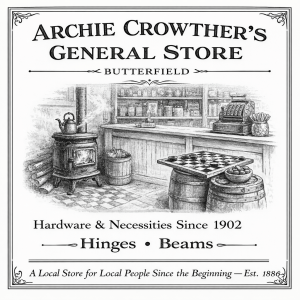 while explaining in a manner that suggested both instruction and conversation, though not always in equal measure.
“You see, it’s hinge work, this—everything’s hinge work if you look at it properly.
Something turns where it oughtn’t, or doesn’t where it should, and before long the whole arrangement starts tellin’ a different story than the one it began with, alright.”
The little rabbits watched. The parents listened.
And bit by bit, the wheel came back into its proper place.
When the work was done, Archie stepped back, gave the wheel a final look, and nodded as though the matter had been resolved not by effort, but by agreement.
“There you are,” he said. “Back on the beam. Mind how you take the road from here — no need to rush what’s already goin’ in the right direction, you see.”
The father offered thanks.
The mother gathered the children.
The cart moved forward—true this time.
A Small Thing, Properly Done
By the time I heard of it, the family was already well on their way home.
Archie, it was said, had continued on as he came — no mention made, no credit taken, no reason given beyond what was needed.
Some things are not meant to be made much of.
Only set right.
— Abby W.


Front Porch Reflections . . . .
When Everything Happens at Once
by James Milson
Some weeks arrive one piece at a time.
You take them as they come—one matter, then another—and by the end of it, you can point to each thing and say where it began and how it found its way along.
And then there are weeks like this one.
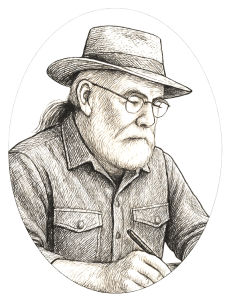 A door opens somewhere, and a crowd gathers.
Rain comes in steady, and the ground asks for patience.
A schoolhouse thought to need mending quietly suggests it may require something more.
A train may or may not be coming, depending on who you ask—and where they are standing when they do.
And in between all of it, folks go about their days, doing what needs doing, making sense where they can, and leaving the rest to settle in its own time.
There is a feeling that comes with such weeks.
Not confusion, exactly.
More a sense that everything is moving at once, and not all of it in the same direction.
But if you step back a little—just enough to see it whole—you begin to notice something else.
The door that opens brings people together.
The rain that delays also prepares.
The trouble that grows reveals what must be done.
The road that bends still leads somewhere, whether it says so plainly or not.
And the people?
They do what they have always done.
They speak their minds.
They lend a hand.
They argue a point, then stand beside one another all the same.
There is no tidy way to set such a week in order.
No single line to draw beneath it.
But there is a kind of quiet understanding that comes when you let it be what it is.
Things are moving.
Some of it uncertain.
Some of it unexpected.
All of it, in one way or another, leading forward.
And that, more often than not…
is enough.
We will see you again next Saturday.
— Jim (and Red!)
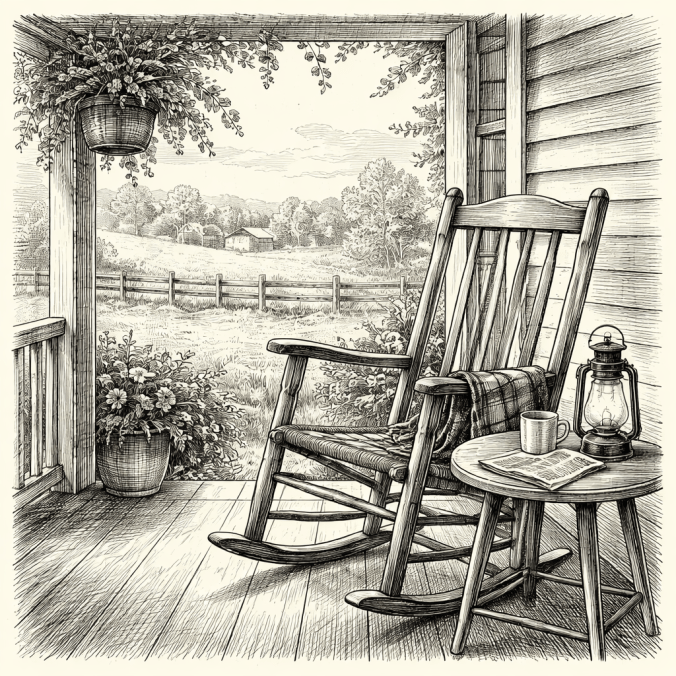
The Hearth & Holler Gazette is a work of fiction, created for entertainment and storytelling purposes. The people, places, events, and notices appearing within its pages are imagined, and any resemblance to actual persons or events is purely coincidental.
© 2026 James Milson. All rights reserved.
Pen-and-ink illustrations created with the assistance of AI and lovingly styled for Little Red Bear Land.
Would you prefer Coffee or Tea with your newspaper?


Thanks for visiting with us! Happy April and Spring, Rosie! 🤠 🐻 ❤️
LikeLike
A few new things going on in Honey Hill Country. A new character, (Groovy Gary,) “The Alley Cats,” and a party line. Oh my! 😉
Happy April, James and Little Red Bear!
LikeLiked by 1 person