Oh my gosh! It’s early Spring and here come the dandelions all over the yard. What to do?!?
Answer — absolutely nothing. Relax, have an iced tea, and simply leave them be. We really dig dandelions here, but perhaps not in the way some may imagine.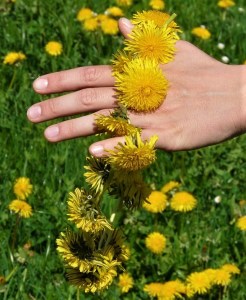
My father, noted for his dandelions obsession, would have me busy every available free moment years ago it seemed, dandelion puller in hand, sent out to pull and dispatch the lowly yellow flowers out of our burgeoning green lawn.
“Now, get down deep and pull ’em up by the roots or they’ll surely come back on us, son!”
My idea of true technological progress was when my father came home one day with a long-handled dandelion puller newly purchased from the hardware store, one I didn’t have to bend over all day with or crawl around the yard on hands and knees. Yep, modern science had come a long way. I could pull ’em standing up!


In the suburban sprawl era of the early ’60s with new subdivisions sprouting up everywhere, my father could and did spend hours talking with other men in the  neighborhood about — Grass.
Seriously weighing the merits of one variety of grass versus another and how best to care for their lawns.
Those out there on the very cutting edge of technology were experimenting with the new Zoysia Grass just becoming available at the time, and “plugging” their lawns with it. Anybody in their right mind seeded. Everybody knew that. They were “plugging!”
“Poor Troutman’s lost his mind this year with that Zoysia grass.”
“Gonna have an ugly mess on his hands for sure!”
“That Zoysia stuff turns brown like straw all winter. A real fire hazard, that! He’ll be sorry.”
“Well, he’s a young college guy and doesn’t know anything. He’ll learn. Ya just can’t beat good ol’ Kentucky Blue Grass.”
“Nah, that stuff burns up in the summer heat. I’ll stick with my Fescue.”
And on and on it went. Heady stuff, those evening, after-dinner grass meetings on the sidewalk. We won’t even go into Crabgrass debates. And what in the world to do about that guy on the corner and his dandelion infested yard, blowing seeds all over the neighborhood?
“Who does Baggett think he is, after all, a Dandelion Farmer? Look at his mess down there! Why doesn’t he get out and pull those dad-gummed weeds?!?”


The beauty of one’s lawn was definitely a status symbol in the subdivision back then, as dandelions in your yard certainly meant that you would be looked down upon by all of the folk meticulously fertilizing, treating, and clipping perfectly manicured lawns, proudly pushing their new, bright green Scotts’ spreaders in front of them while whistling a happy tune, dandelion digger tucked into their belt or back pocket. And yes, there was a distinction. Farmers ‘mowed’ down weeds. Lawn aficionados ‘clipped’.
Folks with dandelions in their yards were judged to be lazy, uncaring, and downright disrespectful because soon those wicked seed puffs would be blowing thru the air on spring breezes and re-infesting all of the honorable and upstanding folks’ yards.
Such was life in the suburbs during the time of manicured lawns and new homeowners aspiring to be featured on the cover of ‘Better Homes & Gardens’ magazine.

But, let’s hold on just a bit and fast forward several decades.
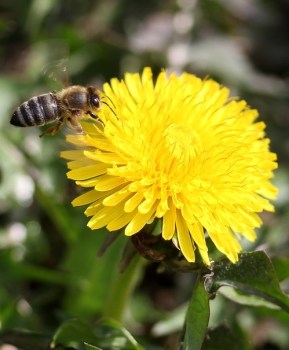
Honeybees, critical to the world’s food supply, have been decimated in recent years from an assortment of maladies — colony collapse disorder (CCD), global warming, selective industrial crop plantings, insecticide and herbicide poisoning, the uprooting and destruction of native plant species, and so much more. They sorely need our assistance for the benefit of the planet, and it just so happens that leaving those dandelions in your yard alone for a while is one of the very best things that you can do to help them in early Spring.


When honeybees and other pollinators first emerge in the very first warm days of early Spring, like bears coming out from their dens after a long Winter and having depleted their honey stores which kept them going thru the Winter months, they are hungry and in need of nutrition right away. And just as Mother Nature intended, those bright yellow dandelion flowers in your yard are one of the very first emerging and available food sources for them every year.
Each dandelion flower is composed of up to a hundred individual florets, each one packed with needed nectar and pollen before later emerging flowers and plants bloom and are available. Dandelions are one of the earliest and best food sources for bees and pollinators each Spring. They count on dandelions for survival.

Not only honeybees feast on the flowers but also bumblebees, hoverflies, beetles, and butterflies. Later, goldfinches, house sparrows, and others eat the seeds while raising babies in the nests.
For us, young dandelion leaves make a fine addition to spring salads and are loaded with vitamins and antioxidants, and the flowers (leaving some for the honeybees and wildlife) have been made into Dandelion Wine for ages. Just be sure the plants have not been treated with chemicals or lawn fertilizers for food safety.


So, if it is necessary to mow the grass, please consider raising the height of the cutting blades to safely pass over the dandelion flowers for the first month or so. It makes mowing thick spring grass easier, anyway. And then sit back with your iced tea on the porch to enjoy the parade of honeybees, butterflies, and other visitors to the dandelion flowers in your yard, confident that you are helping both them and the environment.

And if a well-intentioned neighbor makes a comment, just bring them up to speed about why it is so important to simply leave the dandelions be in early springtime, for the sake of the honeybees and pollinators. And us.
Cross-pollination helps at least a third of the world’s food crops and 90% of wild plants to survive. Without bees to pollinate and spread seeds, many plants, including major food crops that we ourselves depend upon for survival, would die off. And that is why early spring dandelions are so important.
Some have stated that if honeybees disappeared from the Earth, humans would inevitably follow four years later due to lack of food supplies. If letting the dandelions grow in early springtime helps the bees survive and keeps the grocery shelves stocked, we are all for that.
Besides, I haven’t met the Mother yet who doesn’t delight in a freshly-picked dandelion bouquet from her four-year-old in the Spring.
And, if the dandelions are all mowed down, pulled out, and tossed away — how could we ever hope to make a wish?
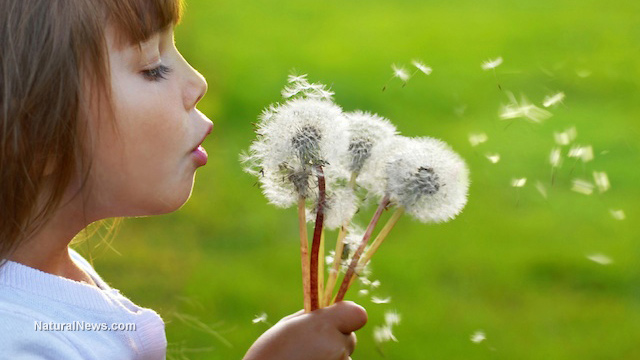
Speaking of dandelion bouquets and making wishes, if you have small children or grandchildren, check out the delightful little children’s book “Why Dandelions Grow” by Nita Marie Clark available on Amazon.
Told in verse with colorful illustrations, the book tells about how dandelions came to be (they seemed to be an afterthought, you know), and is very instructive for youngsters on both dandelions and bees, along with the importance of dandelions to the survival of bees in early springtime.
Little Red Bear and I always advocate teaching children about Nature and its importance, beginning at the earliest age, so they will become involved, learn to appreciate, and care about taking care of and preserving it for the future. That’s the Little Red Bear way.
Working together we can do our best with Mother Nature to help the bees and other  pollinators.
Thanks always for stopping by to visit with us, and please feel free to share this important message with family and friends!
My story friend, Little Red Bear, and I hope you will join us in the “Bee Friends” club and simply sitting back to watch the dandelions grow, confident in knowing that you are doing something positive and a ‘good thing’ for the environment and Mother Nature. — Jim (and Red!)
If you enjoyed this feature, you may also like → “Happy Hummer Season! Welcoming, Helping, and Attracting Hummingbirds In Your Neighborhood”
Think Globally — Act Locally — Tomorrow Begins With You TODAY!

Children + Nature + Outdoors = Happy, Healthy, Balanced Kids
Meet Little Red Bear & His Friends — “Once Upon A Time In A Very Special Woods . . . .”

“Those who contemplate the beauty of the earth find reserves of strength that will endure as long as life lasts.” – Rachel Carson
 This is a purposefully non-monetized, ad-free site to be able to offer the most enjoyable reading and viewing experience for everyone, with all content freely shared, and generates no income to offset the costs of maintaining and operating. If you enjoy your visits and time with us, Join our new Patron Community today. Patrons help my friend Little Red Bear and me to continue this as an ad-free site, dedicated solely to entertainment and educational purposes.
Because together we can do so much!
“How doth the little busy bee, Improve each shining hour,
And gather honey all the day, From every opening flower!”
– Isaac Watts, ‘Divine and Moral Songs for Children’