On Rabbitbrush, Ripples, Sheriffs and Such

Had a terrific weekend of writing.  I had an idea for a story in my head for several months but it never went anywhere, very unusual for me because I am a “pantser” in approach mostly, just sitting down and writing from start to finish from an initial story concept or character name, without a lot of forethought or planning.  I had the initial story idea, which is usually enough, but it never developed.  After sitting down the other day with the story idea once again, the light suddenly went on and it entered that magical land where the story writes itself.  Very happy with it, delighted actually, and wish I could share the story now with you.  But it is to be included in the upcoming “Adventures of Little Red Bear” collection so we will all have to wait just a little longer.

Work then started on another new story late last night.  So today I am working on what quite possibly could be the final story in the collection, and writing about Rabbitbrush, a featured element in the story.  Love the stuff.  To me, it is beautiful.   It is a plant native to arid regions in the North American West and Southwest, and thrives in coarse, alkaline soil common to desert environments.

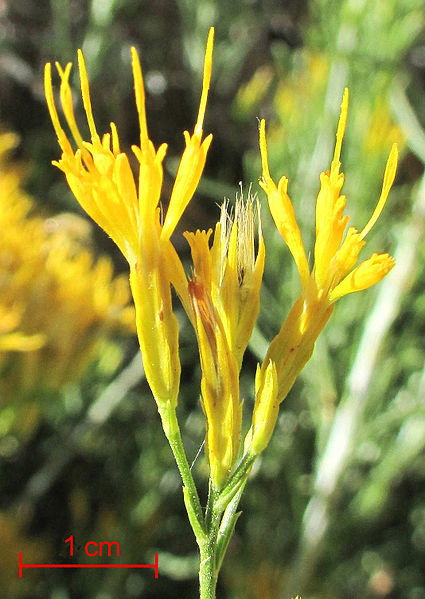
Detail of Rabbitbrush Flower Head (Image Courtesy of Wikipedia)

Detail of Rabbitbrush Flower Head
(Image Courtesy of Wikipedia)

Rabbitbrush is an important food source for wildlife, especially during winter months.  The Zuni people of the Southwest used the plant’s blossoms to make a yellow dye, and stems for baskets.  Rabbitbrush is gaining popularity now as an ornamental plant in areas where water conservation is a growing concern.  In the wild, it is often found in unmanaged range lands, along roadways and in abandoned fields.

Also known as Rubber Rabbitbrush for its uses as a source of rubber dating back to 1904, it is a shrubby perennial growing in sizes ranging from 12 to 90 inches tall.  It’s flower heads are comprised of five small, yellow tubular flowers appearing in clusters.  The flexible stems are rubbery (hence the name) and its leaves a greenish-grey in color with a felt-like covering.

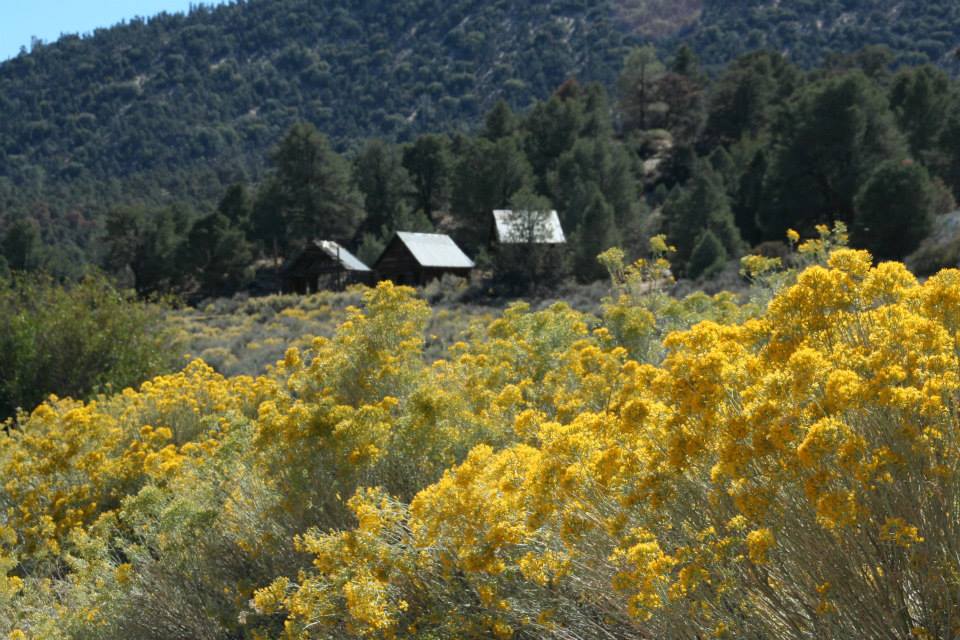
Rabbitbrush- Chrysothamnus nauseosus (Photo credit- Wikipedia)

Rabbitbrush- Chrysothamnus nauseosus
(Photo credit- Wikipedia)

Having seen Rabbitbrush before in travels to the Southwest but not knowing what it was, I learned more about it from beautiful photos shared over a year ago by a great friend, the award-winning author Kathleen Creighton in California. That is how I met her, actually.  She shared the photos online, I commented, she replied, and without hesitation granted me permission to use her photos.  Kathleen then contacted and put me in touch with others to provide me with more information on the plant.  A conversation struck up and we have been talking and great friends ever since.  And now I am including it in a Little Red Bear story.  It’s wonderful how it all works when one is open and receptive to meeting new people.  More of that Sending Out Ripples notion.

But, it has taken me a year to get the Rabbitbrush into a story, and I have stacked up a pile somewhere north of 1,000 story ideas and features since then.  I will have to live to the age of Moses and Methuselah to get them all into stories.  Since that is probably unlikely, I better pick up the pace it seems.

And in case you are wondering– “How does an arid desert plant find its way into a story about Little Red Bear and friends based in the Ozarks Mountains in the Southern Midwest?”  Well, guess you will have to wait for the upcoming collection of stories to find that one out.  But here’s a hint– There’s a new sheriff in town!

Wishing everyone a great day and positive start to the New Year!  Break time is over and Little Red Bear is calling me back to writing so I need to go.  Thanks for visiting! — Jim (and Red!)

Rabbitbrush, California Farm- October, 2013. (Photo by Kathleen Creighton Fuchs)

Rabbitbrush, California Farm- October, 2013.
(Photo by Kathleen Creighton Fuchs)

“Howdy!” (Or- How I Spent My Weekend)

“Howdy!”

That is how a new story character introduced himself to me on Friday morning. Out of nowhere, he just popped into my head with a loud “Howdy!” It has been an interesting, and exciting, weekend.

Red and I already have more story characters lined up for his upcoming “Adventures of Little Red Bear” short stories than we can probably squeeze into three or four collections. Nevertheless, in popped another one on Friday. He and Red hit it right off. I do declare, Little Red Bear collects new story characters and companions faster than a hound dog walking thru a flea patch.
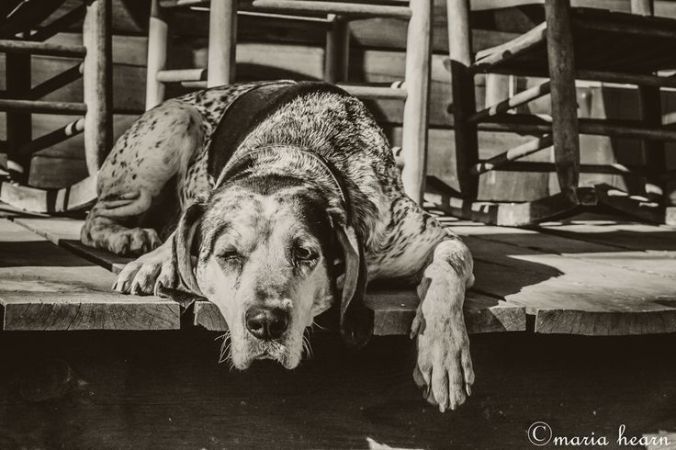
 Old Hound Dog (by Maria Hearn)

Old Hound Dog (by Maria Hearn)

It’s a struggle to keep up with them all, to be honest. And suddenly on Friday—here came another one into my head, totally uninvited. “Howdy!” But that was pretty much it. For Friday anyway. He just popped in, introduced himself and went to spend time with Little Red Bear. I didn’t learn any more from him that day. Just the “Howdy!” Hearing it over and over again.

Early Saturday morning was spent catching up on odds and ends for the week, and by late morning it was so beautiful outside I decided to go walkabout for a while, to get some fresh air and exercise.

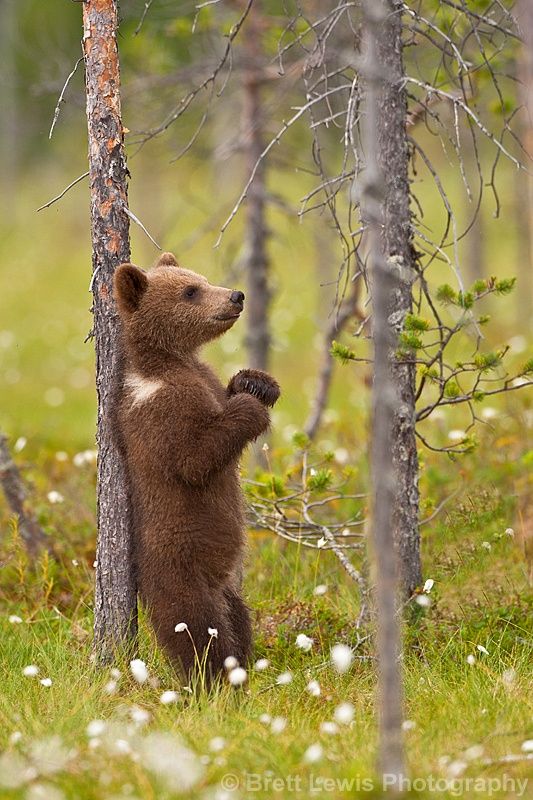
Bear Scratching Against a Tree (by Brett Lewis Photography)

Bear Scratching Against a Tree (by Brett Lewis Photography)

Two blocks from home while checking out dropped walnuts on the ground from an old Black Walnut tree up on the hill, the quiet was broken once again with a loud “Howdy!” in my head. I suppose he had talked Red’s arm off the night before, and now it was to be my turn.

The further I walked the more he talked. On and on, revealing his story to me. He continued talking thru Saturday night, was in my head when I woke up Sunday morning, and continued on thru the day. I have been listening to this little guy all weekend! Turned out, he is a Burrowing Owl.

Burrowing Owl- Sneaking A Peek

Burrowing Owl- Sneaking A Peek

We usually don’t give this much away about upcoming story characters, but this fellow is special, caught us totally by surprise and immediately stole our hearts. So much so, that Red and I are even reworking some things to move his introduction up into the first collection of stories, already nearing completion. I am so excited about him it’s hard not to just tell you all about him right now. But that would spoil all the fun.

Regardless, I can let you know that he is a Burrowing Owl from way out west in the Oklahoma Panhandle with quite a story to tell. Burrowing Owls inhabit grasslands, rangelands, agricultural areas and other open, dry areas with low vegetation. From their name, they live in a hole in the ground, not up in a tree like other owls. Although capable and willing to dig their own burrows, more frequently they inhabit existing holes abandoned by prairie dogs, skunks, armadillos, tortoises and the like.
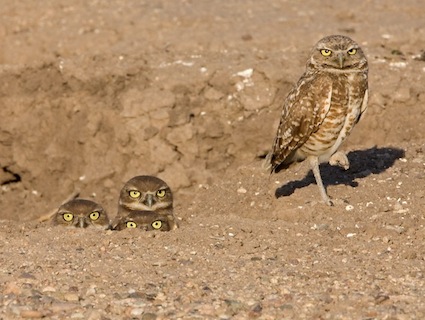
 Burrowing Owls via Cornell Lab of Ornithology (© Ned Harris, AZ, Tucson, June 2009)

Burrowing Owls via Cornell Lab of Ornithology (© Ned Harris, AZ, Tucson, June 2009)

Unlike most owls, Burrowing Owls are active during the day, although wisely avoiding the midday heat. But like most owls, they do most of their hunting between the hours of dusk to dawn, taking advantage of their superior night vision and hearing. So they do not sleep a lot, which may go a long way towards explaining his extended chattiness all weekend.

Living in open grasslands as opposed to forests, Burrowing Owls have long legs and short tails which allow them to sprint very quickly across the ground in pursuit of prey. They are small in size, about 11” long, a little larger than an American Robin when fully grown. When agitated, they bob their head up and down, revealing a white chin patch. But I cannot imagine this sweet little guy ever being agitated or angry.
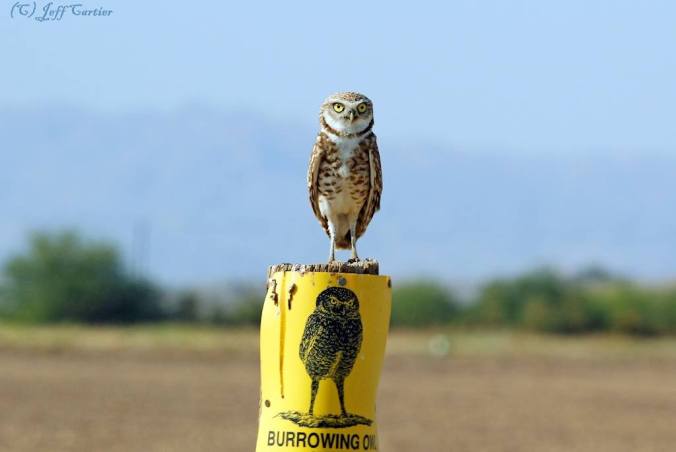
Burrowing Owl in California on top of Burrowing Owl Sign Post (by Jeff Cartier of Ventura, CA)

Burrowing Owl in California on top of Burrowing Owl Sign Post (by Jeff Cartier of Ventura, CA)

Burrowing Owls have no ear tufts, unlike many other owls. They feature prominent white eyebrow markings, and in color they are brownish, with lighter colored bars on the front and spots on the back.  They have noticeable bright yellow eyes.  No other owls are commonly seen on the ground or so frequently during daylight hours.  As with many birds and creatures, Burrowing Owls are threatened or endangered in some areas due to loss of habitat as more open nesting areas are plowed under for development and agriculture.

 Burrowing Owl, via Cornell Lab of Ornithology (© Bob Gunderson, CA, Antioch, May 2011)

Burrowing Owl, via Cornell Lab of Ornithology (© Bob Gunderson, CA, Antioch, May 2011)

This half-pint owl has captured our hearts and will be featured in the first “Adventures of Little Red Bear” short story collection available soon. Red and I just couldn’t wait to tell you at least a little about him, and are sure you will recognize him when he enters the stories.

“Howdy!”

As always, thanks for reading and have a great day! – Jim (and Red!)

Burrowing Owls Group, Southern Variety

Burrowing Owls Group, Southern Variety

Kohl’s Misrepresenting Real as “Faux Fur”– Caught Again!

Sad news today.  The department store chain Kohl’s has been passing off real fur as “faux” or artificial, synthetic fur.  Again!  This time Raccoon Dog real fur trim on a men’s parka was described as “faux-fur”. Hey Kohl’s– it’s not that hard to tell the difference if someone cared enough to check. For one, faux fur has a woven, synthetic cloth backing. Raccoon Dog fur, as with other real furs, has a real hide backing.  As in someone’s skin.   Duh!

Kohl's Mens Parka,  Photo: Pierre Grzybowski, The Human Society

Kohl’s Mens Parka, Photo: Pierre Grzybowski, The Human Society

As those who may recall Rusty the Fairydiddle’s first interview with the Gray Fox on my Blog here, the Raccoon Dog is the only other canine species in the world capable of climbing trees. Apparently they didn’t climb high enough to avoid Kohl’s reach. Here’s a link to the interview if you missed it → The Gray Fox Interview

Asian Raccoon Dog

Asian Raccoon Dog

I’m thinking customer refunds aren’t really that appreciated by the Raccoon Dogs. Or the Cyber Monday Rabbits.  It is one thing to be tricked and misled by a supplier once, as with the rabbit fur last year.  But not twice.  It calls into question what else may be improperly labeled or described.  Way to go Kohl’s, the second time in a year that you have been caught misrepresenting real fur as artificial. Shame on you!

Raccoon Dogs, Photo: Chiaki Tsukumo, AP

Raccoon Dogs, Photo: Chiaki Tsukumo, AP

For more information, here is a link to the news article as presented by USA Today → USA Today News Article, 09-24-14

Being caught the second time in a year makes me think that Kohl’s wasn’t all that truly sorry the first time.  Once may be accidental.  The second time is at least careless, if not intentional and knowingly dishonest.

But corporate credibility and dishonesty is one issue.  The other is the issue of fur trapping in general.  Haven’t we advanced enough as a civilization not to be trapping and hunting down other living creatures for their fur?  Is it really necessary anymore, with so may other options available to us now?  There is a better way.

Asian Raccoon Dogs Pair

Asian Raccoon Dogs Pair

Knitting Nests To Save Orphaned Baby Birds & Wildlife!

Little Red Bear and I have rescued a number of orphaned baby birds and other baby critters over the years. Are you a friend of the birds and like helping out? Do you knit or know someone who does? The NBC Nightly News on Saturday evening (August 23, 2014) featured wonderful work being done to rescue orphaned baby birds at a wildlife rescue center.

The name of the center is Wildcare and they are located in San Rafael, California in Marin, County. Each spring throughout the country, baby birds are orphaned while still in the nest due to severe weather and storms, tree trimming, flooding (for ground nesting birds, baby rabbits and such), lost parents, and other causes.

The Wildcare center has a “Baby Bird Nest Craft-along” project where people make knitted nests in various sizes (for different sized baby birds) and donate them to the center to help care for orphaned babies. The fabric nests serve as snug and cozy replacement nests while the baby birds are being cared for in the center, being the next best thing to real nests. The fabric nests retain heat and insulate against the cold, keeping the babies toasty warm (very important for baby birds!), and are soft for fragile little bodies, preventing injuries from the birds bashing against hard cardboard boxes and the like.

Wildcare has instructions for making the nests on their website. Knitting a bunch of little nests would make for a wonderful and rewarding project thru the upcoming cold winter months to have a supply ready to help out orphaned baby birds come next spring’s nesting season. If reading this outside the U.S. or if one did not want to send the knitted nests out to California, I am sure any local wildlife rescue organization in your area would be delighted to have these available for their use. I think the larger size would be perfect for baby rabbits, squirrels and such.

Here are some helpful links for more information and the patterns to download, along with the NBC news report to help get you going. Happy knitting! And thanks for helping the baby birds and critters! — Jim (and Red!)

Wildcare’s Main Site→ Wildcare Wildlife Rescue

Information On Making Knitted Nests→ Making Knitted Nests Patterns & Downloads

NBC News Feature→ NBC Nightly News Wildcare Feature 08-23-2014

Knitted Nests for Baby Birds, courtesy of Wildcare Wildlife Rescue Center

Knitted Nests for Baby Birds, courtesy of Wildcare Wildlife Rescue Center

World Elephant Day– The Power of 96!

Today is WORLD ELEPHANT DAY! Please check out “The Power of 96 Elephants Campaign” below, as 96 elephants die every day for their ivory. At the current rate of slaughter they will be gone in 12 years, as ivory poaching is at its highest level since 1989, with much of the money going to fund terrorist groups.  Elephants can be a vital long term tool to aid African communities thru eco-tourism.

“But with 35,000 elephants killed on average each year, more work is needed to reverse this trend. The death of 96 elephants each day is more than just a tragedy; it destabilizes countries by funding dangerous armed groups and international criminals, disrupts the order of delicate ecosystems, and brings the already endangered species of African elephants, who now number around 420,000, ever closer to extinction.” — from the article.  Here is a link for more information on “The Power of 96 Elephants Campaign.”


World Oceans Day

Today (Sunday, June 8 if reading this later) is World Oceans Day!

And boy do they need our help.  No oceans, no people.  Simple really.  More pollutants → higher acid levels → less marine life → less seafood → lower oxygen levels for the planet.

Even if not living on the coast, actions in the middle of the continent affect the oceans as waste, pollutants and trash work their way down thru the streams and river systems into the oceans.

Please help promote sustainable seafood practices, conservation and ecology awareness.  The life you save may be a nameless shrimp in the Gulf of Mexico.  Or it might be your own.

World Oceans Day Information


World Oceans Day

World Oceans Day