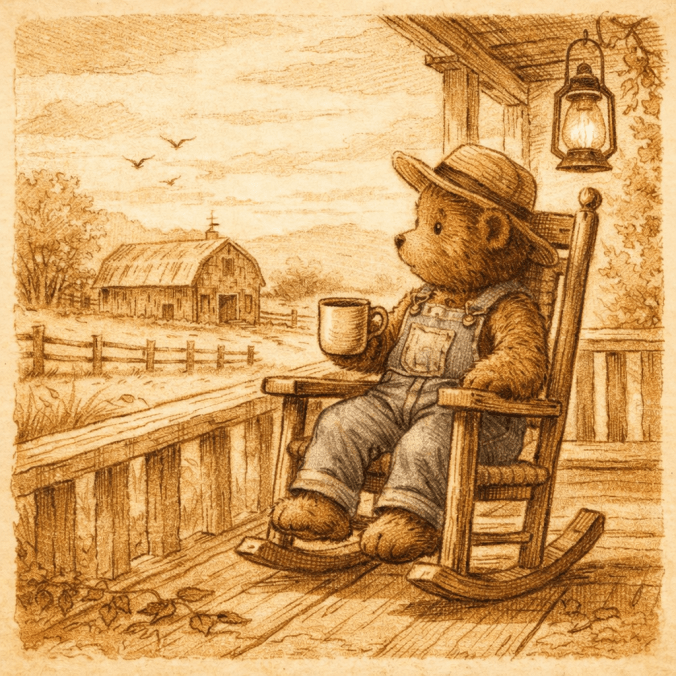
Something New Is Nearly Ready

One more chat before the porch light comes on.

There is a particular kind of anticipation that comes just before something good arrives.

Not the hurried sort.
Not the loud sort.
But the steady, warm kind — like setting an extra cup on the table because you know someone will soon be coming by.

That is where we are today.

Next Saturday — January 24The Hearth & Holler Gazette will make its first appearance here on The Writing Pages! And before it does, this felt like the right moment to pause, take a breath, and talk plainly about what it is, who it is for, and just as importantly, what it is not.

What’s Nearly Ready

At its heart, The Hearth & Holler Gazette is a weekly Saturday morning visit.

A small-town paper from a gentler place and time — filled with short pieces meant to be read slowly, smiled over, and enjoyed with a warm cup of coffee or tea for a moment before moving on with your day.

The Hearth & Holler Gazette is a fictional paper, created for enjoyment and relaxation, drawn from the characters and places of Little Red Bear’s Honey Hill Country.

Each issue will include familiar sections you can come to expect:

— lighthearted community tidings
— gentle humor and country chuckles
— a heartwarming piece from the Heart of the Holler
— and a closing reflection meant to leave you steadier than when you arrived

Nothing long.
Nothing demanding.
Just enough to feel like we passed a little time together.

Who It’s For

This Gazette is for readers who enjoy:

— quiet, comforting storytelling
— old-fashioned newspaper charm
— a sense of place and neighborliness
— kindness without preaching
— imagination without noise

It is for those who like to read with a moment, not race through one.

And What It Is Not

It is not a newsletter competing for attention.
It is not a commitment you must keep up with.
It is not something being sold to you, nor another thing to keep track of.

There are no subscriptions to purchase.
No ads or promotions to navigate.
No extras you must chase down.
No pressure to do anything at all.

If a week comes when you read it — wonderful.
If a week comes when you do not — it will be there when you return.

Continue reading

Porch Notes From Little Red Bear

Hey, folks —

Jim is up to his ears with work on the Gazette right now, so asked me to fill in for him today. And I’ve got a few minutes so thought – “Sure. Why not?” Hope you don’t mind.

Farmer Turner dropped by earlier for no particular reason. That’s what folks do around these parts. Stopping by to visit. Just bein’ neighborly, is all.

As usual, we got to talkin’ about the weather. Lately it’s been like riding a seesaw. We seem to go from way above normal one day to way below normal the next. We set a record for both a record all-time high temperature and another record 62-degree temperature drop all in the same day last week. From 80F to 18F. I started the morning in my overalls and ended up wearing three different coats by the end of the day, each one heavier than the one before. I hear the birds down south are flyin’ in circles, not knowing whether to migrate back up north or stay put where they are. They can’t figure it out either, it seems.

Anyway, that’s what Farmer Turner and I were talking about — the weather. I will say, if ever you feel like talking about the weather with someone, just go find yourself a farmer. Farmers love talking about the weather. For them, it’s not just small talk, of course. It’s an important discussion about crop yields, planting schedules, and their very survival. Weather determines a farmer’s livelihood, after all.

Well, I see Aunt Ivy coming up the way, probably coming to trade some cookies for some of the fresh herbs we still have growin’ alongside the cabin. So, I’ll be going now. She may need my help gettin’ to some of the herbs. That, and I don’t want Jim spottin’ her coming and dashin’ out the door to beat me to any fresh cookies.

‘Til next time then.

— Little Red Bear (and Jim!)

If you’d like to spend a little more time in Little Red Bear’s world, Jim has gathered some of the stories and books together on his Author’s Page. You’re always welcome to stop by.

Things Worth Noticing in Winter

Winter has a way of slowing the world just enough for a person to notice things that usually pass unseen. Not the grand sort of things — nothing you would mark on a calendar or read about in the paper — but the smaller, steadier ones that tend to show up when days grow shorter and folks move a little more deliberately. It is a season that rewards paying attention. If you step outside and stand still for a moment, you may discover there is more going on than the quiet first suggests.

One of the first things one notices is wood smoke. It drifts low and unhurried, slipping between houses and along fence lines, carrying with it the sense that someone, somewhere, has settled in for the evening. It does not announce itself so much as it reassures you. Fires have been laid, kettles set on, and the day has found a comfortable place to rest. On winter nights, that smell lingers, as if the air itself has decided to hold onto it just a little longer.

On certain evenings, when the air lies heavy and keeps every sound close, there is something else worth listening for. Long before you ever see it, you may hear the train. At first it is only a low rumble — so far off you might take it for weather, or wind working its way slowly thru the hollers. But if you stand still and listen, it keeps coming. Minutes pass and the sound gathers itself as it travels, rounding distant bends, slipping along the lay of the land, growing clearer without ever seeming in a hurry. Folks who live within reach of the tracks come to know this kind of listening. It is not something you rush toward. You let it come to you — steel and motion carried on cold air, mingling with the smell of wood smoke — until, for a little while on a quiet winter night, you are reminded that even in the stillness, the world is finding its way along.

By morning, the snow has stories of its own to tell. Tracks crisscross yards and paths where wandering critters passed thru while most folks were asleep. Small prints hop and pause, then disappear beneath hedges or brush piles. Others wander more boldly, heading straight across open ground as if nothing in the world had reason to hurry them along. From the tracks, it looks like a porcupine left them for us to discover. But one does not need to know exactly who made the tracks to appreciate them. It is enough to know that life moved along quietly thru the night, leaving behind just enough evidence to be noticed.

Daylight brings its own set of noticings. Winter birds seem to understand the season better than most, wearing their colors proudly against the pale background. A bright red cardinal perched on a snow-dusted evergreen looks as if it was placed there on purpose, perhaps waiting for an artist with their paints and canvas passing by. Chickadees move quickly, darting and bobbing, as if they have errands to run and very little time to waste. Many folks keep watch for the dark-eyed juncos — the little “snowbirds” that seem to arrive right on cue — hopping and skittering along the ground and fence lines. And then there are the red-bellied woodpeckers, working steadily up and down bare trunks, tapping out a rhythm that feels as much a part of winter as breath in cold air.

There is a different kind of noticing that comes with taking a walk thru the woods on a snowy late afternoon. Sound is deadened as it seems to settle into the ground, and you find your own footsteps feel as though they belong there.

Light behaves differently then — sunlight catching the snow in one moment, moonlight taking its turn not long after — each making the world glisten in its own way. It is the sort of stillness that does not ask anything of you. You walk, you look, you breathe, and for a little while the quiet feels complete, as if nothing is missing at all. And, just for the moment, it is as if all the world is at peace.

Myrtle Mae Meadowbloom, our Farm & Home editor for the “Hearth & Holler Gazette” coming soon, reminds us that winter noticing often comes with small responsibilities of its own. Birds need full feeders when the ground stays hard, and fresh water matters even more than seed when everything else is frozen solid. A shallow pan set out and checked often can make all the difference.
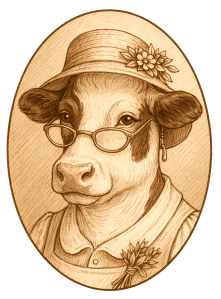
She is the sort who never forgets the squirrels and chipmunks either, setting out a little something for them well away from the house. These are not grand gestures, Myrtle Mae says, just the ordinary kind of care that keeps a place feeling lived in and looked after. It is the kind of Farm & Home wisdom that never asks for credit, and here at the Gazette, we have learned that those are often the things most worth passing along.

In the end, winter does not demand much of us. It asks only that we slow down enough to notice — the drift of wood smoke at dusk, the far-off sound of a train finding its way thru the hollers, a flash of red against the snow, the quiet stories written overnight in tracks, the calm of the woods when snow glistens and light rests gently on the ground.

These are the kinds of things that never make headlines — but somehow matter most. They have a way of steadying a season, and the people moving thru it, reminding us where we are and what matters still, if we merely take the time to look and listen.

Thanks for walking along with me for a while. Safe steps until next time.

— Jim  (and Red!)

And before you go — a small note from the Gazette.

Something new is nearly ready here, and we will share a first look this Saturday, January 17th. It will be the last quiet preview before The Hearth & Holler Gazette officially opens its doors the following week.

P.S. from Little Red Bear — Red would like it noted that he has been noticing winter too — mostly from indoors, with a warming cup of tea and hot biscuit drenched with honey nearby, which he feels is the sensible approach, after all.
 

Once A Week, and Close To Home

How a paper told you what happened — and reminded you who lived nearby

There was a time when the paper did not arrive every morning.

It came once a week — sometimes folded neatly, sometimes creased and softened by many hands — and it usually ended up on the kitchen table, beside a coffee cup or under a pair of reading glasses. You did not rush through it. There was no need to. It would still be there after supper, and often the next day, and sometimes the day after that alongside the easy chair or rocker.

Before you reached the end of the first page, you had already seen names you knew.

Someone had a new baby. Someone else was celebrating a long-awaited anniversary. There would be a church supper on Saturday, a school program midweek, and a notice about a lost dog that everyone hoped would turn up before the next issue came out. Someone’s daughter had been mentioned for her playing at the spring recital, and the high school team had won on Friday night. And sometimes — quietly, respectfully — there would be a name you recognized for a different reason, and the house would grow a little still as you read.

Those small-town papers were not trying to impress anyone.

They did not shout. They did not hurry. They did not pretend that every day was historic. What they did, instead, was tell people what mattered right here — the kind of news that lived just down the road, in their own streets, their own schools, and their own kitchens. Who needed help, who was being celebrated, who would be missed, and what the coming days might hold. News and events close enough to touch, and familiar enough to care about.

They gave ordinary lives a place to be seen.

A person did not have to be famous to appear in print. You only had to belong. A spelling-bee ribbon, a new porch, a good harvest, a bad winter — all of it counted. The paper did something quiet but important: it slowed time just enough for people to recognize one another and remember that they belonged to the same place.

Somewhere along the way, those kinds of papers grew thinner — or quieter — or disappeared altogether.

It did not happen all at once, and it did not come with ceremony. One week there was a paper, and then one week there wasn’t. Or there was one, but it felt different. Faster. Louder. Less familiar. And without anyone quite meaning for it to happen, a small and steady way of keeping track of one another slipped out of reach.

This winter, I found myself missing that kind of paper.

Not the headlines — but the notices. Not the urgency — but the presence. Not the noise — but the quiet. Not the crowd — but the community.

The kind of paper that does not hurry, does not shout, and does not forget the small things. The kind that assumes you will sit with it awhile, maybe pass it across the table, maybe read a bit aloud.

So, missing all that, I decided to create one.

Not to recreate the past exactly — but to borrow its patience. To gather stories the way they used to be gathered. To leave room for observations, oddments, wanderings, and the sorts of things that never make headlines but somehow make up a life.

There are always stories circulating around a town, after all — if someone is willing to go looking for them. Some are found by a roving squirrel reporter with a knack for being in the wrong place at the right time. Others are sniffed out by a good-natured news hound who never missed the scent of a good story.

If this feels familiar, that is no accident.

Some things were worth keeping. And we’re in Little Red Bear’s “Honey Hill Country,” after all.

— Jim  (and Red!)

In the days ahead, I will be sharing more of the people and small happenings that make a paper like this feel alive — the kinds of names and notices that once filled the margins and gave a town its own sense of place and to know itself a little better.

There’s more to come — not all at once, and not in a hurry.

P.S. from Little Red Bear —
Little Red Bear says if a paper feels close to home, it probably is. It tells you what happened and reminds you who lives nearby.

Pen-and-ink illustrations created with the assistance of AI and lovingly styled for Little Red Bear Land.

A Year’s Worth of Little Good Things

As the year begins to slow down and we edge closer to Christmas, I have found myself thinking less about what was accomplished and more about what quietly mattered — the small moments, the kindnesses that did not make headlines but made days a little better.

A few evenings ago, Little Red Bear asked if he might stop by the Writing Pages for a few minutes to share some of the things that stayed with him this year. Not the grand events, but the everyday goodness he noticed along the way. I was glad to say yes — and this is his note.

Continue reading

Meet Clara Thimblewick — A Holiday Note from Little Red Bear Land

From the Winter Desk of Clara Thimblewick

INTRODUCTION —

As we make our way through this busy December stretch, I thought it might be nice to pause for just a moment and share a quiet word from someone new in our Honey Hill world — someone many of you first met a few days ago in “The Lantern in Clara Thimblewick’s Window.”

Clara Thimblewick will soon be stepping into an important role in our community. Beginning in January, she will serve as the Editor of The Hearth & Holler Gazette, guiding our weekly wanderings through Honey Hill, Hopper’s Holler, Round Corners, and beyond with a steady hand and a thoughtful eye.

After spending much of her life working in newspapers back East, Clara has returned to Missouri to take up this new post and, in her words, “to resume a more measured life than present-day city rhythms permit.”

As a small seasonal greeting — and an early chance to become acquainted — Clara wished to offer a brief message to readers here on The Writing Pages. I am delighted to share her note with you today.

A Holiday Note from Clara Thimblewick —

It is my hope that this message finds you in a moment of quiet, however small such moments may be in December. The soft light of winter has a way of inviting reflection, even in the midst of the season’s many demands, and I am grateful for the opportunity to address you for the first time.

Although my name may be unfamiliar to you at present, please allow me to offer a brief introduction. I was raised in Missouri during childhood, later sent East for my schooling, and remained there for many years while building a career in the newspapers. I have now returned home to serve as Editor of The Hearth & Holler Gazette, a responsibility I accept with both humility and resolve. It is my intention to honor the stories of this community with clarity, fairness, and respect.

There is much work ahead as we prepare the Gazette for its January debut. New ventures often bring with them a quiet sense of anticipation, and I feel it very keenly. In time, I hope to become a familiar presence in your weekly reading — not by insistence, but by steady and conscientious service.

For now, I simply wish to extend to you my warmest regard during this winter season. May the quieter hours be gentle company to you and may the small lights along your path — a lamp in a window, a friendly word, a simple kindness — bring you a measure of comfort as the year draws to its close.

With sincere respect,
Clara Thimblewick 
Editor, “The Hearth & Holler Gazette” 


CLOSING THOUGHTS —

I hope Clara’s note brought a touch of calm to your day. She will be joining us more regularly once the Gazette begins its weekly visits in January, and I am looking forward to the steady presence she will bring to our little corner of Honey Hill Country.

Thank you for reading and settin’ a spell with us today.

— Jim (and Red!)

If you would enjoy a weekly visit to Little Red Bear’s Honey Hill Country, you are already in the right place. A simple subscription to The Writing Pages is all that is required. Beginning in January, the Hearth & Holler Gazette will arrive automatically each week, bringing a small slice of Honey Hill Country to your doorstep.


P.S. from Little Red Bear — “Clara is too polite to say it, but I am not — you ought to sign up for the Gazette. Good things are on the way, and I would hate for you to miss out.”