Things Worth Noticing in Winter

Winter has a way of slowing the world just enough for a person to notice things that usually pass unseen. Not the grand sort of things — nothing you would mark on a calendar or read about in the paper — but the smaller, steadier ones that tend to show up when days grow shorter and folks move a little more deliberately. It is a season that rewards paying attention. If you step outside and stand still for a moment, you may discover there is more going on than the quiet first suggests.

One of the first things one notices is wood smoke. It drifts low and unhurried, slipping between houses and along fence lines, carrying with it the sense that someone, somewhere, has settled in for the evening. It does not announce itself so much as it reassures you. Fires have been laid, kettles set on, and the day has found a comfortable place to rest. On winter nights, that smell lingers, as if the air itself has decided to hold onto it just a little longer.

On certain evenings, when the air lies heavy and keeps every sound close, there is something else worth listening for. Long before you ever see it, you may hear the train. At first it is only a low rumble — so far off you might take it for weather, or wind working its way slowly thru the hollers. But if you stand still and listen, it keeps coming. Minutes pass and the sound gathers itself as it travels, rounding distant bends, slipping along the lay of the land, growing clearer without ever seeming in a hurry. Folks who live within reach of the tracks come to know this kind of listening. It is not something you rush toward. You let it come to you — steel and motion carried on cold air, mingling with the smell of wood smoke — until, for a little while on a quiet winter night, you are reminded that even in the stillness, the world is finding its way along.

By morning, the snow has stories of its own to tell. Tracks crisscross yards and paths where wandering critters passed thru while most folks were asleep. Small prints hop and pause, then disappear beneath hedges or brush piles. Others wander more boldly, heading straight across open ground as if nothing in the world had reason to hurry them along. From the tracks, it looks like a porcupine left them for us to discover. But one does not need to know exactly who made the tracks to appreciate them. It is enough to know that life moved along quietly thru the night, leaving behind just enough evidence to be noticed.

Daylight brings its own set of noticings. Winter birds seem to understand the season better than most, wearing their colors proudly against the pale background. A bright red cardinal perched on a snow-dusted evergreen looks as if it was placed there on purpose, perhaps waiting for an artist with their paints and canvas passing by. Chickadees move quickly, darting and bobbing, as if they have errands to run and very little time to waste. Many folks keep watch for the dark-eyed juncos — the little “snowbirds” that seem to arrive right on cue — hopping and skittering along the ground and fence lines. And then there are the red-bellied woodpeckers, working steadily up and down bare trunks, tapping out a rhythm that feels as much a part of winter as breath in cold air.

There is a different kind of noticing that comes with taking a walk thru the woods on a snowy late afternoon. Sound is deadened as it seems to settle into the ground, and you find your own footsteps feel as though they belong there.

Light behaves differently then — sunlight catching the snow in one moment, moonlight taking its turn not long after — each making the world glisten in its own way. It is the sort of stillness that does not ask anything of you. You walk, you look, you breathe, and for a little while the quiet feels complete, as if nothing is missing at all. And, just for the moment, it is as if all the world is at peace.

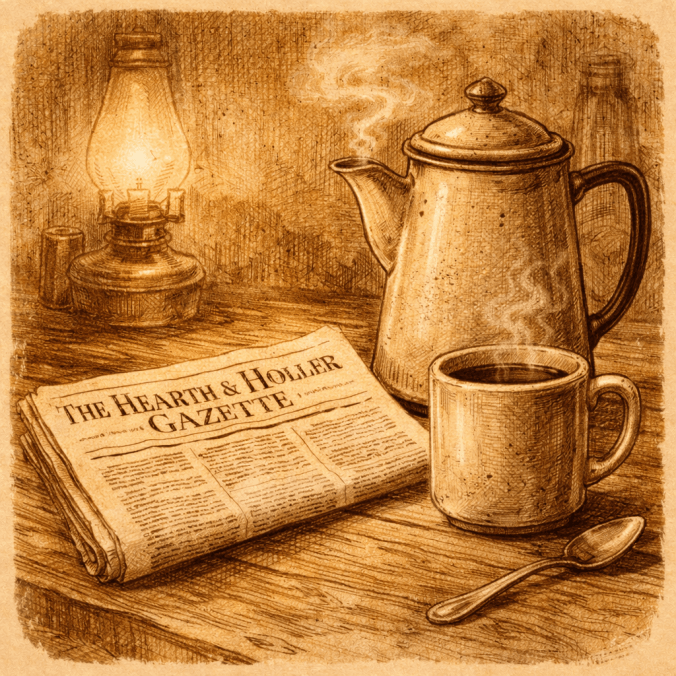
Myrtle Mae Meadowbloom, our Farm & Home editor for the “Hearth & Holler Gazette” coming soon, reminds us that winter noticing often comes with small responsibilities of its own. Birds need full feeders when the ground stays hard, and fresh water matters even more than seed when everything else is frozen solid. A shallow pan set out and checked often can make all the difference.

She is the sort who never forgets the squirrels and chipmunks either, setting out a little something for them well away from the house. These are not grand gestures, Myrtle Mae says, just the ordinary kind of care that keeps a place feeling lived in and looked after. It is the kind of Farm & Home wisdom that never asks for credit, and here at the Gazette, we have learned that those are often the things most worth passing along.

In the end, winter does not demand much of us. It asks only that we slow down enough to notice — the drift of wood smoke at dusk, the far-off sound of a train finding its way thru the hollers, a flash of red against the snow, the quiet stories written overnight in tracks, the calm of the woods when snow glistens and light rests gently on the ground.

These are the kinds of things that never make headlines — but somehow matter most. They have a way of steadying a season, and the people moving thru it, reminding us where we are and what matters still, if we merely take the time to look and listen.

Thanks for walking along with me for a while. Safe steps until next time.

— Jim  (and Red!)

And before you go — a small note from the Gazette.

Something new is nearly ready here, and we will share a first look this Saturday, January 17th. It will be the last quiet preview before The Hearth & Holler Gazette officially opens its doors the following week.

P.S. from Little Red Bear — Red would like it noted that he has been noticing winter too — mostly from indoors, with a warming cup of tea and hot biscuit drenched with honey nearby, which he feels is the sensible approach, after all.


A Fresh Stack of Mornings

A quiet New Year arrives in Honey Hill Country, bringing stillness, reflection, and the promise of days yet to be read.

The New Year has come quietly to Honey Hill Country.

A cold winter morning has settled in. Snow lies clean and unbroken beneath the trees, save for a line of rabbit tracks stitching their way across the yard and disappearing into the brush. Frost rests easy on the fence rails, and the woods hold the kind of silence that only follows a good snowfall — deep, listening, and kind.

No fanfare, no fuss — just the slow turning of the calendar page, with a fresh stack of new mornings waiting to be opened on the kitchen table. The old year folded itself away politely, and the new one stepped in like a neighbour removing their hat at the door.

Out here, the year always begins the same way — with a pause.

There is time to look back at what was carried, what was learned, and what, perhaps, is ready to be set down. There is time to stand a moment longer at the window and consider what might yet come walking up the lane. And there is time — always time — to say, You Are Welcome Here.

Honey Hill Country remains much as you left it — and Little Red Bear is still right where he has always been.

The paths are familiar. The front porches are swept. The kettle is warm — Little Red Bear is keeping it so. Your choice, coffee or tea. Fresh biscuits, always. The stories continue — some by the fire, some on the page, and some quietly, heart to heart.

As the new year unfolds, there will be small kindnesses, ordinary miracles, and a few good surprises tucked between the days. There will be laughter that arrives unannounced. There will be reflections that linger. And there will be new rhythms settling gently into place, one week at a time.

Later this month, something long-planned and much-loved will find its way into the light — The Hearth & Holler Gazette, a weekly visit of tales, tidings, and old-time country comfort, shared from Little Red Bear’s corner of Honey Hill Country and meant to be read slowly, like the morning paper at the table.

But for now, there is no rush.

This first week of January is for standing still just long enough to take a breath, to look around, and to remember that beginnings do not need to be loud to be meaningful.

So welcome — to the New Year, to Little Red Bear’s Honey Hill Country, and to whatever good may yet come.

The gate is open. The light is on.
Come in when you are ready.

— Jim  (and Red!)

“A new year does not ask us to be different people,”
Clara Thimblewick once wrote,
“only to listen a little more closely to the better parts of ourselves.”

Pen-and-ink illustrations created with the assistance of AI and lovingly styled for Little Red Bear Land.

Critter Tales — “The Fence Post Carrot”

From the critters near home . . . to the wildlands beyond.

Critter Tales are small, gentle stories — meant to be read in a few quiet minutes, enjoyed with a smile, and written and shared simply for the fun of it.

The two brothers were not looking for anything in particular that afternoon.

They were doing what bunny brothers often do on mild days — wandering along the roadside, stopping now and then to inspect a pebble, a bent leaf, or a place where something interesting might have happened earlier and could possibly happen again.

That was when the younger brother stopped so suddenly the older one nearly walked straight into him.

They both stared.

Lying just off the road, half in the grass and half in the dust, was a carrot.

Not a carrot carrot.

A carrot the size of a fence post.

It was long and thick and sun-warmed, its orange skin dulled with soil, its green top snapped short as if it had once belonged to a wagonload of respectable vegetables that had not expected to lose a member along the way.

The brothers walked slowly around it.

They stood beside it.

They placed a paw on it, just to be sure.

“It’s real,” said the younger one.

“It’s ours,” said the older one, immediately and with confidence.

The only problem was getting it home.

They tried first to drag it.

They braced their feet, leaned back, and pulled with all the seriousness such a carrot deserved. The carrot did not move. It merely sat there, unimpressed and unmoved, as though it had been waiting for this moment and was quite prepared to wait longer.

They tried lifting one end.

That end rose exactly as far as the other end sank, and the carrot pivoted neatly back into place, landing with a thump that rattled their paws.

They rested, catching their breath.

“Maybe if we roll it,” said the younger brother.

This seemed reasonable.

The carrot was round, after all. Mostly.

They pushed.

The carrot rolled.

Not forward.

It rolled sideways, drifting lazily toward the road, as though it had somewhere else to be.

They scrambled to stop it, wrestling it back into the grass before it could embarrass them in front of any passing wagons.

They tried again, this time from the other side.

The carrot rolled the opposite direction, wobbling, curving, and clearly unwilling to be guided in a straight line.

“It doesn’t listen,” the younger brother said.

“It’s shaped wrong,” said the older one.

They studied it closely then — the thick top, the narrowing point, the subtle curve that promised cooperation and delivered betrayal.

They attempted to lever it with a stick.

The stick snapped.

They attempted to roll it while running alongside, paws scrambling, ears flapping.

The carrot rolled faster than expected, slower than hoped, and then gently pinned them both in the grass until they agreed to let go.

Eventually, they sat down beside it.

The afternoon was quiet. A breeze stirred the grass. The carrot lay peacefully between them, as though nothing at all had happened.

Their house sat below them on the hillside — not far, really, when one looked at it that way.

The younger brother tilted his head.

“What if,” he said slowly, “we don’t take it up to the house?”

The older brother followed his gaze.

The hill sloped gently downward, straight toward their front wall.

They looked at the carrot.

They looked at the hill.

They smiled.

Getting it started was easy.

Stopping it was not.

The carrot tipped, rolled, hesitated, and then gathered confidence, wobbling its way downhill with growing enthusiasm. It veered left. It corrected. It veered right. The brothers ran alongside, shouting helpful suggestions that the carrot ignored entirely.

The curve took over.

The carrot picked its own path.

The brothers watched, helpless and hopeful, as it rolled faster, straighter, and with increasing purpose — directly toward their house.

There was a sound.

A solid, unmistakable WHUMP against the wall.

Silence followed.

Then the front door flew open.

Their mother rushed out, apron askew, eyes wide — ready for disaster.

She stopped.

She stared.

Leaning neatly against the wall, as if it had always belonged there, was a carrot the size of a fence post.

The brothers stood very still.

Then their mother laughed.

She laughed the way one does when something is too unexpected to be annoying and too useful to be ignored.

“Well,” she said happily, “that’s carrot soup for a month.”

The brothers sat down in the grass, dusty and pleased.

The carrot did not move again.

It had arrived.

Pen-and-ink illustrations created with the assistance of AI and lovingly styled for Little Red Bear Land.

Why do I write these? Aw, I don’t know. Just thought it might make you smile.

You’re Welcome Here

Some Sundays end the way they should.

A good meal. Plates pushed back. Folks sitting around a little longer than planned. Nobody watching the clock. The talk wandering from one thing to the next, easy and unimportant in the best way. Somebody pours another cup of coffee or tea. Slices of pumpkin and pecan pies are served. Or maybe a slice of cake. Or two. And no one says much about it.

Those moments matter more than we sometimes realize at the time.

Continue reading

Introducing “The Hearth & Holler Gazette”

A Small-Town Paper from Little Red Bear’s Honey Hill Country

Before we get too far along, there is one small thing I would like to settle right from the start.

These days, the moment someone hears the words “weekly” and “email,” a little voice pipes up:

Oh no… not JAN.

Just Another Newsletter.

You know the kind.
Crowded inbox. Loud subject lines. Endless self-promotion.
More noise than nourishment.

And if that is what The Hearth & Holler Gazette were going to be — I would not blame you one bit for steering clear.

But here is the thing —
This is not JAN. Not even close.

The Gazette is not a newsletter.
There will be no book pitches.
No launch announcements.
No character reveals dropped like bait.
No “Pre-order Now!” or “Don’t forget to buy!” reminders elbowing their way into your morning.

Instead, think of it this way —

The Hearth & Holler Gazette is a fictional small-town paper, delivered once a week on Saturday mornings, the way such things used to be — its pages set in the early years of the twentieth century, beginning in January of 1904.

A place for:

  • Short Stories and Sketches
  • Bits of Humour
  • Kind News
  • Happenings and Events from Little Red Bear’s Honey Hill Country
  • Old-fashioned Advertisements that Exist Only for the Smile
  • And the sort of Gentle Company you might enjoy with a cup of coffee while the house is still quiet

It exists for one reason only —

To offer a pause.
A smile.
A little warmth.

That is the why.
Everything else grows from that.

One might think of The Hearth & Holler Gazette as something closer to Garrison Keillor’s Prairie Home Companion
without the live music, and without needing to go buy a radio.

A familiar voice.
A small town and folks you come to know.
Stories and observations that take their time, and trust you to do the same.

Or perhaps it brings to mind Charles Osgood’s quiet pieces — the kind that never shouted for attention, yet somehow always earned it.

If you ever found comfort in evenings spent with The Andy Griffith Show, The Waltons, or Little House on the Prairie, then you already understand the spirit at work here.

Not because those stories ignored the wider world —
but because, for a little while, they set a different table.

That is the neighbourhood the Gazette hopes to live in.

Continue reading

A Year’s Worth of Little Good Things

As the year begins to slow down and we edge closer to Christmas, I have found myself thinking less about what was accomplished and more about what quietly mattered — the small moments, the kindnesses that did not make headlines but made days a little better.

A few evenings ago, Little Red Bear asked if he might stop by the Writing Pages for a few minutes to share some of the things that stayed with him this year. Not the grand events, but the everyday goodness he noticed along the way. I was glad to say yes — and this is his note.

Continue reading