Endangered Species Day

Today is “Endangered Species Day”, a day set aside by Congress to bring awareness and attention to the plight of endangered, fragile and threatened species.  Folks of all ages can and are encouraged to learn more about the importance of protecting imperiled species and what they can do through their own actions to help.

For more information and links, please visit The Endangered Species Site.

Here are two other links for great information–

From the Park Advocate Site — Nine Endangered National Park Animals.

Black-footed Ferret in a Colorado conservation center. Photo by U.S. Fish and Wildlife Service.

Black-footed Ferret in a Colorado conservation center. Photo by U.S. Fish and Wildlife Service.

From the wonderful folks at BirdNote, a discussion of Piping Plovers and Golden-cheeked Warblers– BirdNote.

Golden-cheeked Warbler, via BirdNote, photo by Greg Lavaty

Golden-cheeked Warbler, via BirdNote, photo by Greg Lavaty

Please learn more and contact your elected representatives to help support the wildlife and plants struggling so hard to survive faced with oppressive habitat loss, climate change, illegal poaching and other dangers.  And please get the children involved, as it is their future we are talking about, as well.

Thanks as always for stopping by!  — Jim (and Red!)

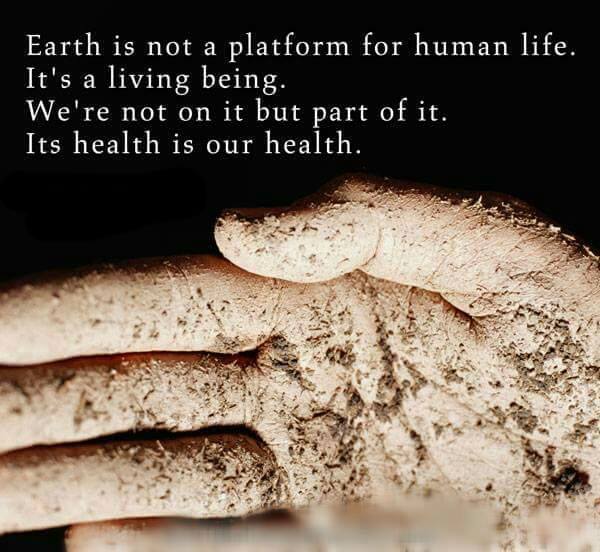
We Are Part of Mother Earth!

Whoever was the first to coin the term “dominant species on the planet” should have also spent more time addressing the responsibility that comes with that assumption.  We need to do better, for the sake of all species and the Earth, not just ourselves.

“Forest, Soil, Water, and Wildlife are mutually interdependent, and the ruin of one element will mean, in the end, the ruin of them all.”

~ Peter Matthiessen, “Wildlife in America” (1959)

Quote- Ecology - Earth

Native Plants for Birds & Wildlife

Getting ready to start work on the garden and yard work soon?  Please consider using and decorating with plants, trees and wildflowers native to your geographical region.  Here’s why it is so important– the birds and animals in your area have adapted to native plants over thousands of years and are dependent on them.  Overrunning the landscape with non-native plants, trees and ornamentals can seriously impact the native wildlife’s food chain and resources.

“Because native insects did not evolve with nonnative plants, most of them lack the ability to overcome the plants’ chemical defenses so cannot eat them. Caterpillars, a particularly important food source for birds, are especially picky about what they feed on. Like the famous monarch butterfly larva, which must have milkweed to survive, more than 90 percent of moth and butterfly caterpillars eat only particular native plants or groups of plants.”

— Laura Tangley, National Wildlife Federation article.

And of course, the birds feed on the insects feeding on the plants.  Not only are the insects directly affected, but the pollinators and those that feed on the insects as well, right up the food chain. As more and more imported varieties and ornamentals crowd out native plants, the birds, pollinators and wildlife have an increasingly difficult time. That plant at the nursery might be pretty, but is there another native to the area that might work just as well or better? Check it out.  The birds and wildlife will thank you for it!

For more information and to read the article in entirety → “Chickadees Show Why Birds Need Native Trees”

Thanks as always for reading.    — Jim (and Red!)

Birds- Chickadee, Carolina Chickadee via National Wildlife Federation FB, photo by Doug Tallamy

Carolina Chickadee via the National Wildlife Federation. Photo by Doug Tallamy.

Old-fashioned, Family-friendly Stories and Fun for All Ages and Fitness Levels!
Join us for an Adventure in the beautiful Ozarks Mountain Country!

“The Adventures of Little Red Bear” Goes Out for Review!

Breaking News!  Stop the presses!

We interrupt your Monday morning reading for a breaking news story.

Huzzah and Hip Hooray!  After a solid and non-stop writing push for the past several weeks to finish, the first collection of Short Stories in the “Adventures of Little Red Bear” series went out for review and beta reads yesterday afternoon!  Happy Days!

You haven’t been to a hootenanny until you’ve seen a bear Texas Two-steppin’ across the floor and dancing to “Cotton-Eyed Joe!”   Yee-Haw!    As soon as I uttered the magical words of “That’s a wrap, folks!” – somebody switched on the music followed immediately by critters and story characters rushing to the dance floor in all directions.   The dance party lasted til the wee hours of the morning and Little Red Bear is still going strong kicking up his heels around the place.

While awaiting feedback the next step is to get busy on a cover design.  Hopefully, it won’t be long until the first collection is available for release.

We now return you to regularly scheduled programming.  Please stay tuned to this station for more updates! —  Jim (and Red!)

News Reporter Snoopy

News Reporter Snoopy

First Annual Report for the Blog– “2014 In Review”

The WordPress.com folks, who host my blog site, prepared a 2014 Annual Activity Report for this blog.

Bear Waiting for the Activity Report

“Here it comes.” — Waiting for the Activity Report (Photo credit- Ron Niebrugge, Wild Nature Images)

Here’s an excerpt:

“A San Francisco cable car holds 60 people. This blog was viewed about 2,800 times in 2014. If it were a cable car, it would take about 45 trips to carry that many people.  This blog featured 51 new posts and was visited by readers in 67 countries in 2014, with the United States leading the way, and the United Kingdom, Italy, Ireland, Australia and Brazil close behind.”


"Little Red Bear"-- Pleased as Punch!  (Photo credit- by Wildlife Photographer Marina Cano)

“Little Red Bear”– Pleased as Punch!
(Photo credit- by Wildlife Photographer Marina Cano)

This blog began as a way to share creative works and writings in May, 2014.  With that in mind, and considering most days I am still figuring out step by step what I am doing in the social media and tech world, and that the above report reflects activity starting from ground zero for only a little more than half a year, I am very happy with that.  Or, as my good friend Siobhan Daiko would say- I am “really chuffed!”

Special thanks to Siobhan Daiko , Lesley Sky, Kim Gosselin, Frank Clark and Adele Wilson for being top commenters in the year, to Sylva Fae’s “Sylvanian Ramblings Blog” for being one of the top referral sites right behind Twitter and Facebook, and to the wonderful artist Christine Southworth of “Bear Prints Studio” who provided original artwork for my primary blog image– “Milson, the Steampunk Bear“, top right.  And another special thank you to Matthew Milson, my author son, who pushed me into starting the blog in the first place.

Bear Hugs!   Perfect in all Sizes!

Bear Hugs! Perfect in all Sizes!

And a big Bear Hug and Thank You to all who have visited and continue to follow along.  Your support and encouragement is what keeps it all going.  Onward now to an exciting New Year, featuring many new creations, writings and the upcoming release of the first collection of “Little Red Bear” stories.

We’re off to a great start.  Let’s keep it rolling! — Jim (and Red!)

"Little Red Bear"-- Story Research in a Tree

“Little Red Bear”– Story Research in a Tree (Photo courtesy of National Geographic)


“Howdy!” (Or- How I Spent My Weekend)

“Howdy!”

That is how a new story character introduced himself to me on Friday morning. Out of nowhere, he just popped into my head with a loud “Howdy!” It has been an interesting, and exciting, weekend.

Red and I already have more story characters lined up for his upcoming “Adventures of Little Red Bear” short stories than we can probably squeeze into three or four collections. Nevertheless, in popped another one on Friday. He and Red hit it right off. I do declare, Little Red Bear collects new story characters and companions faster than a hound dog walking thru a flea patch.
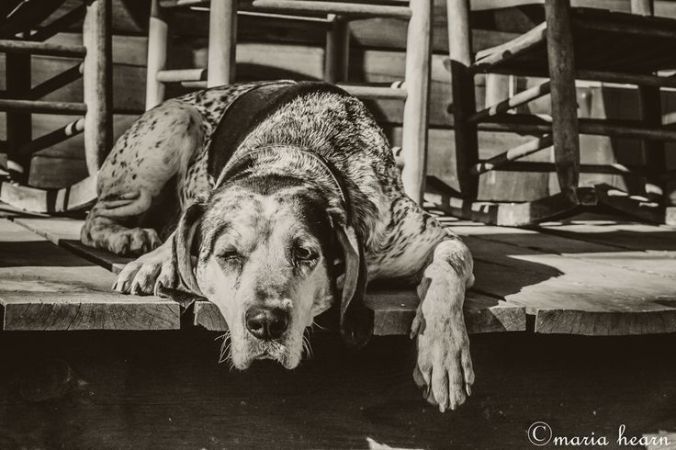
 Old Hound Dog (by Maria Hearn)

Old Hound Dog (by Maria Hearn)

It’s a struggle to keep up with them all, to be honest. And suddenly on Friday—here came another one into my head, totally uninvited. “Howdy!” But that was pretty much it. For Friday anyway. He just popped in, introduced himself and went to spend time with Little Red Bear. I didn’t learn any more from him that day. Just the “Howdy!” Hearing it over and over again.

Early Saturday morning was spent catching up on odds and ends for the week, and by late morning it was so beautiful outside I decided to go walkabout for a while, to get some fresh air and exercise.

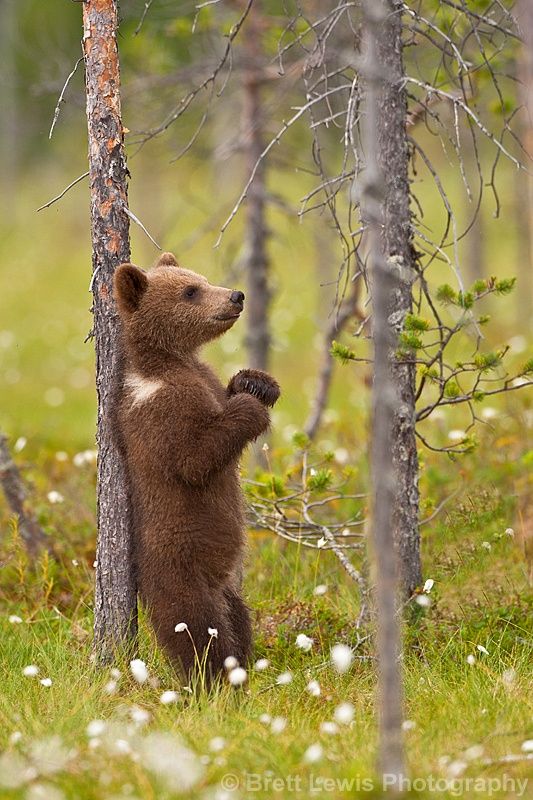
Bear Scratching Against a Tree (by Brett Lewis Photography)

Bear Scratching Against a Tree (by Brett Lewis Photography)

Two blocks from home while checking out dropped walnuts on the ground from an old Black Walnut tree up on the hill, the quiet was broken once again with a loud “Howdy!” in my head. I suppose he had talked Red’s arm off the night before, and now it was to be my turn.

The further I walked the more he talked. On and on, revealing his story to me. He continued talking thru Saturday night, was in my head when I woke up Sunday morning, and continued on thru the day. I have been listening to this little guy all weekend! Turned out, he is a Burrowing Owl.

Burrowing Owl- Sneaking A Peek

Burrowing Owl- Sneaking A Peek

We usually don’t give this much away about upcoming story characters, but this fellow is special, caught us totally by surprise and immediately stole our hearts. So much so, that Red and I are even reworking some things to move his introduction up into the first collection of stories, already nearing completion. I am so excited about him it’s hard not to just tell you all about him right now. But that would spoil all the fun.

Regardless, I can let you know that he is a Burrowing Owl from way out west in the Oklahoma Panhandle with quite a story to tell. Burrowing Owls inhabit grasslands, rangelands, agricultural areas and other open, dry areas with low vegetation. From their name, they live in a hole in the ground, not up in a tree like other owls. Although capable and willing to dig their own burrows, more frequently they inhabit existing holes abandoned by prairie dogs, skunks, armadillos, tortoises and the like.
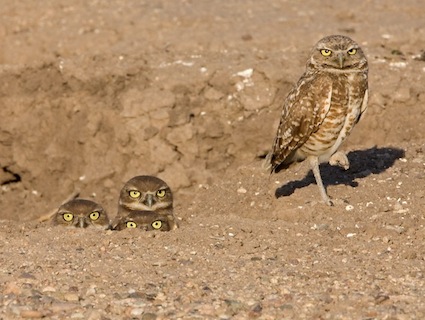
 Burrowing Owls via Cornell Lab of Ornithology (© Ned Harris, AZ, Tucson, June 2009)

Burrowing Owls via Cornell Lab of Ornithology (© Ned Harris, AZ, Tucson, June 2009)

Unlike most owls, Burrowing Owls are active during the day, although wisely avoiding the midday heat. But like most owls, they do most of their hunting between the hours of dusk to dawn, taking advantage of their superior night vision and hearing. So they do not sleep a lot, which may go a long way towards explaining his extended chattiness all weekend.

Living in open grasslands as opposed to forests, Burrowing Owls have long legs and short tails which allow them to sprint very quickly across the ground in pursuit of prey. They are small in size, about 11” long, a little larger than an American Robin when fully grown. When agitated, they bob their head up and down, revealing a white chin patch. But I cannot imagine this sweet little guy ever being agitated or angry.
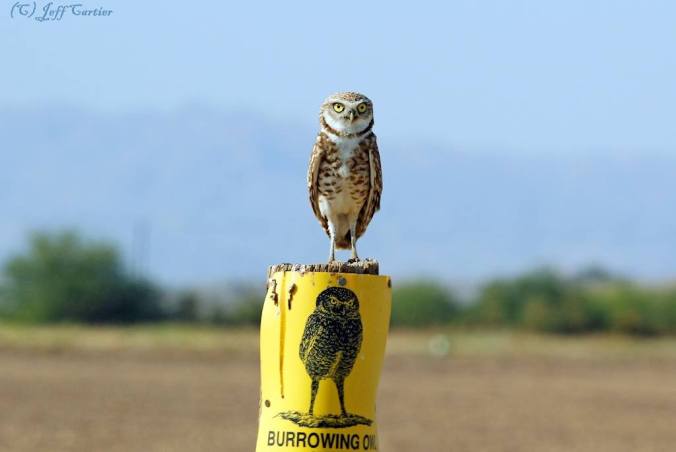
Burrowing Owl in California on top of Burrowing Owl Sign Post (by Jeff Cartier of Ventura, CA)

Burrowing Owl in California on top of Burrowing Owl Sign Post (by Jeff Cartier of Ventura, CA)

Burrowing Owls have no ear tufts, unlike many other owls. They feature prominent white eyebrow markings, and in color they are brownish, with lighter colored bars on the front and spots on the back.  They have noticeable bright yellow eyes.  No other owls are commonly seen on the ground or so frequently during daylight hours.  As with many birds and creatures, Burrowing Owls are threatened or endangered in some areas due to loss of habitat as more open nesting areas are plowed under for development and agriculture.

 Burrowing Owl, via Cornell Lab of Ornithology (© Bob Gunderson, CA, Antioch, May 2011)

Burrowing Owl, via Cornell Lab of Ornithology (© Bob Gunderson, CA, Antioch, May 2011)

This half-pint owl has captured our hearts and will be featured in the first “Adventures of Little Red Bear” short story collection available soon. Red and I just couldn’t wait to tell you at least a little about him, and are sure you will recognize him when he enters the stories.

“Howdy!”

As always, thanks for reading and have a great day! – Jim (and Red!)

Burrowing Owls Group, Southern Variety

Burrowing Owls Group, Southern Variety