A Short List of Things That Are Still Just Plain Good

There are days when the world feels a little too loud and a little too busy explaining itself.

On those days, it helps to remember that not everything needs fixing, debating, improving, or shouting about. Some things are already doing their job just fine. They have been for a long time. They simply carry on, quietly, without asking for applause.

So here — for no particular reason other than it felt like a good moment — is a short list of things that are still just plain good.

Not perfect.
Not flashy.
Just . . . . good.


A fresh cup of coffee that tastes exactly the way you hoped it would.
Not better than expected. Not worse. Just right. The kind that lets you take a slow sip and think . . . . “Yes. That’ll do.”

A handwritten note.
Even a short one. Even a crooked one. The kind where you can tell the writer paused for a moment before finishing the sentence.

A dog asleep in the sun.
No ambition. No agenda. Just fully committed to a relaxing nap in the afternoon.

A cat choosing to sit near you.
Not because it was asked. Because it decided. Which somehow makes it feel like a small honour.

A well-worn book that falls open to a favourite page.
Like it remembers where you left off last time — and waited there for you.

The sound of someone laughing in the next room.
Especially when you do not know the joke, and it does not matter.

The sound of children laughing and playing.
Inside or outside. Close by or down the street. It always reminds us that things are going right somewhere.

A front porch — or whatever serves as one.
A chair by a window counts. So does a stoop. A step. Or the edge of a bed where you linger for a moment longer than planned.

Kindness that does not announce itself.
No trumpet. No explanation. Just a small adjustment or touch made for someone else’s comfort.

Old sayings that still manage to be true.
The kind you used to roll your eyes at — until one day you catch yourself repeating them.

Something that works the way it always has.
A lamp. A watch. A sunrise. There is a quiet relief in reliability, and in knowing some things still arrive on time..

And for me, a rainy afternoon with a new story waiting to be told.
Nothing urgent. Nothing polished yet. Just the promise of words finding their way.

But then again . . . . the feeling that today does not need to be extraordinary to be worthwhile.
Ordinary will do just fine.


None of these things will trend.
None of them will fix everything.

But taken together, they do something better.

They remind us that simple goodness has not gone anywhere. It has simply stayed where it always was — in familiar places, doing familiar work, waiting to be noticed again.

And perhaps that is just plain good enough for today, isn’t it?

What might you add to the list?

‘Til next time, then — Jim  (and Red!)


P.S.
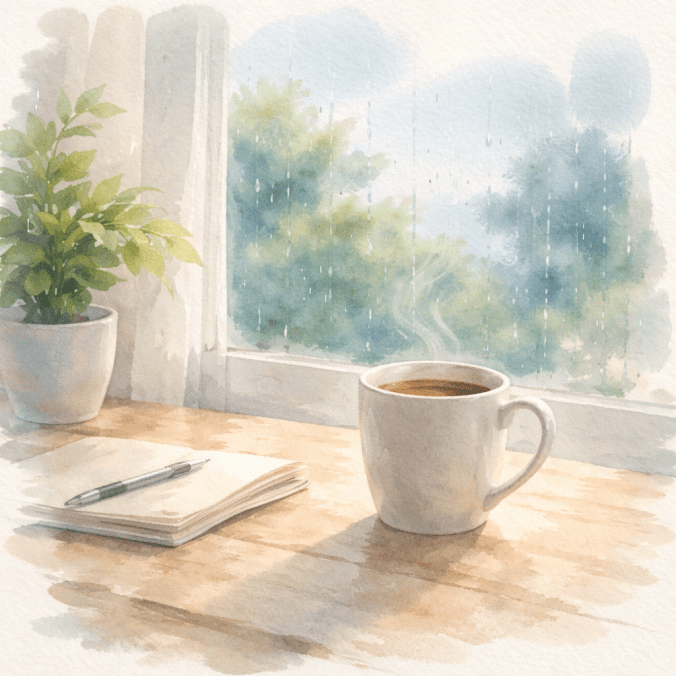
Little Red Bear read this list over my shoulder and cleared his throat — politely — to point out that tea belongs on any list of good things worth keeping close.
He is not wrong. We are, after all, tea people.

“The Adventures of Little Red Bear: The First Holler!”


These illustrations were created with the assistance of AI.
A Few Things That Still Hold

There are seasons when the world feels like it is shifting underfoot — not all at once, not dramatically, but just enough to make you question your balance.

Do you feel it, too?

Nothing has necessarily collapsed.
Nothing is clearly finished.
And yet, something feels . . . . less certain than it used to.

In moments like that, it can help to notice what has not moved.

Not as a declaration of hope.
Not as an argument against worry.
Just as a quiet inventory — the way one might check familiar landmarks after a fog rolls through.

A few things still hold.

Morning still arrives, even on the days when enthusiasm does not. Light shows up without asking how we slept or what we are carrying. It has a way of finding the edges of things — countertops, window frames, the rim of a coffee cup — and reminding us where we are.

Kindness still happens in small, almost forgettable ways. Someone pauses instead of pushing ahead. Someone listens longer than required. Someone does a thing they will never be thanked for. These moments rarely make noise, but they have not disappeared.

The body still knows how to breathe. Even when the mind is busy rehearsing worries or replaying conversations, the lungs keep doing their quiet work. In and out. Over and over. A small, faithful rhythm we do not have to manage.

Familiar routines still offer their shape. The same chair. The same walk. The same ordinary tasks that once felt dull and now feel oddly reassuring. There is comfort in doing something you have done before, even when the larger picture feels unsettled.

And beneath all of it, there is this —
You are still here.

That may sound obvious. It is not. Being here — present in the moment, trying, showing up in whatever way you can — counts for more than most of us give it credit for. Especially in times like these, don’t you think?

None of this fixes anything.
It is not meant to.

It is simply a reminder that not everything loosened at once. Some things stayed put. Some things kept their place. Some things are still doing exactly what they have always done.

If today feels heavy, that does not mean you are doing it wrong.
If you feel tired in ways sleep does not quite touch, you are not alone in that.
If all you can manage right now is to notice one small, steady thing — that may be enough. And we can do that, can’t we?

There will be time for decisions later.
There will be time for action, and clarity, and movement.

For now, it is alright to rest your attention on what still holds.

That is not giving up.
That is finding your footing.
And for now, that is enough.

‘Til next time.  — Jim  (and Red!)

(We’ll get back together here again on Saturday when the Gazette arrives. Hope to see you!)


If you’d like to receive these notes as they’re written, you’re welcome to follow along here.

These illustrations were created with the assistance of AI.

Lead the Way

Having come across a line the other day that stopped me in my tracks, I wanted to share it with you — not because it was clever, but because it was so clear.


“Don’t wait for other people to be loving, giving, compassionate, grateful, forgiving, generous, or friendly . . . lead the way!” — Steve Maraboli

That simple idea has a way of lingering.

So often, we wait.

We wait for the mood in the room to improve.
We wait for someone else to soften first.
We wait for the world to give us permission to be kind.

But kindness has never needed permission.

Being loving, generous, or compassionate is not something done after conditions improve. More often than not, it is the very thing that improves them.

Leading the way does not have to be loud.
It does not require a spotlight or a platform.

Sometimes it looks like:

  • offering patience when impatience would be easier
  • choosing gratitude when complaint feels tempting
  • being friendly without checking first to see if it will be returned

Small acts, yes — but small acts have a way of traveling farther than expected. Like ripples on water, they move outward quietly, reaching people and places we may never know about. And isn’t that a good thing?


There is a quiet power in deciding to go first.

First to Smile.
First to Forgive.
First to offer Grace.

In uncertain or heavy times, that choice matters even more — not because it fixes everything, but because it reminds us, and those around us, of who we still are —
that we are human, and that we care.

There is no way to know who needed to see that kindness today.
No way to measure the ripple it may have started.

And that is all right. What matters is simply that the kindness was offered.

The world does not change only through grand gestures. Sometimes it shifts because one person decided not to wait.

So if there is a question about what to do today, perhaps this is enough —

Be the Loving one.
Be the Generous one.
Be the Friendly one.

Lead the way.

Doesn’t that feel like a good place to begin — leading with Kindness?

‘Til next time.  — Jim  (and Red!)


If you’d like to receive these notes as they’re written, you’re welcome to follow along here.

These illustrations were created with the assistance of AI


Tuesday, After the Paper Arrived

A quiet word about Tuesdays, and the work they do here.

The morning after a paper comes out is usually quieter than the one before it.

The ink is already dry. The papers delivered where they were meant to go. A deep breath. A satisfying sigh after a job well done.

Somewhere, a cup of coffee has been poured and forgotten for a moment while a headline was read twice, or a paragraph lingered longer than expected. Or when someone paused for a laugh. Somewhere else, a paper has been folded and set aside, ready to be picked up again later in the day.

Life, as it turns out, keeps right on going.

There is something comforting in that.

That the world, for the most part, knows how to carry on.

On Saturday morning, the first issue of The Hearth & Holler Gazette arrived. And then Sunday came, and Monday followed close behind. And now here we are on Tuesday — the morning a little different and things settling again into their usual rhythm.

That is how these things are meant to work.

Once a week is enough for a newspaper. Once a week gives it room to breathe — room to notice, to remember, to arrive without knocking too loudly. It is not meant to rush or crowd the days around it. Or to demand center stage. It is meant to take its place and then let the rest of the week do what it always does in turn.

Tuesdays, for their part, will keep doing Tuesday things here.

They will keep returning us to the quieter work — kindness noticed in small places, moments of grace we almost missed, the steady presence of family, memory, and the natural world doing what it has always done, whether we are watching closely or not — and to the small, steady work of remaining hopeful and finding happiness within, even when the wider world seems determined that we not. These are the themes that have lived here a long while now, and they remain, unchanged by the arrival of anything new. That feels right, and as it should be, don’t you think?

A newspaper can come and go once a week, and still leave the lamp on. A story can be read and folded away, and still be there when needed again. Nothing more is required of it — or of us — than to show up, and carry on.

And so we do.

We will be here with The Hearth & Holler Gazette again on Saturday, and we hope you will be too.

— Jim (and Red!)

P.S. — Little Red Bear here.
I read through the “Hearth & Holler Gazette” twice on Saturday, but the second time I mostly just smiled and nodded like I already knew how it ended.

Pen-and-ink illustrations created with the assistance of AI and lovingly styled for Little Red Bear Land.


Something New Is on the Way

An invitation, quietly extended.

Over the past several weeks, I have mentioned a new project taking shape just over the hill — something written carefully, assembled slowly, and meant to be read at ease.

With the first issue now nearly ready to be set before you, it felt right to let the editor speak for herself.

🖋 A Note from Clara Thimblewick, Editor

For some time now, a small staff has been at work — gathering items of interest, setting type, sharing a pot of coffee, and preparing a paper meant to be read slowly and kept close at hand.

We have taken care to make it worthy of your time.

The Hearth & Holler Gazette was created for readers who still find pleasure in neighborly news, in small observations, and in stories that do not hurry you along.

It is not meant to be exhaustive.
It is not meant to be loud.
It is meant to feel familiar.

If you care to join us, we would be glad to have you.

The first issue will be set before you this Saturday.

— Clara Thimblewick, Editor

Before we close, one small thing for clarity.

The Hearth & Holler Gazette is a make-believe newspaper from a make-believe place in Little Red Bear’s Honey Hill Country, staffed by characters who do not exist anywhere outside these pages.

The things they practice, however, most certainly do.

Kindness.
Compassion.
Looking out for one another.
Stopping long enough to notice.

Those are as real as it gets — and what it is all about.

If this sounds like something you might enjoy, the first issue will be waiting for you this Saturday.

We hope you will join us.

— Jim  (and Red!)

A small note for new readers:
Receiving The Hearth & Holler Gazette is as simple as being registered for this blog. There is nothing more to do.

Why Small Stories Last

Why the Little Things Stay With Us

Small stories. Small moments. Small actions that reverberate through the years, often in ways we never fully realise at the time.

My own writing life — if one can call it that — began in the fourth grade, with a teacher named Mrs. Drew. I do not recall her first name, if I ever knew it at all. Back then, adults were simply Mr., Mrs., or Miss, and that seemed sufficient. (You need not bother doing the arithmetic — I am seventy-six.)

One afternoon near the end of the school day, Mrs. Drew propped a landscape painting against the blackboard for all of us to see. Our assignment was simple enough — write a short story inspired by the scene in the painting. It showed a family in a wagon, travelling along a dirt road that wound through woods and farmland, headed somewhere beyond the frame.

We began writing in class and were sent home to finish. A few days later, Mrs. Drew returned our papers, handing them back one by one. All except mine. Mine, she kept.

When she finally explained why, it was because she intended to read it aloud to the class. And when I eventually received it back, there at the top of the page were words I have never forgotten:

“A++      Jim — You will be a writer someday.”

I was painfully shy at the time. I did not know what to do with such encouragement. But I carried it with me — quietly, steadily — for the rest of my life.

There are moments like that — small at the time, almost unnoticed — that stay with us long after louder things have passed. They do not announce themselves. They do not demand attention. And yet, years later, they are often the ones we remember most clearly.

Perhaps it is because they arrive without agenda. Or because they involve people rather than events. Or because they ask nothing of us except that we notice.

Continue reading →