On Soil, Arrogance, and the Loss of Good Shoes
A struggle older than fences . . . .
Older than porches.
Older than the first confident step taken in good shoes.
It is the ancient feud.
Mud vs. Man.
And Mud remembers.

A struggle older than fences . . . .
Older than porches.
Older than the first confident step taken in good shoes.
It is the ancient feud.
Mud vs. Man.
And Mud remembers.

Welcome!
It is shaping up to be a lively week in Honey Hill Country, as March Madness Days begin in earnest and the Square fills once more with banners, brass, and bright expectation.
As always, The Hearth & Holler Gazette is a work of fiction set in a place that exists most clearly in the imagination — though from time to time it may resemble somewhere you have known. But for first time visitors, it may help to know where — and when — we are, and what I am talking about
The Hearth & Holler Gazette hails from Honey Hill Country, a small, rural corner of the Missouri Ozarks, as it might have been known in the year 1904 — a time of front porches and wagon roads, oil lamps and handwritten letters, when news traveled at a human pace, where animals and humans interact and live side-by-side, and a Saturday paper was meant to be read slowly, with coffee close at hand. This is not a paper of breaking news or loud headlines. It prefers instead to notice it — the small, human-sized moments that once filled a morning without asking much in return.
The Hearth & Holler Gazette is a work of fiction — a made-up paper from a made-up place, written in the spirit of an earlier time. Any resemblance to real towns, people, or events is entirely coincidental, though we do our best to make it feel otherwise.
This must be understood at the beginning — the towns, fields, and citizens described here exist only within these pages. With that firmly agreed, the small and ordinary wonders of the week may unfold as they will. That is the way of things here. That is all we need to know, and that ought to be enough.
With that understood, come along — the Square is lively, the rabbits are ready, and there is a place waiting along the rail.

March 1st has always been the first day of Spring for me.
Not astronomically. Not technically. Simply.
March, April, May — three months. One Season.
June, July, August — Summer.
September, October, November — Autumn.
December, January, February — Winter.
Four Seasons. Three equal months each. Clean. Understandable. No misunderstandings. No negotiating with it.
That calendar has served well for a very long time.
There was a time — and it does not seem so very far away — when the rest of life followed that same rhythm without effort.

February can feel long.
Not dramatic. Not tragic. Just . . . . long.
The trees are bare. The color has drained from the fields. The air moves a little slower.
And yet — there is motion.
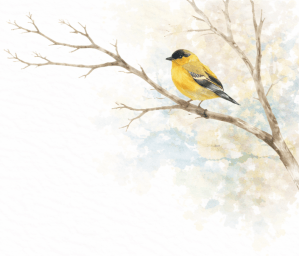
A flutter in the honey locust.
A finch on the ledge.
A woodpecker arriving like he owns the place.
February is National Bird Feeding Month.
And it is not only about enjoying the view.
It is about helping birds make it through winter — and preparing the ones who are about to arrive after journeys that stretch farther than we can easily imagine.

Welcome!
It’s been a week of preparation in Honey Hill Country.
As always, The Hearth & Holler Gazette is a work of fiction set in a place that exists most clearly in the imagination — though from time to time it may resemble somewhere you have known. But for first time visitors, it may help to know where — and when — we are, and what I am talking about
The Hearth & Holler Gazette hails from Honey Hill Country, a small, rural corner of the Missouri Ozarks, as it might have been known in the year 1904 — a time of front porches and wagon roads, oil lamps and handwritten letters, when news traveled at a human pace, and a Saturday paper was meant to be read slowly, with coffee close at hand. This is not a paper of breaking news or loud headlines. It prefers instead to notice it — the small, human-sized moments that once filled a morning without asking much in return.
The Hearth & Holler Gazette is a work of fiction — a made-up paper from a made-up place, written in the spirit of an earlier time. Any resemblance to real towns, people, or events is entirely coincidental, though we do our best to make it feel otherwise.
This must be understood at the beginning — the towns, fields, and citizens described here exist only within these pages. With that firmly agreed, the small and ordinary wonders of the week may unfold as they will. That is the way of things here. That is all we need to know, and that ought to be enough.
Winter loosens its hold by degrees. In St. Louis, great halls rise in anticipation of the Louisiana Purchase Exposition. Here at home, neighbors measure beams, set buckets beneath persistent drips, and begin planning how best to raise a roof before spring rains press their case.
Maple sap runs quietly. Rabbits consult schedules and polish sashes. Markets shift. Coin jars gather weight.
The county is not yet in motion — but it is readying itself.

On February 18, 1885, The Adventures of Huckleberry Finn was published.
More than a century later, the river is still moving.
I first read Tom Sawyer and Huckleberry Finn years ago — long before I understood what they were doing to me as a writer. Later came Life on the Mississippi, and more besides. At the time, I simply loved the stories. The raft. The sparks in the dark. The sound of the river settling back into itself.
Years later, walking through EPCOT at Walt Disney World, I wandered into a special exhibit of personal items belonging to Mark Twain. Behind glass sat a simple fountain pen he had once held in his own hand.
Not a monument.
Not a statue.
A pen.
I remember standing there, thinking about the ordinary act of writing — the scratch of nib against paper, the slow forming of sentences, the patience of revision. That pen had once rested between his fingers while he shaped rivers, boys, steamboats, sparks.
And I felt, in a very quiet way, connected.
There is a passage from Huckleberry Finn that has stayed with me all these years . . . .

“Once or twice of a night we would see a steamboat slipping along in the dark, and now and then she would belch a whole world of sparks up out of her chimbleys, and they would rain down in the river and look awful pretty; then she would turn a corner and her lights would wink out and her powwow shut off and leave the river still again; and by and by her waves would get to us, a long time after she was gone, and joggle the raft a bit, and after that you wouldn’t hear nothing for you couldn’t tell how long, except maybe frogs or something.”
It is not dramatic. It is not moralizing. It is simply noticing.
The sparks.
The bend in the river.
The long delay before the waves arrive.
There is something in that river passage that has followed me all these years — the way the sparks fall, the way the steamboat disappears around the bend, the way the waves arrive long after she is gone. Those gentle waves are still reaching me. Without my fully realizing it at the time, they found their way into Little Red Bear. He would not make a speech about it. He would simply watch the sparks, listen to the frogs, and notice how the raft rocks a little after the noise has faded. Red has always trusted the quiet aftermath more than the loud arrival. In many ways, I suspect that is where he was born — somewhere between Twain’s river and the stillness that follows.
Stories turn the bend.
The sparks fade.
The whistle grows faint.
The river grows still.
And years later, the waves arrive.
Some of them began their journey in February of 1885, though it would take many years before they reached a desk of my own. Some reached me standing in EPCOT, looking at a fountain pen once held in Mark Twain’s hand. And some are still arriving, rocking the raft just enough to remind me why I began writing in the first place.
If Little Red Bear ever feels steady beneath you, if his voice ever sounds like it trusts the quiet more than the noise, you now know where that began.
Somewhere on a river.
Somewhere after the steamboat turned the bend.
‘Till next time, then — Jim (and Red!)


P.S. from Little Red Bear
Sometimes the river seems still, but the current is moving steady and sure beneath the surface. Stories are like that. They keep shaping us quietly — and then one day, we notice the raft has carried us farther than we realized.
“The Adventures of Little Red Bear: The First Holler!”

These illustrations were created with the assistance of AI.


 James Milson - The Writing Pages