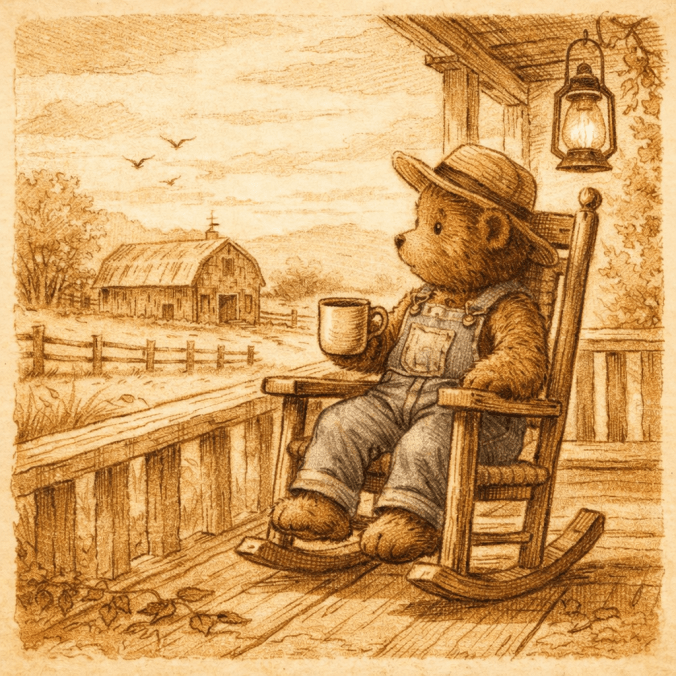
Porch Notes From Little Red Bear

Hey, folks —

Jim is up to his ears with work on the Gazette right now, so asked me to fill in for him today. And I’ve got a few minutes so thought – “Sure. Why not?” Hope you don’t mind.

Farmer Turner dropped by earlier for no particular reason. That’s what folks do around these parts. Stopping by to visit. Just bein’ neighborly, is all.

As usual, we got to talkin’ about the weather. Lately it’s been like riding a seesaw. We seem to go from way above normal one day to way below normal the next. We set a record for both a record all-time high temperature and another record 62-degree temperature drop all in the same day last week. From 80F to 18F. I started the morning in my overalls and ended up wearing three different coats by the end of the day, each one heavier than the one before. I hear the birds down south are flyin’ in circles, not knowing whether to migrate back up north or stay put where they are. They can’t figure it out either, it seems.

Anyway, that’s what Farmer Turner and I were talking about — the weather. I will say, if ever you feel like talking about the weather with someone, just go find yourself a farmer. Farmers love talking about the weather. For them, it’s not just small talk, of course. It’s an important discussion about crop yields, planting schedules, and their very survival. Weather determines a farmer’s livelihood, after all.

Well, I see Aunt Ivy coming up the way, probably coming to trade some cookies for some of the fresh herbs we still have growin’ alongside the cabin. So, I’ll be going now. She may need my help gettin’ to some of the herbs. That, and I don’t want Jim spottin’ her coming and dashin’ out the door to beat me to any fresh cookies.

‘Til next time then.

— Little Red Bear (and Jim!)

If you’d like to spend a little more time in Little Red Bear’s world, Jim has gathered some of the stories and books together on his Author’s Page. You’re always welcome to stop by.

Once A Week, and Close To Home

How a paper told you what happened — and reminded you who lived nearby

There was a time when the paper did not arrive every morning.

It came once a week — sometimes folded neatly, sometimes creased and softened by many hands — and it usually ended up on the kitchen table, beside a coffee cup or under a pair of reading glasses. You did not rush through it. There was no need to. It would still be there after supper, and often the next day, and sometimes the day after that alongside the easy chair or rocker.

Before you reached the end of the first page, you had already seen names you knew.

Someone had a new baby. Someone else was celebrating a long-awaited anniversary. There would be a church supper on Saturday, a school program midweek, and a notice about a lost dog that everyone hoped would turn up before the next issue came out. Someone’s daughter had been mentioned for her playing at the spring recital, and the high school team had won on Friday night. And sometimes — quietly, respectfully — there would be a name you recognized for a different reason, and the house would grow a little still as you read.

Those small-town papers were not trying to impress anyone.

They did not shout. They did not hurry. They did not pretend that every day was historic. What they did, instead, was tell people what mattered right here — the kind of news that lived just down the road, in their own streets, their own schools, and their own kitchens. Who needed help, who was being celebrated, who would be missed, and what the coming days might hold. News and events close enough to touch, and familiar enough to care about.

They gave ordinary lives a place to be seen.

A person did not have to be famous to appear in print. You only had to belong. A spelling-bee ribbon, a new porch, a good harvest, a bad winter — all of it counted. The paper did something quiet but important: it slowed time just enough for people to recognize one another and remember that they belonged to the same place.

Somewhere along the way, those kinds of papers grew thinner — or quieter — or disappeared altogether.

It did not happen all at once, and it did not come with ceremony. One week there was a paper, and then one week there wasn’t. Or there was one, but it felt different. Faster. Louder. Less familiar. And without anyone quite meaning for it to happen, a small and steady way of keeping track of one another slipped out of reach.

This winter, I found myself missing that kind of paper.

Not the headlines — but the notices. Not the urgency — but the presence. Not the noise — but the quiet. Not the crowd — but the community.

The kind of paper that does not hurry, does not shout, and does not forget the small things. The kind that assumes you will sit with it awhile, maybe pass it across the table, maybe read a bit aloud.

So, missing all that, I decided to create one.

Not to recreate the past exactly — but to borrow its patience. To gather stories the way they used to be gathered. To leave room for observations, oddments, wanderings, and the sorts of things that never make headlines but somehow make up a life.

There are always stories circulating around a town, after all — if someone is willing to go looking for them. Some are found by a roving squirrel reporter with a knack for being in the wrong place at the right time. Others are sniffed out by a good-natured news hound who never missed the scent of a good story.

If this feels familiar, that is no accident.

Some things were worth keeping. And we’re in Little Red Bear’s “Honey Hill Country,” after all.

— Jim  (and Red!)

In the days ahead, I will be sharing more of the people and small happenings that make a paper like this feel alive — the kinds of names and notices that once filled the margins and gave a town its own sense of place and to know itself a little better.

There’s more to come — not all at once, and not in a hurry.

P.S. from Little Red Bear —
Little Red Bear says if a paper feels close to home, it probably is. It tells you what happened and reminds you who lives nearby.

Pen-and-ink illustrations created with the assistance of AI and lovingly styled for Little Red Bear Land.

Introducing “The Hearth & Holler Gazette”

A Small-Town Paper from Little Red Bear’s Honey Hill Country

Before we get too far along, there is one small thing I would like to settle right from the start.

These days, the moment someone hears the words “weekly” and “email,” a little voice pipes up:

Oh no… not JAN.

Just Another Newsletter.

You know the kind.
Crowded inbox. Loud subject lines. Endless self-promotion.
More noise than nourishment.

And if that is what The Hearth & Holler Gazette were going to be — I would not blame you one bit for steering clear.

But here is the thing —
This is not JAN. Not even close.

The Gazette is not a newsletter.
There will be no book pitches.
No launch announcements.
No character reveals dropped like bait.
No “Pre-order Now!” or “Don’t forget to buy!” reminders elbowing their way into your morning.

Instead, think of it this way —

The Hearth & Holler Gazette is a fictional small-town paper, delivered once a week on Saturday mornings, the way such things used to be — its pages set in the early years of the twentieth century, beginning in January of 1904.

A place for:

  • Short Stories and Sketches
  • Bits of Humour
  • Kind News
  • Happenings and Events from Little Red Bear’s Honey Hill Country
  • Old-fashioned Advertisements that Exist Only for the Smile
  • And the sort of Gentle Company you might enjoy with a cup of coffee while the house is still quiet

It exists for one reason only —

To offer a pause.
A smile.
A little warmth.

That is the why.
Everything else grows from that.

One might think of The Hearth & Holler Gazette as something closer to Garrison Keillor’s Prairie Home Companion
without the live music, and without needing to go buy a radio.

A familiar voice.
A small town and folks you come to know.
Stories and observations that take their time, and trust you to do the same.

Or perhaps it brings to mind Charles Osgood’s quiet pieces — the kind that never shouted for attention, yet somehow always earned it.

If you ever found comfort in evenings spent with The Andy Griffith Show, The Waltons, or Little House on the Prairie, then you already understand the spirit at work here.

Not because those stories ignored the wider world —
but because, for a little while, they set a different table.

That is the neighbourhood the Gazette hopes to live in.

Continue reading