A Weekly Visit of Tales, Tidings, and Old-Time Country Comfort
Welcome!
It has been a snowbound week in Honey Hill Country — one marked by delays, detours, and the steady work of getting on with things as best they could be managed.
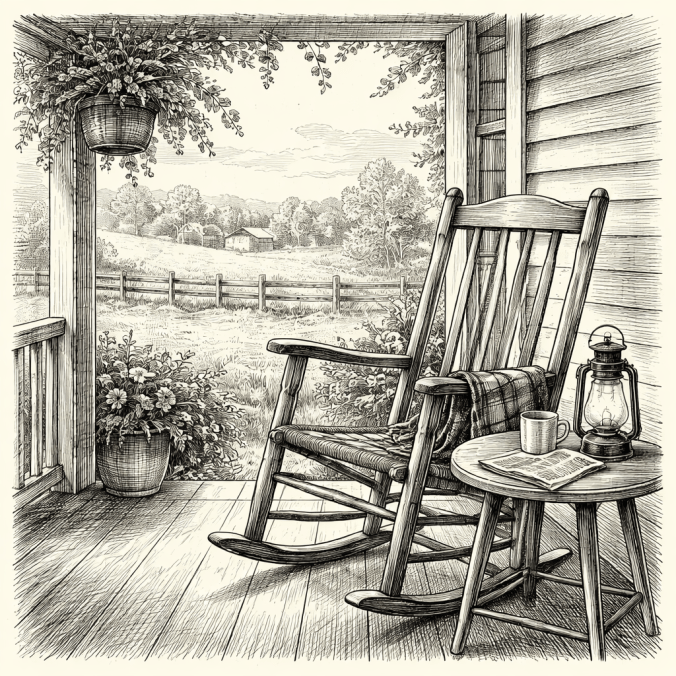
But this week also marks a small but meaningful change for the The Hearth & Holler Gazette — one that has me genuinely excited about where the paper is heading. From time to time, select stories will now be accompanied by period-style illustrations, offering a visual record of events alongside the printed word. These images are meant to be read as much as seen — another way of noticing what has happened around us and remembering it clearly.
These illustrations are being prepared carefully, with focused attention to the Ozarks setting of Little Red Bear’s stories and the 1904 period the Gazette inhabits. They are intentionally restrained, observational, and rooted in the visual language of the time — not modern embellishments, but echoes of how stories were once quietly shown as well as told before the use of photography became commonplace.
But before we go any further, for first time visitors, it may help to know where — and when — we are, and what I am talking about
The Gazette hails from Honey Hill Country, a small, rural corner of the Missouri Ozarks, as it might have been known in the year 1904 — a time of front porches and wagon roads, oil lamps and handwritten letters, when news traveled at a human pace, and a Saturday paper was meant to be read slowly, with coffee close at hand. This is not a paper of breaking news or loud headlines. It prefers instead to notice it — the small, human-sized moments that once filled a morning without asking much in return.
The Hearth & Holler Gazette is a work of fiction — a made-up paper from a made-up place, written in the spirit of an earlier time. Any resemblance to real towns, people, or events is entirely coincidental, though we do our best to make it feel otherwise.
What follows reflects the shape of these past days: trains slowed and roads altered, plans postponed and routines adjusted. It also holds the smaller things that traveled just as surely through the cold — a door opened, a shovel shared, a joke passed along to lighten the work. Taken together, they tell the story of a week that tested patience, rewarded cooperation, and reminded us that even when progress is measured in careful steps, it is still progress all the same.
So, with that said — Please come on in. Your newspaper awaits . . . . . .
THE HEARTH & HOLLER GAZETTE
Sharing Stories and Smiles from Little Red Bear’s World
— A Weekly Visit of Tales, Tidings, and Old-Time Country Comfort —
Serving Honey Hill, Hopper’s Holler, and Beyond | Est. 1904
Saturday Morning Edition
February 07, 1904
Honey Hill Country • Cricket Hollow County
Vol. I — No. 3
Price: Five Cents (If You Have It) • Free to Read (If You Do Not)
Published Weekly on Saturday Mornings
From the Front Porches, Back Rooms, Kitchens, Workshops, Hillsides, and Quiet Corners of Honey Hill Country
DEEP SNOW DISRUPTS TRAVEL AND DAILY LIFE
Local News from Around the Holler
Filed by Percival “Percy” Puddlesniff, News-Hound
With Field Notes from Rusty the Fairydiddle, Roving Reporter
ROADS, RAILS, AND ROUTINES SHIFT AFTER HEAVY SNOW
The recent heavy snowfall has left much of Honey Hill Country blanketed under deep drifts, altering travel, delaying deliveries, and pressing daily routines into unfamiliar shapes across towns and countryside alike.
Roads that only days ago carried wagons, sleds, and foot traffic with ease have 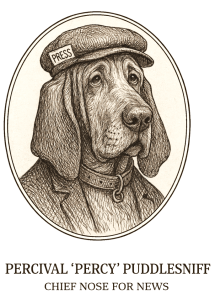 narrowed to single tracks, while lesser-used lanes have disappeared altogether beneath packed snow. In several places, fences have been buried to their top rails, gate latches frozen fast, and fence lines traced only by memory and habit.
Rail traffic through the region has also been affected, with delays reported as crews worked overtime to keep lines open and switches clear. Deliveries of mail, supplies, and goods arrived late in many towns, though in most cases they arrived nonetheless — slower, perhaps, but welcomed all the same.
Merchants adjusted hours as best they could, farmers tended stock closer to home, and many residents found themselves traveling less and relying more heavily on neighbors within walking distance. Schools in some areas operated on reduced schedules, while others closed briefly until paths could be cleared and attendance reasonably ensured.
The weight of the snow proved troublesome in places not built to bear it. Outbuildings sagged under the load, sheds were hastily reinforced, and older structures were watched with care as temperatures fluctuated and thaw threatened to add weight where none was wanted. Some tattered structures did not survive the combined snow and winds.
Despite the disruptions, communities responded with the quiet competence winter demands. Shovels appeared early along walks and storefronts. Paths were cut where none existed the night before. Those with teams or sleds lent them where needed, and news traveled quickly from house to house when assistance was required.
While the storm has passed, its effects remain, and full recovery will take time. Clearing continues along roads and rail lines, repairs are being assessed, and several planned undertakings have been postponed until conditions allow work to proceed safely.
For now, life in Honey Hill Country moves at a slower pace — measured not by clocks or timetables, but by daylight, weather, and the simple question of what can reasonably be done today.
TRAIN STALLED BY DEEP DRIFT; COMMUNITIES OFFER AID
A passenger train of the St. Louis, Iron Mountain, & Southern line traveling through the region was brought to a halt during last week’s heavy snowfall after encountering a deep drift in Willow Bend Cut. Crews were unable to clear the obstruction before nightfall, resulting in an unavoidable delay that lasted into the following afternoon.
According to railroad officials, the locomotive attempted what engineers commonly refer to as “bucking the drift,” a method used in heavy snow in which the train is reversed some distance and then driven forward at speed in the hope that momentum will carry the engine through the packed snow. While the practice has been successful under certain conditions, it carries risks, and in this instance the drift proved too deep and dense to be overcome.
The locomotive became lodged fast in the snow, leaving the train unable to proceed. With daylight fading and temperatures continuing to fall, it was soon apparent that the delay would extend through the night.
Arrangements were made to see to the comfort and safety of the passengers, many of whom were taken in by residents of nearby communities. Homes were opened, meals prepared, and warm places found for travelers who had expected to be well on their way by evening. By all accounts, the hospitality shown was prompt and unhesitating, with families making room where they could and offering what help was at hand.
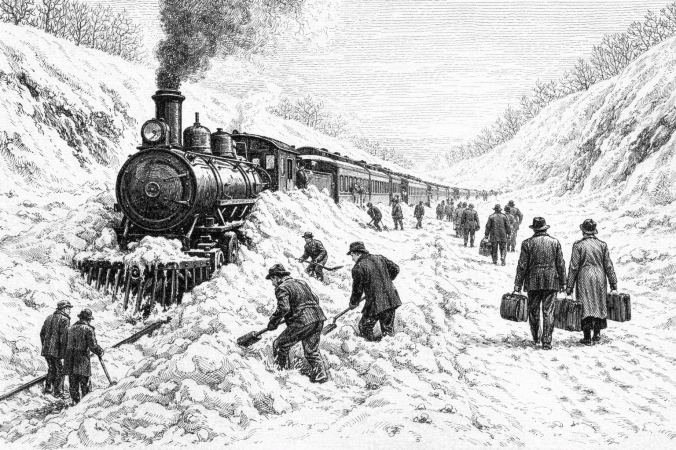
Work to free the train resumed early the following morning. Railroad crews were joined by local volunteers and section gangs armed with shovels, working steadily to cut through the drift, clear frozen switches, and widen the trackway. Progress was slow but persistent, as care had to be taken to avoid damage to the rails or engine.
After roughly a day and a half of effort, the train was finally freed during the afternoon hours and able to continue on its route. Officials described the delay as unfortunate but unavoidable, given the depth of the snow and the conditions encountered.
Railroad representatives noted that wedge plows and other equipment are employed whenever possible during winter weather, but that no method is foolproof when drifts form rapidly and wind packs snow tightly along open stretches of track.
Passengers resumed their journeys with delays behind them and stories to tell, while the incident served as a reminder of the challenges winter continues to pose for rail travel across the countryside.
GETTING THE PAPER THROUGH
A Word with Circulation Editor Thaddeus “T. J.” Booker
When last week’s snow settled deep across the hills and hollers, it did more than slow travel. It tested whether routines could hold at all.
For the Gazette, that meant facing a simple question with no simple answer: how to get a brand-new paper into readers’ hands when roads were narrowed, wagons stalled,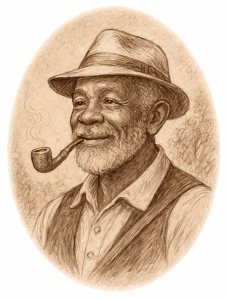 and daylight was short.
According to Circulation Editor Thaddeus “T. J.” Booker, the answer came down to planning, patience, and a willingness to take the long way around.
“We didn’t do anything clever,” Booker said. “We just did what could be done, one stretch at a time.”
Delivery routes were adjusted early, with outlying roads attempted first while snow was still light. Where drifts proved impassable, routes were combined or delayed rather than forced. In a few cases, bundles were carried the final distance on foot.
Booker credited his small delivery staff, noting that several made more than one attempt at the same route after turning back earlier in the day. “Nobody wanted to  leave folks wondering,” he said. “If a paper could get there, we aimed to get it there.”
Not every delivery arrived on its usual schedule, and Booker was quick to acknowledge that. “Some came late,” he said. “But they came.”
He also noted help offered along the way — a warm place to rest, directions shared, a shovel borrowed where it was needed. “That makes a difference when the weather’s working against you,” he said.
By the end of the week, nearly all copies had reached their destinations, with remaining deliveries completed as conditions allowed. No injuries were reported, and no papers were lost.
Asked what he took from the experience, Booker paused before answering.
“It showed us where the weak spots are,” he said. “And it showed us what people will do when they care about a thing being done right.”
He added that routes and contingencies are already being reviewed in light of the storm. “Next time,” he said, “we’ll be better prepared.”
For a paper still finding its footing, the week offered a hard but useful lesson: that even under difficult conditions, steady effort carries weight — sometimes literally.
CONSTRUCTION DELAYED ON NEW COBBLE CREEK MILL
Construction on the new mill planned for Cobble Creek has been temporarily delayed following last week’s heavy snowfall, which slowed the arrival of building materials and left the proposed site blanketed under deep snow.
Work on the mill had been scheduled to begin on February 1, but officials involved with the project reported that several key shipments were held up by weather-related travel disruptions. In addition, the depth of snow at the creek site has made initial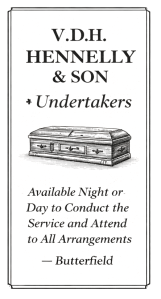 ground work impractical until conditions improve.
The mill, once completed, is expected to be a two-story structure designed to serve both the Cobble Creek settlement and surrounding farms. Plans call for a solid timber frame and stone foundation, with operations intended to handle local grain and related milling needs. Ownership and operation will remain local, with the enterprise anticipated to provide steady service to area farmers and additional employment once underway.
Though the delay is unwelcome, those overseeing the project emphasized that it is a matter of timing rather than difficulty. No changes have been made to the design or purpose of the mill, and construction is expected to proceed as soon as materials arrive and the site can be safely prepared.
Residents familiar with the creek noted that winter conditions often linger longer in the low ground, and that patience is required when building near water during a season marked by snow, ice, and fluctuating temperatures.
For now, the project remains on course for construction, if briefly postponed, with Cobble Creek’s new mill still anticipated to become a lasting fixture in the area once work resumes.
SHOVELS OUT AND NEIGHBORS BUSY AFTER THE SNOW
With the snow piled high along walks and lanes across Honey Hill Country, shovels have been much in evidence these past few days, along with a great deal of determined puffing, stamping of cold feet, and the sound of steel scraping its way toward bare ground.
In several towns, enterprising youngsters were quick to recognize opportunity where  others saw only drifts. Armed with borrowed shovels and bundled up to the eyes, they went door to door offering their services, and by most accounts did very well for themselves before their mittens finally gave out.
In Butterfield, young Johnny Wilkins was among those lending a hand, clearing paths for neighbors unable to manage the heavy snow on their own. While helping elderly Mr. Thompkins make a way from porch to gate, Johnny’s shovel met its match and snapped clean across the handle.
Mr. Thompkins, who no longer has much use for a shovel himself, promptly produced his own from the shed and pressed it into Johnny’s hands, insisting it would see better days in active service. Johnny returned to work at once, and Mr. Thompkins reported later that the walk had never been cleared so quickly.
Elsewhere, the work took on a more communal air. Groups of neighbors turned out together to clear walks for those laid up by age or illness, sometimes without being asked. Paths appeared in the snow as if by quiet agreement, leading from house to house where help was needed most.
At one such stop, Mrs. So-and-so (who shall remain nameless to protect her baking secrets) insisted that all shoveling be paused long enough for the proper serving of hot cocoa and a tin of oatmeal cookies. This reporter can confirm that the cookies were worth the interruption and may have contributed to a noticeable increase in enthusiasm once work resumed.
By the time daylight faded, many walks were passable once more, hands were sore, cheeks were red, and a fair amount of snow had been relocated with no clear idea of where it might best belong.
Winter work is seldom easy, but it has its moments. And if a few pockets were made heavier by honest labor and a few kitchens warmer for the company they kept, so much the better.
OLD DARCY CREEK BRIDGE FAILS UNDER SNOW; TRAVEL REROUTED
The old Darcy Creek Bridge spanning Darcy Creek along the main road between Butterfield and Round Corners collapsed late last week under the accumulated weight of heavy snow, prompting an immediate rerouting of travel in the area.
The bridge, believed to have been constructed more than thirty years ago and long familiar to teamsters and travelers alike, gave way after several days of strain from deep snow and ice. No injuries were reported at the time of the collapse, as mercifully, the structure failed during the night when traffic was light.
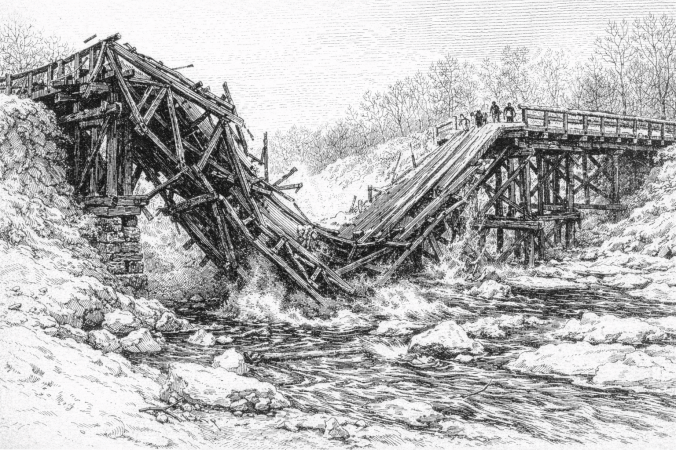
Local residents noted that the bridge had served faithfully for many years, carrying wagons, livestock, and foot traffic through all manner of weather, though its age and repeated winters had taken their toll.
Until repairs can be made or a new crossing constructed, travel to and from Round Corners along that route is being diverted to Buffalo Trace Road, which remains passable despite recent snowfall. Travelers are advised to allow additional time and to take care along narrower stretches.
Officials indicated that an inspection of the site will be conducted once conditions allow, after which plans for replacement or repair will be determined.
Editor’s Note
Readers are reminded that not all happenings arrive with fanfare or leave visible marks. Some matters are quietly seen to — a fence set right, a task finished, a small trouble tended to before it grows larger.
Such reports from the community are always welcome.

Letters to the Editor
Our readers are invited to share their thoughts, observations, and neighbourly remarks. Letters may be shortened for space, but never for spirit.
A Further Word on Undersupplied Undergarments
To the Editor,
I write again, as the situation has not improved. Another issue has arrived, handsomely printed and full of news, yet still no mention whatsoever of long underwear, advertisements, or sales.
One begins to wonder if the Gazette is opposed to warmth below the waist, or whether some editorial bias against sensible flannel is at work. I assure you, sir or madam, High Hill is no place for such negligence.
My knees remain unconvinced by your silence.
— Chilly B. Bottoms, High Hill
The Gazette prints letters of interest to the community and trusts that merchants will take note of local concerns as they see fit. — The Editor
Praise for a Paper Well Put Together
To the Editor,
Having read the latest issue from front page to back, I wish to commend the staff on a most engaging paper. The accounts of weather, travel, and local doings were particularly well set down, and I found myself reading far longer than intended.
It is a comfort to know what is happening beyond one’s own gate.
— A Satisfied Subscriber, Butterfield
Gratitude for Honest Reporting
To the Editor,
The Gazette’s reporting on recent weather conditions and their effects was both accurate and useful. It is no small thing to feel informed without being alarmed, and I thank the writers for striking that balance.
Please continue.
— E. R. Collins, Round Corners
A Neighborly Observation
To the Editor,
It was good to see mention of neighbors helping neighbors during the snow. Such things are easily overlooked, though they are what carry us through hard weather. I hope the paper continues to notice them.
— One Who Has Been Helped, Packet’s Landing
A Question of Character
To the Editor,
I have read the Gazette with growing interest these past weeks and commend the paper for its thorough reporting on weather, roads, and other matters of importance to our communities.
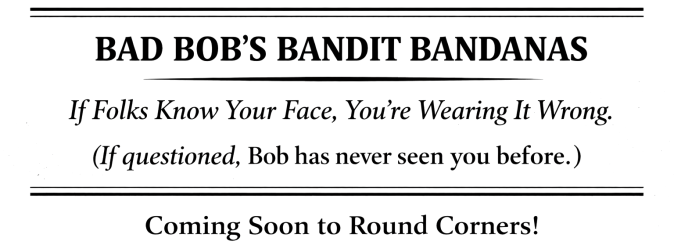
However, I feel compelled to raise a concern regarding a recent advertisement for Bad Bob’s Bandit Bandanas, which I find troubling.
Bandanas, as any sensible person knows, are commonly associated with disguises, mischief, and, in some cases, outright criminal activity. One cannot help but wonder what sort of message is being sent when such items are promoted in a paper that arrives on respectable doorsteps.
Are we to understand that the Gazette endorses banditry? Or is this merely a lapse in judgment brought on by the rush to fill advertising space?
I ask these questions not in anger, but in genuine concern for the character of our towns and the example set before our young people, who are ever impressionable and quick to tie things about their faces.
I trust the Editor will give this matter due consideration.
— A Concerned Citizen, Round Corners
The Gazette accepts advertisements from local merchants and leaves the interpretation of their goods to the judgment of its readers. — The Editor
Crops & Markets Report
By Virgil Stone
Deep snow and continued cold have kept activity light across area markets this past week, with most trade confined to necessities and transactions already set in motion before the storm.
Livestock movement was notably reduced, as many farmers elected to hold stock closer to home rather than risk difficult roads and exposed travel. Cattle and sheep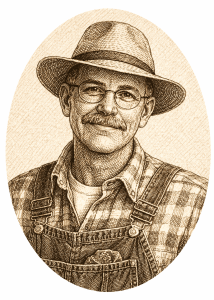 remain largely where they stand, with feed taking priority over movement. Hogs offered little change in price, though few were brought in.
Grain trading was limited, with corn and wheat seeing minimal exchange as hauling conditions remained poor. Several buyers reported delays in delivery rather than cancellations, and most expect trade to resume once roads and rail schedules return to more reliable footing.
Hay and feed continue to be in demand, particularly among those tending stock through the cold, though deliveries have been slower than usual. Supplies remain sufficient in most areas, with no shortages reported at this time.
Farmers report that animals are holding well under shelter, though attention remains fixed on water sources, frozen troughs, and feed stores as the cold persists. Little field work is expected until conditions ease.
With winter firmly in place, the market remains quiet but watchful, awaiting clearer roads and steadier weather before activity quickens again.
Market Notes
- Corn: Limited movement
- Wheat: Light trade
- Hay: Steady demand, slow delivery
- Cattle & Sheep: Held back due to conditions
- Hogs: Little change, few brought in
Our advice is patience and preparation until weather and travel improve.
— Virgil Stone
Hillside Chronicles
By Silas Thorne
The hills have taken on a different sort of beauty these past evenings, one that belongs only to winter. With the leaves gone, the trees no longer keep their own counsel, and the light is allowed to pass through them freely.
At sunset, the sky has been laying down bands of pink, orange, and pale purple, seen not beyond the trees but through them. Bare branches stand dark against the colour, fine and branching, like lace held up to the light. There is nothing bleak about it. Instead, the hills seem quietly revealed, as though winter has chosen to show their structure rather than dress them.
After the recent snow, the ground has become a kind of ledger. Tracks appear where there were none the day before, telling small stories to anyone willing to look down. Squirrel marks stitch the surface where buried stores are being checked and rechecked, and the neat, paired prints of rabbits cross open places without hesitation.
Earlier in the week, I came upon the tracks of deer moving along the lower slope, their paths pressed cleanly into the snow. They had passed sometime before daylight, untroubled and unhurried, heading toward the cover of the trees.
The following morning, I saw them again — a small group standing near the treeline, half-shadowed and watchful. They lingered only a short while before slipping back into the woods, leaving the field unchanged except for the knowledge that it had been shared.
Winter often gives the impression of stillness, but it is more accurate to say that it asks us to slow down enough to notice movement when it occurs. Much is going on, if one keeps one’s eyes open and expectations quiet.
— Silas
Farm & Home
By Myrtle Mae Meadowbloom
Notes From the Farm & Field
The snow has kept many of us closer to home this past week, and there is no great harm in that. Winter has a way of reminding us that not every road needs traveling, and that much of the season’s good work can be done without leaving the yard.
With stock held nearer than usual, attention has turned to the small, steady tasks that keep animals comfortable through cold spells. Extra bedding has gone a long way, as has breaking ice more often than feels necessary. A little warm water added to feed on the coldest mornings has been well received, and animals that are dry, fed, and out of the wind tend to worry less than we do.
Those tending poultry have found that keeping birds content matters as much as keeping them warm. A handful of grain scattered in straw gives them something to do when the day is long and white, and checking drafts before checking the thermometer has spared more than one flock unnecessary trouble.
Inside the house, many of us have been making do with what was already on hand. Meals have leaned toward the simple and filling, and shelves have been surveyed with new appreciation. When the roads are quiet, one learns again the usefulness of a well-kept pantry and the comfort of food that warms more than just the body.
I had intended to make a short trip early in the week and did not, finding instead that there was enough to be done right where I was. Mending that had waited too long was finally seen to, and a kettle put on more than once for no reason other than it seemed a good time for it.
Snow will pass when it is ready. Until then, there is sense in tending what is close, keeping both animals and people steady, and trusting that the roads will open soon enough.
A Closing Thought
Winter asks less speed and more care. Those who answer it patiently often find they have done enough by staying put and doing well what was already theirs to do.
— Myrtle Mae
Community Notices & Small Tidings
Items of interest from Honey Hill Country and nearby hollers. Notices are printed as received and offered in good faith.
• Several businesses across Honey Hill Country remained closed for part of the week following the recent snowfall, reopening as walks were cleared and deliveries resumed. In a few cases, shortened hours continued while staff attended to snow removal and delayed supplies.
• Merchants in Round Corners and Butterfield report that a number of re-supply orders were held up by weather-related travel disruptions. As a result, certain staple goods ran temporarily low, with shelves expected to be restocked once rail and wagon traffic returns to regular schedules.
• Meetings and gatherings planned for early in the week were widely postponed or canceled, including lodge meetings, church socials, and club assemblies. Organizers indicated that rescheduling will be announced once conditions allow for reliable travel.
• Several deliveries of mail and printed matter arrived later than usual but were ultimately received, and no losses were reported. Patrons are reminded that patience is requested while routes continue to be cleared.
• Residents are asked to take note that some outlying roads remain narrow or partially blocked, and unnecessary travel is discouraged until further notice. Assistance continues to be offered where needed, particularly for those unable to leave their homes during the cold.
Despite the interruptions, most essential services have remained available, and cooperation among neighbors has eased the week’s difficulties.
A Small Reminder
If you have a notice to share — a gathering, a need, a thank-you, or a simple word worth passing along — you may leave it with the Editor by letter or in person. Space is limited, but goodwill is not.
Meeting Notices & Postponements
Owing to continued snow and difficult travel conditions, a number of meetings and gatherings scheduled for the past week were postponed or canceled. Notices received include the following:
- The Sons of the Split Timber postponed their regular meeting, originally set for Monday evening, until travel conditions improve.
- The Ladies’ Practical Improvements Circle canceled its midweek gathering and will announce a new date once members are able to attend safely.
- The Independent Order of the Busy Bee deferred its sewing meeting, with members encouraged to continue work at home until roads are more passable.
- A planned social supper at Pleasant Grove Community & Fellowship Church was postponed, with organizers noting that supplies could not be delivered in time due to weather delays.
- The Honey Hill Improvement Circle rescheduled its monthly discussion, citing both road conditions and the difficulty of heating the meeting room during the cold spell.
- A lodge meeting of the Order of the Hewn Log was called off after several members reported being unable to leave their farms.
Organizers across the region note that notices of rescheduled dates will be posted once roads clear and regular travel resumes.
IMAGE
Classifieds
Notices are printed as submitted. Replies may be made discreetly, or not at all.
WANTED — LONG UNDERWEAR. LOTS.
Thermal, flannel, wool, or otherwise respectable. Must cover knees at a minimum. Immediate need. Discretion appreciated.
— C. B. Bottoms, High Hill
FOR SALE OR TRADE — WOOD STOVE.
Older model, sound and serviceable. Recently removed from summer kitchen. Buyer to arrange hauling once roads allow. Will consider trade for feed or dry split wood.
— Inquire at Gazette Office
WANTED — WOOD STOVE OR HEATER.
For small dwelling. Condition less important than warmth. Will fetch when travel improves.
— E. Thompkins, Butterfield
HELP WANTED — SNOW CLEARING.
Able-bodied youth or men with shovels needed for walks and outbuildings. Pay fair. Hot drink likely.
— William Henry, Old Orchard
FOR SALE — SNOW SHOVEL.
Plain but sturdy. Owner moving south. Claims — “It has seen many winters and still survived.”
— Contact: Amos Barnes, Butterfield
A Small Reminder
Classified notices may be left with the Editor in person or by letter. Brevity is appreciated. Honesty assumed.

Country Chuckles
By Cousin Orville P. Dithers
I have been hearin’ a great many things about the recent cold, most of them unverified but all delivered with such confidence that I see no reason to doubt them outright.
A Reedy Hill man claimed that when he stepped out to spit, the cold caught it halfway down and froze it solid, leaving him attached briefly to a fencepost. This account was accompanied by gestures and a drawing in the dirt, which lends it some authority, despite a lack of witnesses.
When the temperature dropped to ten below, I was told the wood stove in one house did not merely go out — the fire itself froze. A glowing orange icicle was said to be hanging there in mid-air, smelling faintly of hickory and regret. No one touched it, which I believe was wise.
Music did not fare much better. One afternoon, Henry Calder whistled “Yankee Doodle” on his porch, only to have the notes freeze in place and fall to the boards with a clatter. He had to sweep them up with a dustpan and melt them over a candle just to hear what tune he’d been attempting. Reports differ on whether it sounded any better with the notes shuffled around the second time.
I also heard of a bucket of water that froze so hard it rang like a church bell when struck, a rooster that crowed once and lost its voice, and a dog that went outside, reconsidered the situation, and then immediately returned up the steps backward.
Now, it may be that the cold has loosened a few tongues along with freezing everything else. Or it may be that when winter settles in this deep, the truth stretches a little to keep warm.
But then again, residents of the High Brush vicinity report that Hickory Pinenut, proprietor of High Brush Farm, suffered an unusual inconvenience during last week’s severe cold, when his false teeth froze solid overnight in their customary glass of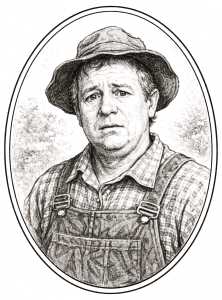 water set by the bedside after the fire burned low.
In a cold morning daze and unaware of their condition, Mr. Pinenut is said to have placed the frozen block directly into his mouth upon waking, where it remained for the better part of two hours before the block of ice and his teeth thawed and the situation resolved itself. Mrs. Olivia Pinenut is said to have waited breakfast for him and handled the matter calmly, as she does most things.
No permanent damage was done, though Mr. Pinenut did suffer a brain freeze while the frozen teeth thawed in his mouth, and was later overheard advising that future cold nights may call for the teeth to be kept closer to the stove. Or worn to bed.
Either way, the stories seem to have been circulating more freely than traffic this past week, which is one thing, at least, that seemed to escape the deep freeze.
— Cousin Orville
Heart of the Holler
By Abigail “Abby” Whitcombe
After the Snow Arrived
Cold weather has a way of narrowing the world, drawing attention back to what is nearest and most in need. During the recent stretch of snow and hard temperatures, that attention was put to good use across Honey Hill Country.
In Packet’s Landing, a familiar stray dog known to linger near the shops and cafés was taken in when the cold worsened. The animal had been seen often enough to earn a passing name from regulars, and when the nights turned sharp, a door was opened and a place found by the stove. No announcement was made, and no reward expected. The dog was simply where it needed to be.
Elsewhere, a mother cat and her kittens were discovered sheltering beneath a front porch, pressed close together against the wind. They were brought inside and set up in a box near the warmth, where the kittens were reported to sleep in a pile that shifted only when food appeared.
In several places, neighbors checked in on those living alone, knocking snow from boots before stepping inside to see if wood was stacked, water drawn, and spirits holding. In a few cases, a chair was pulled up and stayed pulled for a while.
These were not large gestures, and they were not made for notice. They were simply the sort of things that present themselves when weather reminds people that no one does well unattended.
The cold will ease in its own time. Until then, the holler has been keeping watch.
— Abby W.


Front Porch Reflections
February Has a Quieter Voice
There is something about February that does not raise its voice.
January announces itself — cold, bright, insistent, all sharp edges and fresh starts.
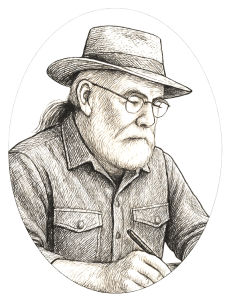 February, on the other hand, steps in more softly. It does not ask for resolutions. It does not demand momentum. It simply arrives, pulls its coat tighter, and settles in.
Around here, February is when the land seems to exhale.
The hills are still bare, the trees still etched like pencil lines against the sky, but there is a difference you can feel if you stand still long enough. The light lingers just a breath more in the afternoons. The shadows stretch, not in a hurry, as if even they have decided to take their time.
February is a month that notices small things. And takes its time, despite its comparative shorter stay.
A mug warming both hands.
The sound of a floorboard you forgot creaked.
A bird you had not seen all winter, suddenly back as if it never left.
It is a month that reminds us that waiting is not the same as doing nothing.
Under frozen ground, work is already underway. Roots are shifting. Buds are quietly counting days. The world is not asleep — it is gathering itself.
And so are we.
If January is about deciding, February is about listening. About allowing ourselves to move at the pace the season sets, not the pace the calendar insists upon. About remembering that rest can be purposeful, and stillness can be full.
So if this week feels a little quieter — a little slower — perhaps that is exactly as it should be.
Pull your chair closer to the window. Let the light come to you. Enjoy a warming cup of tea. There is no need to rush what is already on its way.
We will see you again next Saturday.
— Jim (and Red!)
The Hearth & Holler Gazette is a work of fiction, created for entertainment and storytelling purposes. The people, places, events, and notices appearing within its pages are imagined, and any resemblance to actual persons or events is purely coincidental.
© 2026 James Milson. All rights reserved.
Pen-and-ink illustrations created with the assistance of AI and lovingly styled for Little Red Bear Land.
Would you prefer Coffee or Tea with your newspaper?

 James Milson - The Writing Pages
Thanks for visiting with us, Frank! Ethel McNickle’s is a landmark in Honey Hill Country, for sure. We are growing and will be adding more very soon, so please stay tuned. Best wishes always! 🤠 🐻
LikeLike
Great edition. So full of news. A lot is going on in a small Ozark country town, particularly the illustrations and ads. Ethel McNickle’s Famous Pickles and Pork Rinds caught my eye. Enjoyed the read.
Frank Clark
LikeLiked by 1 person