A Weekly Visit of Tales, Tidings, and Old-Time Country Comfort
Welcome!
It has been a mud bound week in Honey Hill Country. Another marked by delays, detours, growing shortages of everyday staples, and the steady work of getting on with things anyway.
Regular readers may recall that last week we introduced period-style illustrations, offering a visual record of events alongside the printed words of selected stories. This week, we take another big step forward — introducing our new staff editorial cartoonist, Clarence “Clary” Moss. Clary will be introducing his first editorial cartoon in the pages of the Gazette today, and will be a featured weekly contributor going forward.
But before we go any further, for first time visitors, it may help to know where — and when — we are, and what I am talking about
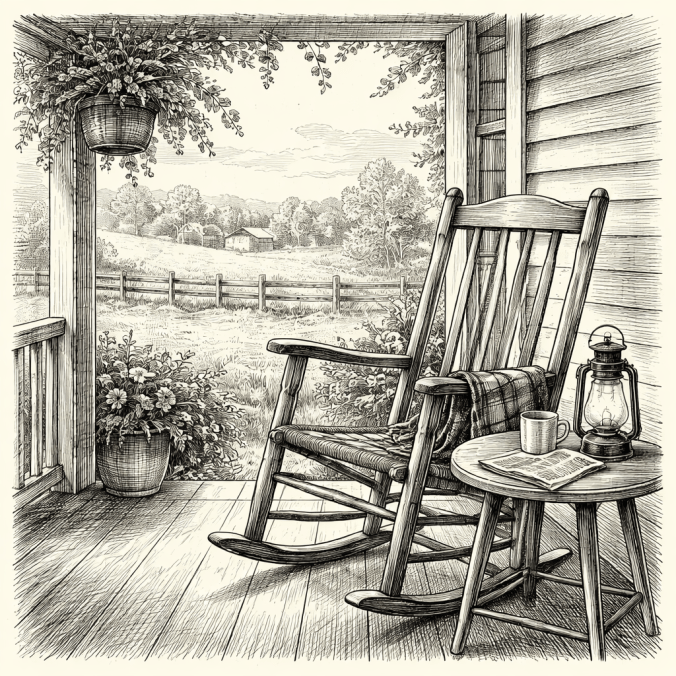
The Hearth & Holler Gazette hails from Honey Hill Country, a small, rural corner of the Missouri Ozarks, as it might have been known in the year 1904 — a time of front porches and wagon roads, oil lamps and handwritten letters, when news traveled at a human pace, and a Saturday paper was meant to be read slowly, with coffee close at hand. This is not a paper of breaking news or loud headlines. It prefers instead to notice it — the small, human-sized moments that once filled a morning without asking much in return.
The Hearth & Holler Gazette is a work of fiction — a made-up paper from a made-up place, written in the spirit of an earlier time. Any resemblance to real towns, people, or events is entirely coincidental, though we do our best to make it feel otherwise.
So, with that said — Please come on in. Your newspaper awaits . . . . . .
And would you prefer Coffee or Tea with your newspaper?
THE HEARTH & HOLLER GAZETTE
Sharing Stories and Smiles from Little Red Bear’s World
— A Weekly Visit of Tales, Tidings, and Old-Time Country Comfort —
Serving Honey Hill, Hopper’s Holler, and Beyond | Est. 1904
Saturday Morning Edition
February 14, 1904
Honey Hill Country • Cricket Hollow County
Vol. I — No. 4
Price: Five Cents (If You Have It) • Free to Read (If You Do Not)
Published Weekly on Saturday Mornings
From the Front Porches, Back Rooms, Kitchens, Workshops, Hillsides, and Quiet Corners of Honey Hill Country
A WEEK OF MELT AND MUD ACROSS THE HOLLERS
Local News from Around the Holler
Filed by Percival “Percy” Puddlesniff, News-Hound
With Field Notes from Rusty the Fairydiddle, Roving Reporter
GRABBING THE BULL BY THE HORNS
Local Effort Frees Prize Animal from February Mire
It was only a matter of time before someone, somewhere in Honey Hill Country, would find himself obliged to grab a bull by the horns.
The snow that fell so prettily last week reconsidered its posture once the thaw set in, slipping down off hillsides and barn roofs and settling with determined purpose into low spots, wagon ruts, and pastures that had not been consulted in the matter. By Tuesday afternoon, what had been a respectable stretch of grazing field near Miller’s Lower Meadow had turned into a soft, sucking morass that looked firm from a distance and treacherous upon approach.
It was there that Horace Miller’s prize Hereford — a broad-shouldered fellow of questionable temperament and even more questionable footing — discovered that dignity and gravity are not always in agreement.
The bull had ventured a few steps too far toward what appeared to be greener ground and found himself sunk to the brisket in a patch of mud that had no intention of letting him go. Each attempt to free himself resulted in deeper entanglement and a growing expression of disbelief and frustration upon his face, as though he had been personally betrayed by the landscape.
Word travels swiftly when livestock is involved.
Within the hour, several neighbors had gathered along the fence line, each offering advice of the sort that comes readily when one is standing on solid ground on the opposite side of the fence. Ropes were fetched. Planks were suggested. One gentleman proposed a team of mules, though none seemed eager to test whether the mules shared his optimism or would fare any better in the mud.
There remained, however, the delicate matter of the bull’s front end.
A rope about the hindquarters may persuade. A push from the side may assist. But a bull, once mired, does not take kindly to being surprised from behind, and no one present expressed a keen interest in being introduced to that fact at close range of the front end.
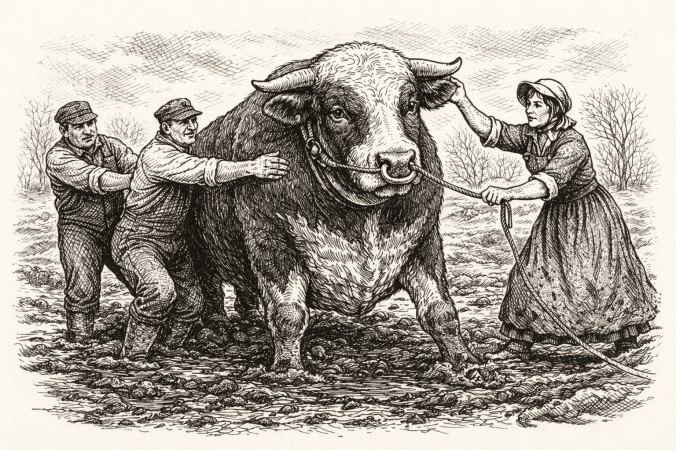
It was at this juncture that Little Red Bear, having arrived with the steady gait of someone accustomed to difficult footing, surveyed the scene and made the quiet assessment that sometimes the shortest path through a problem is directly toward it.
If the bull was to come forward, someone would need to be at the front.
And so — with a few calming words for the bull and a firm step — Little Red Bear did what many have spoken of metaphorically and few have done literally.
He grabbed the bull by the horns.
There was a moment — brief but instructive — during which the gathered company appeared to reconsider the entirety of their acquaintance with livestock. The bull, for his part, seemed less offended than relieved to discover that someone had finally addressed him properly.
With ropes secured and neighbors pushing from safer angles, Little Red Bear leaned back with measured strength, guiding the animal’s head upward and forward, encouraging movement rather than resistance. Mud protested. Boots disappeared. One hat did not survive the effort.
But inch by stubborn inch, the Hereford rose from his muddy predicament, emerging at last with a heave, a snort, and a splatter that ensured all present would carry a  visible reminder of the afternoon’s labors.
Once free, the bull stood for a long moment, sides heaving, eyes wide, and then — with what can only be described as restrained indignation — proceeded toward higher ground without so much as a backward glance.
There were no speeches.
There was, however, a general agreement among those assembled that certain expressions and outbursts during the mud battle ought perhaps to be used more carefully in future conversation.
As for Little Red Bear, he was observed later that evening rinsing mud from his sleeves with the same unhurried patience he had shown in the field.
When asked whether the task had troubled him, he is said to have replied only:
“Well now. If you’re going to pull someone out of the mud, you may as well start where they can see you.”
The field will dry in time. The ruts will firm again. And the Hereford, it is reported, has chosen for the present to remain on the higher side of the pasture.
But for one muddy February afternoon, Honey Hill Country was reminded that sometimes a saying is not merely a figure of speech.
Sometimes, it is an assignment.
MUDSLIDE BLOCKS RAIL LINE THROUGH CLEVENGER GAP
Missouri Pacific Traffic Rerouted While Crews Clear Debris
The week’s thaw has not confined its mischief to barnyards and wagon ruts.
Rail authorities report that a portion of track through Clevenger Gap in High Hill was  covered late Wednesday evening by a slide of loosened earth and stone following continued runoff from melting snow along the cut.
The affected stretch lies where the MoPac line threads between two steep embankments, long considered sturdy but susceptible during rapid thaws. As the frost gave way beneath the surface, saturated soil along the upper slope surrendered to gravity, carrying with it a mix of mud, shale, and early spring debris.
No trains were struck in the incident, and no injuries have been reported.
An eastbound freight was halted safely short of the obstruction after a section hand on routine patrol observed shifting earth along the line and sent warning ahead by telegraph. Railroad officials have since rerouted traffic around Steamboat Mountain through Myrtleville, a detour expected to add modest delay while crews work to restore the passage.
By Thursday morning, laborers equipped with shovels, picks, and a rail crane were engaged in clearing the heavier stones. Additional drainage trenches are being cut along the upper bank in hopes of preventing further movement should temperatures continue to rise.
A company spokesman noted that February thaws are often “more persuasive than January storms,” as frozen ground, once loosened, seldom negotiates.
Passengers are advised to expect schedule adjustments through the following week. Freight shipments, already slowed by muddy approaches to depots across the region, may experience continued brief delays and interruptions.
Residents in High Hill reported the sound of the slide as “a low rolling and rumbling sound,” not unlike distant thunder, though skies remained clear at the time.
Rail service, it is anticipated, will resume through Clevenger Gap once the line is declared stable and safe for passage.
Until then, the Whistling Iron will take the longer road — as many have found necessary this week.
BEAVER TWINS REINFORCE DAM IN BLACKBERRY HOLLER
Runoff from Thaw Tests Winter Construction
While much of Honey Hill Country has been occupied with wagons, roofs, and the general indignities of soft ground, a more serious matter has been unfolding in Blackberry Holler.
The steady thaw, coupled with runoff from higher ridges, sent a determined surge of water through the channel feeding the beaver pond maintained by the industrious twins known locally as Flap and Slap.
Residents familiar with the pond’s usual quiet surface reported noticeable rise by midweek. What is ordinarily a glassy stretch of patient water began pressing hard against the downstream face of the dam, carrying twigs, bark, and winter debris in restless accumulation.
For most of Wednesday, the twins were observed working without pause.
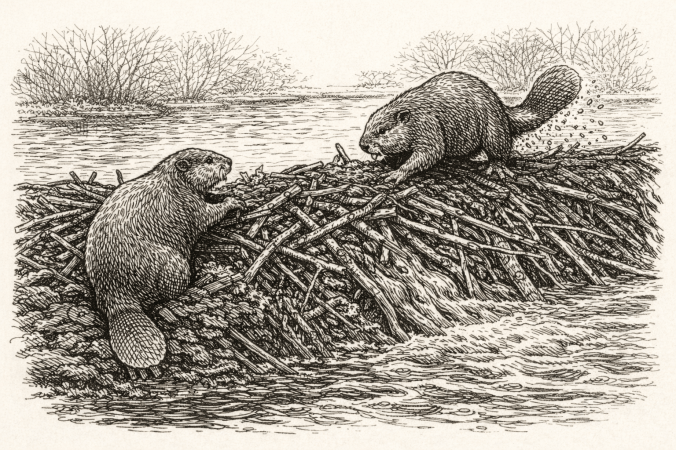
Witnesses describe a coordinated effort: one reinforcing the upstream side with freshly cut saplings and mud packed firm against vulnerable seams, the other hauling branches to widen the base and redirect the heaviest current toward a spillover channel carved late last autumn in anticipation of such a week as this.
At one point, a section near the eastern bank sagged visibly under pressure. Rather  than retreat, the pair set to work at once, layering cross-braced limbs and sealing gaps with a mixture of silt and leaf matter drawn from the pond’s shallows. Within the hour, the weakened section held.
By Thursday afternoon, water levels had stabilized just below the crest.
Blackberry Holler residents expressed confidence in the structure’s integrity, noting that the twins’ winter preparations — often dismissed by passersby as excessive — have proven timely.
One local farmer remarked, “They build like they mean to stay.”
No downstream flooding has been reported, though footpaths along the holler remain soft and are best approached with care.
Should temperatures continue to moderate, additional adjustments may be required in the coming days. For now, however, the pond stands, the current is managed, and the twins have returned to their steady watch along the banks.
In a week when much has shifted, it is no small comfort to see something held firm.
RUN ON BUCKETS REPORTED AT HENDERSON’S MERCANTILE
Leaky Roofs Send Residents Searching for Anything That Will Hold Water
If the thaw has revealed weakness in pasture and rail line alike, it has been no kinder to shingles.
Henderson’s Mercantile reports a brisk and somewhat unexpected run this week on metal buckets, wash tubs, and any vessel capable of catching what falls from 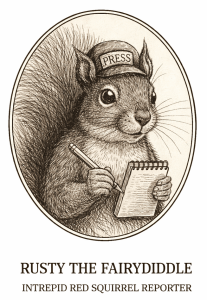 above. By Wednesday afternoon, the hardware aisle featured empty shelves, bereft of all things cylindrical and watertight.
Mr. Henderson, wiping rainwater from the brim of his own hat while offering this account, stated that demand began modestly on Monday and accelerated by midweek as snowmelt found its way through loosened flashing and tired rooflines across the countryside.
“It always drips in the same spot,” one customer was heard to remark, “until it doesn’t.”
Galvanized pails were first to disappear. Wash tubs followed. Even smaller kitchen basins found themselves reassigned from their usual domestic duties to ceiling-watch.
We have heard through the grapevine that more than one hat has been pressed into service as a last-minute solution beneath an inconvenient leak. One felt derby reportedly surrendered its shape in honorable duty somewhere near Upper Bottom Road. A straw boater, less structurally suited to the task, fared poorly.
At present, Henderson’s awaits delayed resupply, as muddy roads have complicated deliveries from beyond the region. In the meantime, residents are encouraged to rotate containers with vigilance and to avoid standing directly beneath questionable rooflines.
Whether this week’s precipitation will produce a secondary run on hats remains to be seen. The Gazette advises prudence — and perhaps a steady ladder — before surrendering one’s Sunday best to indoor weather.

EDITOR’S DESK
On Streets, Surfaces, and Sensible Preparation
— Clara Thimblewick, Editor
The recent thaw has provided Honey Hill Country with a most instructive reminder that what lies beneath us is as important as what stands above.
Snow is democratic in its arrival. It settles with equal charm upon porch railings and wagon tongues, lending all communities a similar appearance for a brief and agreeable time. The thaw, however, is far more particular. It reveals.
In Round Corners this week, several thoroughfares have displayed a certain softness of temperament, yielding to wheel and hoof alike in a manner that may be described as generous, though not especially convenient. Wagons have leaned. Boots have lingered. One may reasonably suggest that certain intersections have adopted a personality not originally intended by their planners.
It has not gone unnoticed that Packet’s Landing, having recently invested in the installation of cobblestone along its primary commercial street, has experienced fewer such entanglements. The stones, though initially regarded by some as ambitious for a river town, have held firm under the present persuasion of mud and melt.
This is not a matter for rivalry, nor for embarrassment. Communities grow at differing paces and in accordance with their own priorities. Yet it would be imprudent to ignore what the week has plainly demonstrated — that foresight, though sometimes costly in its beginning, often proves economical in the long run.
Round Corners has long prided itself on refinement. It may be that refinement occasionally benefits from reinforcement.
The Gazette does not presume to dictate municipal policy. It does, however, encourage thoughtful consideration while the lessons and reminders are still visibly fresh upon the boots of its readership.
The mud will dry. It always does.
Whether the memory dries with it, or serves to take a firmer step forward, remains to be seen.

Letters to the Editor
Our readers are invited to share their thoughts, observations, and neighbourly remarks. Letters may be shortened for space, but never for spirit.
To the Editor,
It has come to my attention that Round Corners, long reputed to be a town of discernment and quality, has this week more closely resembled a livestock demonstration in applied suction.
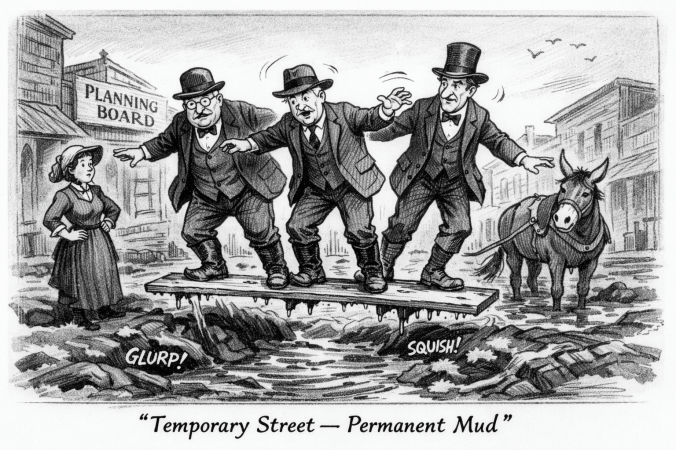
I observed three respectable gentlemen stranded upon a single plank near the mercantile, discussing drainage in tones more suitable to philosophy than to rescue. Meanwhile, a lady of evident composure was obliged to navigate the street as though testing porridge.
I ask only this: is mud now to be considered a permanent civic feature, or shall we one day aspire to streets that retain their character without retaining our footwear?
Respectfully,
A Resident Who Values Dry Ankles
To the Editor,
As a citizen of Packet’s Landing, I hesitate to speak, yet conscience compels me.
Our recently laid cobblestones, once regarded by certain neighbors upriver as an extravagant affectation, have this week borne up under traffic with admirable firmness. Wagons roll. Ladies proceed. Shoes remain intact on the feet of their owners.
I mention this not in pride but in hope — that investment in stone may, in time, prove less expensive than investment in replacement boots.
With neighborly regard,
One Who Has Crossed the Street Unassisted
To the Editor,
Sir,
I wish to report that mud does not discriminate.
On Tuesday last, I stepped from what appeared to be solid ground near Cattywampus Creek and found myself engaged in a depth study of local soil composition. My boots remain in that field, having elected to pursue independent residence.
In my retreat homeward, certain garments were subjected to conditions for which they were neither designed nor prepared.
Should any reader discover a pair of long undergarments of reputable manufacture but questionable current dignity somewhere between the lower bend and my cabin door, I would be obliged by their return.
I remain, in hopeful anticipation of warmer weather,
Chilly B. Bottoms
To the Editor,
Sir,
It is with restrained astonishment that I observe the present condition of certain streets within Round Corners, which I had previously understood to be intended for travel rather than trial.
While mud is a natural phenomenon and thus not, in itself, immoral, negligence in anticipating its arrival may fairly be categorized as preventable.
I have witnessed respectable citizens reduced to a manner of locomotion better suited to marsh birds than to upright society. Hats have been sacrificed. Gloves have suffered indignity. I am told that at least one individual was compelled to abandon footwear entirely in the public way, which raises questions not only of drainage but of decorum.
One cannot help but inquire whether the Planning Board, in its wisdom, accounted for gravity when considering street design. Water, I am reliably informed, tends to travel downward.
Packet’s Landing, whose recent adoption of cobblestone was met in some quarters with lifted brows and lowered expectations, now appears to possess both dry footing and the last word.
I trust that Round Corners will rise — figuratively if not presently literally — to meet the standard it so frequently proclaims.
Concerned, as ever, for the Maintenance of Proper Conditions,
Mrs. Silence DoBetter
The Gazette prints letters of interest to the community and does not inquire overly into the private identities of correspondents.– The Editor
A NEW EDITORIAL CARTOONIST JOINS THE GAZETTE
The Gazette is pleased to welcome Mr. Clarence “Clary” Moss to its staff as Editorial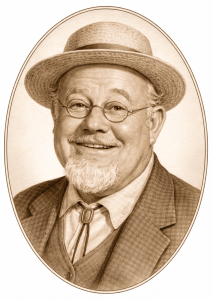 Cartoonist.
Mr. Moss brings a practiced eye for the small ironies of civic life and a steady hand in their illustration. His drawings will appear regularly, offering visual commentary on matters of local interest — with due regard for both humor and fairness.
We trust our readers will receive his work in the spirit in which it is offered.
Crops & Markets Report
By Virgil Stone
The week’s thaw has complicated travel but has not materially unsettled the markets.
Corn holds steady at prior valuation, with most local stores drawing from reserves laid in before the last storm. Oats show modest firmness, owing in part to delayed deliveries along muddied approaches, though no lasting shortage is anticipated should roads regain their manners by midweek.
Hay remains dependable, with several farmers reporting that winter stores were better provisioned this year than last.
Livestock prices are unchanged, save for a slight upward interest in sound breeding stock — a reminder that spring, however distant it may feel underfoot, remains on schedule in the calendar.
Eggs are scarce but honest.
Butter trades quietly. Sorghum steady.
A brief interruption in freight service through Clevenger Gap has slowed some shipments beyond the region, though rerouting is expected to mitigate prolonged delay.
Local buyers are advised patience in both purchasing and transport, as teams move cautiously along softened ground. Mud, while inconvenient, does not negotiate with urgency.
Market Notes:
– Seed orders for early planting have begun to appear at the mercantiles, suggesting optimism persists despite present conditions.
– Several farmers report fencing repairs postponed until footing improves.
– One prize Hereford, recently extracted from an unsuitable pasture location, is said to be recovering his composure.
As ever, markets favor preparation and steadiness. The thaw will pass. The ground will firm. Those who have planned accordingly are unlikely to find themselves surprised by either.
— Virgil Stone
Hillside Chronicles
By Silas Thorne
The thaw has reached even the smallest of us.
On Wednesday morning, while making my usual circuit along the edge of the lower ridge, I came upon a chipmunk engaged in what may be described as determined diplomacy with the present condition of the earth.
He had chosen — unwisely, though with confidence — a route across a patch of ground that had been firm only days before. The snow’s retreat had left behind a surface that appeared settled but proved otherwise under modest weight. The first two bounds were successful. The third, in hindsight, was ill-advised.
It is a curious thing to watch a creature accustomed to lightness encounter resistance.
The chipmunk paused mid-stride, forepaws lifted, hind feet held fast in a manner not anticipated. He turned around to find his lower parts buried up to his tail in mud.
There followed a brief but vigorous struggle involving tail balance, rapid readjustments, and what I can only describe as a thoughtful glance at the sky, as though petitioning it for both explanation and assistance.
The mud, for its part, remained unmoved.
After several industrious attempts, the small traveler altered his approach. Rather than continue forward, he leaned back, redistributed his weight, and made a cautious retreat along his own tracks — each step tested before being trusted — in backwards fashion like a crab carefully inching its way backwards.
Once back to firmer ground, he sat upright, whiskers forward, surveying the terrain as though taking notes for future reference. His next crossing was accomplished by means of a fallen branch — an elevation chosen not for elegance but for practicality.
It occurred to me then that winter conceals much, and spring reveals more than flowers.
Paths that seemed certain may soften. Ground that carried us easily last week may require revision this one. Even the smallest among us must sometimes abandon forward ambition in favor of measured retreat.
By afternoon, the sun had done its quiet work, and the patch in question had begun to firm again.
The chipmunk returned, crossed without incident, and continued on his business as though nothing at all had transpired. But wiser for the experience.
— Silas

Farm & Home — Notes From the Farm & Field
By Myrtle Mae Meadowbloom
On Candling Eggs, And Why It Matters
The hens have been faithful through the cold, though not as generous as they are come April.
In winter, every egg counts.
That is why, before any egg makes its way to skillet or market basket, it ought to be examined by light. Candling is not new, nor complicated, but it is often neglected when chores are many and daylight short.
The principle is simple. Hold the egg before a steady flame or lantern in a dim room. The light will pass through the shell and reveal what the eye alone cannot see.
A sound egg will show clear and bright inside, with a small, steady air pocket at the larger end. The yolk may shift gently when turned but should not float loosely. If the interior appears cloudy, mottled, or overly dark, the egg has overstayed its welcome.
Winter eggs, particularly, may vary. Hens lay less frequently in the cold, and an egg that sits unnoticed in straw too long may not announce its decline until cracked — which is not the moment one wishes to discover it.
Candling also allows one to observe shell quality. Thin shells, common when hens lack  sufficient grit or calcium, will glow unevenly and often appear fragile at the edges. A handful of crushed oyster shell added to the feed trough can remedy much.
Those who sell or trade eggs owe their neighbors this courtesy. Those who cook for their own table owe themselves the same.
A lantern and a steady hand are all that is required. It is a small effort, and it prevents a larger disappointment.
Spring will bring abundance. Winter requires attention.
A Closing Thought:
Good tending is rarely complicated. It is simply the habit of looking closely before moving on.
— Myrtle Mae
ANNUAL VALENTINE’S DAY DANCE
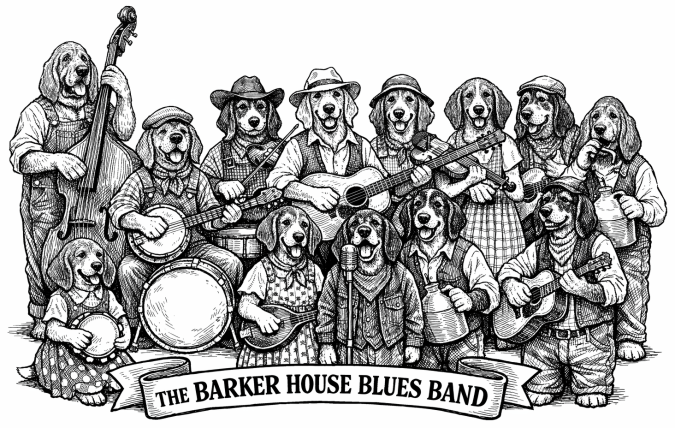
Saturday Evening, February 14
Whispering Pines Meeting House
Mud or No Mud — Music Will Be Made!
FEBRUARY FROST DAYS CHILI COOK-OFF
Saturday, February 21
Packet’s Landing Commons
Preparations are underway for next Saturday’s annual February Frost Days Chili Cook-Off, to be held at Packet’s Landing Commons.
Returning to defend his title is three-time champion Buck Thornberry, proprietor of the Old River Road Smokehouse in Packet’s Landing. Mr. Thornberry’s recipe — closely guarded and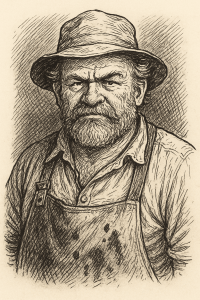 vigorously debated — has carried him to repeated victory, and he remains the odds-on favorite to claim the ladle once more.
Competitors from Round Corners, Butterfield, and as far as Snow Hill are expected to enter. Judges will evaluate based on flavor, consistency, aroma, and fortitude.
Mr. Thornberry was seen earlier this week standing ankle-deep in mud while tending a pot with the seriousness of a man who understands reputation is both earned and defended.
Registration remains open through Thursday. Participants are encouraged to account for muddy travel conditions when transporting their entries.
Spectators are advised to arrive hungry.
Community Notices & Small Tidings
Items of interest from Honey Hill Country and nearby hollers. Notices are printed as received and offered in good faith.
• Several businesses across Honey Hill Country remained closed for part of the week following the recent snowfall and now muddy conditions.
• Merchants in Round Corners and Butterfield report that a number of re-supply orders were still held up by weather-related travel disruptions. As a result, certain staple goods have run low, with shelves expected to be restocked once rail and wagon traffic returns to regular schedules.
• Meetings and gatherings planned for early in the week were widely postponed or canceled again, including lodge meetings, church socials, and club assemblies. Organizers indicated that rescheduling will be announced once conditions allow for reliable travel.
A Small Reminder
If you have a notice to share — a gathering, a need, a thank-you, or a simple word worth passing along — you may leave it with the Editor by letter or in person. Space is limited, but goodwill is not.
Meeting Notices & Postponements
Owing to continued difficult travel conditions, a number of meetings and gatherings scheduled for the past week were postponed or canceled.
Organizers across the region state that notices of rescheduled dates will be posted once roads clear and regular travel resumes.

Classifieds
Notices are printed as submitted. Replies may be made discreetly, or not at all.
WANTED — LONG UNDERWEAR. LOTS.
Still seeking thermal, flannel, wool, or otherwise respectable long johns. Must cover knees at a minimum. Immediate need. Discretion appreciated.
— C. B. Bottoms, High Hill
FOR SALE OR TRADE — WOOD STOVE.
Older model, sound and serviceable. Recently removed from summer kitchen. Buyer to arrange hauling once roads allow. Will consider trade for feed or dry split wood.
— Inquire at Gazette Office
FOR SALE:
Two pairs gentleman’s boots, lightly used, recently recovered from Lower Meadow. Thorough cleaning recommended. Inquire at Henderson’s Mercantile.
LOST:
One felt hat, dark brown, last seen demonstrating civic concern near Main Street. Return to Gazette office.
WANTED:
Dry firewood, split and seasoned. Must not resemble sponge upon inspection. Leave word at Planters Feed & Seed, Butterfield.
NOTICE:
Person or persons discovering a pair of long undergarments in respectable but fatigued condition somewhere between Cattywampus Creek and Upper Bottom Road are kindly requested to deliver them discreetly to the cabin of Chilly B. Bottoms in High Hill. No questions asked. Or answered.
A Small Reminder
Classified notices may be left with the Editor in person or by letter. Brevity is appreciated. Honesty assumed.

Country Chuckles
By Cousin Orville P. Dithers
Hickory Pinenut and the Matter of the Mud
Hickory Pinenut has always maintained that he knows the land at High Brush Farm “like the back of his own hand,” which begs one to wonder why he is so frequently surprised by it.
On Thursday morning, confident in both his footing and his schedule, Hickory set out for Round Corners with what he described as “a modest list and a hopeful disposition.”
The disposition did not survive the first low stretch of road.
Witnesses report that Hickory’s wagon entered a patch of mud with cautious optimism, only to be lodged in a quagmire of disappointment. One wheel sank. Then the other, as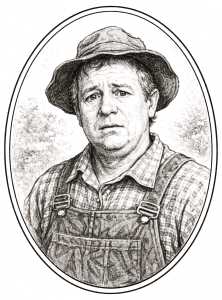 though not wishing to be left out of events.
Hickory climbed down to assess the situation, which is when his boots made what might generously be called a long-term commitment to the soil.
He tugged once. He tugged twice. On the third attempt, he achieved freedom of motion in everything but footwear.
It was at this moment that the wagon horses, observing the proceedings, adopted expressions suggesting they had seen this pattern before.
 By the time assistance arrived — summoned less by alarm than by familiarity — Hickory stood ankle-deep in reflection, holding one liberated bare boot and regarding the other as though it had betrayed him personally.
The wagon was eventually freed. The boots were recovered. Socks not. The list, though dampened in spirit, survived.
Hickory was later heard to remark that mud is “a persuasive negotiator” and that next year he may consider conducting February business by correspondence.
High Brush Farm and Ol’ Hickory report no permanent damage beyond dignity, which, according to neighbors, has always been resilient.
— Cousin Orville
Heart of the Holler
When the Wagons Would Not Come In
By Abigail “Abby” Whitcombe
By late Thursday afternoon, the wagons had given up.
Three of them, freight wagons heavily loaded with dry goods, flour, lamp oil, and sundry necessities bound for the general stores, found themselves stalled just beyond the eastern edge of Round Corners where the road bends low and lingers longer than it should.
The drivers had tried patience. They had tried coaxing. One had tried optimism.
The mud declined all three.
Word traveled the way it does in small towns — not by announcement, but by noticing. A boy sent on an errand saw the wheels half-sunk. A woman hanging linens observed the stalled teams. A shopkeeper, counting dwindling stock, stepped outside and understood at once.
Lizzy Whitaker was among the first to reach the bend.
 She did not arrive with instruction. She arrived with sleeves already rolled.
Soon after came others — some curious, some concerned, none empty-handed for long.
A few men unhitched the horses and mules, leading them carefully to firmer footing. Two of the stronger fellows began shifting heavier crates onto the animals’ backs, cinching loads with practiced knots.
The rest required no coordination.
One by one, and then two by two, townsfolk stepped forward and lifted what they could.
A sack of flour.
A crate of tinned goods.
A parcel of lamp oil wrapped twice for safety.
Bolts of fabric balanced against shoulders not meant for freight.
Ladies who might ordinarily have crossed the street to avoid the worst of the muck found themselves wading straight through it, skirts gathered, boots surrendering their polish without protest. Trousers darkened. Gloves sacrificed their cleanliness. A hat or two reconsidered its place in the world.
No one mentioned inconvenience.
They simply carried.
Down the street.
Across the plank.
Up to the mercantile doors where shelves stood waiting.
The line formed naturally — a quiet procession from wagon to storefront — until the loads were lighter, the wheels less burdened, and the bend in the road relieved of its obligation.
By dusk, the shelves were stocked.
The wagons, though mud-splattered and chastened, stood empty. The town, though equally soiled, stood satisfied.
Lizzy was seen later brushing dried clay from her hem with an expression that suggested the effort had cost less than it had given.
In a week when much refused to move, Round Corners discovered that sometimes the only way forward is move — together — one sack, one crate, one muddy step at a time.
— Abby W.


Front Porch Reflections
Mucky, Marshy Muds March On
It has been a muddy week in Honey Hill Country.
Snow arrived in record measure, laying its quiet blanket across rooftops and ridgelines as though determined to prove winter’s authority. Then came the cold — sharp, insistent, and well below what most of us would have chosen for comfort. And finally, as though not content with either spectacle or severity, the thaw.
The thaw is honest. It reveals what holds and what does not.
Wagons stuck. Boots surrendered. Roofs dripped. Rails shifted. Even a prize Hereford found himself reconsidering his footing. It would be easy to say that Mother Nature and Old Man Winter had conspired together this week to test the patience of every soul from Snow Hill to Packet’s Landing.
And perhaps they did.
Yet what remains most noticeable is not the mud itself, but the manner in which it was met.
A bull mired in pasture required someone to step forward and take him by the horns. 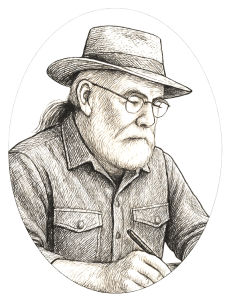 Wagons stalled at the bend required hands willing to lift and carry. A beaver dam demanded reinforcement. Rooflines called for buckets. Streets invited reconsideration. Even a small chipmunk learned to retreat and try again from firmer ground.
In one way or another, each of us was presented with something that would not move unless we did.
Sometimes in life the phrase is only a figure of speech. This week, it was not.
There are seasons when we are snowed in. There are days when we are frozen stiff. And there are weeks when the ground beneath us turns soft and uncertain, and we must decide whether to use up our time complaining about it, or to climb, crawl, and pull our way through to the other side.
It is rarely graceful.
It is often messy and muddy.
But we get through it.
We hold on. We manage what we can. We lend a hand where needed and accept one when offered. We steady what wobbles. We lift what sinks. We take hold of what must be faced and do not let go until it yields.
The sun will shine again. It always does.
The ground will firm. The ruts will settle. The planks will be removed, and boots will dry by the door.
Until then, we do what we have always done.
We step forward.
We take the matter by the horns.
And we keep going.
We will see you again next Saturday.
— Jim (and Red!)
The Hearth & Holler Gazette is a work of fiction, created for entertainment and storytelling purposes. The people, places, events, and notices appearing within its pages are imagined, and any resemblance to actual persons or events is purely coincidental.
© 2026 James Milson. All rights reserved.
Pen-and-ink illustrations created with the assistance of AI and lovingly styled for Little Red Bear Land.
Would you prefer Coffee or Tea with your newspaper?

 James Milson - The Writing Pages
Thanks so much, and so happy to hear you are enjoying the Gazette each week! Comments came thru loud and clear! 🤠 🐻 ❤️
LikeLike
Let’s see how this comment comes through about your wonderful newspapers, James and Little Red Bear. Keep up the great work. I’m really enjoying these. 🙂
LikeLiked by 1 person