A Weekly Visit of Tales, Tidings, and Old-Time Country Comfort
Welcome!
It’s been a noisy week in Honey Hill Country.
Not troublesome noise, mind you — nothing of the sort — but the cheerful kind that arrives when rabbits outnumber common sense and every available square foot of Butterfield seems determined to host a race, a cook-off, a judging table, or a parade that may or may not have been planned in advance. March Madness Days are now fully underway, and the countryside has answered with enthusiasm, energy, and an astonishing number of competitors who appear convinced that ribbons, bragging rights, and possibly pie are within reach if they simply run fast enough.
As always, The Hearth & Holler Gazette is a work of fiction set in a place that exists most clearly in the imagination — though from time to time it may resemble somewhere you have known. But for first time visitors, it may help to know where — and when — we are, and what I am talking about
The Hearth & Holler Gazette hails from Honey Hill Country, a small, rural corner of the Missouri Ozarks, as it might have been known in the year 1904 — a time of front porches and wagon roads, oil lamps and handwritten letters, when news traveled at a human pace, and a Saturday paper was meant to be read slowly, with coffee close at hand. This is not a paper of breaking news or loud headlines. It prefers instead to notice it — the small, human-sized moments that once filled a morning without asking much in return.
The Hearth & Holler Gazette is a work of fiction — a made-up paper from a made-up place, written in the spirit of an earlier time. Any resemblance to real towns, people, or events is entirely coincidental, though we do our best to make it feel otherwise.
This must be understood at the beginning — the towns, fields, and citizens described here exist only within these pages. With that firmly agreed, the small and ordinary wonders of the week may unfold as they will. That is the way of things here. That is all we need to know, and that ought to be enough.
With that firmly understood, we may proceed to the week’s news — which presently includes athletic contests, decorated burrows, culinary triumphs, minor athletic injuries, an unscheduled victory on Cedar Lane, and a new invention producing a sound that can now be heard echoing across several hollers at once.
Hold on to your top hat.
So, with that said — Please come on in. Your paper awaits . . . . . .
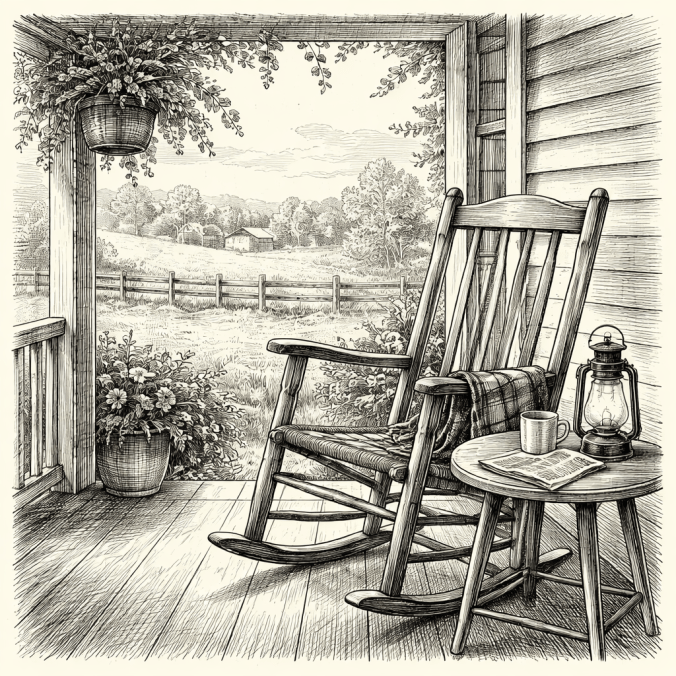
And would you prefer Coffee or Tea with your newspaper?
THE HEARTH & HOLLER GAZETTE
Sharing Stories and Smiles from Little Red Bear’s World
— A Weekly Visit of Tales, Tidings, and Old-Time Country Comfort —
Serving Honey Hill, Hopper’s Holler, and Beyond | Est. 1904
Saturday Morning Edition
March 07, 1904
Honey Hill Country • Cricket Hollow County
Vol. I — No. 7
Price: Five Cents (If You Have It) • Free to Read (If You Do Not)
Published Weekly on Saturday Mornings
From the Front Porches, Back Rooms, Kitchens, Workshops, Hillsides, and Quiet Corners of Honey Hill Country
MARCH MADNESS DAYS BRING RABBITS AND RACKET
“Carrozelas Sound Across Honey Hill Country as March Madness Days Reach Full Roar!”
Local News from Around the Holler
Filed by Percival “Percy” Puddlesniff, News-Hound
With Field Notes from Rusty the Fairydiddle, Roving Reporter
CARROZELAS SWEEP MARCH MADNESS DAYS
Tin Horn Craze Echoes Across Honey Hill Country as Rabbits Lead the Charge
Butterfield has known lively parades before.
Butterfield has known noise before.
Butterfield has hosted picnics, band concerts, election speeches, and one memorable mule auction that could be heard nearly to Snow Hill.
Yet even the oldest residents admit that nothing in recent memory has produced quite the sound presently rolling across the hollers.
Nothing.
The source of this sound is a new noisemaker now being carried by nearly every young rabbit attending March Madness Days.
They are called Carrozelas (care-oh-ZAY-lahs).
Fashioned from rolled tin and shaped unmistakably like long carrots, the horns emit a loud, droning buzz when blown with sufficient enthusiasm — which,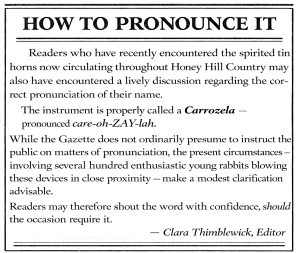 judging from current conditions, appears to be the only manner in which they are ever blown.
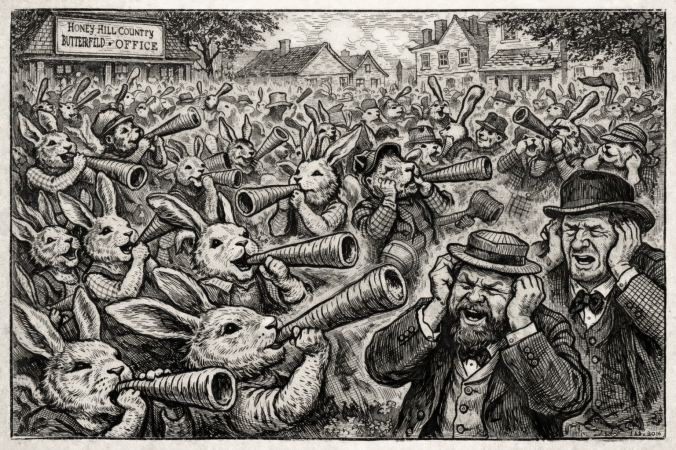
When sounded together, the effect resembles a hive of determined bees echoing through the valley.
The horns first appeared during the opening parade earlier in the week. By the following afternoon they had spread through Butterfield Square, and by Wednesday evening general stores throughout the area were reporting a steady stream of young customers determined not to be the only participant without one.
Several merchants report selling every available horn within hours.
One storekeeper remarked that he had scarcely finished unpacking a new crate before it disappeared again into eager hands.
Local tinsmiths have responded with admirable industry. Shops that normally devote their work to lanterns, roof flashing, and stove fittings are now turning out the carrot-shaped horns in remarkable numbers, cutting and rolling thin sheets of tin as quickly as hands can manage.
One smith was heard to remark that he had not worked this steadily since the last barn-raising season.
Despite these efforts, supply continues to lag behind demand.
Young rabbits can be seen throughout Butterfield marching between events with Carrozelas tucked beneath their arms, sounding them at the start and finish of races, cook-offs, burrow judging ceremonies, and nearly any moment that appears to benefit from additional excitement.
The results have been enthusiastic.
They have also been loud.
Barty Hopperson, who is attempting to oversee the various athletic contests taking place across several venues, admitted Thursday afternoon that the horns have made it “somewhat difficult” to determine precisely when a race has begun.
“In a normal week,” he explained, “one listens for the starting whistle. At present, there are approximately two hundred whistles.”
Several judges have taken to waving hats, flags, and in one case a dishtowel in an effort to restore order.
Even so, most residents appear to regard the phenomenon with amusement.
The horns have quickly become a symbol of the week’s festivities, sounding from  parade routes, contest grounds, and occasionally from porch railings where younger celebrants practice their technique with admirable dedication.
One citizen described the sound drifting across the valley at dusk as “the countryside humming to itself.”
Whether the Carrozela craze will quiet once March Madness Days conclude remains uncertain.
For the moment, however, the sound of tin horns continues to echo from Butterfield Square to the surrounding ridges — a reminder that when rabbits celebrate, they seldom do so quietly.
Shops Turn From Roof Flashing to Festival Horns
The sudden popularity of Carrozelas during this week’s March Madness Days has created an unexpected boom for local tinsmiths throughout Honey Hill Country.
Workshops that ordinarily produce lantern fittings, stovepipe sections, roof  flashing, and household repairs have turned their attention almost entirely to shaping the carrot-shaped horns now heard across Butterfield Square and neighboring settlements.
Several craftsmen report that orders have arrived faster than finished horns can be delivered.
Thin sheets of tin are cut, rolled, and soldered into the distinctive trumpet shape before being fitted with small mouthpieces and a flared bell. The process is simple but time-consuming, and the demand from eager young celebrants has kept many smiths at their benches late into the evening.
General stores throughout Butterfield, Round Corners, and nearby communities report that new shipments often disappear within hours of arriving.
One tinsmith remarked that he had not cut so much tin in a single week “since the last barn-raising season.”
For the moment the steady ringing of hammers and the buzzing of Carrozelas appear likely to continue side by side as March Madness Days carry on.
HOG WINS CEDAR LANE SPRINT
Hickory Pinenut’s Escaped Hog Crosses Finish Line Ahead of Competitors
Confusion briefly interrupted the otherwise orderly proceedings of March Madness Days on Thursday afternoon when an unexpected competitor entered the Cedar Lane Sprint and proceeded to win the race.
The competitor in question was a hog belonging to Hickory Pinenut of High Brush Farm.
Witnesses report that the animal had escaped its enclosure earlier in the day, prompting Mr. Pinenut to pursue it through the woods and over several hills in determined fashion.
The chase continued for some distance before the hog, still traveling at notable speed, burst from the treeline near Cedar Lane at the very moment contestants were assembling for the start of the race.
Exactly how the animal arrived at the starting line remains the subject of lively debate.
What is certain is that when the starting signal was given, the hog surged forward with remarkable determination and ran the full length of Cedar Lane, crossing the finish line a length and a half ahead of the nearest competitor.
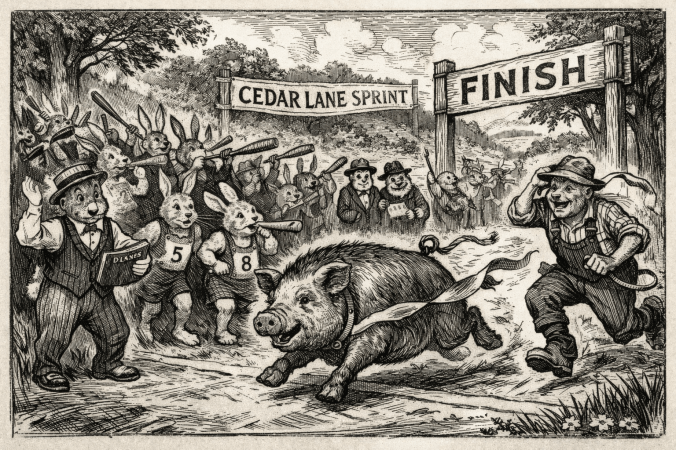
The crowd erupted.
Young rabbits immediately began sounding their Carrozelas in protest, while many human spectators cheered both the hog and the breathless Mr. Pinenut, who arrived moments later still in pursuit.
The judges, however, faced a complication.
The hog had not officially entered the race and was not wearing a competitor’s number.
This distinction proved important to the rabbits in attendance, who continued to sound their Carrozelas vigorously in what appeared to be a protest on behalf of their fellow rabbits originally entered in the race.
Event organizer Barty Hopperson, now positioned squarely between the rulebook and the crowd, conferred briefly with the judges while the horns of the assembled rabbits created a noise described by one spectator as “a swarm of bees arguing with a brass band.”
After several minutes of spirited discussion, Mr. Hopperson announced a compromise.
The hog and Mr. Pinenut would be awarded an Honorable Mention Ribbon for Exceptional Enthusiasm and Speed, while the official race would be run again with properly registered competitors.
This solution was greeted with a somewhat subdued cheering from the human spectators and an animated chorus of Carrozelas from the rabbit section.
The race was then restarted without further incident.
Mr. Pinenut later confirmed that the hog has been safely returned to High Brush Farm, where additional precautions are reportedly being taken to prevent future competitive appearances.
Several observers nevertheless remarked that the animal’s performance will likely be remembered as one of the most impressive runs of the week.
Unconfirmed reports suggest the hog may now hold the unofficial Cedar Lane speed record.
LOCAL PHYSICIAN BUSY AS MARCH MADNESS DAYS CONTINUE
Minor Scrapes, Pulled Muscles, and Competitive Enthusiasm Fill the Waiting Room
Dr. Jefferson “Doc” Adams, whose office stands beside Myra Cookson’s Pie Pantry & Goodies Shoppe in Butterfield, reports a steady stream of visitors this week as March Madness Days continue across Honey Hill Country.
Fortunately, the ailments have been of the minor variety.
Most cases have involved pulled hamstrings, twisted ankles, bruised elbows, and the occasional over-enthusiastic hop, all brought about by the vigorous athletic contests now underway.
In addition to assorted scrapes and contusions, other common ailments so far  include bruised pride and a few cases of competitive overconfidence.
Doc Adams noted that the competitors appear to be in otherwise excellent health.
“High spirits are doing most of the damage,” he remarked with a smile while preparing a fresh bandage.
Several young rabbits arrived together following a particularly spirited relay race, each insisting the other had been responsible for the fall that sent them tumbling into a patch of early spring grass.
Another competitor appeared with what the doctor described as “a dramatic but harmless collision with a fencepost.”
The waiting room has reportedly remained cheerful despite the steady traffic, with athletes comparing race results, cook-off strategies, and the latest rumors surrounding the Carrozela craze that has swept the Square.
Doc Adams expressed confidence that most competitors would return to their events shortly.
“A bit of rest and a proper bandage,” he said, “usually sends them right back to the starting line.”
Doc Adams advises stretching before races and remembering that “despite their obvious health benefits, carrots are not worth the pain of pulling a muscle over.”
Residents are reminded that Dr. Adams’s office remains open throughout the week should further excitement require professional attention.
EDITOR’S DESK
— Clara Thimblewick, Editor
The present week has brought an unmistakable sign that March Madness Days have truly arrived in Honey Hill Country.
This sign does not appear in the form of banners, nor in the number of rabbits gathering in Butterfield Square, though both are plentiful.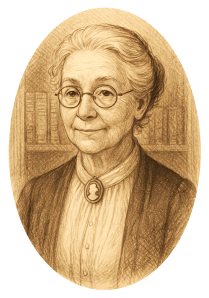
Rather, it arrives in the form of a most energetic instrument now known widely as the Carrozela.
From morning until evening, the cheerful horns may be heard sounding from parades, contests, cook-offs, and occasionally from locations suggesting that a young rabbit has discovered the admirable echo produced by blowing one beside a barn or fence.
Some readers have written to inquire whether such enthusiasm might be considered excessive.
It must be admitted that the sound carries remarkably well.
Nevertheless, it is worth remembering that a town celebrating together is rarely a quiet place.
Festivals are not designed for silence.
They are designed for laughter, competition, and the joyful disorder that follows when neighbors gather for the simple purpose of enjoying one another’s company.
If, in the course of such celebrations, a few hundred Carrozelas happen to be sounded at once, it may be taken as a sign that the spirit of the occasion is fully understood.
And if the horns should continue for another day or two, one suspects Honey Hill Country will survive the experience.
Indeed, it may even remember it fondly.
— C.T.


Letters to the Editor
Our readers are invited to share their thoughts, observations, and neighbourly remarks. Letters may be shortened for space, but never for spirit.
To the Editor,
On the Subject of Noise
Madam Editor,
While I appreciate a lively community celebration as much as the next citizen, I must respectfully observe that the recently introduced Carrozela appears capable of producing a volume of sound that might reasonably be heard in neighboring counties.
Yesterday afternoon I counted no fewer than seventeen of these instruments being sounded simultaneously within sight of my front gate.
At one point I briefly suspected that a swarm of unusually musical bees had descended upon the neighborhood.
I trust the festivities will conclude before the bees themselves begin lodging formal complaints.
Respectfully submitted,
Mrs. Silence DoBetter
Round Corners
To the Editor,
Rabbits in All Directions
Dear Editor,
I write only to remark that during the present March Madness celebrations one cannot walk across Butterfield Square without encountering rabbits engaged in some form of athletic training.
They are hopping across roads, leaping fences, practicing jumps, and blowing carrot-shaped horns with admirable enthusiasm.
While I commend their spirit, I confess that yesterday I nearly stepped upon three contestants who appeared to be warming up for something called a Grand Hop-Off.
At present I am proceeding about town with a degree of caution normally reserved for crossing a busy rail yard.
Yours in careful walking,
Harold P. Weatherby
Butterfield
To the Editor,
Regarding Certain Winter Garments
Editor,
I had hoped to devote this week’s letter to the continued search for a respectable pair of longjohns, the matter having thus far proven more complicated than anticipated.
However, the present festival conditions have introduced a new concern.
The constant blowing of Carrozelas has created such a breeze of excitement throughout town that I now find myself wondering whether the matter of warm undergarments may soon resolve itself by the simple arrival of spring.
Should this occur before I locate the aforementioned garment, I shall consider the matter settled by Providence.
With cautious optimism,
Chilly B. Bottoms
To the Editor,
A Word in Favor of the Carrozelas
Editor,
I have read the recent remarks concerning the noise produced by Carrozelas and wish to offer a different opinion.
I believe the sound is cheerful, spirited, and entirely appropriate for a celebration of this size.
Besides, if a fellow cannot make a little noise during March Madness Days, when exactly would be the proper time?
Sincerely,
A Friend of Festivities
(Name cheerfully withheld)
To the Editor,
Three More Cents for the School Roof
Dear Miss Thimblewick,
Last week you printed that I was saving money to help fix the roof on the schoolhouse.
This week I earned three more cents by helping Mr. Hollister shovel out a stall in his barn after his mule made a very determined effort to fill it.
It took most of the afternoon.
Mr. Hollister said the mule seemed quite proud of the work he had done.
I had twelve cents in my jar already, and last week I earnedfour more cents, so now with the three I made this week I have nineteen cents altogether for the school roof fund.
I will keep working when I can.
Respectfully,
Thomas Hale, Age 9
Butterfield
The Gazette prints letters of interest to the community and does not inquire overly into the private identities of correspondents.– The Editor

EDITORIAL CARTOONS — by C. “Clary” Moss
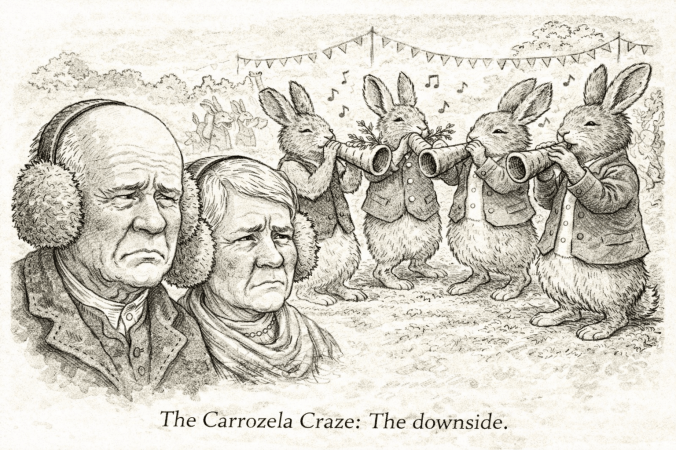
Each week, Mr. Moss offers a pen-and-ink observation of life in Honey Hill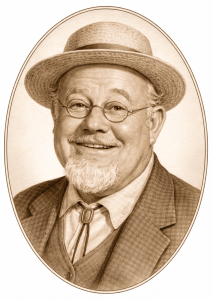 Country. This week’s illustration accompanies the ongoing discussion regarding the Butterfield Schoolhouse roof.
Mr. Moss brings a practiced eye for the small ironies of civic life and a steady hand in their illustration. His drawings will appear regularly, offering visual commentary on matters of local interest — with due regard for both humor and fairness.
We trust our readers will receive his work in the spirit in which it is offered.
Crops & Markets Report
By Virgil Stone
Market activity across Honey Hill Country has quickened noticeably with the arrival of milder weather and the ongoing celebrations of March Madness Days.
Merchants report steady movement in flour, sugar, and other baking staples, owing largely to the many cook-offs and gatherings taking place throughout the region this week. Farm families appear to be making generous use of their winter stores, particularly where festival cooking is concerned.
One vegetable in particular has become surprisingly scarce.
Local supplies of carrots have thinned rapidly as cooks prepare stews, pies, breads, and other entries for the various festival competitions now underway. Several growers note that bins which ordinarily last well into early Spring have emptied sooner than expected.
A different sort of shortage has appeared in the trades.
Demand for tin has risen sharply due to the sudden popularity of the carrot- shaped festival horns now commonly known as Carrozelas. Tinsmiths throughout the area have turned much of their recent effort toward producing the noisemakers, leaving less material available for ordinary work such as lantern repairs, stovepipe fittings, and roof flashing.
Some merchants report that sheets of workable tin are now selling at prices noticeably higher than they were only a fortnight ago.
Despite these temporary shifts, most farm goods remain steady in value, and traders expect normal Spring planting supplies to remain available as river traffic gradually resumes along the Mississippi routes to the north.
As always, farmers are advised to keep a careful eye on their remaining winter stores while the season makes its slow turn toward planting time.
— Virgil Stone

Hillside Chronicles
By Silas Thorne
These past few days have given the hills a bit of a head start toward Spring — though the season itself has not quite settled on the matter.
The mornings have arrived warmer than one would normally expect for this time of year. The sort of warmth that makes a man pause on the porch a moment longer before heading about his work, just to see what the air intends to do next.
But each mild stretch has been followed, sooner or later, by a brisk cold front rolling over the ridges.
When those colder winds meet the warm ground and damp air, the result has been a run of early thunderstorms — quick-moving affairs that sweep across the hollers with a burst of rain, a few lively rumbles, and then pass along as though they had somewhere else to be.
The land, it must be said, has welcomed the rain.
Creeks that had been running low through much of the winter are beginning to speak again, and the soil has taken on that dark, loosened look which tells a farmer the ground is waking from its long rest.
The only difficulty, if it can be called one, is the mud.
Every road in the countryside seems to have found its softest condition all at once. Wagon wheels settle deeper than expected, boots collect a good deal of  honest earth, and more than one traveler has discovered that a short walk across a pasture can become a longer journey than originally planned.
Still, there are worse troubles to have.
A wet field in March often proves a generous one in July.
And if the storms continue to visit now and then, the hills may yet enter the planting season in better spirits than they have shown for some time.
Spring rarely arrives with much patience.
But it does tend to knock on the door a few times before it finally comes inside.
And on certain mornings now, when the air turns suddenly cool after a warm rain, a man standing near the creek may notice thin ribbons of steam fog rising quietly from the water, as though the hills themselves are stretching and breathing again after the long winter sleep.
— Silas

Farm & Home — Notes From the Farm & Field
By Myrtle Mae Meadowbloom
One does not have to look far this week to see that carrots have taken on a certain importance in Honey Hill Country.
Between the cook-offs, the carrot-shaped festival horns now sounding across Butterfield, and the many young rabbits who appear to have developed an increased interest in the vegetable, it is fair to say that carrots are enjoying a moment of recognition.
Several grocers have even remarked that their usual winter supply has been thinning rather quickly — though whether the cause is festival cooking or enthusiastic rabbit appetites remains open to friendly debate.
For the gardener, however, carrots have always held an honorable place in the spring garden.
They are dependable, nourishing, and well suited to our soil when the ground has been properly prepared.
The secret to a fine carrot harvest is not the seed, but the soil.
Carrots prefer earth that has been worked deep and made loose, free from stones and heavy clods. When the ground is packed or stubborn, the roots must twist and turn as they grow, and the result is a carrot that resembles a walking stick more than a proper vegetable.
A bed that has been gently loosened and cleared of rocks will reward the patient gardener with long, straight roots and a sweeter flavor besides.
Early spring is an excellent time to prepare such ground.
Even if planting must wait for a warmer stretch of weather, the soil may be turned and allowed to settle for a few days in the sun. A little wood ash or well-rotted compost worked lightly into the top layer will often improve the condition of the bed.
When the seeds are finally sown, it is best to scatter them thinly and cover them  only lightly. Carrot seeds are small and should not be buried deeply.
With a bit of patience, small feathery tops will appear soon enough.
From that point forward the main task of the gardener is simple: keep the rows thinned, the soil loose, and a careful eye on any rabbits who may take an interest in the proceedings.
In my experience, rabbits possess a remarkable talent for discovering the exact moment when a carrot has reached its finest stage of development.
Fortunately, there is room in a good garden for both careful growers and appreciative visitors.
A Closing Thought
A garden rarely gives its best to hurried hands.
But it almost always rewards the ones that take their time.
— Myrtle Mae

Fleet on the Field
By Fleetwood “Fleet” Hopperson
March Madness Days athletic contests opened this week before one of the largest and loudest crowds Butterfield Square has seen in recent memory.
Spectators filled fences, wagon rails, and nearby hillsides while what must surely have been several hundred Carrozelas sounded at once — a festive buzzing so enthusiastic that officials were occasionally obliged to delay the start of events until the horns subsided enough for the judges’ whistles to be heard.
The opening competition, the Annual Grand Hop-Off, tests both power and judgment. Contestants must cross the marked field course using the fewest hops possible, a feat requiring tremendous leg strength and careful timing.
This year’s standout effort came from Crispin Longstride of Copper Creek County, who crossed the course in nine powerful hops, drawing a roar from the crowd and a celebratory burst of Carrozelas that briefly halted proceedings.
Despite the impressive showing, the long-standing record of eight hops, set years ago by the legendary Bartholomew “Big Hop” Thistlewick, remains unbroken for another season.
The excitement carried directly into the Long Jump, where a new champion emerged.
After several promising attempts, Juniper Fleetfoot of Cedar Ridge Hollow launched an extraordinary leap measured at 14 feet, 7 inches, surpassing the 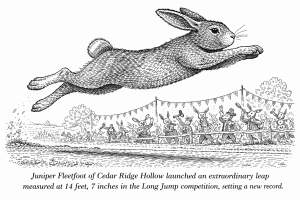 previous record and establishing a new March Madness Days mark.
Carrozelas were sounded so vigorously following the jump that one official was observed holding down the measuring tape with both feet to keep it from blowing away.
The day’s most unusual moment arrived during the 100-Yard Dash.
Shortly after the starting whistle, an unscheduled competitor — later identified as a hog belonging to Hickory Pinenut of High Brush Farm — unexpectedly entered the course and ran the full distance ahead of the startled field.
Observers estimated the hog’s time at eight seconds, an impressive showing for a hog but still well behind the typical rabbit finishing time of four to five seconds.
The incident produced loud cheers from human spectators and a vigorous protest from the rabbit competitors, who sounded their Carrozelas in objection while judges consulted the rulebook.
The race was ultimately declared unofficial and run again later in the afternoon.
During the restart, pre-race favorite Thaddeus Swiftfoot of Round Corners, widely expected to challenge the course record, pulled up suddenly near the halfway mark with what witnesses described as a severe hamstring strain, tumbling spectacularly into the grass before sliding several feet to a stop.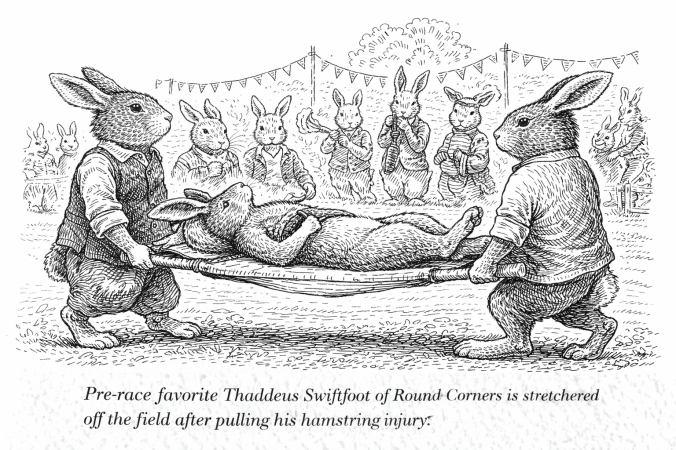
Swiftfoot was assisted from the field and later seen visiting Dr. Jefferson “Doc” Adams in Butterfield, where several other athletes were reportedly receiving treatment for sprains, strains, and festival-related overexertion.
A favorite crowd event proved to be the Carrot Toss, which pairs contestants in teams.
One rabbit throws a carrot downfield while a partner must catch it cleanly for the distance to count.
The winning team of Thistle & Poppy Burrows completed a remarkable toss-and-catch measuring 41 feet, though judges were forced to repeat the measurement after the catching rabbit began nibbling the carrot before officials could confirm the mark.
The afternoon concluded with the technically demanding Standing High Leap, in which a carrot is balanced atop a flat board while the contestant must leap from a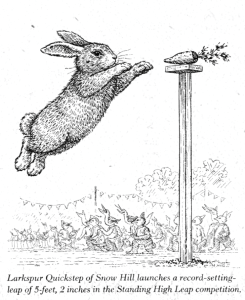 stationary position and snatch it from the platform.
In a spectacular finish, Larkspur Quickstep of Snow Hill cleared a height of 5 feet, 2 inches, establishing another new March Madness Days record and sending the Carrozela section of the crowd into a buzzing celebration that could reportedly be heard well beyond Butterfield.
Perhaps the most unusual competition of the day, however, proved to be the newly introduced Clover Endurance Graze.
Contestants were seated within a large clover patch and instructed to begin eating at the signal. The rules were simple: the last rabbit still chewing would be declared the winner.
As might be expected, the field consisted largely of rabbits of particularly confident appetite and impressive proportions, several of whom approached the contest with what observers described as professional seriousness.
After four hours and twenty-seven minutes of determined grazing, the field gradually narrowed to two finalists — Bramble Patchworth of Cricket Hollow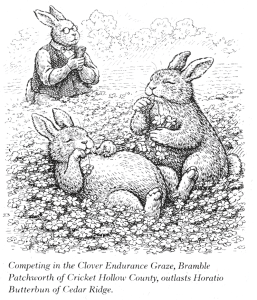 County and Horatio Butterbun of Cedar Ridge.
Both competitors displayed remarkable stamina.
The contest was finally decided when Butterbun paused briefly, leaned back with visible satisfaction, and slowly rolled onto his back in the clover, declaring the field “most agreeable” before closing his eyes in complete culinary contentment.
Patchworth, meanwhile, continued calmly chewing for several minutes more, thereby securing the victory.
Officials declared him the clear champion, though he was later observed resting comfortably beneath a nearby wagon while contemplating what witnesses described as a very full afternoon’s work.
March Madness Days competitions will continue throughout the week, with additional races and exhibitions scheduled throughout Honey Hill Country.
Spectators are respectfully reminded that while Carrozelas contribute greatly to the festive spirit, they should not be sounded directly beside the judges’ table during official measurements.
OFFICIAL RESULTS
March Madness Days — Butterfield Athletic Grounds
Grand Hop-Off
Winner: Crispin Longstride — 9 hops
Record: 8 hops (Bartholomew “Big Hop” Thistlewick)
Long Jump
Winner: Juniper Fleetfoot — 14 ft. 7 in.
NEW RECORD
100-Yard Dash (Official Re-Run)
Winner: Petunia Quickdash — 4.8 seconds
Notable Incident: Unofficial hog run recorded at approximately 8 seconds
Carrot Toss (Team Event)
Winners: Thistle & Poppy Burrows — 41 ft.
Standing High Leap
Winner: Larkspur Quickstep — 5 ft. 2 in.
NEW RECORD
Clover Endurance Graze
Winner: Bramble Patchworth — 4 hours, 27 minutes
Runner-Up: Horatio Butterbun
Additional Contests
Burrow Entrance Dash
Winner: Willow Flashfoot — 3.2 seconds
Barrel Hop Slalom
Winner: Cedric Thistletoe
Young Kits Sprint (Under 1 Year)
Winner: Nibble Quickwhisk
Spectator Note
Officials remind attendees that Carrozelas should not be sounded directly beside the judges’ table during measurements or starting signals.
— Fleet

Where Folks Gather in Good Company
By Felicity Grace Merriweather
It did not take long for the first thirsty parade-goer to inquire after something cold.
By the third loop down Main Street, nearly half the marching party had drifted toward the broad porch of Ethel McNickle’s Famous Pickles & Pork Rinds, where something new — or perhaps very old — was being poured from a clear glass dispenser set over a bucket of chipped ice.
It is called Switchel.
Mrs. McNickle explained, in her practical way, that it has been known by farmers as Haymaker’s Punch and has kept many a field hand upright through long hours beneath the sun.
“It’s ledger work for the body,” she was heard to say, borrowing a phrase recently circulating in town. “Keeps a body on the beam.”
Switchel, as prepared in Butterfield, contains:
- Cool well water
- Apple cider vinegar
- Fresh grated ginger
- A measure of molasses
- A touch of local honey
The result is not overly sweet, nor sharp, but lively — the sort of drink that wakes  a fellow up rather than laying him down.
Several young rabbits, having marched themselves nearly sideways with enthusiasm, declared it “unexpected but agreeable.”
One elderly spectator claimed it “tastes like someone put sense into lemonade.”
Mrs. McNickle assures readers that pre-made jugs will now be available daily through planting season, kept chilled on ice for field hands, gardeners, and any citizen who has mistaken marching for mild exertion.
It is said to replenish what the sun takes.
No spirits are involved — nor required.
With Spring work approaching and temperatures already wandering into the sixties between passing showers, Switchel may become a common sight on porches and in lunch pails throughout Honey Hill Country.
Readers may inquire directly at Ethel McNickle’s porch counter.
Bring a clean jug.
— F.G.M.

From Around Our Way
By Lillian Harper
March Madness Days has drawn even the more reserved citizens out onto the boardwalks this week, and while seeking comment along Main Street, this reporter paused outside Archie Crowther’s General Store.
Mr. Crowther stood in his doorway in long shirt sleeves rolled to the forearm, dark arm garters holding the fabric smartly in place. His arms were folded across his chest, posture firm and measured. A reddish beard — trimmed but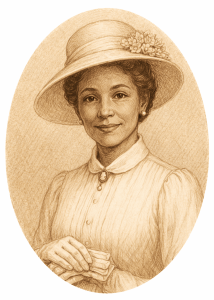 unapologetically present — framed his jaw, and his hair, longer than most gentlemen in these parts prefer, was drawn back neatly at the nape.
He carries himself less like a shopkeeper awaiting trade and more like a man accustomed to weather.
He observed the forming parade with the narrowed attention of someone measuring more than noise.
When asked his view of the festivities, he did not answer at once.
“Parades,” he began slowly, eyes still on the Square, “are like shipments. Look tidy from a distance. Bright ribbon on the crate. Clear label on the side. Very fine. Very respectable.”
A pause.
“But it always hinges — always hinges — on whether what’s inside matches what’s painted without. That’s ledger work, you see. Proper ledger work. You account for what’s declared. You account for what’s delivered. And if the two don’t agree, well… something’s shifted.”
A trio of young rabbits marched past with tin pans and tremendous enthusiasm.
“Now enthusiasm,” he continued, as if picking up a thread he had set down deliberately, “is wind in a sail. Wind’s useful. Necessary, even. But without sound ballast beneath it, you tip. Tip quietly at first. Then all at once. That’s the difficulty.”
He shifted slightly, arms still crossed.
“But these rabbits appear to have ballast. For the moment. They know why they’re marching. That’s rare. Rare and encouraging.”
When the subject of the cook-off was raised, Mr. Crowther’s brow lifted the smallest degree.
“Stew,” he said thoughtfully, “is ledger work in a pot. Measurements matter. Timing matters. You mind the timber when you build a shelf — same principle when you build a recipe. Cut corners and the thing creaks. Creaks today, collapses tomorrow. That’s how structures behave.”
A cheer rose from the Square as the procession doubled in size. The sound of  Carrozelas filled the Butterfield streets, halting further discussions for a full six minutes.
Mr. Crowther listened to the buzzing finally fading in the distance for several seconds before attempting to speak over the droning sounds.
“That,” he said thoughtfully, “is a sound that could loosen the hinges if it’s allowed to continue. Mind the timber with noises like that.”
“But a wholesome celebration,” he added after a beat, “is a fine thing. Provided one keeps it on the beam. Keep the hinges oiled. Mind the timber. See that the ballast’s sound. Do that, and you may march all afternoon without incident.”
“My shop has endured fog that swallowed whole docks and rain that negotiated with rooftops for days,” he said. “It will survive a parade. Provided no one mistakes the pickle barrels for percussion. That would be poor accounting.”
There was the faintest tightening at the corner of his mouth — almost amusement, almost warning.
He stepped back toward his shelves then, returning to the quiet geometry of sacks and tins.
One suspects Mr. Crowther will continue to watch where matters hinge — and whether Honey Hill Country keeps its celebrations properly balanced.
— L.H.

Community Notices & Small Tidings
Items of interest from Honey Hill Country and nearby hollers. Notices are printed as received and offered in good faith.
SCHOOLHOUSE INSPECTION CONTINUES
The Butterfield School Trustees report that a follow-up inspection of the local schoolhouse structure is currently underway. A professional evaluation of certain woodwork and structural timbers is being completed, and the board expects to receive a full report in the coming days regarding recommended repairs.
Classes continue as usual, and trustees emphasize that the inspection is being conducted as a matter of proper caution rather than immediate concern.
RIVER TRADE BEGINNING TO STIR
Merchants report encouraging news from the river routes to the north, where the ice has begun to loosen along portions of the Mississippi River. Traders expect regular traffic to resume soon as navigation improves.
Several shopkeepers in Butterfield and Round Corners note that the return of river shipping should bring a welcome increase in goods and supplies as Spring commerce gathers strength.
FISH FRYS RETURN FOR THE SEASON
With the arrival of March and milder weather settling across the countryside, Little Red Bear has announced the return of his Friday Night Fish Frys.
Friends and neighbors are welcome to gather as usual, rain permitting, for fresh fish, good company, and the sort of conversation that tends to improve with each passing plate.
MARCH MADNESS DAYS CONTINUE
Festivities associated with March Madness Days remain in full swing throughout Honey Hill Country. Events scheduled in the coming days include additional athletic contests, cooking competitions, and the judging of the Best Decorated Burrow.
Residents are reminded that parade routes and event grounds may become lively with little notice.
A Small Reminder
If you have a notice to share — a gathering, a need, a thank-you, or a simple word worth passing along — you may leave it with the Editor by letter or in person. Space is limited, but goodwill is not.

Classifieds
Notices are printed as submitted. Replies may be made discreetly, or not at all.
LOST
One respectable hat, brown felt, last seen departing my head during the opening March Madness parade when a particularly enthusiastic Carrozela sounded directly beside my ear.
Finder may return same to the Gazette office.
Reward offered.
— Harold P. Weatherby
EAR MUFFS MADE TO ORDER
Ear Muffs prepared promptly for those wishing a measure of quiet during the present festivities.
Wool-lined. Comfortable fit.
Orders taken daily.
Apply to Mrs. Agatha Penbury, Seamstress
Butterfield — two doors west of the Old School Road
FOR SALE — STRONG GARDEN SEED
Fresh seed suitable for early planting now available.
Peas, onions, radishes, turnips, and carrots in quantity.
Inquire at Planters Feed & Seed
Butterfield
MULE FOUND
One grey mule discovered wandering near the Upper Creek Road on Tuesday morning.
The animal appears to believe the oats field belongs to him.
Owner may claim upon proper identification.
Hollister Farm
Cedar Ridge Road
WANTED — ONE CARROZELA
For a young bunny who has already marched three parades without one and now finds himself the only quiet participant in the Square. Will pay a fair price or exchange two jars of respectable pickles and one ribbon from last year’s hopping contest.
— Inquire at the Sunset Farm Lane gate.
WANTED — TIN WORK APPRENTICE
The present demand for Carrozelas has created an unexpected shortage of capable hands.
A young person of good character and steady habits may learn the tinsmith trade while earning honest wages.
Apply at the shop of Ephraim Cutter, Tinsmith
Butterfield Square
RABBIT FOOTPRINTS REMOVED
Garden beds restored to proper appearance following the present season of enthusiastic hopping.
Paths smoothed, rows straightened, and evidence of midnight carrot sampling respectfully erased.
Apply to Caleb Dunning
Grounds & Garden Work
Round Corners
A Small Reminder
Classified notices may be left with the Editor in person or by letter. Brevity is appreciated. Honesty assumed.

Country Chuckles
By Cousin Orville P. Dithers
The recent arrival of the now-famous Carrozelas has introduced a new and energetic sound to Honey Hill Country.
From early morning until well after supper, the cheerful horns can now be heard echoing across Butterfield Square and along the surrounding roads. The instruments have proven especially popular with young rabbits, who appear to have discovered that the horns may be blown not only at parades and races, but also while standing on barrels, fence rails, porch steps, wagon seats, or any other location that improves the echo.
Several observers report that the sound carries remarkably well across the countryside.
One resident described the effect as resembling “a swarm of determined bees that have somehow learned brass band discipline.”
The enthusiasm has grown so quickly that a number of participants now travel from one March Madness Days event to another with their Carrozelas already in  hand, ready to sound them at the beginning, the end, and occasionally the middle of whatever activity happens to be underway.
At one point during yesterday’s festivities, a group of rabbits reportedly sounded their horns in celebration of a race that had not yet started, which prompted another group to answer with equal enthusiasm in case the race had perhaps already finished somewhere else.
For the moment, the Carrozela appears to have become the official voice of the celebration.
And judging by the steady buzzing now drifting across Honey Hill Country, it is a voice that shows no particular sign of tiring.
One merchant remarked that if the horns continue much longer, the town may soon require a second celebration simply to celebrate the moment when everyone finally stops blowing them.
— Cousin Orville
Heart of the Holler
By Abigail “Abby” Whitcombe
When the Town Pulled Together
While horns sounded across the hills this week, something quieter — and finer — took place beside the schoolhouse.
There has been no shortage of excitement across Honey Hill Country this week.
Carrozelas sounding from one end of town to the other. Rabbits darting through doorways and under wagons. Merchants selling tin faster than it can be hammered into shape.
In short, it has been lively.
Yet tucked among the noise and the laughter, there was a quieter moment this week that deserves remembering.
Early Wednesday morning, while the square was still muddy from the night rain, a small crowd gathered beside the schoolhouse. No announcement had been made, and no one had called for a meeting. Still, folks arrived one by one.
A farmer with a ladder.
A carpenter with a hammer.
Two boys carrying a bucket of nails that clinked like pocket change.
By the time the sun rose above the ridge, half a dozen neighbors had climbed onto the schoolhouse roof to begin patching the places where winter had pushed the shingles loose.
Below them stood young Thomas Hale, holding his small coin jar like it contained something grander than nineteen cents.
Which, in truth, it did.
No speeches were made.
No banners were hung.
But by midmorning the worst of the roof was mended, and the sound of hammering drifted out across the muddy yard like a promise.
The children would have a dry classroom again.
In a week filled with horns, races, and general celebration, that quiet work may not draw the loudest cheer.
But it is exactly the sort of thing that keeps a town standing.
And that, friends, is the true heart of the holler.
— Abby W.


FRONT PORCH REFLECTIONS
by James Milson
There are weeks when Honey Hill Country moves along quietly, like a wagon rolling down a long road with no particular hurry.
And then there are weeks like this one.
March Madness Days have arrived in full voice — with rabbits leaping fields, 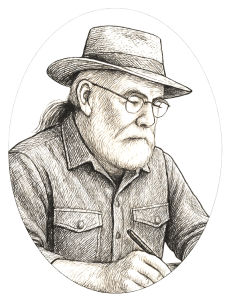 carrots flying through the air in athletic contests, hogs appearing where hogs were never meant to appear, and a sound across the hills that can only be described as a great many Carrozelas being blown with tremendous enthusiasm.
A person might be forgiven for wondering whether the town has briefly misplaced its good sense.
But if you watch closely, something else becomes visible beneath the noise.
You see neighbors gathering where they might otherwise pass one another with only a nod.
You see children laughing until they can barely stand up straight.
You see competitors congratulating one another, even after a race does not go as planned.
And sometimes you see something smaller still.
Someone helping an injured runner from the field.
Someone respectfully holding their Carrozela quietly at their side for a moment.
Those things are easy to miss in a busy week.
But they are the pieces that matter most.
Festivals come and go.
Records are set and later broken.
Even the loudest horns eventually fall silent.
What remains afterward is the simple fact that people gathered together and shared the time.
And if a town can still do that — even noisily — it is probably doing just fine.
We will see you again next Saturday.
— Jim (and Red!)
The Hearth & Holler Gazette is a work of fiction, created for entertainment and storytelling purposes. The people, places, events, and notices appearing within its pages are imagined, and any resemblance to actual persons or events is purely coincidental.
© 2026 James Milson. All rights reserved.
Pen-and-ink illustrations created with the assistance of AI and lovingly styled for Little Red Bear Land.
Would you prefer Coffee or Tea with your newspaper?

 James Milson - The Writing Pages
Great newspaper once again, James and Little Red Bear.
I could hear the buzz Carrozelas from where we live, ha!
Congratulations to the hog and Mr. Pinenut for winning the unexpected award for “Honorable Mention Ribbon for Exceptional Enthusiasm and Speed,”
I need some of that “Switchel” to get me going this spring.
I won’t say another word to give this awesome news of March’s celebration away. 🙂
PS. I have a wonderful recipe for Carrot Soup to make and donate to Dr. Adam’s office, for those ailing.
Thanks again for the fun!
LikeLiked by 1 person
Thanks fof visiting with us and sharing the Gazette, Rosie! So happy to hear you are enjoying it each week. And we would love to share your Carrot Soup recipe, maybe even enter into the coming Carrot Soup competition soon! 🤠 🐻 ❤️
LikeLike