Beyond the town limits, Honey Hill Country has another kind of neighborhood.
Its homes may be farther apart, with fields, pastures, and stretches of woodland between them, but the neighbors still depend upon one another. A borrowed tool, a wagon ride, help with the harvest, or something brought over from the kitchen can travel a good distance along a country road.
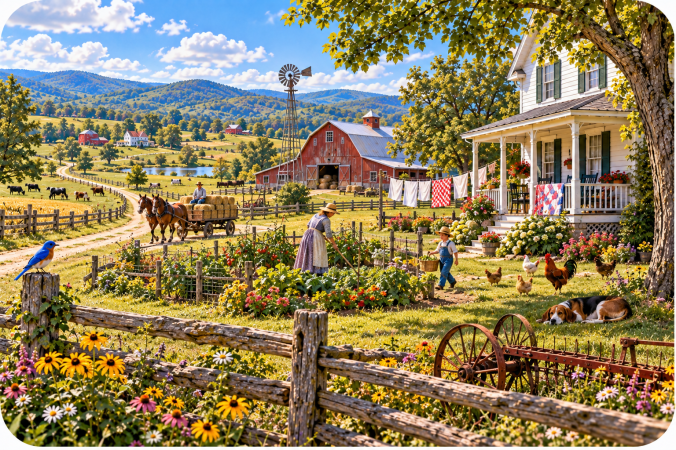
Here in the Missouri Ozarks of 1904, farms come in many sizes. Some are well-established and prosperous. Others are places where a young family is making a beginning, repairing what can be saved and working toward a little more security with each passing season.
These are working places, certainly. But first of all, they are somebody’s home.
Turner’s Farm
One of the most familiar farms in Little Red Bear’s world belongs to Farmer Turner, a nearby neighbor and one of Honey Hill Country’s most successful farmers.
Turner’s Farm gives us a look at the prosperous end of country life — an established operation with plenty of work to keep a household busy. For Little Red Bear, though, Farmer Turner is more than a name attached to a farm. He is part of the neighborhood, and the farm is part of the everyday world beyond Honey Hill.
Meet Little Red Bear & Friends →
Sidebottom Farm
Near Butterfield, “Old Tom” Sidebottom runs a substantial farm with a particular interest in goats. Goat milk, cheeses, and soaps are among the goods that make their way from Sidebottom Farm to towns and restaurants, with teamster Ennis Greenlea handling pickups and deliveries.
Despite his familiar nickname, Old Tom Sidebottom is a strong, middle-aged family man, known as someone worth turning to for advice or a helping hand. His farm includes teams of Morgan horses for field work, timber hauling, and wagon work, along with an enormous white dog of the Great Pyrenees type.
It is a place where practical knowledge, steady work, and good neighbors all have their uses.
Ditchfield Farm
Herman Ditchfield owns and operates one of Honey Hill Country’s less prosperous working farms, where heavy rain can undo a good deal of careful work.
Runoff washes across his fields, cutting channels through the soil and carrying away carefully prepared furrows. Repairing washouts and reclaiming ground are recurring parts of Herman Ditchfield’s farming year, taking time and effort that might otherwise go toward getting ahead.
He is a capable farmer working a difficult piece of land, and Ditchfield Farm continues operating despite those persistent troubles. Around here, a view from the road does not always tell you how much work it takes to keep a place going.
The Old Longenecker Homestead
For years, the old Longenecker place stood abandoned and overgrown. Now Littleberry Bedford and his young family are gradually bringing it back to life.
Their story belongs to a different side of farming — making a home from what remains, repairing buildings, preparing ground, and finding ways to keep going when there is more work waiting than daylight to do it in.
A homestead does not have to be grand to matter. Sometimes its greatest promise is that a family has come to stay, and a place that stood empty has become a home again.
High Brush Farm
High Brush Farm is another established name in Honey Hill Country’s farming landscape. We will leave its gate open for a fuller visit as its present-day story develops.
Dancing Goats Farm
At Dancing Goats Farm, a country afternoon may include something a little out of the ordinary: six performing goats and a farmer with a showman’s flair.
Colonel Beauregard “Bo” T. Billingsley owns the farm and trains its resident troupe, The Dancing Goats. His honorary, theatrical title suits his broad-brimmed hat, magnificent goatee, and commanding stage presence. But beneath the show clothes is a hardworking farmer with feed to haul, fences to mend, and a barn to clean.
On selected Saturdays and special occasions, weather permitting, families can gather beside a modest covered wooden stage for a short performance, with simple seating and shade trees for picnicking. The farm remains a working goat farm throughout.
Bo Billingsley knows each of “his boys” individually and never asks a frightened, ill, or tired goat to perform. When the show is over, the costumes come off, and the goats return to their ordinary farm routines.
Ray Jay’s Lunch Wagon may join the festivities on selected weekends and special occasions, adding another reason to settle in for a pleasant afternoon in the country.
Orchards, Gardens & the Turning Seasons
Not everything grown in Honey Hill Country comes from a broad field. Fruit trees, grapevines, kitchen gardens, and small orchard plots help fill supper tables and pantry shelves, too.
Spring blossoms give way to Summer fruit, and Autumn brings gathering, preserving, and putting things by. These smaller places have their own work and pleasures — and their own stories, which we will visit as our travels continue.
From the Farm Gate to the Rest of Honey Hill Country
Country life reaches well beyond the fence. Farm goods travel to mills, shops, kitchens, and markets, while news and conversation make the return trip. Ennis Greenlea and his mules, Buck and Jenny, know something about those connections.
Ride along with Ennis Greenlea in “A Little Help With the Harvest” →
A Little Red Bear P.S. —
A farm can look peaceful from the road. And it often is.
But if you stop for a visit, you may discover that somebody has been working since before you finished your breakfast.
Cinnamon Charlie likes to ask how things grow. I like that about him. There is a good deal to learn from folks who spend their days helping things along.
And if we happen to be invited to stay for supper . . . . well, we would certainly want to be polite.
— Red 🐾
Return to Welcome to Honey Hill Country →

Original artwork throughout The Front Porch has been created from my concepts and creative direction with the assistance of AI.