OUR COUNTRY KITCHEN
Seasonal Recipes and Kitchen Traditions with Myrtle Mae Meadowbloom
“Strawberry Season at the Packet House Hotel”
Myrtle Mae Meadowbloom knows that some of life’s happiest moments begin in the kitchen. Myrtle Mae believes good food brings people together.
From seasonal recipes and family favorites to baking, preserving, and holiday traditions, she invites readers to pull up a chair and enjoy the tastes and hospitality of Honey Hill Country.

The first thing I noticed upon entering the kitchen of the Packet House Hotel was the smell.
Fresh strawberries. Warm biscuits. A hint of vanilla. And somewhere nearby, cream waiting patiently to become whipped cream.
If summer has an official scent, I suspect it smells very much like Eva Quarles’ kitchen in late May.
To find that kitchen, one must first travel to Packet’s Landing, the busy river town at the edge of Honey Hill Country. There, near the waterfront, stands the Packet House Hotel, widely regarded as the finest hotel in town. The desk clerk was kind enough to remind me of this fact almost immediately upon my arrival.
Twice.
Inside the hotel is the Packet House Dining Room, where travelers, townsfolk, riverboat passengers, and local families gather for some of the finest meals to be found anywhere along the river.
At the heart of it all is Mrs. Evelina “Eva” Quarles.
Eva serves as head cook and kitchen manager of the Packet House. Her Sunday Morning Brunches are famous. Her Family Fried Chicken Dinners have inspired lengthy discussions throughout Honey Hill Country. Her Bread Pudding is spoken of with a degree of affection usually reserved for relatives.
And every spring, visitors begin asking a single question:
“When does the strawberry shortcake return?”
Working beside her is Lila May Booker, a young kitchen assistant with quick hands, a cheerful smile, and a determination to learn everything Eva is willing to teach.
On the morning of my visit, both appeared to be very busy.
I had come to Packet’s Landing to learn about the hotel’s famous strawberry shortcake.
Eva had other plans.
“You’re just in time,” she said, placing a large bowl of strawberries in front of me.
“For what?”
“Hulling.”
Before I could ask another question, an apron appeared in my hands.
A moment later, I was wearing it.
That is how most visits to a working kitchen begin, I have discovered.
Not with interviews.
With chores.
At a nearby table, Lila May Booker was already hard at work. A wooden tray beside her was piled high with strawberries, and she moved through them with the speed and confidence of someone who had hulled several hundred already that morning.
“Three hundred and fourteen,” Lila said proudly when I asked.
Eva glanced up from her mixing bowl.
“Three hundred and twelve.”
Lila sighed.
“Three hundred and twelve.”
I had a feeling Eva rarely lost count of anything in her kitchen.
Through the screened kitchen windows, Packet’s Landing bustled with its usual river traffic. Inside, however, the kitchen belonged entirely to strawberry season.
Bowls of bright red berries lined the worktables. Fresh biscuits cooled on racks. The ovens radiated a gentle warmth. And everywhere one looked, preparations were underway for the evening meal.
I picked up a strawberry.
“Now Eva, I know we’re here to talk about strawberries and shortcake, but folks all across Honey Hill Country have been asking me about those biscuits, too.”
“Nice try, Myrtle,” Eva said before I could continue.

Lila laughed.
Eva winked in her direction.
Clearly, this was not Eva’s first interview.
“When I was growing up,” Eva said, returning to her strawberries, “you knew summer had arrived when the strawberries came in. Not when the calendar said so. Not when school let out. When the strawberries arrived.”
Lila nodded.
“My grandfather says summer doesn’t officially begin until he’s had strawberry shortcake at least once.”
Eva laughed.
“Your grandfather has been saying that for twenty years.”
“Longer than that,” Lila replied. “Every June he insists upon it.”
“Does he really?”
“Oh yes. Last year he told my grandmother there was no sense starting summer properly without strawberry shortcake.”
“And what did she say?”
“She made strawberry shortcake.”
Eva nodded approvingly.
“A wise woman.”
I had to agree.
There are worse traditions to keep.
Especially the delicious ones.
For several minutes the only sounds were knives, conversation, and the occasional clatter of pans. Sunlight streamed through the screened windows. The scent of strawberries seemed to fill every corner of the room.
Finally, I asked the question that had brought me to Packet’s Landing.
“What makes your strawberry shortcake so special?”
Eva continued hulling strawberries.
“Strawberries.”
Lila immediately looked down at her work, though not quickly enough to hide her smile.
“That can’t be the whole answer,” I protested.
“It helps.”
I waited.
Eva continued working.
“You are not going to make this easy, are you?”
“No.”
This time Lila laughed out loud.
“My grandfather says it’s the biscuits,” she offered.
“Your grandfather says that because he likes biscuits,” Eva replied.
“He also likes the strawberries,” Lila added.
“He likes anything served with whipped cream,” Eva replied.
“That’s true,” Lila admitted.
I was beginning to appreciate why Eva generally wins these discussions.
A moment later, she relented.
“The secret isn’t really a secret,” she said. “The strawberries have to be fresh. That’s first. Everything else comes after that.”
She held up a berry.
“If these aren’t good, nothing else matters.”
I nodded.
That sounded suspiciously like experience talking.
Eva set another bowl aside and reached for a tray of cooling biscuits.
“People always ask about ingredients,” she said. “The ingredients matter. But what matters more is paying attention.”
She broke open a biscuit and examined the center.
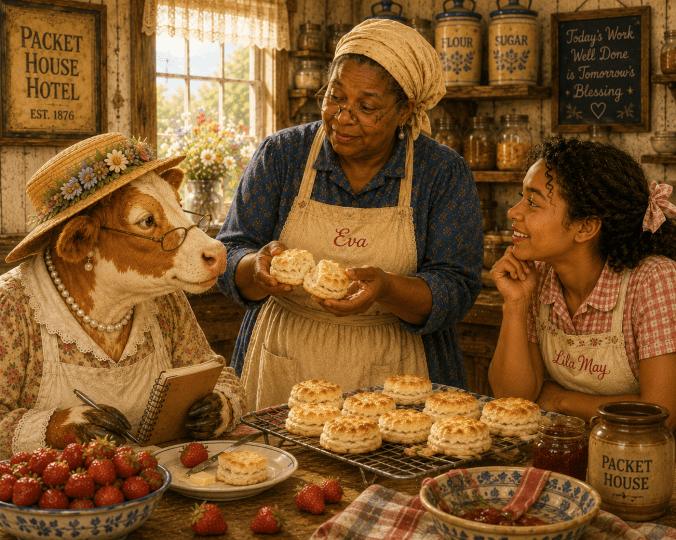
“Ovens vary. Strawberries vary. Flour varies. Some days you need a little more milk. Some days you need a little less. For goodness’ sake, even the humidity in the air varies.”
I nodded.
That sounded suspiciously like experience talking.
“You can follow every recipe in the world, right down to the last spoonful,” Eva continued, “but eventually you have to trust your own judgment.”
“That sounds like advice for more than baking.”
Eva looked at me over the top of her spectacles.
“It usually is.”
Beside her, Lila nodded without looking up from her strawberries.
I suspected she had heard that particular piece of wisdom before.
For several minutes the only sounds were knives, conversation, and the occasional clatter of pans.
Or at least that was true at our table.
The rest of the kitchen operated at an entirely different pace.
Behind us, biscuits disappeared into ovens and reappeared golden brown a short time later. Someone carried trays of vegetables across the room. A cook at the stove stirred a kettle while keeping an eye on two skillets at once. Near the far wall, two young kitchen helpers worked steadily at a large sink, washing pots, pans, and kitchen utensils almost as quickly as new ones appeared.
The dining room would open soon.
A young cook carrying a tray paused beside Eva.
“Mrs. Quarles, peach preserves or apple butter with the supper rolls tonight?”
“Apple butter,” Eva answered without looking up.
The young cook nodded and disappeared.
Less than a minute later, another voice called from across the room.
“Mrs. Quarles, how much parsley in the potatoes?”
Eva didn’t even glance up.
“A little more than you’ve got now.”
The answer came back immediately.
“So . . . more parsley?”
“Exactly.”
As we continued hulling strawberries, the kitchen continued moving around us like a well-rehearsed orchestra.
No one seemed rushed.
No one appeared idle.
And somehow Eva seemed aware of everything happening at once.
I had begun to suspect that if the Mississippi River itself suddenly changed course, someone would first seek Eva’s opinion and ask what ought to be done about it.
At some point during our conversation, I noticed the strawberries we had been so busy hulling had gradually become several bowls of strawberries. Then several bowls became many bowls, and I began to suspect they were multiplying when no one was looking.
“How many shortcakes are we making?” I asked.
“Enough,” Eva replied.
This answer was not especially helpful.
Lila smiled.
“That’s usually the answer.”
Eva crossed to the ovens, removing several trays of golden biscuits and replacing them with fresh trays waiting nearby. A wave of warm biscuit-scented air drifted across the room.
Before I could finish writing down another note, she pointed toward the oven.
“Biscuits.”
I looked up.
“What about them?”
“Keep an eye on them.”
“How long?”
“Until they’re done.”
I waited.
Eva returned to her strawberries.
“How long is that?”
She considered the matter.
“Depends.”
“On what?”
“The biscuits.”
Lila immediately became very interested in a bowl of strawberries, and I suspected she was trying not to laugh.

Nevertheless, I rose and crossed the kitchen to inspect the oven.
Several trays of biscuits were baking inside.
I checked them carefully.
Then I checked them again.
A minute later, I checked them a third time.
They appeared unchanged.
“Eva?”
“Yes?”
“I don’t think they’re done.”
“They’re not.”
“How do you know?”
“Because I put them in three minutes ago.”
Suppressing laughter, Lila nearly dropped a strawberry.
I returned to my assignment.
A few minutes later, a loud crash echoed from the dishwashing sink.
Every head in the kitchen turned.
One of the young dishwashers stood staring down at a pan he had apparently dropped.
“I meant to do that,” he announced.
No one appeared convinced, and the staff soon returned to their work amid the natural rhythm of the kitchen.
A few minutes later, I checked the biscuits again.
The tops had risen beautifully. Their color was turning golden brown, and the aroma drifting from the oven seemed capable of attracting hungry travelers from neighboring counties.
Quite suddenly, I knew.
“Eva!”
“What?”
“They’re done!”
Eva glanced toward the oven.
“See?”
I stood there for a moment.
Then I smiled.
“They told me.”
“They told you.”
Lila laughed.
I suspect Eva was trying very hard not to.
At that point, I began to understand what she had been telling me all afternoon.
The recipe mattered. Of course it mattered. But the recipe was only part of the story.
The rest came from experience.
From paying attention.
From making something often enough to know when the strawberries wanted more sugar and when they did not.
From knowing your oven.
From trusting your judgment.
The recipe could tell me what to do.
Experience taught me when and why.
How to read the food.
And, in its own way, how to listen to it.
The strawberries were eventually carried away, replaced by trays of biscuits cooling on wire racks.
Now, I should probably pause here.
Some folks hear the words strawberry shortcake and immediately imagine sponge cake.
Not at the Packet House Hotel.
Eva’s shortcake begins with biscuits.
Beautiful golden biscuits.
The sort that practically demand butter.
I noticed one sitting unattended nearby.
For journalistic purposes, I felt obligated to investigate.
“Leave that one alone,” Eva said without turning around.
I withdrew my hand.
Slowly.
“I hadn’t touched it.”
“You were thinking about it.”
“I was.”
“I know.”
Lila laughed so hard she had to set down her knife and take a moment to recover.
A short time later, bowls of sliced berries began appearing on the worktable. Sugar had already worked its quiet magic, drawing out the juices and turning the strawberries into a bright ruby-red mixture that seemed determined to smell like summer itself.
The whipped cream came next.
Then the assembly began.
A warm biscuit bottom.
A generous spoonful of strawberries.
Another spoonful because the first one never seems quite sufficient.
A cloud of whipped cream.
Then the top half of the biscuit.
Simple.
Beautiful.

And, judging by the number of people already asking when dessert would be served, highly anticipated.
A waitress passing through the kitchen paused long enough to inspect a ready dessert plate.
“That one won’t make it to the dining room.”
“Why not?” I asked.
The waitress pointed toward a young dishwasher watching from across the room.
“Because he’ll eat it if I set it down.”
The dishwasher protested immediately.
“I heard that.”
“Good,” she replied. “Then stop looking at it.”
The kitchen laughed.
The dishwasher looked wounded.
A few moments later, the shortcake disappeared into the dining room.
The dishwasher continued to look disappointed.
The dishwasher was not the only person watching the shortcake disappear.
I had spent the better part of the afternoon surrounded by strawberries, biscuits, whipped cream, and glowing descriptions of Eva’s famous dessert.
At this point, professional curiosity had turned into hunger.
Fortunately, Eva appeared to notice.
Or perhaps she simply believed a person who had hulled several bowls of strawberries and monitored several trays of biscuits had earned a reward.
Either way, a plate soon appeared in front of me.
“Quality control,” Eva explained.
“Of course.”
Beside her, Lila nodded solemnly.
“Very important work,” she confirmed.
I agreed.
Somebody had to do it.
The biscuit was still slightly warm. The strawberries were sweet without being overly sweet. The whipped cream seemed to belong exactly where it was. Individually, none of the ingredients were particularly complicated.
Together, however, they managed something remarkable.
They tasted like June.
Now, I realize that is not an official culinary description.
Nevertheless, it remains accurate.
The first bite tasted like strawberry patches, garden gates, open windows, long summer evenings, family reunions, church suppers, birthday celebrations, and every other reason people have ever invented to gather around a table together.
I took a second bite for verification purposes.
Journalistic integrity demands consistency.
“Well?” asked Eva.
I considered the matter carefully.
“I believe your reputation is considerably safer than mine.”
Eva raised an eyebrow.
I took another bite.
“The strawberries are perfect. The biscuits are perfect. And I now fully understand why people begin asking about this shortcake before strawberry season even arrives.”
“Good,” said Eva.
“That’s all?”
“That’s all.”
Lila laughed.
“She’s been hearing that for twenty years,” she managed through her laughter.
Eva nodded.
“And I intend to keep hearing it.”
I could not argue with that.
I finished the last bite and set down my fork.
“Now then, Eva.”
Eva looked up immediately.
“Here it comes.”
The sigh suggested she had been expecting this moment all afternoon.
“Readers are going to want the recipe.”
“I suspected they might.”
“Can I have it?”
“You may write it down.”
I considered this a promising start.
My notebook appeared almost instantly.
Eva noticed.
“You had that notebook ready awfully fast.”
“I came prepared.”
“Clearly.”
Lila pointed a strawberry knife in my direction.
“I told you, Eva, that she’d ask.”
“I knew she’d ask,” Eva replied.
“Everybody asks,” Lila confirmed.
I was beginning to suspect this was true.
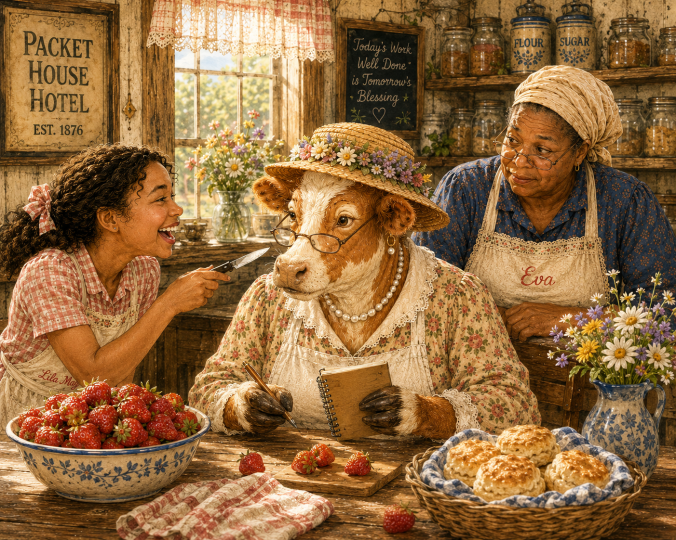
“Three cups of fresh strawberries,” Eva began.
“Fresh being important?”
“Very important.”
I wrote that down.
“One-quarter cup sugar.”
“Approximately.”
I paused.
“Approximately?”
Eva looked at me as though this ought to have been obvious.
“The strawberries get a vote.”
“The strawberries get a vote?”
“If they’re especially sweet, use less. If they’re tart, use a little more.”
I carefully wrote:
The strawberries get a vote.
That seemed important.
“Now for the biscuits.”
I noticed Eva glance at me suspiciously.
“What?” I asked.
“Nothing.”
“It wasn’t nothing.”
“It might have been something.”
Lila laughed again. She seemed to be having a wonderful afternoon at my expense.
Eva shook her head and continued.
“Flour. Baking powder. A little sugar. Butter. Milk.”
“How much butter?”
“Enough.”
“Eva.”
“You’ll have the recipe when I’m finished.”
I settled down and continued writing.
The recipe gradually made its way into my notebook, though not always in a straight line.
Every measurement seemed accompanied by an observation.
Every instruction came with a story.
Every ingredient appeared to have an opinion.
“Bake until golden brown.”
“Everybody says that.”
“Because that’s when they’re done.”
I could not argue with the logic.
“You’ll know.”
“How?”
“You’ll look at them.”
This, I am afraid, was apparently the official answer.
By the time I finished writing, the dinner hour had fully arrived.
The Packet House Dining Room remained pleasantly busy.
Families lingered over their meals. Travelers settled comfortably into chairs after long journeys. Conversations rose and fell across the room. Somewhere, a child was already asking about dessert.
The kitchen behind us continued moving with its practiced rhythm.
Plates appeared.
Plates disappeared.
Questions were answered.
Meals were served.
And through it all, Eva somehow seemed to know exactly what was happening everywhere at once.
I closed my notebook.
The recipe was safely recorded.
At least most of it.
I still suspect Eva may have withheld one or two details.
“You’re looking suspicious,” she observed.
“I was wondering if you’ve told me everything.”
“I have.”
Lila raised an eyebrow.
Eva ignored her.
I considered this answer carefully.
Then decided some mysteries are best left unsolved.
After all, if every secret in Honey Hill Country were revealed, what would we have left to talk about?
I gathered my notebook and prepared to leave.
Eva handed me a loaded dinner tray.
I stared at it.
“What’s this?”
“Table four.”
“Eva.”
“Yes?”
“I’m writing an article.”
“You’re done writing. Now you’re helping.”
Lila laughed.
Again.
I looked at the tray.
I looked at Eva.
Eva looked back.
The tray remained stubbornly in my hands.
A few moments later, I delivered it to table four.
Upon returning to the kitchen, I discovered that neither Eva nor Lila appeared the least bit surprised.
I suspect this had been the plan all along.
A waitress passed by carrying several plates of strawberry shortcake toward the dining room.
Curiosity got the better of me.
I stepped through the doorway to take another quick look at the dining room.
Each plate looked exactly as inviting as the last.
But it was not the shortcake that caught my attention.
It was the people.
A family sharing dessert together after supper.
Friends lingering a little longer over conversation.
Travelers ending the day around a welcoming table.
A little girl proudly showing her grandmother a ribbon she had won earlier that afternoon.
A riverboat passenger listening to a story he had probably heard before and was happy to hear again.

And everywhere I looked, people seemed reluctant to hurry away.
That may have been my favorite part of the afternoon.
Not the recipe.
Not even the shortcake.
The people.
Strawberry season lasts only a few short weeks.
Soon enough the strawberries will be gone, giving way to peaches, apples, pumpkins, and all the other flavors that follow the seasons through Honey Hill Country.
But for a little while each year, strawberries return.
And when they do, people gather.
Around tables.
Around conversations.
Around traditions.
The shortcake is merely the excuse.
The time spent together is the real gift.
As I thanked Eva and prepared to leave for a second time, she slid one final bowl across the worktable.
I looked down.
Strawberries.
“Eva.”
“They won’t hull themselves.”
Lila laughed again.
By now I suspected she had enjoyed the entire afternoon considerably more than even I had.
Eva smiled.
I sighed, picked up my apron, and returned to work.
Judging by the crowd gathered at the Packet House Hotel that evening, I believe Eva Quarles had understood the secret all along.
That life is made up of ordinary moments that become extraordinary because of the people sharing them.


From Myrtle’s Notebook
Readers are going to want the recipe.
Eva knew it.
Lila knew it.
And if we’re being honest, I knew it too.
Fortunately, after a bit of persuasion (and several samples taken strictly in the interest of proper reporting), they agreed to share it.
I hope you enjoy it as much as I did.
— Myrtle Mae Meadowbloom

Pen-and-ink illustrations have been created for this piece with the assistance of AI . . . lovingly prepared and styled for the world of Little Red Bear.