ALONG THE BACK ROADS . . . .
Visiting the People and Places of Honey Hill Country with Henry Calder
“The Sound of the Mill”
Henry Calder has always believed that every town, shop, farm, and front porch has a story worth telling. Along the back roads of Honey Hill Country, he spends his days meeting neighbors, sharing conversations, and discovering the people and places that make the countryside feel like home.
The leaves on Old Mill Road were dry enough to announce my arrival.
They crackled beneath my boots, skittered ahead of me, and settled again along the wheel ruts. Above the road, a maple had turned nearly the color of a good fire. Farther up the hillside, gold and russet stood among trees still holding their green.
I had passed Ennis Greenlea at the turn.
“Heading to see Will Keller,” I told him. “Hoping to catch him with a little time to talk.”
“In October?”
“I’m prepared to listen while he works.”
“That ought to improve your chances.”
Now, coming around the bend, I could hear what he meant.
Old Copper Creek Mill stood against the Autumn hillside, with its great wheel turning beside the building.
Water came down the race, spilled onto the wheel, and escaped below in splashes and bright, broken streams. Wet wood shone almost black where the sunlight caught it. Droplets fell from the rising paddles, glittered briefly, and returned to the creek.
I stopped beside the road.
For a little while, there seemed no particular reason to go farther.
The wheel turned steadily. Beyond it, Copper Creek slipped over stones and carried a yellow leaf into a quiet eddy. Two wagons waited in the yard. A man stood beside one, talking with a neighbor who had apparently finished unloading but had found no pressing reason to leave.
Behind the mill, the wooded slope rose in layers of October color.
I had come to ask questions.
It seemed only courteous to look first.
Inside, I felt the mill before I had properly taken stock of it.
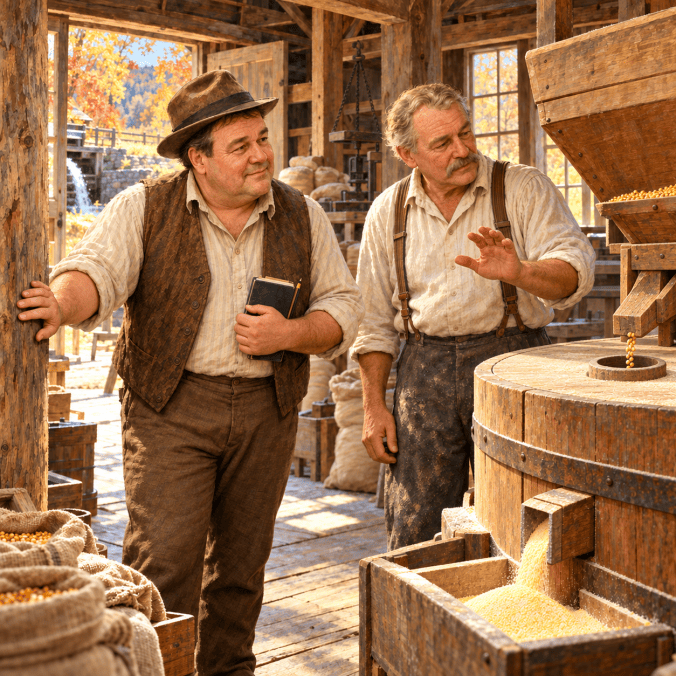
A deep, steady rumble came through the floorboards and into the soles of my boots. Above it were smaller sounds: wooden creakings, the clatter of the feeding mechanism, the rustle of grain, and water splashing beyond the wall.
My eyes adjusted to the softer light between the beams.
There were sacks waiting their turn, a scale, wooden bins, and the pale dust of work on surfaces that had already been swept that morning.
The air smelled of dry grain, freshly ground corn, and old timber.
Wilhelm Keller looked up from his work.
“Henry. That sack behind you — mind where you step.”
I stepped around it.
Neighbors called him Will, and sometimes called the mill Keller’s, although Old Copper Creek Mill remained its proper name.
He was a sturdy man in his late fifties, with greying sandy hair, a well-kept moustache, and flour dusting his practical work clothes. His broad hands moved with an assurance I would have reason to notice more than once that afternoon.
“Ennis said you might be busy.”
“Ennis comes through here. The work, he has seen.”
That explained his reliable information.
I told Will I hoped to write something about his work.
He considered this, then nodded toward a clear place beside a post.
“There you can stand. You will see well, and nobody must carry a sack around you. We can talk while I work.”
It was an agreeable arrangement. From there I could see without being in anybody’s way, and the floor continued its quiet conversation with my feet.
He showed me how the grain traveled from the hopper to the opening in the center of the upper stone.
The grinding surfaces were enclosed, but he explained what happened within.
“The lower stone stays. Above it, the runner turns. Between them goes the grain, and as it is ground, it travels outward.”
“How close do they run?” I asked.
“For that, I must know the grain. And what the customer wants.”
He checked the meal coming through, rubbing a little between his fingers.
“This fellow wants meal for his kitchen. Another wants feed for his stock. The same grinding will not please them both.”
“Do they tell you if it does not?”
He glanced at me.
“Oh, certainly. Sometimes with the sack still on the scale.”
A farmer brought another sack forward.
“Meal for the house, Will.”
“The same as last time?”
“Same as last time.”
“Good. Then we understand.”
That was the entire instruction.
They discussed a gate that needed rehanging while the weight was taken. Another man joined them to ask whether the road beyond the creek had dried sufficiently for a loaded wagon.
Someone knew.
Someone else knew a better way around.
By the time the sack had been set in its place, arrangements had been made to look at the gate, the road had been considered from three directions, and a message had been entrusted to a neighbor going toward Butterfield.
Will returned to his work.
“Does that happen every day?” I asked.
“What happens?”
I indicated the departing conversation.
“Ach. While the grain is waiting, the news can travel.”
He straightened the mouth of a sack.
“Some of these men, they do not see one another all week.”
He stopped in the middle of his next sentence.
One hand lifted slightly.
I waited.
The mill sounded exactly as it had a moment before.
At least, it did to me.
Will listened, then moved to the feed and made a small adjustment.
The clatter settled into a more even rhythm.
“The grain was feeding a little slow,” he said.
I listened again.
Now that he had changed it, I thought I could hear what had been wrong.
“You picked that out of everything else?”
He stood beside me for a moment.
“First, listen past the water.”
I tried.
The splashing remained loud, but beneath it I began to distinguish the steady turning of the machinery and the quicker wooden chatter above it.
“That little clatter helps feed the grain,” he said. “Regular, it must be. Enough grain for the stones, but not too much.”
He let me listen.
“And the stones must never run empty. You want grain between them, not stone rubbing on stone.”
Until then, I had heard one large sound filling a building.
Will had been hearing several things, each worth his attention.
“A miller must listen to his mill. The stones will tell you when something is wrong. But first, you must learn how to listen.”
He returned to the meal and checked its texture once more.
I left my next question a little longer.
A boy waiting beside his father shifted his feet.
“The floor shakes,” he said.
“A little,” his father answered.
The boy planted both boots firmly and stood very still.
I understood what he was doing.
Outside, a breeze stirred the leaves against the doorway. Inside, the wheel’s work passed through shafts and gears to the stones, and some small part of it reached every board beneath us.
The boy looked up and grinned.
His father smiled back.
Will noticed them.
“You feel her working, eh?”
The boy nodded.
For a moment, all three stood listening.
Then the father’s order was ready, and there was a sack to carry.
I helped hold the next sack while Will settled the contents.
A little meal dusted my sleeve.
I brushed it away, then discovered I had transferred some to my notebook.
Will glanced at the page.
“A little of the mill goes home with you.”
“I was hoping to take something.”
He smiled beneath his moustache.
“Then already your visit is worthwhile.”
He tied the sack, and its owner lifted it onto his shoulder.
There were more waiting.
I thanked Will for his time.
“A quiet day, I could have talked more.”
“I think I came on the right sort.”
He looked around the working room.
“Ja. On a day like this, you see what the talking is about.”
Outside, the air felt cool against my face.
For a moment, the yard seemed unusually quiet, although the wheel was still splashing and two neighbors were still discussing something beside a wagon.
I walked down toward the creek and looked back.
Sunlight lay across the weathered building. The hillside rose behind it in gold, copper, and red. Water fell from the wheel, and another wagon came slowly into the yard.
I could still hear the mill.
This time, I knew a little more of what I was listening to.
I walked back to the doorway and rested my hand against the doorpost.
The old building trembled gently beneath my palm.
Another customer came up with a sack, and I stepped aside to let him through.
A sack of meal is an ordinary enough thing to carry home. I had watched several leave that afternoon.
But I would remember this visit whenever I saw one: the creek turning the wheel, the grain passing between the stones, and a man who could hear when something needed tending.
The miller had made it look simple, and I was beginning to understand just how unsimple it really was.
And how much he knew to simply keep it all running.
Original artwork throughout The Front Porch has been created from my concepts and creative direction with the assistance of AI.