COME WITH ME . . . .
Strolling Through Honey Hill Country with Willow Meadows
“A Good Day to Take the Long Way”

Willow Meadows invites readers to experience Honey Hill Country one step at a time through its trails, towns, waterways, and hidden places. She believes the journey is often just as important as the destination and rarely passes a scenic overlook, garden gate, or interesting story without stopping to investigate.
Join her each month as she explores the landscapes, histories, people, and stories that make the region unique.
Before we could ride into the Autumn hills, Mr. Bellamy needed a hat.
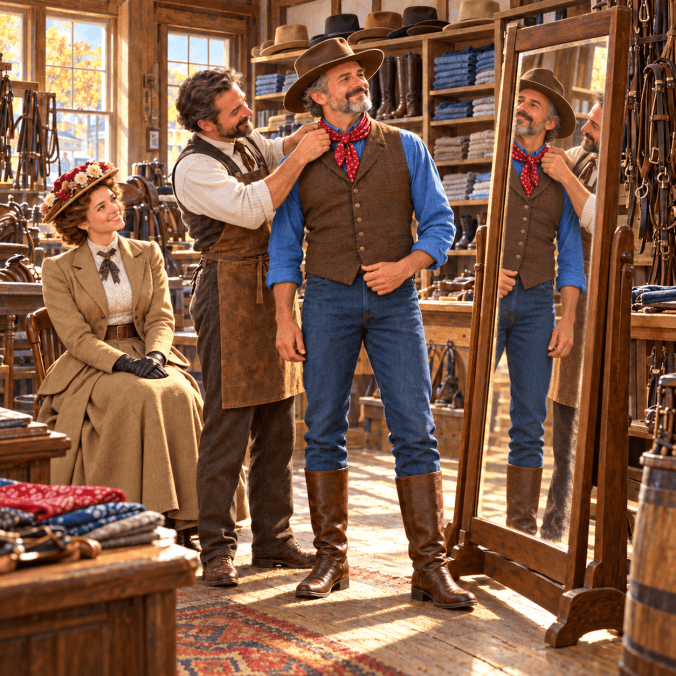
He had arrived in Butterfield wearing a perfectly serviceable Derby hat from St. Louis. By the time he stood before the full-length mirror at Hollister’s Stockmen’s Store, however, he had decided that it did not sufficiently express his intentions.
“I should like something Western,” he told the proprietor.
“How Western?”
Mr. Bellamy considered this.
“Quite.”
Above the door, the sign promised Western Wear & Riding Goods. Inside, boots stood in orderly pairs, bridles hung along the wall, and the smell of leather mingled with wool and new cloth.
The proprietor brought a hat.
Mr. Bellamy put it on, turned slightly, and studied the result.
His wife watched with affection.
“You will still be home for supper, Arthur.”
“Yes, of course.”
He adjusted the brim.
“Nevertheless.”
The hat revealed certain deficiencies in the rest of his appearance.
He looked down at his city clothes.
“Perhaps a proper shirt.”
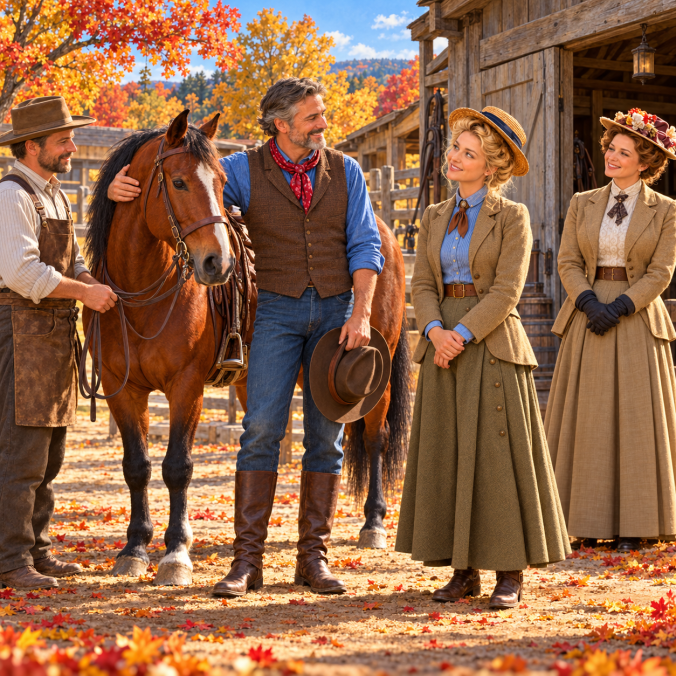
The proprietor found him a sturdy shirt, then a pair of blue denim trousers suitable for riding. Arthur emerged from changing and returned directly to the mirror.
“A vest, perhaps?”
Another was brought.
He tried it buttoned, then unbuttoned, and turned to examine the effect from the side.
Mrs. Bellamy sat down.
I had agreed to lead a small party of St. Louis visitors through the hills and hollers beyond Butterfield. We had begun along Horseman’s Row to see that everyone was comfortably prepared.
Arthur was becoming thoroughly prepared.
The proprietor checked the fit of his boots, helped him settle the vest, and explained why the hat needed to stay on when the wind came over a ridge.
Then Arthur discovered the bandanas.
He held a red one against his shirt.
“A rider must have a proper bandana for trail dust, dear.”
His wife looked toward the quiet street outside.
“Let us hope the dust appreciates your preparations.”
Behind Arthur, the proprietor’s eyes traveled briefly toward the ceiling. When they returned, he was ready to help fold the bandana.
“Comfortably at the neck, sir. You will want room to turn your head.”
Arthur turned it experimentally.
“Excellent.”
He surveyed himself again.
“I believe that is nearly everything.”
“Nearly?” Mrs. Bellamy asked.
“Nearly,” he replied while glancing to the right.
His attention had reached the spurs.
“We shall leave those here today,” I said. “No need to confuse or spook the horses on the trail today.”
He accepted this without complaint, though he gave them a dismayed farewell glance.
The ladies had their own arrangements to consider.
I wore my divided riding skirt and would ride astride, with a leg on either side of the saddle. Two of the younger women had chosen the same manner of riding.
Mrs. Bellamy and an older member of the party, Miss Helen Mercer, preferred sidesaddles, which they already knew.
“I see no reason to learn an entirely new seat while admiring a hillside,” Mrs. Bellamy said.
“Nor do I,” I told her.
We saw to skirts, boots, and warmer layers. October sunshine can be generous in town and considerably less attentive beneath the trees.
Mr. Bellamy emerged from the mirror’s vicinity looking ready for a much longer journey than ours.
The proprietor brushed a little lint from his shoulder.
“There you are, sir. Comfortable?”
“Very.”
That was the right answer, and the proprietor looked pleased.
At the Spur & Bridle Livery, our mounts were thankfully chosen with more attention to experience than ambition by the owner, Tobias Clinkwater. Everyone knows him as Toby.
A worker asked each visitor about previous riding, listened to the answers, and brought out animals accordingly.
Mr. Bellamy described himself as familiar with horses.
His wife looked at him. A side glance which implied more than words could have expressed.
“I have been around them,” he clarified.
A quiet bay gelding named Bramble was selected for him.
“He knows his work,” the livery worker said.
Arthur looked him over.
“He will do,” he agreed.
Mrs. Bellamy was matched with a quiet mare accustomed to carrying a sidesaddle.
Helen Mercer, who confessed to very little riding experience, was offered a steady riding mule.
“Would a horse be better?” she asked.
“This mule suits what you have told me,” the worker said. “We know her, and she knows these paths.”
He let the woman make her acquaintance before proceeding.
Nobody was hurried into a saddle.
Stirrups were adjusted, tack checked, and the riders were given time to settle. A second guide would follow at the rear, leaving me free to lead and stop where there was something worth noticing.
When Mr. Bellamy was comfortably mounted, he straightened his shoulders.
“Yee-haw!”
His gelding turned one ear.
The livery worker looked up.
“No need to announce it, sir. He knows you’re aboard. Nobody really says that.”
Mrs. Bellamy laughed first.
Arthur joined her.
After that, we were ready.
We left Butterfield, heading out at a slow walk along the Crimson Ridge Trail.
There was the ordinary business of finding a comfortable seat in the saddle, discovering what to do with one’s hands, and learning that a horse’s movements continue whether one has finished arranging oneself or not.
Mr. Bellamy looked down at his gelding’s ears.
“Does he know where we are going?”
“He knows who is ahead of him,” I said. “He follows me. You still attend to him.”
“I am attending very closely.”
He was.
Before long, the last houses fell behind us.
A fence followed the road for a while, then turned away across a field. Beyond it, the hills rose in gold, copper, and red beneath a clear October sky.
The air smelled of dry leaves and sun-warmed grass.
Hooves settled into a comfortable rhythm.
Conversation began to come more easily.
Then, for a little while, it stopped.
We rounded a bend, and a broad sweep of Autumn color came into view across the hillside — gold, copper, and crimson beneath the clear blue sky.
“Oh,” said Miss Mercer softly.
Nobody seemed inclined to improve upon that.
A familiar wagon approached along the road.
“That is Ennis Greenlea,” I told the visitors as we drew aside to make room. “He earns his living hauling things for people around the country. Those are his mules, Buck and Jenny.”
“What sort of things?” Mr. Bellamy asked.
“Ennis could probably give you a longer answer than I could.”
Ennis slowed beside us.
“Morning, Willow.”
I introduced the party.
“Out to see the leaves?” he asked.
“And learn a little about riding,” Mrs. Bellamy said.
Her husband sat very properly.
“Both going well so far,” Ennis said.
His glance rested briefly on Arthur’s splendid new hat and outfit, but he offered no remark about it.
There were jugs secured among the wagon’s load.
“Cider?” I asked.
“Some of it. Been helping with the pressing.”
He had more calls to make before the day was out.
We wished him well and watched Buck and Jenny take the wagon onward.
“He seems to know everybody,” one visitor said.
“He knows a good many doors,” I replied. “And generally what needs carrying through them.”
Where we left the road for the trail itself, sumac burned bright red along the sunny edges.
One of the women asked whether it always grew so brilliantly.
“Some years are better than others,” I said. “Today, we have come at a good time.”
The leaves were close enough to see their individual colors, not merely a red patch on a distant hill. Scarlet lay beside deeper crimson, with a few green leaves remaining farther down the stems.
We rode beneath oaks and hickories, over earth softened by fallen leaves.
A breeze moved through the branches.
Several leaves came down together.
One settled on Mr. Bellamy’s hat.
His wife noticed.
“Arthur, you have acquired a decoration.”
He removed the leaf carefully and looked at it.
“Does it suit?”
“Very well.”
He tucked it into his coat pocket.
We heard the geese above the trees.
I raised a hand, and the riders paused where the trail widened.
The calls grew nearer.
Then a company of Canada Geese crossed the opening overhead, their formation stretching and adjusting as they went.
Faces lifted all along our little party.
Miss Mercer rested her reins quietly and watched until the last bird had passed.
“I hear them in the city,” she said. “But there is always something else to hear, too.”
Out here, their voices followed them across the sky.
Even after they were gone, everyone kept looking up.
Mr. Bellamy’s gelding took the opportunity to consider a leaf near his feet.
Arthur noticed.
“I believe we are interested in different things,” he commented.
“That happens on a trail ride,” I said.
Farther on, we came beside a meadow.
I saw movement in the grass and slowed.
Wild turkeys were working along its farther edge, several partly hidden until they lifted their heads.
We watched without calling to them or attempting to ride closer.
One stepped into a patch of sunlight, showing the dark sheen of its feathers. Another followed, then disappeared behind a fold of ground.
“There are more than I first thought,” Mrs. Bellamy whispered.
“There often are.”
Mr. Bellamy leaned forward slightly.
Then he remembered his gelding and settled again.
The birds moved toward the trees at their own pace.
We waited until the last had gone.
“I would have ridden past,” Arthur said.
“You saw them now.”
“Yes, I did,” he replied.
He looked toward the place where they had disappeared.
“I am glad we stopped,” he concluded.
We had gone a little farther when I stopped at an opening between the trees.
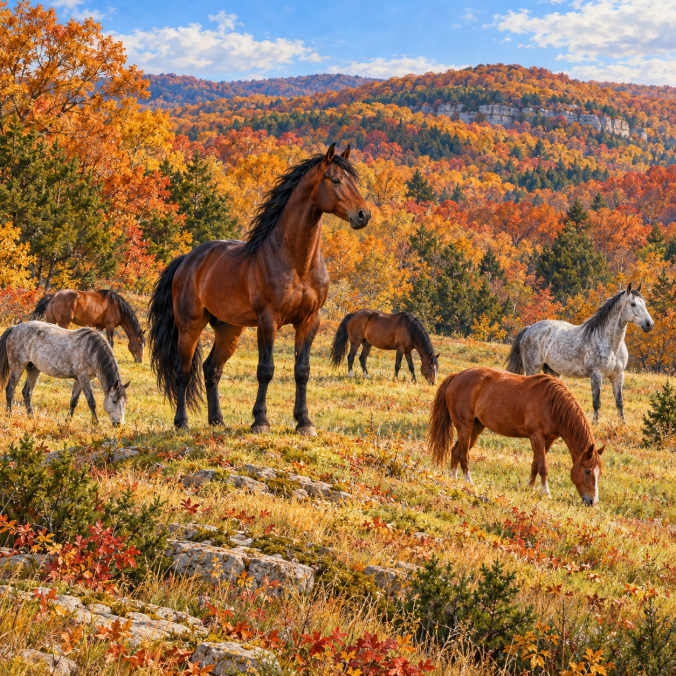
Across the hollow, horses grazed in a broad meadow beneath the Autumn hillside.
A chestnut stood nearest the sunlight. Beyond her were a bay, two greys, and others partly hidden by the slope.
“Whose horses?” Mrs. Bellamy asked.
“The Copper Mist Band. They roam these hills.”
“Wild horses?” Arthur said.
“People call them that. Somewhere in their history were horses that belonged to somebody. These live without saddles or a stable door closing behind them now.”
He looked across the hollow.
There was no fence between the meadow and the woods.
“Can we get nearer?”
“We will watch safely from here.”
Our rear guide kept the party together while we remained on the trail, well across the hollow from the band.
A dark bay stallion stood a little above the grazing band, his black mane stirring in the breeze.
He lifted his head and watched us across the hollow. Sunlight caught the reddish brown of his shoulder, while his legs and tail were nearly black.
“What a handsome fellow,” Mrs. Bellamy said softly.
“He is keeping an eye on us,” I told her.
The mares continued grazing below him. The chestnut moved a few steps, and one of the greys followed her into the sunlight.
The stallion remained where he was, ears turned toward our little party.
Arthur sat very still.
There was something stately about the horse against that bright hillside, standing without bridle or saddle, attending to the distant strangers.
Nobody spoke.
I could hear a saddle creak behind me.
At last, Arthur said quietly, “Imagine seeing this every morning.”
I looked back.
He was speaking to his wife, but his eyes remained on the meadow.
We stayed a little longer, then continued along the trail.
For once, Mr. Bellamy had nothing to announce.
Near another stretch of road, Percy Puddlesniff was occupied with two smaller neighbors.
A grey squirrel stood near a chipmunk whose cheeks suggested considerable preparation for Winter.
Both appeared to have opinions in a sometimes-heated discussion.
Percy was listening and taking notes.
We passed at a quiet walk.
The squirrel made a brisk gesture toward the ground.
The chipmunk responded with as much dignity as his crowded cheeks permitted.
“What are they discussing?” someone asked softly.
“Arrangements and gathering methods for Winter, I expect.”
“Do they disagree?”
At that moment, the squirrel made his point again.
“It appears they may,” I replied.
Mr. Bellamy looked back once, smiling.
“Everybody has work to do.”
“Yes,” I said.
For a while, we listened to the leaves beneath the horses’ feet.
Our last rise brought us to an open view across the hollers.
The trail widened there, and we stopped with room between the animals.
Below us, wooded slopes folded into one another. Gold crowns stood against copper, with red appearing here and there like something newly discovered each time the eye moved. Among them, stands of Shortleaf Pine and Eastern Red Cedar held their green, dark patches that made the surrounding colors seem brighter still.
A thin line of road showed in the distance.
Beyond it lay another hill, and another.
The breeze was cooler now.
One woman drew her jacket closer.
Nobody asked how soon we would be getting back.
At the trail junction, I turned us toward home along the Sassafras Trail.
“We came out on Crimson Ridge,” I explained. “This brings us around the other side of the hill.”
“New scenery all the way?” Mrs. Bellamy asked.
“As much as we can arrange.”
Arthur looked ahead between the trees.
His gelding had already turned his ears toward home.
Mr. Bellamy sat quietly in the saddle beneath his new hat.
He appeared that he had grown less occupied with how he looked in the saddle.
When a leaf drifted past his horse’s shoulder, he followed it with his eyes until it reached the ground.
Mrs. Bellamy noticed, too.
She smiled without saying anything.
Back at the livery, we dismounted with varying degrees of grace and a shared appreciation for steady animals.
Mr. Bellamy stood beside his gelding while a worker took the reins.
“Thank you,” he said, giving the horse a gentle stroke along the neck.
He meant it.
His wife adjusted her gloves.
“Still pleased with your hat, Arthur?”
“Very.”
“And the ride?” she asked.
He looked toward me.
“Could we come again?” he inquired.
“Certainly,” I replied.
Arthur rested a hand on the gelding’s neck.
“Could I have Bramble again?”
“We can ask if he is available that day.”
He gave the horse another gentle stroke.
“I should like that.”
He nodded, satisfied.
As the others gathered their belongings, he took the red sumac leaf from his pocket.
He examined it a moment, then laid it carefully between the pages of a small notebook.
At Hollister’s that morning, the mirror had received a good deal of his attention.
Now he was showing his wife something he wanted to remember.
We had taken the long way out of Butterfield.
It had been a good day to do so.
Original artwork throughout The Front Porch has been created from my concepts and creative direction with the assistance of AI.