HEART OF THE HOLLER
Neighborly Visits with Abigail “Abby” Whitcombe
“Enough Glow to Bring Home”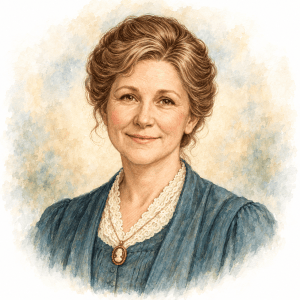
Abigail “Abby” Whitcombe finds the heart of Honey Hill Country in the ways its neighbors care for one another. She notices the tired parent, the small hand looking for someone to hold, and the simple opportunity to turn an ordinary afternoon into something worth remembering.
Join her each month for visits and outings filled with friendship, thoughtful gestures, and the everyday kindnesses that help a community feel like home.
“Small Kindnesses Have a Way of Traveling”
By late afternoon, I had been entrusted with six children, one loose bonnet ribbon, and a wooden sword whose owner had promised three times not to poke anybody.
The smallest child, dressed as a pumpkin, could not see her own shoes.
“I know they’re there,” she assured me.
“That will be useful when we start walking,” I assured.
Her mother knelt to shorten the orange skirt another inch. Behind her, preserving kettles steamed in the kitchen, and a row of clean jars waited on a folded towel.
Across the road, a wagon was being loaded with corn. Rain was expected before morning, and several neighbors were trying to bring the last of their harvest in under cover. There were only so many hands, and considerably more work than daylight.
I had offered to take the children to the Pumpkin Glow Ramble.
“You finish what you need to,” I told their parents. “We shall have plenty to tell you when we get back.”
Judging by the conversation already underway around my knees, that promise would be easily kept.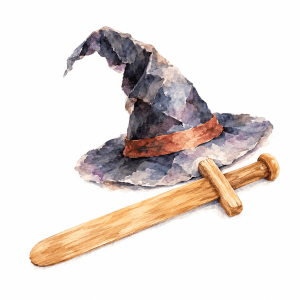
A father came from beside the wagon to admire his son’s costume.
“Well, Captain. Keeping everybody in order?”
“I’m a knight.”
“Of course you are,” I agreed.
The knight allowed his father to straighten his cap.
Then the man bent and kissed him on the forehead, which the knight accepted without lowering his sword.
“Mind Miss Abby.”
“I will,” the knight replied rather earnestly.
“And no charging or sticking anybody with the sword. Remember . . . . you’re a good knight tonight.”
The sword drooped a little.
“O-kay.”
We set out while there was still a wash of gold above the western hills.
Our company included the knight, the little pumpkin, a fairy with slightly unequal wings, a black cat, a girl in a pointed paper hat, and a shepherd who had brought a small stuffed lamb.
The lamb had apparently been difficult all afternoon.
“He wouldn’t stay in the basket,” its keeper explained.
I looked at the lamb, lying quietly beneath one arm.
“He seems settled now.”
“He knows we’re going somewhere,” was the response.
At the entrance to the Ramble, two tall shocks of corn stood beside a wooden arch. Pumpkins clustered around their feet, some carved into broad smiles and others left round and handsome in their own skins.
Beyond the arch, lanterns marked a winding path beneath the trees.
The little pumpkin stopped.
“Oh,” was all she could get out.
For once, nobody had anything to add.
The first lanterns were already glowing. Farther along, where the trees gathered more closely, little points of amber light curved out of sight.
Dry leaves stirred around our shoes. Somewhere ahead, children were laughing.
“Is all that for us?” the fairy asked.
“For everybody who comes,” I replied.
She considered this.
“That’s a great many people to make something nice for,” the fairy added.
“Yes,” I said. “It is.”
We had scarcely passed beneath the arch when the black cat discovered that her tail was being stepped upon.
It was her own foot.
We shortened the tail, counted everybody, and continued.
The Ramble had been arranged with small scenes along the way, each offering something new to find.
At the first stood a little village made from gourds.
There were tiny doors, crooked chimneys, and a bridge across a narrow ribbon of blue cloth. A walnut-shell cart waited outside one house.
Our shepherd bent nearly double to inspect it.
“Who lives there?” he asked.
“Who do you think?” I answered.
He examined the doorway.
“Somebody without much furniture,” he observed after careful inspection.
A few steps farther on, smiling pumpkins sat upon fence posts. One wore an old straw hat. Another had spectacles fashioned from bent wire.
The smallest pumpkin in the row had only two round eyes and a little surprised mouth.
Our own little pumpkin stood before it for some time.
“That one looks like me,” she said proudly.
“It does a little,” I agreed.
“Only, I’ve got shoes,” she said flatly.
“Yes you do,” I responded. “And a very good thing. We have a lot of walking to do.”
At a table beneath an oak, a woman invited the children to search through a shallow basket of dried corn for hidden walnuts.
The knight laid down his sword.
That seemed a sound decision.
Soon six pairs of hands were busy, and the table gave off a soft rustling sound, like a very small harvest being brought in.
The fairy found a walnut first.
The black cat found two together.
The little pumpkin searched patiently, her brow drawn into a crease. She seemed working very hard.
Beside her, the oldest girl uncovered a walnut, glanced at the orange sleeve, and quietly worked it beneath a loose handful of corn.
A moment later, the little pumpkin’s face opened into delight.
“I’ve got one!” she exclaimed!
“So, indeed you have,” I said.
The girl in the paper hat kept looking into the basket.
I kept looking into it, too.
Some kindnesses are best allowed to finish without an audience.
We met Alma Thimbleberry at a bend in the path.
She had her own little company of costumed bunnies gathered around a lantern-lit display of woodland animals made from leaves, nutshells, and pinecones.
One bunny wore a waistcoat. Another was a ghost whose ears had required special care and consideration.
Our black cat regarded those ears with interest.
“Did somebody make holes for them,” she asked.
“Very necessary,” Alma said.
The ghost nodded beneath the sheet.
Our knight and the bunny in the waistcoat inspected one another with the seriousness of gentlemen meeting on important business.
Then the bunny pointed at the wooden sword.
“Is it heavy?”
“Only after a while.”
The knight offered to let him hold it.
In exchange, he was permitted a close examination of a very fine waistcoat button.
While the children compared costumes, Alma and I stood together beneath the trees.
“Busy households?” she asked.
“Very.”
She nodded toward my little group.
“A good evening to lend a hand,” she said.
At that moment, the fairy’s left wing slipped sideways.
“Possibly two,” I replied with a laugh.
The light changed while we walked.
At first, we could see the lanterns and the trees around them equally well. Then the tree trunks grew softer, the spaces between them deepened, and each little flame seemed to gather its own warm room out of the dusk.
Nobody hurried.
There were too many things to notice.
A pumpkin with a crooked grin.
A row of leaf boats resting beside a little wooden bridge.
An owl made from a pinecone, with acorn cups for eyes.
The shepherd showed the owl to his lamb, which from what I could tell, appeared unimpressed.
Near the next turn, a breeze sent a handful of leaves skittering across the path.
The little pumpkin reached for my hand.
“Are we nearly to the end?”
“We can stop whenever you need to,” I replied.
She looked ahead, where another lantern shone.
“I don’t need to. I just wondered.”
We walked a little more slowly after that.
The knight, who had begun the evening several paces ahead, fell into step beside us. When the little pumpkin’s skirt caught upon a twig, he stopped and freed it with great care.
His sword remained tucked beneath his other arm.
I thought his father would have been pleased.
At the end of the trail, tables stood beneath an open shelter.
There were small ginger cakes, apple slices, and cups of sweet cider. A few pumpkins glowed along the rail, and someone had brought quilts to lay across the benches.
I settled the children together and counted them again.
Six.
The lamb made seven, according to its shepherd, and I was willing to accept that.
For several minutes, the conversation consisted chiefly of requests to pass things.
Then the fairy leaned against my shoulder.
“I liked the little houses best,” she said.
“I liked finding the walnut,” said the pumpkin. “That was fun!”
“The big pumpkin with the teeth,” said the bold knight. “That was my favorite.”
“They weren’t frightening teeth,” the black cat explained. “They were happy teeth.”
The girl in the pointed hat brushed crumbs into her palm.
“Can I take my cake home?”
“You have hardly touched it.”
“It’s for Mama. She likes ginger.”
The knight looked down at his own remaining piece.
“Could I take some for Papa?”
Soon we were wrapping several small portions in clean paper, helped by the woman serving the cakes, who quietly added a few more.
The children had been given an evening’s entertainment, and now they were busy finding ways to share it.
We returned by lantern light.
The fairy’s wings had grown tired. The shepherd’s lamb needed carrying, so I took a turn with it. The little pumpkin walked between the knight and me, holding a hand on either side.
At the first house, a mother opened the door before we reached the gate.
“Well?”
Six voices began at once.
There had been a village. A ghost bunny. Walnuts. An owl. A pumpkin with spectacles. A very good cake that must not be squashed.
“And I didn’t poke anybody,” the knight added.
His father, coming around the corner of the house, received that report with evident relief.
The last loaded wagon was under cover now. In the kitchen across the road, filled jars stood cooling beneath a clean cloth.
There was still washing up to do, and tomorrow would bring its own work. But for a few minutes, the grown-ups stood and listened.
The girl in the pointed hat put her little parcel into her mother’s hand.
“I brought you some.”
Her mother looked at the folded paper, then at her daughter.
“Well, now,” she said softly.
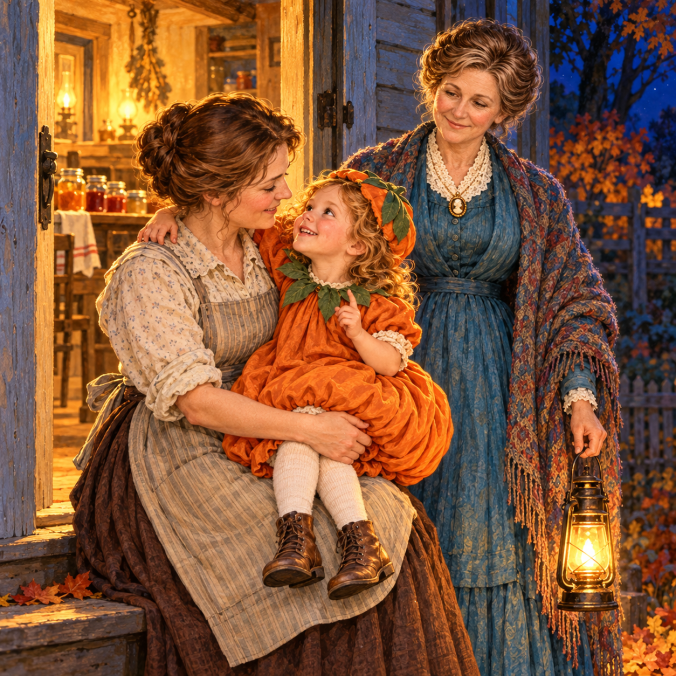
The little pumpkin was lifted into waiting arms.
“Did you have a good time?”
She nodded against her mother’s shoulder.
Then she lifted her head.
“You can come next time. I know where everything is.”
By the time I reached my own door, there was a leaf caught in my hem and a faint stickiness upon one glove.
I stood a moment before going inside.
The lanterns along the Ramble would be going out soon, one by one. Someone would gather the cups, fold the quilts, and carry the little gourd village indoors before the rain.
But behind the windows up and down our road, children were still telling their stories.
We had brought plenty of glow home with us.
Original artwork throughout The Front Porch has been created from my concepts and creative direction with the assistance of AI.