NOW THEN, LITTLE ONES
Learning Along the Way with Alma Thimbleberry
“A Little History, with Room for Ears”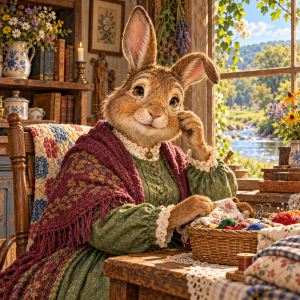
Alma Thimbleberry helps young minds discover the stories behind familiar things, with patience, practical activities, and room for every question. Whether she is explaining an old custom or helping little paws try something new, she knows that a lesson remembered often begins with something enjoyed.
Join her each month as the little ones of Honey Hill Country explore, make, listen, and learn — with plenty for the grown-ups to discover along the way, too.
The ghost could not see.
This was the first difficulty of any note.
The second was that his ears had lifted the sheet so far above his head that the eyeholes were looking at the ceiling.
“Stand still a moment,” Alma Thimbleberry said.
“I am standing still.”
“Your feet are. Your ears are doing their own thing and considering other arrangements.”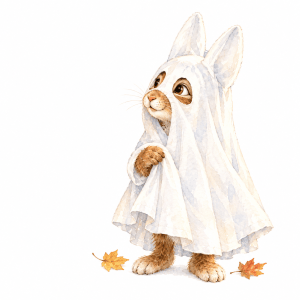
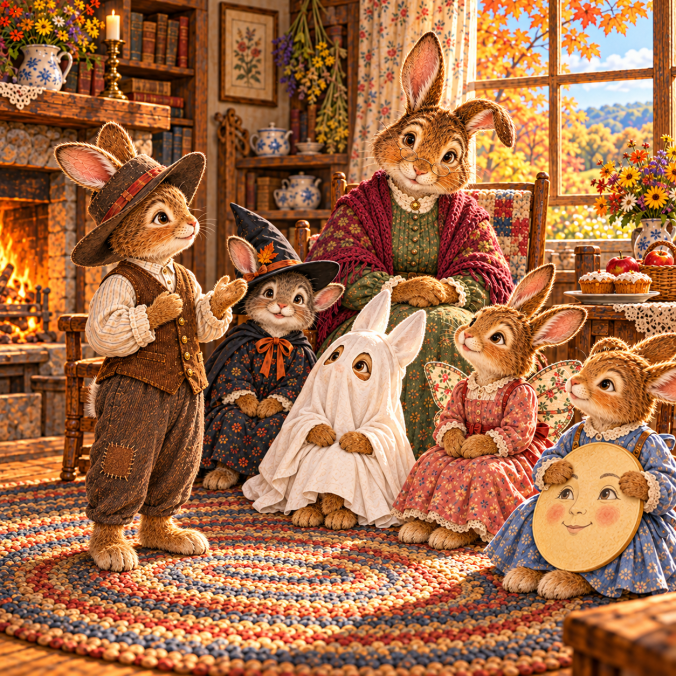
Around her, a circle of young bunnies waited in various stages of disguise.
There was a small witch whose paper hat leaned sideways, a fairy with ribbon-tied wings, a little fellow in a borrowed waistcoat and an enormous hat, and another bunny who had announced that she was going to be the Moon.
Her round pasteboard costume rested against a chair.
Alma adjusted the ghost’s sheet, marked where his eyes actually were, and lifted the cloth away before reaching for her scissors.
“Why do we dress up for Halloween?” the fairy asked.
“A good question,” Alma said. “And one we can discuss while I persuade this ghost to fit.”
“First, the name,” she began. “Halloween is a shortened way of saying All Hallows’ Eve — the evening before All Saints’ Day, which is on the first of November.”
“What is a hallow?”
“An old word for a holy person, or saint.”
“And eve means evening?”
“Just so.”
The bunny in the waistcoat nodded.
“So, Halloween has a longer name underneath.”
“It does.”
“Like me when Mother calls from the doorway.”
Alma smiled.
“Something like that.”
She laid the scissors aside.
“The name belongs to that part of its history. Some customs associated with the season are older still. In Ireland and Scotland, long ago, the end of the harvest and the coming of Winter were important occasions.”
“Because they needed their food put away?”
“Yes. Crops gathered, animals tended, and preparations made before the cold. People held gatherings, and they told stories about what might be out and about on an unusual night.”
“Ghosts?”
“Among other things.”
The little ghost looked pleased.
“Not necessarily ones with their ears showing,” Alma added.
“Did everybody wear sheets?” asked the Moon.
“No, indeed. Disguises have taken many forms. Old clothes, strange faces, masks — things to make a familiar person difficult to recognize.”
“Why?”
“In some old stories, a disguise might keep wandering spirits from knowing who you were. In other customs, dressing up became part of visiting and entertaining. There is no single explanation for every costume in every place.”
The witch straightened her hat.
“Would a spirit recognize my nose?”
“I could not speak for a spirit,” Alma said. “But your grandmother would.”
That satisfied everyone except the witch, who covered her nose experimentally.
Alma returned the sheet to its owner.
This time, he could see.
His ears still made two unmistakable peaks beneath the cloth.
“There,” she said. “A thoroughly respectable rabbit ghost.”
He turned toward the others.
“Did you know it was me?”
They all did.
He took this very well.
“What about the things to eat?” asked the bunny in the waistcoat.
Alma looked at him.
“I wondered when we would reach that portion of the history.”
He folded his paws in his lap.
“In parts of Britain, people once went visiting at this season and received small cakes while offering prayers for the departed. That custom was called souling.”
“Were they sweet cakes?”
“Small cakes, with recipes differing from place to place. Elsewhere, disguised visitors might offer a song, a verse, or some little entertainment and receive food or a coin.”
“I know a verse.”
“I expect you do.”
“Would you like to hear it?”
“Presently.”
Alma reached for a length of ribbon.
“Families brought customs with them when they crossed the ocean. Their stories, games, recipes, and ways of celebrating came along, too. Things changed as neighbors shared them.”
“Like your apple cake?”
“Rather like that. A recipe can travel a long way in somebody’s memory.”
The fairy thought about this.
“So, Halloween did not all happen at once?”
“No, dear. Different people added different things over a very long time.”
“What did you do when you were little?” asked the Moon.
“We gathered with family and neighbors. There were apples and nuts, games, stories, and sometimes more noise than the grown folks had hoped for.”
“What games?”
“Trying to catch an apple floating in a tub without using your hands was one. We called it “bobbing for apples.’”
The bunnies considered their teeth.
“That might be easier for us,” the waistcoat observed.
“It might,” Alma agreed.
“And there were games in which people pretended an apple peeling or a nut could tell them something about their future.”
“Could it?”
“I have never found an apple peeling that could tell me what the weather would do tomorrow.”
“Could it tell you who you would marry?”
“People certainly asked it.”
“What did it say?”
“Generally something that required a great deal of interpretation. And maybe a bit of imagination mixed in.”
Alma tied the fairy’s ribbon into a comfortable bow.
“We can enjoy an old game without believing that an apple knows more than we do,” Alma explained.
The fairy looked over her shoulder.
“Are my wings straight?”
“Straighter than they were.”
“That is good enough. I am not really flying.”
“Were there tricks?” asked the ghost.
Alma’s expression changed.
There was a small silence of anticipation.
“There was mischief.”
“What kind?”
“Well. One Halloween, when I was younger, some local boys placed a farmer’s buggy on top of a haystack.”
Every pair of ears rose.
“On top?”
“On top.”
“With the horse?”
“Certainly not with the horse.”
“How did they get it up there?”
“With considerably more determination than good judgment.”
The waistcoat leaned forward.
“What did the farmer say?”
“I was not present for his first remarks.”
“Was he pleased?”
“He had intended to use his buggy on the ground.”
A giggle traveled around the circle.
“What happened?”
“The boys were found, and they helped get the buggy down.”
“Was it funny?”
“To the boys at first. Less so when the work to get back down began.”
Alma smoothed the Moon’s shoulder ribbon.
“A little surprise can be fun. Damaging somebody’s belongings, frightening an animal, or leaving another person with a day’s work is a different matter.”
The ghost nodded solemnly.
“We could put something little on a haystack.”
“We could leave the haystack alone,” Alma corrected.
By then, the costumes were nearly ready.
The witch’s hat sat properly. The fairy could turn without striking her neighbor with a wing. The Moon had discovered that doorways required a little thought before trying to enter.
Alma stood them in a loose circle and inspected her work.
“Now, what have we learned?”
“Halloween has an underneath name.”
“People brought their customs across the ocean.”
“An apple does not know who you ought to marry.”
“No horses on haystacks.”
“No buggies either,” Alma added.
The bunny in the waistcoat raised his paw.
“Yes?”
“I still know my verse.”
“And you have waited very patiently. Let’s hear it.”
He stood, adjusted his enormous hat, and began.
“October leaves go dancing by,
The Moon is round and bright.
My ears are cold beneath this hat,
But my paws are warm tonight.”
He stumbled over “beneath,” began that line again, and finished to warm applause.
Alma smiled.
“A very fine verse.”
“I made up the part about my ears,” he said.
“I rather thought you might have.”
Alma brought out a plate of little cakes and a basket of apples.
“Is this because of the old visiting customs?” the fairy asked.
“Today,” Alma said, “it is because I invited you, and I thought you might be hungry.”
They were.
Even the ghost.
He lifted the bottom of his sheet carefully, accepted a cake, and sat beside the Moon.
For a little while, the history lesson gave way to crumbs.
Then a small voice came from beneath the white cloth.
“Mrs. Thimbleberry?”
“Yes, dear?”
“Next year, could I be something with a hat?”
Alma looked at the two ears standing beneath the sheet.
“Yes, dear. We shall begin with the ears,” she said, “and see what suggests itself.”
Original artwork throughout The Front Porch has been created from my concepts and creative direction with the assistance of AI.