ALONG THE BACK ROADS . . . .
Visiting the People and Places of Honey Hill Country with Henry Calder
The Place Folks Simply Call Ethel’s
Henry Calder has always believed that every town, shop, farm, and front porch has a story worth telling. Along the back roads of Honey Hill Country, he spends his days meeting neighbors, sharing conversations, and discovering the people and places that make the countryside feel like home.

Ethel McNickle’s store announces itself before you ever reach the front door.
The first hint is often the smell. Dill pickles, vinegar, garlic, and fresh dill drift from somewhere within, mingling with the scent of warm wood and summer sunshine. By the time you reach the front steps, you’ve already begun looking forward to whatever waits inside. The smell of pickles does not arrive alone. Somewhere in the back, fresh pork rinds are making their way toward completion, filling the air with a rich, savory aroma that seems perfectly designed to encourage second lunches.
Hanging ferns sway gently from the porch roof. A sun-weathered fellow in blue overalls leans comfortably against a cracker barrel, laughing at a story he has likely heard before but enjoys all the same. The porch boards creak beneath each step, and somewhere ahead the screen door protests briefly on its hinges before slapping gently shut.
A painted sign above the porch reads:
Ethel McNickle’s Famous Pickles & Pork Rinds
Though around Honey Hill Country, most folks simply say they’re stopping by Ethel’s.
Only then do you meet Ethel McNickle.
On any given day, you will most likely find her behind the counter making sandwiches, greeting customers by name, and somehow keeping track of three conversations at once.
She has a way of making newcomers feel expected and regulars feel missed if they have been gone too long. More than one traveler has stopped for a quick sandwich and found himself leaving an hour later with a sack of groceries, a peppermint stick, and news of half the countryside.
The pickles help, of course.
Honey Hill Country has never lacked for opinions, but on the subject of Ethel McNickle’s pickles there exists a rare and remarkable degree of agreement.
Ethel herself is easy to spot. Her sleeves are usually rolled above the wrists, an apron tied securely around her waist, and her brown hair — now showing a respectable streak or two of silver — pulled back neatly to keep it out of the way while she works. She rarely appears to be standing still. One moment she is slicing bread, the next she is helping a customer locate a jar of preserves, and moments later she is handing a string of rock candy to a youngster who had been studying the candy jar with great anticipation.
On the day of my visit, Ethel’s oldest daughter was tending the checkout counter while Ethel herself worked behind the deli case preparing sandwiches for a steady stream of customers. Asked for pickles, she promptly speared three from a wooden barrel, carefully wrapping them in heavy brown butcher paper and folding the corners tightly to keep the brine where it belonged.
“Henry,” she called when she spotted me. “You look hungry.”
It was less a question than an observation.
Before I could answer, she slid a small plate across the counter.
“Try these.”
The plate contained samples of her newest creation — Sweet & Snappy Pickled Carrot Sticks, first introduced during March Madness Days earlier this spring.
Professional courtesy required me to accept.
They were excellent.
A second sample followed in the interest of accuracy.
A third seemed necessary for confirmation.
Near the front window, two old gentlemen were engaged in a checker match atop an upturned pickle barrel that had long ago found a second life as a table.
The game appeared to have been underway for several days.
“Morning, Henry,” one of them said without looking up.
“Who’s winning?”
He studied the board for a moment.
“Depends who you ask.”
The other gentleman nodded solemnly.
“That’s been the problem from the start.”
Neither man moved a checker for the next several minutes, though both offered detailed commentary on the position.
Ethel paid them no mind.
Some things become part of a place after enough years.
The checker game, it seemed, was one of them.
The pickles are another.
The McNickle family has been making pickles for generations. Family tradition holds that Ethel’s great-grandfather carried an early version of the family recipe west when he left New York and settled among Missouri’s rich farmland many years ago. Each generation made a small adjustment here, a slight refinement there, until the recipe became what it is today.
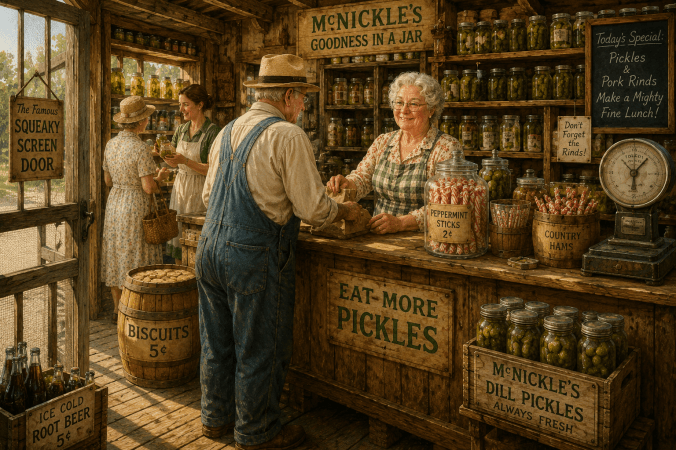
Exactly what goes into that recipe remains known only to family members and perhaps the Almighty.
Many have tried to discover the secret.
None have succeeded.
The results, however, speak plainly.
Over the course of twelve years, Ethel’s dill pickles have claimed six consecutive First Place Blue Ribbons at the Tri-County Fair. Since the fair is held only every other year, that means every judging for more than a decade has ended the same way — with Ethel McNickle carrying home the ribbon.
Mention the achievement to Ethel and she waves it away.
“The cucumbers do most of the work,” she told me.
This explanation seemed unlikely, though she appeared determined to stick with it.
The carrot sticks may soon have a chance to continue the family tradition.
Several customers had already begun predicting blue ribbons for the carrot sticks.
A steady stream of customers passed through the screen door throughout the morning.
A farmer stopped in for a ham sandwich on rye, a pound of coffee, and a sack of sugar.
A fisherman purchased bait and lunch. Small-mouth bass were biting over at Crane Pond Lake, he’d been told.
Two ladies discussed church picnic plans while selecting jars of preserves. Blackberry, strawberry, and apple butter quickly found their way into the basket. They paused over the damson plum preserves and left the jar sitting on the shelf. Peach would likely disappear faster at the picnic than the plum, they decided.
The most memorable visit belonged to a young mother named Priscilla and her daughter, Clara Mae.
As Ethel rang up their purchases, she paused.
“How’s your Aunt Beatrice doing?” she asked.
Priscilla smiled.
“Still poorly, I’m afraid.”
Ethel nodded gently.
Without another word, she wrapped a fresh ham sandwich in butcher paper, added a parcel of pickles, and tucked both into Priscilla’s market sack.
“Take these over to her,” she said. “Maybe it’ll help put a little strength back in her.”
Priscilla began to protest.
Ethel waved the objection away before it could gain any momentum.
Then she turned to Clara Mae, who had been patiently studying the candy display.
“Well now,” Ethel said, reaching beneath the counter, “I think somebody has been especially patient today.”
She produced a small paper bag containing three pieces of molasses taffy, twisted neatly at the top and tied with a pink ribbon.
The little girl’s eyes widened.
“For me?”
“For you.”
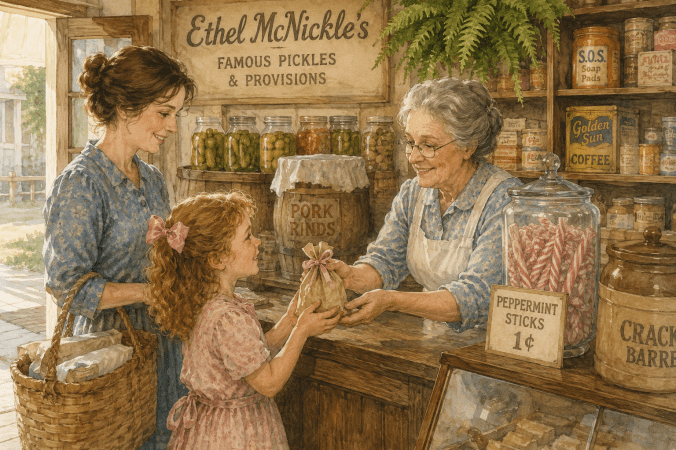
Clara Mae accepted the treasure with both hands.
By the time mother and daughter stepped out onto the porch, they were both smiling.
Ethel tucked a loose strand of hair back into her bun and returned to a discussion already underway at the counter concerning the weather, the gardens, and whether the strawberries would be especially plentiful this year.
A young boy spent several minutes deciding how best to invest three pennies. Peppermint stick or black licorice. Nobody rushed him.
Such decisions deserve careful consideration.
Nobody appeared to be in a particular hurry, for that matter.
That may be the real secret of Ethel McNickle’s store.
People come for groceries.
They come for sandwiches.
They come for pickles.
But many stay a little longer than they intended.
By late morning, I had reached the point where continued reporting required lunch.
Ethel seemed to arrive at the same conclusion.
A few minutes later I found myself seated beneath the broad canopy of the old Bur Oak beside the store with a roast beef sandwich piled high between thick slices of fresh farmhouse white bread. Dill pickles, sweet onion, and enough horseradish to command one’s full attention completed the arrangement. A generous serving of pork rinds occupied the remaining space on the plate, accompanied by a brown glass bottle of locally made root beer. The cork gave a satisfying pop when removed, and the bottle quickly began collecting beads of condensation in the June shade.
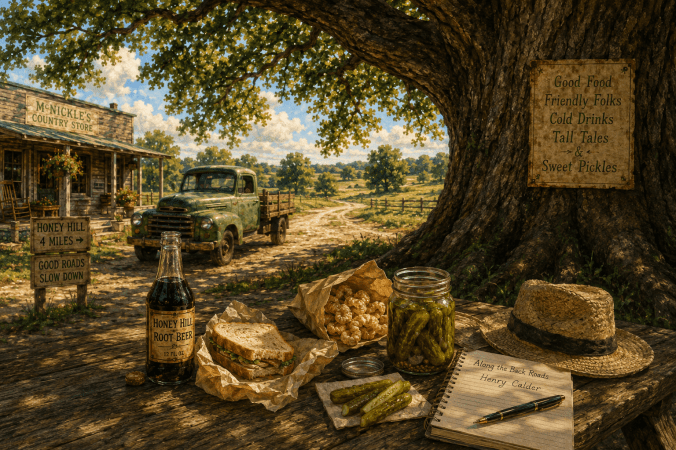
The sandwich was excellent.
The pork rinds were even better.
From my table, I could hear the screen door opening and closing, the checker game continuing near the front window with an occasional outburst from one of the players who had just lost a piece, and the steady rhythm of customers coming and going beneath the hanging ferns. Beyond it all came the clear song of a meadowlark somewhere across the road.
It sounded very much like summer.
And was a pleasant place to spend an afternoon.
It occurred to me then that Ethel McNickle’s store is one of those places where people often arrive intending to make a purchase and leave having spent a good part of the day.
As I prepared to leave, the checker game continued near the front window, a young boy marched proudly toward the door with a peppermint stick clutched in his hand like a hard-earned treasure, and a farmer in dusty overalls stepped aside to hold the screen door for the boy’s mother as she carried a bulging brown paper market sack against her hip and a woven basket over her arm. Behind the counter, Ethel was already helping the next customer.
Some places sell things.
A few become part of the community itself.
Ethel’s crossed that line years ago.
The pickles are certainly worth the trip.
But it has always seemed to me that folks come back for Ethel.

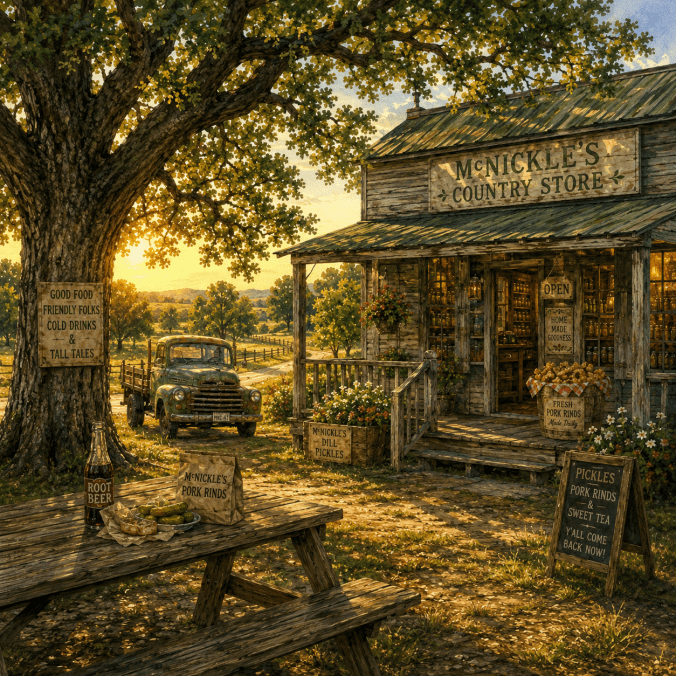

Pen-and-ink illustrations have been created for this piece with the assistance of AI . . . lovingly prepared and styled for the world of Little Red Bear.