THROUGH THE GARDEN GATE
Visiting the Gardens of Honey Hill Country with Maggie Greenleaf
A Visit to a Jeffersonian Garden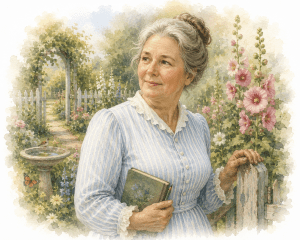
Maggie Greenleaf has a habit of noticing the things others sometimes walk past — a butterfly resting on a blossom, a toad beneath a flowerpot, the scent of lilacs on a spring breeze, or a friendly conversation beside a garden gate.
Through the Garden Gate invites readers to visit the gardens of Honey Hill Country and the people who lovingly care for them.
The first things you notice are the hollyhocks.
Before you see the little white cottage. Before you reach the weathered garden gate. Before you hear the screen door creak open.
You notice the hollyhocks.
Tall and cheerful, well above my shoulders, they stand beside a white picket fence as though greeting visitors before they have properly arrived. Deep pink, crimson, pale yellow, and snowy white blossoms sway gently in the summer breeze, nodding their welcome to anyone passing by.
I had come to visit Clara Hawthorne’s garden on the eastern edge of Butterfield after hearing numerous ladies mention it over the years.
“You really should stop by when the hollyhocks are blooming,” one had told me.
“Especially the hollyhocks.”
So I did.
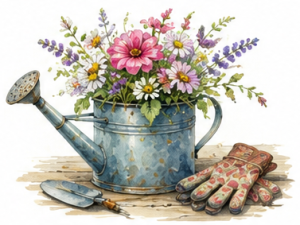
Clara met me at the gate wearing a pair of well-worn blue gardening gloves, sturdy garden boots, and a white apron embroidered with small pink flowers. A broad-brimmed straw hat shaded her face, its ribbon matching the hollyhocks blooming nearby. In one hand she carried a small garden spade.
“Beautiful, aren’t they?” she asked, referring to the hollyhocks and noticing exactly where my attention had settled.
“They certainly are.”
“What varieties are they?” I asked.
She smiled.
“Oh, I couldn’t tell you that. They’ve simply always been hollyhocks.”
Then she added, “My grandmother grew hollyhocks. My mother grew hollyhocks. I suppose it never occurred to me not to.”
I liked that answer.
Not every gardener concerns herself with formal names, varieties, and classifications. Some simply grow what they love.
Together we stepped through the garden gate and onto a winding stone path edged with flat creek stones gathered over many years from Willow Brush Creek. The path curved gently through the garden, and the stones crunched softly beneath our feet, inviting visitors to slow down and wander rather than hurry from one place to another.
The garden itself seemed to follow the same philosophy.
Nothing appeared rigid or formal. Roses shared space with herbs. Columbines mingled with Bee Balm. Old-fashioned Phlox bloomed where they pleased, while patches of strawberries tucked themselves beneath broad green leaves in sunny corners.
Everything felt relaxed.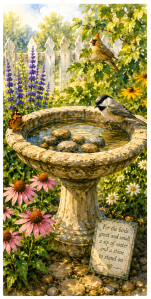
Everything felt lived in.
And yet everything somehow belonged.
Honeybees drifted lazily among the Bee Balm while a pair of butterflies floated from blossom to blossom. One pale yellow butterfly settled briefly on the edge of my notebook before lifting away again.
Clara smiled.
“Oh, that’s Clarice.”
“Clarice?”
“The butterfly.”
She said it so matter-of-factly that I found myself nodding as though this were the most natural thing in the world.
Perhaps it was.
As we wandered the paths, I found myself asking questions about one flower after another. Clara answered most of them with stories rather than gardening advice.
Some plants had belonged to her mother. Others had come from neighbors. Several had arrived in coffee cans, paper envelopes, mason jars, and damp newspapers handed across backyard fences.
The more she talked, the more I realized this was not simply a collection of plants.
It was a collection of memories.
Near the center of the garden stood Clara’s birdbath, a gift from her husband several years before. Several flat stones rested in the basin.
I noticed them immediately.
“Those are for the smaller birds,” Clara explained. “The robins don’t need them, but the wrens and smaller birds seem to appreciate them. They need a place to stand while they drink.”
As though determined to demonstrate her point, a tiny yellow-and-black goldfinch landed on one of the stones, took several quick drinks, and darted away again.
We watched in silence.
Some lessons require no further explanation.
Farther along the path we paused beside a stand of soft pink azaleas still holding onto their blooms despite the unusually cool spring.
“The azaleas are blooming a little late this year,” Clara observed.
I nodded.
They seemed in no particular hurry.
The blossoms glowed softly in the morning sunlight, almost luminous against the deep green leaves, and for a few moments neither of us said much at all.
Gardens are good at reminding people that not everything needs to be rushed.
A little farther on, I noticed what appeared to be an old moss-covered clay flowerpot resting beneath a cluster of hostas.
Good manners suggest one should not immediately inquire about another person’s flowerpots, so I said nothing.
Clara, however, followed my glance and laughed.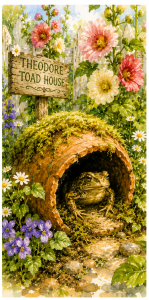
“Oh, that’s Mr. Theodore’s house.”
“Mr. Theodore?”
“Oh yes,” Clara said. “He made it quite clear from the beginning that he expected proper respect.”
“And who is Mr. Theodore?”
“Mr. Theodore the Toad.”
Years earlier Clara had noticed a large toad spending his days beneath the leaves of various plants around the garden. Wanting to give him a cooler place to shelter during the heat of summer, she had taken an old cracked flowerpot, cut an opening into one side, turned it upside down, and tucked it beneath the hostas.
The arrangement apparently met with Mr. Theodore’s approval.
Almost on cue, the distinguished resident emerged from the doorway.
He blinked twice, regarded us both with the solemn dignity of a landowner inspecting visitors, and settled himself comfortably in the shade.
“Good morning, Mr. Theodore,” Clara said.
Mr. Theodore offered no reply, merely blinking once more.
Still, I somehow got the impression he considered the garden to be operating according to acceptable standards.
We continued along the path.
The longer I spent there, the more familiar the garden began to feel. Not because I had visited before, but because it reflected a philosophy I had encountered many times.
Flowers and food. Beauty and usefulness. Learning and enjoyment.
A place for birds. A place for bees. A place for butterflies. A place for people.
And, apparently, a place for toads.
“Clara,” I finally asked, “have you ever heard of a Jeffersonian Garden?”
She shook her head.
“No, dear, I can’t say that I have.”
I explained how Thomas Jefferson believed gardens should nourish both the body and the spirit. Flowers belonged beside vegetables. Beauty belonged beside practicality. Curiosity belonged beside usefulness. A garden could be both beautiful and useful at the same time.
The more I described it, the more she smiled.
“Well,” she said, looking around at the hollyhocks and flowers that surrounded us, “if that’s what a Jeffersonian Garden is, then I suppose I’ve accidentally planted one.”
She paused for a moment.
“Though I have to admit, that’s rather nice to know.”
Perhaps that is what I liked most about Clara’s garden.
Nothing had been created to impress anyone.
It had simply grown through years of attention, affection, generosity, and care.
And if it happened to resemble the work of a Founding Father, so much the better.
Before leaving, I paused once more beside the hollyhocks at the gate. The morning
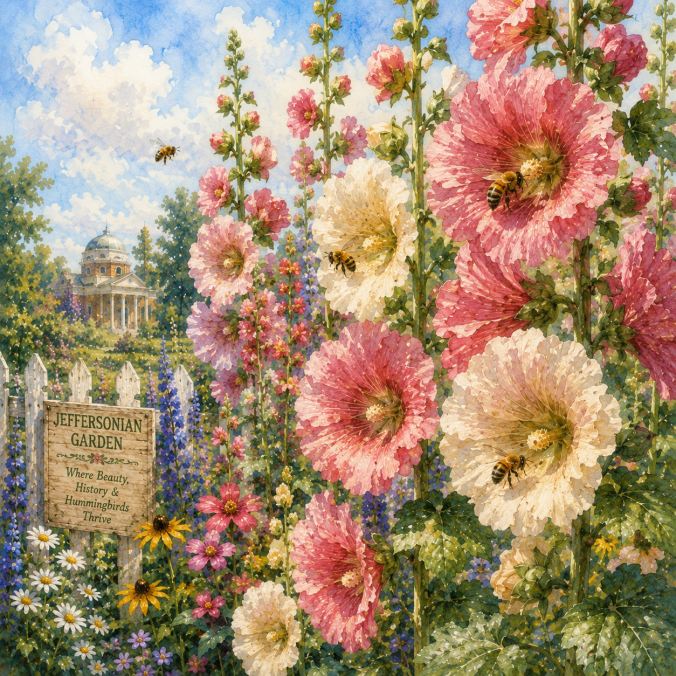
sunlight seemed to shine straight through their blossoms, lighting them almost like stained glass.
Clara noticed me admiring them again.
“They’re beautiful this year, aren’t they?” she said.
“They certainly are.”
“Wait here a moment, dear.”
She disappeared behind the hollyhocks. A few minutes later I heard the distant creak of the screen door, followed by the muffled sounds of cupboards opening and closing.
Soon she returned carrying several healthy hollyhock starts, their roots wrapped carefully in damp newspaper.
“My grandmother shared them with my mother,” she said.
“My mother shared them with me.”
Then she placed them gently into my hands.
“I suppose it’s my turn to share them with someone, too.”
And there it was.
A flower. A memory. A gift.
A tradition carried quietly from one generation to the next.
The world is full of such wonders.
As I carried the hollyhock starts home, I found myself already deciding where I might plant them. Years from now, whenever they bloomed, I suspected I would remember Clara Hawthorne, her beautiful garden, and a distinguished toad named Mr. Theodore.
A patch of flowers. A birdbath. A toad house. A handful of strawberries. A garden gate.
Wonderful things are often hiding in plain sight.
All we have to do is slow down enough to notice them.
And if you should happen to pass a stand of hollyhocks this summer, I encourage you to pause for a moment and enjoy them.
And listen for a moment.
They may be trying to tell you a story.

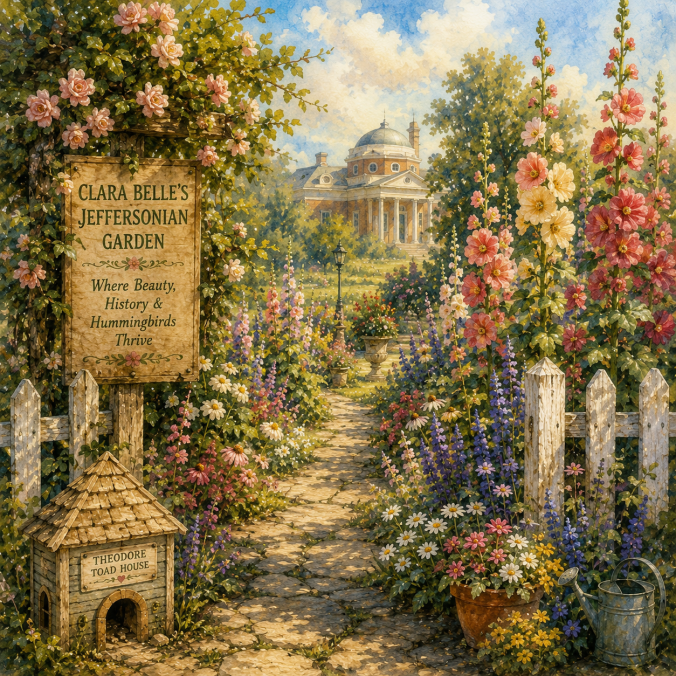
Pen-and-ink illustrations have been created for this piece with the assistance of AI . . . lovingly prepared and styled for the world of Little Red Bear.