WELL NOW, THAT’S INTERESTING . . . .
Discovering the Curious Corners of Honey Hill Country with Clarence “Clary” Moss
“A Few Words with Crowbait”
 Clarence “Clary” Moss firmly believes every town, road, and front porch has a story waiting to be discovered.
With a curious eye and an appreciation for the unusual, he explores the people, traditions, oddities, and local legends that make Honey Hill Country endlessly fascinating.
I had come to interview the scarecrow.
He was not where I expected him.
There was a post in the field, with a crosspiece near the top and nobody on it.
I looked along the rows.
Then someone behind me said, “If you’re looking for me, I’m over here.”
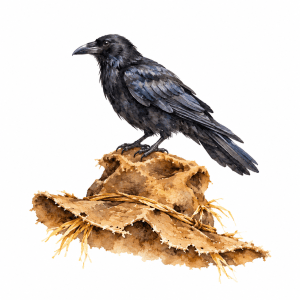
The scarecrow sat on a fence rail beneath a tree.
A crow occupied the rail beside him.
“Taking a rest?” I asked.
“Giving my arms a change.”
He lowered them from his sides and folded them comfortably.
I introduced myself and explained that I hoped to ask a few questions.
“About what?”
“Your work.”
He looked pleased.
“Not many ask about that.”
“What should I call you?”
“Crowbait.”
“Is that your name or your nickname?”
“It’s what they call me.”
“Who?”
“The crows.”
I lowered my pencil.
“That seems an unusual recommendation for a scarecrow.”
“They know me best.”
The crow beside him made a small adjustment to its feathers.
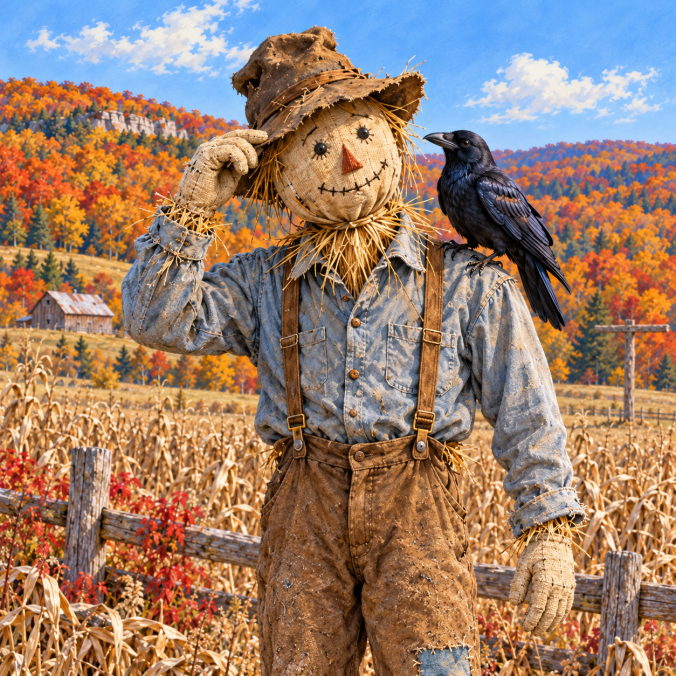
Crowbait wore a faded work shirt, patched trousers, and a felt hat whose brim had settled into several different opinions. Straw showed at his cuffs and collar.
One trouser knee had been mended with cloth that did not match anything else about him.
I found the effect rather agreeable.
“Would you say you are successful at frightening crows?”
“Depends which crow you ask.”
I glanced at his companion.
“May I ask that one?”
“You may.”
The crow looked at me.
Then it looked away.
“He prefers to let me handle visitors,” Crowbait explained.
“How did you get into this line of work?”
“They put me in the field.”
“Had you considered another occupation?”
“Not until you mentioned it.”
“What do you find most difficult?”
“Keeping my hat.”
“From the birds?”
“From the wind. Birds generally bring it back.”
I paused.
“They bring your hat back?”
“Sometimes they’re still in it.”
The crow hopped closer.
Crowbait moved his elbow to make room.
“Do you not find their company interferes with your duties?” I asked.
“They weren’t this friendly at first.”
“What changed?”
“They got to know me.”
I wrote that down.
It seemed important, though possibly troublesome.
“Perhaps,” I suggested, “you could try a more frightening expression.”
Crowbait considered this.
Then he arranged his face.
I waited.
“Are you doing it now?”
“Yes.”
The crow leaned forward and examined him.
Crowbait relaxed.
“Hard on the cheeks,” he said.
“Have you tried waving your arms?”
“Certainly.”
“With what result?”
“They wave back.”
I looked at the crow.
It lifted one wing to attend to something beneath it.
I could not be sure whether this was a demonstration.
“Do you receive wages?”
“No money.”
“What do you receive?”
“Patches. Buttons. Somewhere dry in Winter.”
“Are you satisfied with that arrangement?”
“Could use another elbow.”
I looked at his sleeve.
“Patch,” he explained. “I have enough elbows.”
He turned his arm to show me a thin place in the cloth.
“You can see daylight through that.”
“Does it trouble you?”
“More when the straw starts coming out.”
We walked toward his post.
Crowbait moved with a dry rustling sound, occasionally stopping to push a little straw back inside his cuff.
“Does that happen often?” I asked.
“Less since the new buttons.”
He showed me the front of his shirt.
Three buttons were brown. One was white. The lowest appeared to have belonged to a much more formal garment.
“Fine button,” I said.
“Wedding coat, I’m told.”
“Do you know whose?”
“No. I hope he was finished with it.”
“What do you do when it rains?”
“Get wet.”
“And when it storms?”
“Get wetter.”
“Do you seek shelter?”
“Certainly. I can frighten crows again when it clears.”
At the post, Crowbait looked over the field.
Most of the harvest had been gathered. Dry stalks stood in patches, and a few missed ears remained among them.
“Your season must be nearly over.”
“Quieter part now.”
“What will you do in Winter?”
“Find somewhere out of the weather, if there’s room.”
“Surely there will be.”
“Last year I stood behind a harrow.”
“Was that comfortable?”
“Couldn’t complain.”
“Why not?”
“Nobody in the shed.”
A breeze lifted one side of his hat brim.
He caught it without looking.
“Long practice,” he said.
The crow had followed us and landed on the crosspiece.
“Do the birds ever take your straw for their nests?” I asked.
“In Spring, sometimes.”
“Do you mind?”
“A loose bit, no. But I ask them to let me hand it over.”
“Why?”
“Had a sparrow pull my shoulder out of shape once. Spent the morning pointing at nothing.”
He adjusted his sleeve.
“She made a fine nest, though.”
I asked whether he ever felt lonely in the field.
“Not much.”
“Because of the crows?”
“They help.”
“What do you talk about?”
“Things they’ve seen. Things I’ve seen.”
“You must have a good view from here.”
Crowbait turned slowly.
Beyond the fence lay a road, a wooded slope, and a little stretch of sky between the trees.
“Know when the schoolchildren are late,” he said. “Know which wagon needs grease. Know when somebody’s coming home.”
“How?”
“They look different going that direction.”
I let him explain.
“Some walk faster. Some slow down. Some start looking toward the house before they reach the gate.”
He watched a leaf tumble across the ground.
“One little girl waves every time.”
“Do you wave back?”
“Certainly.”
“Does she know you can?”
“I should think so. She keeps waving.”
The crow moved along the crosspiece.
“Your colleague?” I asked.
“Regular visitor.”
“Does he have a name?”
“Probably.”
“Have you asked?”
“No. I’m the one who agreed to an interview. He just came along for company.”
That seemed fair.
I turned a page.
“What would you like people to understand about scarecrows?”
Crowbait studied me for a moment.
“We can hear you.”
I waited.
“When you say, ‘That fellow’s looking shabby,’ for instance.”
“I see.”
“A new shirt would be more useful.”
I made a careful note of that.
“Anything else?”
“If you stop to eat your dinner by the fence, you needn’t offer me a sandwich.”
“Of course.”
“But you could stay and tell me how your morning went.”
Before leaving, I asked whether he had any advice for someone considering scarecrow work.
“Get a good hat.”
“And after that?”
“Make certain the trousers fit.”
“Anything about the actual business of discouraging birds?”
He thought.
“Tell the crows they’re supposed to be frightened before you learn their names.”
The crow gave a short call.
Crowbait looked up.
“Yes, I know. Bit late now.”
I closed my notebook.
“Thank you for your time.”
“Glad of the company.”
He offered his hand.
His grip was light and dry, and a short strand of straw remained against my palm afterward.
Crowbait noticed.
“You can keep that.”
“Thank you.”
“Not much of a souvenir.”
“It will help me remember the interview.”
He looked pleased again.
I had reached the gate when I heard footsteps rustling behind me.
Crowbait was coming along the fence.
“Forgot something,” he said.
I opened my notebook.
“Yes?”
“Will there be a picture?”
“I expect so.”
He straightened his hat and brushed his patched trousers.
“Give me a moment, then.”
The crow settled on his shoulder.
Crowbait glanced at it.
“For a proper likeness,” he told me, “you’d better leave him in.”
Original artwork throughout The Front Porch has been created from my concepts and creative direction with the assistance of AI.