Once A Week, and Close To Home

How a paper told you what happened — and reminded you who lived nearby

There was a time when the paper did not arrive every morning.

It came once a week — sometimes folded neatly, sometimes creased and softened by many hands — and it usually ended up on the kitchen table, beside a coffee cup or under a pair of reading glasses. You did not rush through it. There was no need to. It would still be there after supper, and often the next day, and sometimes the day after that alongside the easy chair or rocker.

Before you reached the end of the first page, you had already seen names you knew.

Someone had a new baby. Someone else was celebrating a long-awaited anniversary. There would be a church supper on Saturday, a school program midweek, and a notice about a lost dog that everyone hoped would turn up before the next issue came out. Someone’s daughter had been mentioned for her playing at the spring recital, and the high school team had won on Friday night. And sometimes — quietly, respectfully — there would be a name you recognized for a different reason, and the house would grow a little still as you read.

Those small-town papers were not trying to impress anyone.

They did not shout. They did not hurry. They did not pretend that every day was historic. What they did, instead, was tell people what mattered right here — the kind of news that lived just down the road, in their own streets, their own schools, and their own kitchens. Who needed help, who was being celebrated, who would be missed, and what the coming days might hold. News and events close enough to touch, and familiar enough to care about.

They gave ordinary lives a place to be seen.

A person did not have to be famous to appear in print. You only had to belong. A spelling-bee ribbon, a new porch, a good harvest, a bad winter — all of it counted. The paper did something quiet but important: it slowed time just enough for people to recognize one another and remember that they belonged to the same place.

Somewhere along the way, those kinds of papers grew thinner — or quieter — or disappeared altogether.

It did not happen all at once, and it did not come with ceremony. One week there was a paper, and then one week there wasn’t. Or there was one, but it felt different. Faster. Louder. Less familiar. And without anyone quite meaning for it to happen, a small and steady way of keeping track of one another slipped out of reach.

This winter, I found myself missing that kind of paper.

Not the headlines — but the notices. Not the urgency — but the presence. Not the noise — but the quiet. Not the crowd — but the community.

The kind of paper that does not hurry, does not shout, and does not forget the small things. The kind that assumes you will sit with it awhile, maybe pass it across the table, maybe read a bit aloud.

So, missing all that, I decided to create one.

Not to recreate the past exactly — but to borrow its patience. To gather stories the way they used to be gathered. To leave room for observations, oddments, wanderings, and the sorts of things that never make headlines but somehow make up a life.

There are always stories circulating around a town, after all — if someone is willing to go looking for them. Some are found by a roving squirrel reporter with a knack for being in the wrong place at the right time. Others are sniffed out by a good-natured news hound who never missed the scent of a good story.

If this feels familiar, that is no accident.

Some things were worth keeping. And we’re in Little Red Bear’s “Honey Hill Country,” after all.

— Jim  (and Red!)

In the days ahead, I will be sharing more of the people and small happenings that make a paper like this feel alive — the kinds of names and notices that once filled the margins and gave a town its own sense of place and to know itself a little better.

There’s more to come — not all at once, and not in a hurry.

P.S. from Little Red Bear —
Little Red Bear says if a paper feels close to home, it probably is. It tells you what happened and reminds you who lives nearby.

Pen-and-ink illustrations created with the assistance of AI and lovingly styled for Little Red Bear Land.

Reflection and Renewal — Gently Finding Our Way Into the New Year

A gentle welcome for the year ahead — and an unhurried way to begin again.

January has a way of arriving with instructions already written for us, doesn’t it?
Begin again. Improve. Fix. Hurry.

But some years ask for something different.

Some years do not need to be conquered at all — only entered. And once inside, listened to. The quieter truths tend to reveal themselves that way, without ceremony or noise.

Here, reflection is not a reckoning, and renewal is not a contest to be won or lost.
What if it never needed to be?

Instead, it can be something simpler — an ongoing process of noticing what still matters, what has endured, and what might simply need a little tending rather than replacing.

If you have arrived here tired, or curious, or simply passing through, you are in good company. And welcome here.

Continue reading →

A Fresh Stack of Mornings

A quiet New Year arrives in Honey Hill Country, bringing stillness, reflection, and the promise of days yet to be read.

The New Year has come quietly to Honey Hill Country.

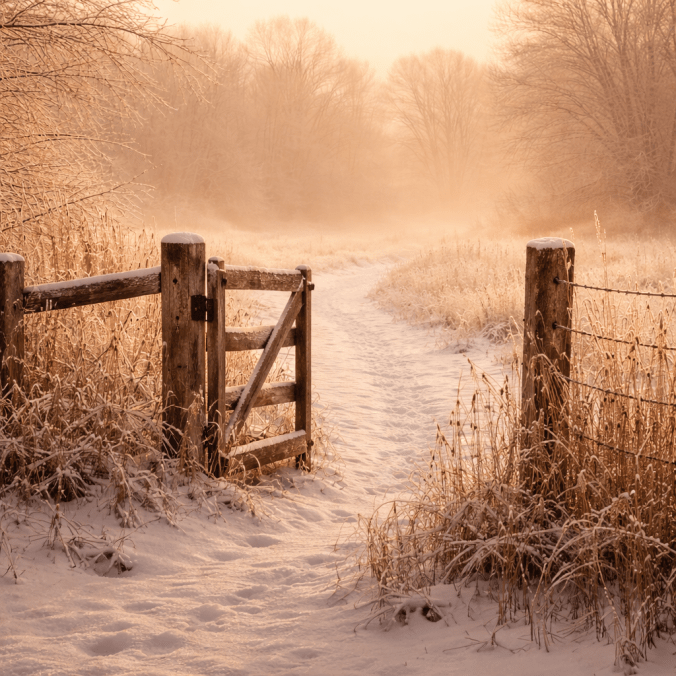
A cold winter morning has settled in. Snow lies clean and unbroken beneath the trees, save for a line of rabbit tracks stitching their way across the yard and disappearing into the brush. Frost rests easy on the fence rails, and the woods hold the kind of silence that only follows a good snowfall — deep, listening, and kind.

No fanfare, no fuss — just the slow turning of the calendar page, with a fresh stack of new mornings waiting to be opened on the kitchen table. The old year folded itself away politely, and the new one stepped in like a neighbour removing their hat at the door.

Out here, the year always begins the same way — with a pause.

There is time to look back at what was carried, what was learned, and what, perhaps, is ready to be set down. There is time to stand a moment longer at the window and consider what might yet come walking up the lane. And there is time — always time — to say, You Are Welcome Here.

Honey Hill Country remains much as you left it — and Little Red Bear is still right where he has always been.

The paths are familiar. The front porches are swept. The kettle is warm — Little Red Bear is keeping it so. Your choice, coffee or tea. Fresh biscuits, always. The stories continue — some by the fire, some on the page, and some quietly, heart to heart.

As the new year unfolds, there will be small kindnesses, ordinary miracles, and a few good surprises tucked between the days. There will be laughter that arrives unannounced. There will be reflections that linger. And there will be new rhythms settling gently into place, one week at a time.

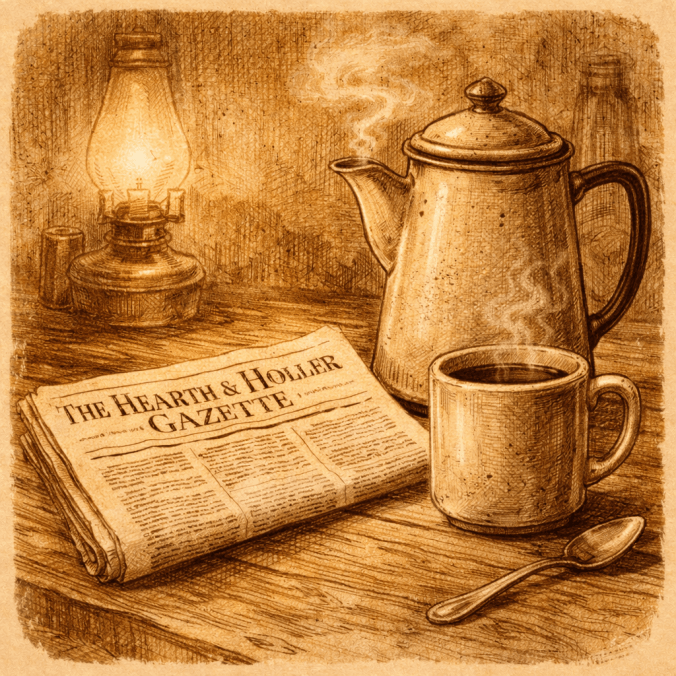
Later this month, something long-planned and much-loved will find its way into the light — The Hearth & Holler Gazette, a weekly visit of tales, tidings, and old-time country comfort, shared from Little Red Bear’s corner of Honey Hill Country and meant to be read slowly, like the morning paper at the table.

But for now, there is no rush.

This first week of January is for standing still just long enough to take a breath, to look around, and to remember that beginnings do not need to be loud to be meaningful.

So welcome — to the New Year, to Little Red Bear’s Honey Hill Country, and to whatever good may yet come.

The gate is open. The light is on.
Come in when you are ready.

— Jim  (and Red!)

“A new year does not ask us to be different people,”
Clara Thimblewick once wrote,
“only to listen a little more closely to the better parts of ourselves.”

Pen-and-ink illustrations created with the assistance of AI and lovingly styled for Little Red Bear Land.

My Year-End Reflection & Looking Ahead

On Writing, Story, and the Road Ahead

As the year draws to a close, I find myself less inclined to sum it up than to simply set it down — like a coat hung by the door at the end of a long day. Some years ask for that. Not a tally, not a verdict, just a moment to breathe before turning toward whatever comes next.

Earlier this week, I shared a few thoughts meant simply to steady the heart as the year turns. This piece is something a little different. Less about what has been weathered, and more about what has quietly taken shape along the way.

Continue reading →

Critter Tales — “The Fence Post Carrot”

From the critters near home . . . to the wildlands beyond.

Critter Tales are small, gentle stories — meant to be read in a few quiet minutes, enjoyed with a smile, and written and shared simply for the fun of it.

The two brothers were not looking for anything in particular that afternoon.

They were doing what bunny brothers often do on mild days — wandering along the roadside, stopping now and then to inspect a pebble, a bent leaf, or a place where something interesting might have happened earlier and could possibly happen again.

That was when the younger brother stopped so suddenly the older one nearly walked straight into him.

They both stared.

Lying just off the road, half in the grass and half in the dust, was a carrot.

Not a carrot carrot.

A carrot the size of a fence post.

It was long and thick and sun-warmed, its orange skin dulled with soil, its green top snapped short as if it had once belonged to a wagonload of respectable vegetables that had not expected to lose a member along the way.

The brothers walked slowly around it.

They stood beside it.

They placed a paw on it, just to be sure.

“It’s real,” said the younger one.

“It’s ours,” said the older one, immediately and with confidence.

The only problem was getting it home.

They tried first to drag it.

They braced their feet, leaned back, and pulled with all the seriousness such a carrot deserved. The carrot did not move. It merely sat there, unimpressed and unmoved, as though it had been waiting for this moment and was quite prepared to wait longer.

They tried lifting one end.

That end rose exactly as far as the other end sank, and the carrot pivoted neatly back into place, landing with a thump that rattled their paws.

They rested, catching their breath.

“Maybe if we roll it,” said the younger brother.

This seemed reasonable.

The carrot was round, after all. Mostly.

They pushed.

The carrot rolled.

Not forward.

It rolled sideways, drifting lazily toward the road, as though it had somewhere else to be.

They scrambled to stop it, wrestling it back into the grass before it could embarrass them in front of any passing wagons.

They tried again, this time from the other side.

The carrot rolled the opposite direction, wobbling, curving, and clearly unwilling to be guided in a straight line.

“It doesn’t listen,” the younger brother said.

“It’s shaped wrong,” said the older one.

They studied it closely then — the thick top, the narrowing point, the subtle curve that promised cooperation and delivered betrayal.

They attempted to lever it with a stick.

The stick snapped.

They attempted to roll it while running alongside, paws scrambling, ears flapping.

The carrot rolled faster than expected, slower than hoped, and then gently pinned them both in the grass until they agreed to let go.

Eventually, they sat down beside it.

The afternoon was quiet. A breeze stirred the grass. The carrot lay peacefully between them, as though nothing at all had happened.

Their house sat below them on the hillside — not far, really, when one looked at it that way.

The younger brother tilted his head.

“What if,” he said slowly, “we don’t take it up to the house?”

The older brother followed his gaze.

The hill sloped gently downward, straight toward their front wall.

They looked at the carrot.

They looked at the hill.

They smiled.

Getting it started was easy.

Stopping it was not.

The carrot tipped, rolled, hesitated, and then gathered confidence, wobbling its way downhill with growing enthusiasm. It veered left. It corrected. It veered right. The brothers ran alongside, shouting helpful suggestions that the carrot ignored entirely.

The curve took over.

The carrot picked its own path.

The brothers watched, helpless and hopeful, as it rolled faster, straighter, and with increasing purpose — directly toward their house.

There was a sound.

A solid, unmistakable WHUMP against the wall.

Silence followed.

Then the front door flew open.

Their mother rushed out, apron askew, eyes wide — ready for disaster.

She stopped.

She stared.

Leaning neatly against the wall, as if it had always belonged there, was a carrot the size of a fence post.

The brothers stood very still.

Then their mother laughed.

She laughed the way one does when something is too unexpected to be annoying and too useful to be ignored.

“Well,” she said happily, “that’s carrot soup for a month.”

The brothers sat down in the grass, dusty and pleased.

The carrot did not move again.

It had arrived.

Pen-and-ink illustrations created with the assistance of AI and lovingly styled for Little Red Bear Land.

Why do I write these? Aw, I don’t know. Just thought it might make you smile.

You’re Welcome Here

Some Sundays end the way they should.

A good meal. Plates pushed back. Folks sitting around a little longer than planned. Nobody watching the clock. The talk wandering from one thing to the next, easy and unimportant in the best way. Somebody pours another cup of coffee or tea. Slices of pumpkin and pecan pies are served. Or maybe a slice of cake. Or two. And no one says much about it.

Those moments matter more than we sometimes realize at the time.

Continue reading →