From the critters near home . . . to the wildlands beyond.
Wilder Tales are small, gentle stories — meant to be read in a few quiet minutes, enjoyed with a smile, and written and shared simply for the pleasure of observing animals a little less settled, and the wider, wilder world they move through.
Having walked with the herd for as long as anyone could remember, the zebra moved once again along the same paths worn smooth by many hooves, stopping where the grass was sweetest and the ground held just enough firmness under foot. There was nothing unusual in the way the herd traveled together — the same easy spacing, the same unspoken understanding of when to pause and when to go on. In the bright, open light of the plain, the zebra’s stripes appeared as they always had, clean and familiar, and no one gave them more thought than the passing breeze or the sky overhead.
Slipping behind a drifting cloud, as it sometimes did, softening the sharp edges of the plain and drawing colors closer together, the sun withdrew for a moment. The air cooled just a little, and shadows loosened their hold on the ground. In that gentler half-light, the stripes on the zebras no longer looked quite the same — not changed, exactly, but revealed differently, as though the sun’s brightness had been doing more work than anyone realized.
At the edge of the plain, where grass rose tall enough to keep secrets, a lioness lay watching. This herd was familiar to her — their number, their movement, the way they held together — but in the softened light her gaze settled longer than usual on one place among them. She did not move, did not crouch or advance. She only watched, with a stillness that carried weight.
Somewhere within the herd, a zebra lifted its head, not in alarm, but in response to a feeling as old as grass and sky — the sense of being watched. That lifting of the head passed lightly from one to another, a ripple rather than a signal, until several pairs of eyes turned, almost without knowing why, toward the tall grass at the edge of the plain. They did not see the lioness at first. They felt her attention before they discerned her shape.
One zebra, standing slightly apart only by the length of a step, followed the lioness’s gaze a moment longer than the others. It was not curiosity exactly, nor fear, but something closer to alignment — the sense of looking where one is being looked through. In the softened light, with shadows loosening and edges no longer sharp, that zebra saw itself reflected faintly in the lioness’s attention, as though singled out without having been chosen.
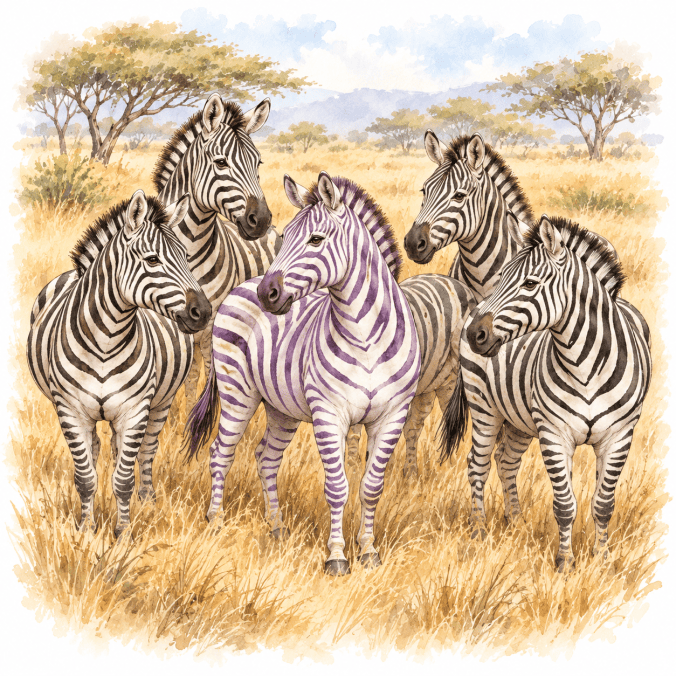
Only then did the difference appear, and even so it did not announce itself. In the half-light, where shadow softened contrast and the sun no longer flattened every surface into certainty, the zebra’s stripes were no longer quite the same black they had always seemed. Along the curve of the shoulder and down the long slope of the flank, a deeper hue emerged — muted, dusty, almost mistaken for shade at first, until it held. Purple, quiet and undeniable, as though it had always been there, waiting for the light to step aside.
The zebra did not move. There was no reason to. The grass was the same beneathfoot, the air unchanged, the herd still close enough to feel without looking. Yet something had shifted all the same. A space opened — not in distance, but in attention — as though a line had been drawn that no one meant to draw, simply by noticing.
One by one, other zebras began to see it too. Not all at once, and not with any agreement. A glance held a moment longer. A head tilted. A pause where there had never been one before. The purple did not grow brighter. It did not spread. It simply remained — unchanged — but newly noticed, now named in the mind even if no one spoke of the difference aloud.
Just as quietly as that awareness had arrived, it began to do its work.
And that work began with something so small it might not have been noticed at all, had anyone been watching for it. When the herd shifted to graze, a familiar space was left unfilled — no more than the length of a shoulder, perhaps — and no one stepped into it. The line adjusted around the absence without comment, the way water moves around a stone.
The purple-striped zebra remained where it had always stood, neither closer nor farther away than before. Yet when the herd moved again, the gap moved with them, keeping its quiet place. Nothing had been said. Nothing had been decided. Still, the shape of togetherness had changed, altered not by action, but by hesitation.
At the edge of the plain, the lioness watched on, her attention unbroken. Waiting. The herd, occupied with its own subtle rearranging, did not notice how much more clearly she could see them now.
The change came all at once.
At the sight of the lioness shifting her weight, lowering her head, the herd’s scattered attention snapped back into alignment. Instinct moved faster than thought. Bodies turned. Hooves thundered against the ground as the line folded inward, closing the space that should never have been left open.
The purple-striped zebra found itself no longer alone at the edge of anything. Warmth pressed in from both sides, familiar and firm. A flank brushed its own. A shoulder settled where the gap had been. The herd did not pause to consider what they were doing or why. They simply remembered how to be together.
Faced with a wall of movement and sound, the lioness halted. She watched for a moment longer, measuring the cost, then eased back into the tall grass, the opportunity gone.
Only after the danger passed did the herd settle again, its collective breath evening. Their shape returned to what it had always been. The purple-striped zebra stood exactly where it always had — no closer to the center than before, no farther away — and the grass beneathfoot felt the same as it always had.
Nothing had changed about the zebra.
Something had changed about the herd.
Pen-and-ink illustrations created with the assistance of AI and lovingly styled for Little Red Bear Land.
Why do I write these? Aw, I don’t know. Just thought it might make you smile.