Welcome back to the Front Porch.
Please pull up a chair for a few minutes and make yourself comfortable. Today I’d like to make a confession — one that may permanently damage my reputation as an honest fellow.
I’ve been lying to perfectly nice people for years.
Professionally.
Now before anyone becomes too alarmed, I’m talking about the respectable, old-fashioned kind of lies. The harmless sort that begin with, “Once upon a time . . . . “ and somehow end with everybody smiling.
Mark Twain is often credited with saying that if you want to become a good fiction writer, you must first become proficient at the art of lying. Whether he actually said those exact words or not, I’ve never been entirely sure. But I’ve always had a difficult time believing he’d object to the sentiment, and cannot argue with it myself.
The longer I’ve been writing, the more I think there may be more than a little truth hiding inside that mischievous observation.
After all, I’ve spent years convincing otherwise sensible people that a talking bear in the Ozarks backwoods wears overalls, a bloodhound interviews a talking mule, a goat develops an unhealthy appetite for hats, and somewhere in a fictional place called Honey Hill Country there are folks who seem just a little more interesting than anyone has a right to be.
And the surprising part?
People keep believing every word.
The curious part isn’t that writers tell these respectable lies.
It’s why perfectly sensible people keep smiling . . . . and asking for another one.
And well . . . . that’s where the real story begins.
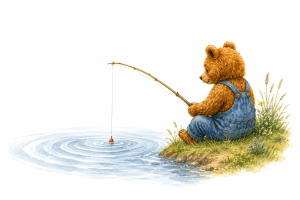
It seems there is a wonderful understanding between a storyteller and a reader.
One says,
“This never really happened . . . . “
And the other replies,
“I know. Go on. Tell me anyway.”
Maybe that is how storytelling has always worked.
Mind you, none of this happens without a surprising amount of homework.
If you happened to read my Front Porch visit a couple of Thursdays ago, you already know I’ve found myself researching everything from mule hearing and homemade blackberry ice cream in 1904 to monarchs and milkweed, old-fashioned screen doors, the price of admission and exhibits at the 1904 World’s Fair in St. Louis, and the curious habits of snapping turtles. And that is just the beginning. The secret lies in stretching what you discovered as true just far enough for imagination to climb aboard.

It is amazing the things a fellow never imagines he will need to know until a story comes knocking.
Take the story “Sir Snapsalot” from “The Adventures of Little Red Bear: The First Holler!” book.
Anyone who has spent much time around ponds and quiet creeks has probably crossed paths with a snapping turtle. They’ve startled fishermen, stolen bait, tangled fishing lines, and generally behaved as though they owned the entire shoreline. That’s not fiction. That is simply a snapping turtle being a snapping turtle.
The respectable lie came afterward.
I added Little Red Bear.
I invited Cinnamon Charlie along with a fishing pole.
I gave the snapping turtle a voice.
Then I quietly stepped aside and let the conversation begin.
Truth be told, the turtle happily supplied the attitude. I merely took dictation as they all proceeded to sort things out.

Over time I have begun to realize something about stories.
People don’t read fiction because they want to be fooled.
They read fiction because, for a little while, they want to believe.
They want to believe that good neighbors still wave from the porch.
That a gentleman like Ennis Greenlea still tips his hat whenever a lady passes by.
That Myrtle Mae Meadowbloom (a dairy cow) somehow manages to turn another kitchen adventure into something worth serving for dessert. And then gives you a recipe to make it yourself.
That Percy Puddlesniff (a bloodhound) can always sniff and find his way to one more interesting animal neighbor willing to tell their side of the story.
That there might really be a place called “The Possum & Mule Exchange.”
That Tiffie Appleyard is already busy making decorations for the annual Riverboat Lantern Festival and Light Parade. Come Christmas season, Packet’s Landing will glow with them.
And maybe — just maybe — that if we wander far enough together down a quiet country road, we’ll eventually come to Honey Hill Country ourselves . . . . and view the riverboats rounding the bend.
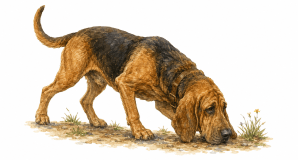
I’ve often been asked where these stories come from. The answer is simpler than most folks expect. They seldom appear out of thin air. Frequently it all begins with something perfectly ordinary.
Stories usually begin with something I’ve seen . . . . or heard . . . . or wondered about.
A weathered old barn.
A butterfly drifting across a field.
A pair of mules hauling a wagon full of sweet potatoes when I was a child.
A fallen oak leaf floating up and out of sight over the roofline in Autumn.
A baby goat untying my shoelaces.
A snapping turtle guarding his favorite fishing hole.
An evening meadow with fireflies,
A neighbor with an unforgettable smile.
A creaking old windmill on my aunt’s farm years ago.
The calls of a whip-poor-will thru the night at summer camp.
All leading to a question that quietly begins with . . . “I wonder if . . . . “
Then, somewhere along the way, another question follows. Followed by another. And then another. And a shortly after a story is born.
A good fiction writer doesn’t create a world out of nothing.
He notices something ordinary . . . . smiles . . . . and then asks , , , ,
“Now . . . . what if , , , ,”
“And before long . . . . what if they could talk?”
That’s where Honey Hill Country has always lived.
Not in escaping the ordinary.
But in discovering the extraordinary that has been hiding there all along.
So, if asked where do I find the stories? I would simply replay . . .
“They’re already there , , , I simply ask them one more question.”
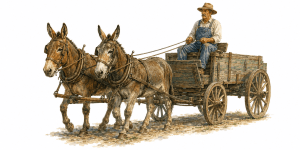
Perhaps that is the real job of a fiction writer. Not to convince people that impossible things are true . . . . but to invite them into a place where, for just a little while, magic is real and believing is part of the fun.
And if, when the story is over, you gently close the book while smiling just a little more than when you opened it . . . .
Well then . . . .
I’d say those were some mighty respectable lies, wouldn’t you?
Till next time then—
Jim (and Red!)

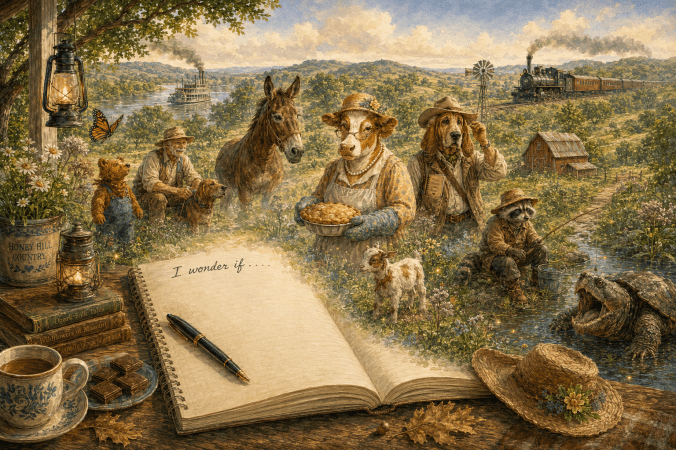
P.S. from Little Red Bear —
I asked Sir Snapsalot whether he thought storytellers ought to tell respectable lies.
He just blinked at me for a long time.
Then he said — “Only if they’re good ones.”
I reckon that’s about as close to literary comment as you’re likely to get from a snapping turtle.
— Red 🐾

Images have been created for this piece with the assistance of AI . . . lovingly prepared and styled for Honey Hill Country and the world of Little Red Bear.



Love it! Keep bringing us those stories, James! Rosie
Rosie Russell Books By Rose “Engaging Young Readers One Book at a Time”
Find me on the below sites:
Rosie Russell
Website/Blog | Facebook | Twitter | Goodreads | Instagram | Pinterest
Website/blog – https://booksbyrose.com/ Facebook https://www.facebook.com/BooksbyRose/ Twitter https://twitter.com/RosieRrbjj Goodreads https://bit.ly/36IiflU
Instagram https://www.instagram.com/booksbyrose4u11/
Pinterest https://www.pinterest.com/rose1628/_save https://www.pinterest.com/rose1628/_saved/
LikeLiked by 1 person
Thanks for visiting with us, Rosie! We were just introducing a new mule character around to everyone on the writing set this morning, actually. 🤠 🐻 ❤️
LikeLike