Happy Hummer Season! Welcoming, Helping, and Attracting Hummingbirds In Your Neighborhood

Happy Hummer Season!  Soon the buzzing and whirring sounds of rapidly beating wings and flashes of color will be filling the air in our backyards once again. The hummingbirds return!
My earliest memories of hummingbirds from many years ago recall the stern admonition and warning from my Mother, taking a page from the ‘Mother’s Guide to Eyes & BB Guns’ — “Don’t go anywhere near the hummingbirds or bother them. They’ll poke your eye out with that bill of theirs!” 

This has always seemed out of character with my Mother’s deep love for all things ‘nature’, but she nevertheless firmly stood by it all thru the years. Maybe she knew someone from her past that had an unfortunate run-in with a disgruntled hummingbird. But I tend to doubt it.

Despite the “Eye Poke” warning, we planted a never-ending stream of flowers and butterfly bushes over the years to attract them, and it was always a special time celebrating new arrivals each Spring. It seemed that Summer would not really be Summer without Hummingbirds buzzing around our flower gardens!
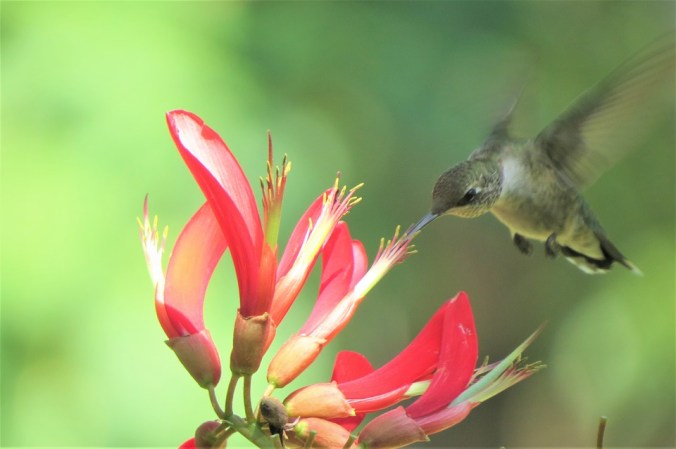


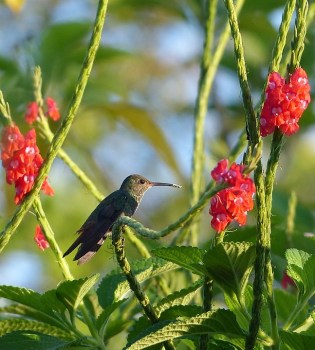
Hummingbirds are a joy to observe in the backyard as they hover, flit and fly about, and will very soon be arriving back to summer homes in North America from winter stays in Southern Mexico, Costa Rica, Panama and other regions of Central America. Hanging a nectar feeder to greet their arrival in Spring will help immensely as they arrive thirsty and in quick need of nourishment following their long migrations northward.


To find out when to expect the arrival of regional hummingbirds in your area, check out the Audubon Guide.  Residents in the South and along the Gulf shores should expect them first and have feeders out, available, and at the ready. When the tiny hummingbirds arrive after long journeys across the Gulf of Mexico from Central and South America they are famished, exhausted, and in need of quick energy resupply!

I invite you to enjoy this slow-motion “Moment of Chill — The Hum of Wings”,  sponsored by The Orvis Company —


Providing a hummingbird feeder in your yard helps to renourish the little hummers quickly and get them off to a healthier start for the coming breeding season after their arduous travels northward, and can be both a source of entertainment and a healthy learning experience for the children in your family as they learn more about nature.

If unprepared in the Spring, not to worry. It is never too late during the season to put your first feeder out for hummingbirds, and extra feeders in the fall are very important for both local birds to prepare for southern migrations and for those passing thru from up north on their way south. It’s never too late to start.

Hummingbirds need to consume several times their body weight in food intake each day and are necessarily always on the lookout for flowering plants to quench their thirst and maintain energy.  Flowering plants for the hummingbirds are much more numerous and available during the summer months, so providing an early supplementary food source with a hummingbird feeder can help them get thru leaner spells in springtime when flowers and natural food sources are not yet as numerous.

There is no need to worry about supplementing their diet with a feeder and distracting hummingbirds from natural food sources, as they will continue to seek out and consume plant nectar, small insects, and tree saps to prepare for the breeding season, and then later feeding their young in the nest. And later still, preparing for fall southern migrations back to their winter homes.


To select the best feeder, choose one that can be easily cleaned on the inside to prevent contamination and illness for the birds, and one that is brightly colored with lots of red to get their attention and attract them to your feeder.

If you have few hummingbirds in your area, completely filling the feeder is not necessary, to not waste the nectar mixture. As the season progresses, filling the feeder to the brim may be more advisable as the birds will be visiting more often to drink and the feeders will probably be even busier with greater numbers in the summer heat and growing families.

If there are a large number of hummers in your area, a larger feeder with a greater number of feeding ports can help to reduce territorial conflicts brought about by the hummingbirds’ natural territoriality and competitiveness to guard the feeding source by allowing more birds to access the feeder. Everyone enjoys a little elbow room.


Feeders can be inexpensive and plain, or very decorative and ornamental.  The hummingbirds only care about the nectar and happily leave design and decor choices to the humans’ personal tastes.  But it is important for any feeder to contain a good deal of bright red coloration.  Hummingbirds are naturally attracted to brightly colored flowers, including yellows, oranges, pinks, and purples, but are drawn to the color red much more than any other color as it signals a food source to the tiny bird, so they naturally associate the color red with food.

Wearing a bright red shirt one hot day last summer, a hummingbird approached and examined me closely before sadly moving on, clearly disappointed after determining that the giant flower he thought he had joyfully discovered was not in fact, a flower.


There is no need to purchase pre-packaged hummingbird food mixes in the store, as a perfect nectar mix can be easily and inexpensively prepared in your home kitchen using only sugar and water as the ingredients.

It is important to prepare the nectar supplement mixture using only Refined White Sugar, as honey can promote dangerous and harmful fungal growth and should never be used. In addition, organic, natural and raw sugars may all contain excessive levels of iron which can be harmful to the birds. Plain, white refined sugar is sucrose, which when mixed with water comes the closest to matching the chemical composition of naturally occurring nectar in the wild.

With a brightly colored red feeder, there is no need to add red food coloring to the nectar mixture, as the chemicals in food coloring can be harmful to the hummingbirds.


Homemade Hummingbird Nectar Recipe

To prepare the nectar mixture, simply mix 1/4 Cup of Refined White Sugar in 1 Cup of Boiling Water until the sugar is all dissolved, or a ratio of 1 part sugar to 4 parts water if preparing a larger amount. Let the mixture cool and then fill the feeder and hang it outside for the birds. Simple as that.


For best results, hang the feeders preferably about head high so you do not need a ladder to reach it for cleaning and refilling, and also in the shade to keep the nectar from spoiling as quickly as it would in the full sun.  The nectar will serve as a healthy and beneficial supplement to the birds’ natural nectar diet in springtime, and then all summer long as well, providing the birds with an extra and welcome energy boost at the end of long, hot, and dry summer days.
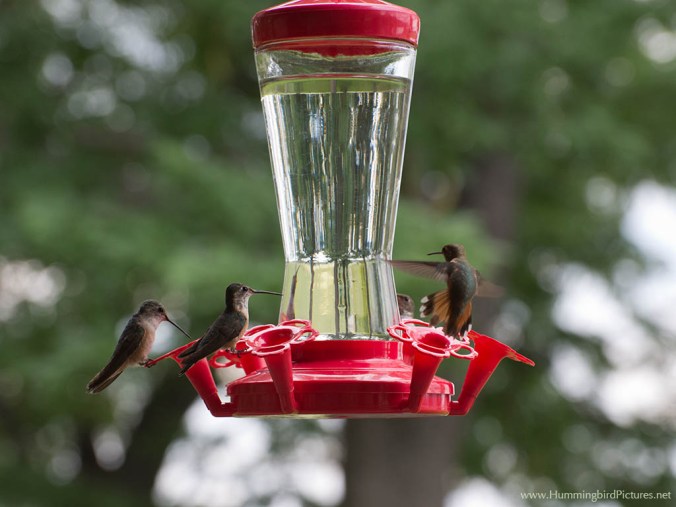


Keeping the feeders freshly filled and available for the birds when fall arrives and having the extra nectar nourishment available will help your little neighborhood hummingbirds restrengthen after the breeding season is finished, boosting energy and helping them to prepare for their long migration back to southern wintering grounds.

Autumn feeders will also provide welcome and needed nourishment to hummingbirds in winter migration passing back thru on their way south. Because of the influx and numbers of migrating birds, putting additional hummingbird feeders out in the fall can actually be very helpful in providing needed migration energy for all who stop by to visit.


Extra nectar mix may be stored covered in the refrigerator for up to two weeks in a clean glass or plastic container.  If the mix in the feeder becomes cloudy or mucky, it should be discarded and the feeder cleaned.  The feeder should be cleaned regularly every few days, especially during hot weather to keep it free from mold and mildew, as nectar is a food and will spoil. We usually clean ours every other day just to be safe.

Feeders can be cleaned using various sized bottle brushes and by soaking them in a mixture of 1 part plain white vinegar and two parts hot water, then thoroughly rinsing to keep the birds healthy.

If black mold is detected, soaking for an hour in a bleach mixture of 1/4 cup bleach to a gallon of water can be done, followed by very thorough rinsing. Mold should not be an issue if the feeders are cleaned regularly.
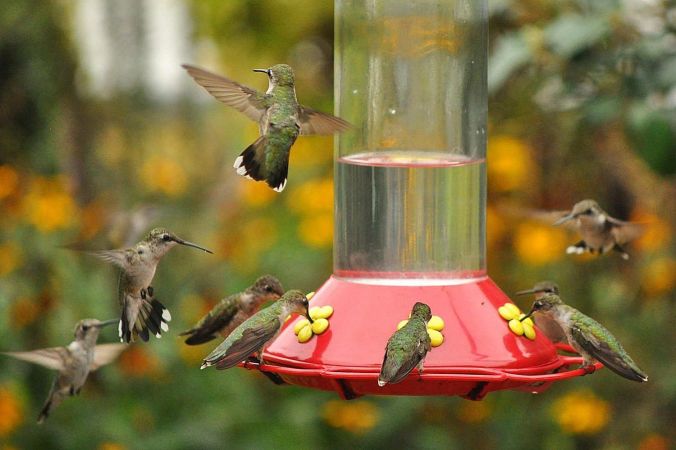


To control and keep away uninvited wasps and bees which may visit hummingbird feeders, avoid choosing a feeder with the color yellow on it, as yellow is known to attract them.  Some feeders have built-in water moats which protect against ants contaminating the nectar, and some have screens over openings which only allow the hummingbird’s long tongue to enter, keeping bees and other insects out.

For additional tips to prevent the problem of unwanted insect visitors,  visit Control All Insects On Nectar Feeders.  In years of feeding hummingbirds with different types of feeders, we have never really had a problem with either mold or uninvited guests.


Hummingbirds can be territorial, especially during breeding season, so there is no harm in hanging out more than one feeder, which may result in even more visitors to your yard.  If possible and for the best results, hang additional feeders out of the line of sight from one to another to attract more birds and to diminish conflicts over territory.


Adding native plants for your regional area and growing them in your garden and yard will also help the hummingbirds by providing natural shelter and food, including a healthy environment for insects. Many are surprised to learn that insects provide an important part of the hummingbird’s diet, especially during the breeding season.

For help in selecting the best native plants for not only hummingbirds but all birds, a great resource to check out is Audubon’s Native Plant Database. Simply enter your zip code to find the recommendations of local experts in your area for your yard. Then you can narrow down the search by the type of birds and/or plants you have in mind.


So, happy Hummer Season!  Little Red Bear and I hope this guide to helping the hummingbirds was helpful, and that both you and your family are able to experience the joys and delights of watching the amazing aerial displays and acrobatics of hummingbirds all summer long. Teaching children about the wonders of Mother Nature can never begin too early, and hummingbirds are fascinating and captivating to watch for all ages.

Likes, Comments, and Shares are always appreciated, in addition to sharing with family and friends to help spread the word to others about Mother Nature and helping to make the world a better place for everyone. Including the Hummingbirds!

Thanks as always for visiting and spending part of your day with us.  A small gesture or kind word can brighten someone’s day or change a whole life around. Join us in the “Smile & Compliment” club and help brighten someone’s life today!  — Jim (and Red!)


If you enjoyed this feature, you may also like — On Singing Birds, Baby Rabbits, and Our “Springtime in Little Red Bear Land!” Video 

(And if a new visitor — Welcome! To find out what we are all about here, please check out — “Welcome To My Writing Pages!” — and sign up to follow and be notified of every new post!)


“Kindness is the sunshine in which virtue grows.” — Robert Green Ingersoll

~ Every Day is Earth Day.   Think Globally — Act Locally. ~


Meet Little Red Bear & His Friends —  “Once Upon A Time In A Very Special Woods . . . .”


Old-fashioned, Family-friendly Stories and Fun for All Ages! 
About an Uncommonly Special Bear and His Friends.

                   “The woods hold not such another gem as the nest of the hummingbird.                   The finding of one is an event.” – John Burroughs


This is a purposefully non-monetized, ad-free site to be able to offer the most enjoyable reading and viewing experience for everyone, with all content freely shared, and generates no income to offset the costs of maintaining and operating. If you enjoy your visits and time with us, Join our new Patron Community today, because together we can do so much!

With the help of patrons, each month we are able to donate free print copies of “The Adventures of Little Red Bear: The First Holler!” to Senior Citizens,  School Libraries and Classrooms, and to those who could otherwise not obtain a copy.

Patrons also help my friend Little Red Bear and me to continue this as a non-monetized, ad-free site,  dedicated solely to entertainment and educational purposes while sharing positive messages of happiness, inspiration, and kindness with everyone. We invite you to join us in making a positive difference in the world!


“If you truly love nature, you will find beauty everywhere.” — Vincent van Gogh


Happy Spring! — On Singing Birds, Baby Rabbits, and Our New Video “Springtime in Little Red Bear Land!”

Happy Spring!  Long awaited, Spring seems to have finally arrived here in the Central Midwest, while other areas to the north are still being buffeted by Winter-like storms.  Two days in the past week reached 80F degrees and doggone it the calendar says April 15th, so with all due respect to Jack Frost and Ol’ Man Winter, Little Red Bear and I are firmly declaring “Welcome Spring!”

As I write this, the windows are open and two Cardinals are singing lustily back and forth in the front of my home, while a House Finch sings for his enchanted in the back. An untold number of English Sparrows are embroiled in loud and urgent arguments over prime nesting spots behind outdoor lamp fixtures around the building.

Robins have been hopping along on the grass for a few weeks now, and I was blessed to see the arrival of a pair of Goldfinches yesterday morning, the first seen this year. The House Wrens have yet to arrive in my neighborhood, but they are usually among the last to arrive, along with the Hummingbirds.

Birds are dashing here and there hurriedly weaving and constructing new nests, while bear cubs, fox kits, and other babies are emerging from dens. A good time to remind to please be careful when driving or out and about with activities, to please be watchful for Mother Nature’s sometimes clumsy and careless new youngsters scurrying about, and to be mindful of spring families and nesting sites, including nesting shorebirds if visiting the beaches.

Because — Spring has arrived!


Little Red Bear has been hard at work on a new video celebrating “Springtime in Little Red Bear Land” and decided it was time to share it with everyone. As the Director of our videos, Little Red Bear has added a new wrinkle to this one, incorporating mini videos within the primary video.  Please let us know if you like our new mini “videos-in-a-video” approach because Red’s always trying new things to make them better and more entertaining for everyone.

Very special “Thank You’s!” to our dear photographer friends Adele Barger Wilson, Marilyn Schroeder, Matt and Delia of M&D Hills Photography, and Sallie J. Woodring Photography for the generous use of their images to create this video, along with images and video inserts from Pixabay.


Our hope is that even though some areas may still be held in Winter’s icy grip, Little Red Bear’s video will help bring warming thoughts of Spring to arrive soon.

We hope you enjoy Little Red Bear’s new video, and if so would truly appreciate a “Thumbs-Up” on YouTube to help other people find their way to it. Likes, Comments, and Shares are always appreciated! Happy Springtime!


When Spring arrives in your backyard — Open the windows! Listen to the songbirds! Watch the baby animals bouncing around! Walk barefoot in the new green grass! Plant a garden with some flowers for the bees and pollinators! Get dirty! Jump in a rain puddle! Take a hike and enjoy all of Mother Nature’s Springtime blessings!

If you have Dandelions popping up here and there in your yard this Spring, please check out “Please Don’t Pull The Dandelions — They’re Nature’s Gift!” before cranking up the lawn mower or reaching for the weed puller.


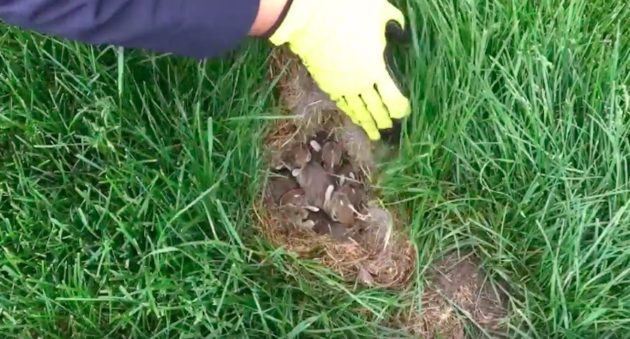
Jeffrey and Jolene are a pair of cottontail rabbits who live with their family beneath Red’s cabin in “The Adventures of Little Red Bear” stories, invited there along with others by Little Red Bear for protection against marauding packs of weasels. But not all rabbit families are so lucky to have a caring and helpful bear in the neighborhood. So, while pushing or riding the lawn mower this Spring, please be watchful to navigate around rabbit nests with babies in your yard.


A quick walk around the yard while picking up winter twigs and debris before mowing, searching for depressions in the ground and grass, can reveal any nests to be easily avoided later when mowing. Be on the lookout for fluffy tufts of the mother rabbit’s fur or for what otherwise may appear to be simply brown patches of dead grass. There may be a nest beneath, and a quick inspection will reveal it.


If you find one, simply leave a six-foot circle of unmowed grass around the nest, and then keep children and pets away for a few weeks. For more information and a quick little video, check out How To Spot A Rabbit Nest Before Mowing Your Lawn from Ontario Wildlife Removal, Inc. The mother rabbit rarely visits the nest during daylight hours (to avoid tipping off the nest’s location to predators), so not seeing any rabbits in your yard is not an indication that there are no nests. Please take a few minutes to simply walk around your yard before mowing to avoid any tragedies.

The baby rabbits only stay in a nest for about three weeks, so while leaving a circle of uncut grass around a nest for a few weeks is not really a big deal for us, it can be a lifesaver for baby rabbits!


If you would like to check out more of our videos, please visit Little Red Bear’s Homespun Videos page to see all that Red has produced to date.

Thanks always for visiting and spending part of your day with us!  Wishing you and your family a very Happy Spring! — Jim (and Red!)


“In spring, at the end of the day, you should smell like dirt.” –  Margaret Atwood

“To pick a flower is so much more satisfying than just observing it, or photographing it . . .                        So, in later years, I have grown in my garden as many flowers as possible                       for children to pick.” – Anne Scott-James 


Old-fashioned, Family-friendly, Multi-generational Stories and Fun for All Ages!
~ About an Uncommonly Special Bear and His Friends ~

“In springtime, love is carried on the breeze. Watch out for flying passion and kisses whizzing by your head.” –  Emma Racine Defleur


This is a purposefully non-monetized, ad-free site to be able to offer the most enjoyable reading and viewing experience for everyone, with all content freely shared, and generates no income to offset the costs of maintaining and operating. If you enjoy your visits and time with us, Join our new Patron Community today. Patrons help my friend Little Red Bear and me to continue this as an ad-free site,  dedicated solely to entertainment and educational purposes.

Because together we can do so much!


” Spring is nature’s way of saying — ‘Let’s party!’ ” –  Robin Williams


Meet Little Red Bear & His Friends — “Once Upon A Time In A Very Special Woods . . . .”

Meet Little Red Bear and His Friends —

“Once upon a time in a very special woods . . . .”

Once upon a time, quite a number of years ago in the Ozarks Mountain Country of Missouri, when steam locomotives rumbled over the rails huff-chuffing along leaving puffy billows and clouds of smoke behind as they went, paddle-wheeled steamboats navigated their way past shifting sandbars in the Mississippi and Missouri Rivers with calliopes playing jaunty melodies to waving folk along the riverbanks, and farmers still relied on wagons, horses, and mules to work the land, there lived three bears.

The three bears were by no means the ordinary, average, or run-of-the-mill bears as most may be familiar with visiting in zoos and observing in nature documentaries today.  Rather, they were quite remarkable. As it turns out . . . . uncommonly special.

The first bear was named Walter, but everyone called him Little Red Bear after an unfortunate run-in with a hive of angry bees one early spring afternoon.  Not to be confused by the name ‘Red’, as his friends frequently shortened his nickname in conversation, his true color was more of a rusty, reddish-brown color.  Kind of an orange, red, and brown all swirled, stirred, and smushed together. So, if after hearing ‘Red’ you had in mind the bright red color of a fire truck, you would be much closer thinking of a rusty old metal wagon in the yard over yonder. That’s Little Red Bear.

Little Red Bear lived in the log cabin he had built on Honey Hill, overlooking Hoppers Holler below, named for the large number of rabbit families who made their homes along Blackberry Creek, meandering aimlessly back and forth, zigging and zagging around boulders and rocky outcroppings from one end of Hoppers Holler to the other.

Little Red Bear had large vegetable and herb gardens, along with many fruit and nut trees. He allowed several rabbits and other assorted critters to make their homes and safely raise their families in the space beneath his cabin for protection against marauding packs of weasels, the scourge of the Ozarks Mountain Country backwoods.

In addition to being regarded as the top honey-gatherer in the mountains, Little Red Bear was equally famous for both the finely crafted bamboo fishing poles and for the flaky, buttery biscuits he made. The steaming hot biscuits drizzled over with plentiful amounts of sweet golden honey of course, and served with every meal. But for some reason, Little Red Bear never learned how to make a decent pie crust. Although he never stopped trying.

Little Red Bear was also known for his weekly Friday night fish fries when neighbors from all over the Tri-County area would bring their families, along with their own prepared dishes and dinner contributions to share for the potluck dinner each week. Everyone, old and young alike, looked forward to Friday nights and Little Red Bear’s fried fish, praised by all as “staggeringly good!”

The second bear was named Bobo.  A black bear and somewhat larger than Little Red Bear in size, Bobo had retired following years of performing in “Barney’s Traveling Big Top Animal Circus and Sideshow” where his balancing feats were legendary. Bobo was widely renowned as ‘Bobo the Balancing Black Bear’ and he still liked to perform for folk whenever the opportunity presented itself. Bobo was rightly confident that he could juggle or balance just about anything tossed his way.

Little Red Bear and Bobo were the very best of friends, an interesting pairing with Little Red Bear being noticeably more calm and thoughtful, while Bobo could be, at times, a bit on the hot-tempered side and given to bouts of occasional grumpiness. But, to his credit, always one to be counted on whenever a problem or threat arose. Or, it must be said, a gathering of onlookers to entertain. Bobo was a trouper and showbear, thru and thru, and could never decline an opportunity to perform for a crowd.

Bobo the black bear was married to Lily, also a black bear retired from Barney’s Big Top circus. They had made an unexpected magical connection behind the circus tent following a performance years before when both had reached for a visitor’s discarded cotton candy at the same moment, touched paws, and had been together ever since. Lily walked away from the chance encounter not only with the cotton candy but also with Bobo’s heart. They are inseparable, and seldom is one seen without the other close by.

Not to be outdone, Lily also was known far and wide for her performing skills in the circus ring as ‘Lily the Dancing Black Bear’. Her graceful and charming dance performances, balletic in style, received rave reviews everywhere the circus traveled, with her most famous dancing maneuver still known as “The Lily Bear Twirl” to this day.

Unlike Little Red Bear, Lily was renowned for her exceptional pie making skills, rivaling that of Myra Cookson who operated ‘Myra Cookson’s Pie Pantry & Goodies Shoppe’ over in the nearby town of Butterfield.  Lily’s special Autumn Spiced Buttermilk Pie was always the most acclaimed and requested at holiday gatherings. It should also be mentioned that Lily’s Persimmon, Gooseberry, Arkansas Black Apple, and Chess Pies were also award-winners at the Tri-County Fairgrounds over the years, along with her Elderberry Jam. No one could compete in the annual county pie rivalry between Lily and Myra, and few tried. Lily’s practice pies undoubtedly contributed to her husband Bobo being of noticeably larger girth than his friend, Little Red Bear, although Bobo always ascribed his ample waistline to “circus muscles”, with a “grruummpphh!” and snort to emphasize the point.

Lily and Bobo lived in their log cabin, not too far away from Little Red Bear’s cabin on Honey Hill, towards the western end of Hoppers Holler. The more secluded and wooded end. The eastern end of the holler, home to Little Red Bear on Honey Hill, was more open with meadows of tall grasses, clover, and wildflowers that rippled in the gentle summer breezes. Honeybees visited the clover and wildflowers to make honey, and as predictably as spring follows winter, Little Red Bear visited the bees.

One day, when traveling to his favorite fishing hole which he had named ‘Perch Lake’ because of all the tasty yellow perch fish swimming about in it, Little Red Bear had come across a  small young bear, scarcely a year old and certainly not ready or large enough to be independent, or to be out on his own or alone yet. The little bear had been trying unsuccessfully to catch a fish, was very thin, ragged in appearance, ravenously hungry, and appearing in every way clearly the worse for wear. His name was Cinnamon Charlie, and his coat color was a brownish cinnamony color.

Upon learning about how he had been left by his mother and aware that young bears struggle mightily on their own with many not surviving, Little Red Bear befriended Cinnamon Charlie, gave him a home, and took him under his wing to look after, guide, teach, and instruct him in the ways of the world. And fishing.

Cinnamon Charlie was delighted to have a roof over his head, regular meals once again, and a comfortably warm bed of his very own near the fireplace. And away from Little Red Bear’s snoring on the other side of the cabin. Cinnamon Charlie had found a home. Even if it meant learning how to read the “Squirrelly World” newspaper each morning.

So, then there were four bears.

The four bears lived in an area of the Ozarks Mountain Country largely unchanged by time or the outside world where they all walked along upright on two legs, and where animals and humans conversed freely with each other and interacted as equals, living side by side as neighbors and friends as it had always been and as Mother Nature had originally intended before things got complicated.

Little Red Bear wore clothes, most frequently a pair of worn, faded and loose-fitting blue denim overalls, accompanied by a wide-brimmed straw hat and a washed-out red bandana tied loosely around his neck or dangling from a rear pocket, its location more often than not determined by the season and temperature of the day.

Together, the four bears and their friends, animal and human alike, are the main characters in “The Adventures of Little Red Bear” tales — positive and inspirational fiction stories told in an easygoing, old-fashioned manner with a bit of down-home Southern flair, which we simply call a Country Comfortable writing style. Themes of Kindness, Positivity, Helping Others, Spirituality, Conservation, and Mother Nature are interwoven throughout, spiced with a little country humor.

The multi-generational short stories are family-friendly, instructive for young middle-grade readers, and perfectly suited for reading to little ones on your lap by the fireside, while also being both humorous and enjoyable entertainment for adult readers on their own. The stories are intended to be Entertaining, Informative, and Educational.

Discover what our readers have had to say about the Little Red Bear stories in their Reviews and Reader Comments, and tap here to enjoy a Free Preview for yourself.

“The Adventures of Little Red Bear” —  about an uncommonly special bear and his friends.  And where no story ever begins with — “Once Upon a Time . . . .”


Thanks as always for visiting and spending part of your day with us! We hope you will join us for Little Red Bear’s stories because everyone needs to step off the front porch for an entertaining and rewarding adventure now and then.

Just please remember to scrape the mud off your boots when you get back.  We still get a few letters now and then about muddy floors.  —  Jim  (and Red!)


“Children are made readers on the laps of their parents.” — Emilie Buchwald

            “Act as if what you do makes a difference. It does.” — William James


Old-fashioned, Family-friendly, Multi-generational Stories and Fun for All Ages!
~ About an Uncommonly Special Bear and His Friends ~

        “When I stand before God at the end of my life, I would hope that I would not have a single bit of talent left, and could say, ‘I used everything you gave me’.” — Erma Bombeck


Like and Follow My Writer’s Page on Facebook For Daily Inspiration and More!


“To read the front pages, you might conclude that Americans are mostly out for themselves, but you can’t travel the back roads very long without discovering a multitude  of gentle                            people doing good for others with no expectation of gain or recognition.”                     — Charles Kuralt


This is a purposefully non-monetized, ad-free site to be able to offer the most enjoyable reading and viewing experience for everyone, with all content freely shared, and generates no income to offset the costs of maintaining and operating. If you enjoy your visits and time with us, Join our new Patron Community today, because together we can do so much!

The help of patrons allows us to donate print copies of “The Adventures of Little Red Bear” to Senior Citizen Centers and Residents, School Libraries and Classrooms, Hospitals, and to those who otherwise would not be able to enjoy or benefit from the stories.

Patrons help my friend Little Red Bear and me to continue this as an ad-free site,  dedicated solely to entertainment and educational purposes while sharing positive messages of happiness, inspiration, and kindness with everyone. We invite you to join us in making a positive difference in the world! 

As Little Red Bear says — “Think Globally, Act Locally. Tomorrow begins with You today!”


“Our greatest national resource is the minds of our children.” — Walt Disney 


What is Patreon, Why I Joined and What It Means For The Future

If you are like me, you may never have heard of Patreon before. I hadn’t until it was suggested to me and I started investigating.

Growing and increasingly popular among artists, writers, videographers, musicians, and other creators, Patreon is a new, web-based membership platform providing a means for creators to build a subscriber base and receive funding directly from their fans and followers who are seeking a way to reward and provide tangible encouragement, help and support for their creative work, thereby enabling creators to focus on their work and do more.

Historically, “patrons” have directly endorsed and supported creative artists’ work over the centuries.  Patreon is a platform for that to happen once again, by providing fans and followers of creators the opportunity to subscribe as a patron of their work at whichever amount they may choose.

Some patrons may contribute each time a creative work is produced, while other patrons may pledge a small monthly amount to assist the creator on an on-going basis. In many instances, as little as a dollar a month.  Membership participation varies, individual to each creator.

So, if you see a new Patreon button or logo on someone’s page that you follow, or are provided an email link in correspondence, that is what it is all about. A way to reward, encourage, and support the creative work of those you follow and enjoy.

Contrary to advice received over the years, I have steadfastly refused to monetize my writing and creativity blog by incorporating advertisers, and will continue to do so, to never distract from positive messages and enjoyment of visitors, so receive no revenues from this site.

Retired on disability and living on a fixed income which diminishes each year with rising housing costs, medical expenses and inflation, I have become increasingly reliant on revenues from the sale of my teddy bear and other creations in my online stores to offset the costs of the blog and writing, and to make ends meet. At the same time those revenues have been decreasing from more difficult days when hand work becomes more challenging, coupled with more time spent on the blog and writing.

After a great deal of thought I came to the decision to join Patreon to help keep it all going, and as a better alternative to intrusive, annoying and questionably tasteless or shady advertisements running on my blog pages, which I would ultimately have little or no control over.

Patreon provides a reliable means for followers who would like to participate in the process, to help keep both the site and my writing work not only going, but also growing to reach a wider audience with our themes of Children, Family, Kindness, Positivity, Mother Nature and Conservation. That is what it is all about here.

What joining Patreon means, is that thru small monthly pledges and encouragement, Patrons allow me to –

  • Devote a greater amount of time to writing both with Little Red Bear and on exciting new projects in the works,
  • Provide a higher quality experience and educational information for visitors to this site,
  • Reach new readers thru my writing blog, Little Red Bear stories, and other new ways,
  • Continue spreading our positive messages to new audiences,
  • Maintain this site free of advertising and easy loading for reader enjoyment,
  • Be able to continue providing free original reading material, poetry, and wholesome entertainment for all ages.

If you are interested in becoming a Patron and would like to learn more about what it involves, simply Visit my Patreon Page and discover the exclusive rewards in store for Patrons as my Thank You – including writing updates, sneak peaks of upcoming releases, extra materials not able to be included in stories and books, the ability to participate in my Patron community, and much more.

Sharing kindness, positivity, and care for Mother Nature, together we can reunite and unify the pieces to help bring about a better future for our children and grandchildren.

Thanks as always for visiting with us. If not able to become a Patron at this time, please be assured that my writing blog will always remain free and accessible for all, and thank you always for your encouragement by following along.  – Jim (and Red!)


If you enjoy your visits here, Become a Patron of this site and my writing work, helping to grow and expand our outreach to others. Find out more and discover Patron benefits today!


“Someone’s sitting in shade today because someone planted a tree a long time ago.” – Warren Buffet


“I’ll lift you, and you lift me, and we’ll ascend together.” – John Greenleaf Whittier


Old-fashioned, Family-friendly Stories and Fun for All Ages and Fitness Levels!
About an Uncommonly Special Bear and His Friends.

“In a gentle way, you can shake the world.” ― Mahatma Gandhi


                                       Enjoy Your Visit?  One-time Tips  Are Appreciated.                               Help Keep It Going For Others!


Please Don’t Pull The Dandelions — They’re Nature’s Gift!

Oh my gosh!  It’s early Spring and here come the dandelions all over the yard.  What to do?!?

Answer — absolutely nothing.  Relax, have an iced tea, and simply leave them be. We really dig dandelions here, but perhaps not in the way some may imagine.

My father, noted for his dandelions obsession, would have me busy every available free moment years ago it seemed, dandelion puller in hand, sent out to pull and dispatch the lowly yellow flowers out of our burgeoning green lawn.

“Now, get down deep and pull ’em up by the roots or they’ll surely come back on us, son!”

My idea of true technological progress was when my father came home one day with a long-handled dandelion puller newly purchased from the hardware store, one I didn’t have to bend over all day with or crawl around the yard on hands and knees.  Yep, modern science had come a long way. I could pull ’em standing up!


In the suburban sprawl era of the early ’60s with new subdivisions sprouting up everywhere, my father could and did spend hours talking with other men in the neighborhood about — Grass.

Seriously weighing the merits of one variety of grass versus another and how best to care for their lawns.

Those out there on the very cutting edge of technology were experimenting with the new Zoysia Grass just becoming available at the time, and “plugging” their lawns with it.  Anybody in their right mind seeded. Everybody knew that.  They were “plugging!”

“Poor Troutman’s lost his mind this year with that Zoysia grass.”

“Gonna have an ugly mess on his hands for sure!”

“That Zoysia stuff turns brown like straw all winter.  A real fire hazard, that!  He’ll be sorry.”

“Well, he’s a young college guy and doesn’t know anything.  He’ll learn.  Ya just can’t beat good ol’ Kentucky Blue Grass.”

“Nah, that stuff burns up in the summer heat.  I’ll stick with my Fescue.”

And on and on it went. Heady stuff, those evening, after-dinner grass meetings on the sidewalk.  We won’t even go into Crabgrass debates.  And what in the world to do about that guy on the corner and his dandelion infested yard, blowing seeds all over the neighborhood?

“Who does Baggett think he is, after all, a Dandelion Farmer? Look at his mess down there! Why doesn’t he get out and pull those dad-gummed weeds?!?”


The beauty of one’s lawn was definitely a status symbol in the subdivision back then, as dandelions in your yard certainly meant that you would be looked down upon by all of the folk meticulously fertilizing, treating, and clipping perfectly manicured lawns, proudly pushing their new, bright green Scotts’ spreaders in front of them while whistling a happy tune, dandelion digger tucked into their belt or back pocket.  And yes, there was a distinction.  Farmers ‘mowed’ down weeds.  Lawn aficionados ‘clipped’.

Folks with dandelions in their yards were judged to be lazy, uncaring, and downright disrespectful because soon those wicked seed puffs would be blowing thru the air on spring breezes and re-infesting all of the honorable and upstanding folks’ yards.

Such was life in the suburbs during the time of manicured lawns and new homeowners aspiring to be featured on the cover of ‘Better Homes & Gardens’ magazine.


But, let’s hold on just a bit and fast forward several decades.

Honeybees, critical to the world’s food supply, have been decimated in recent years from an assortment of maladies —  colony collapse disorder (CCD), global warming, selective industrial crop plantings, insecticide and herbicide poisoning, the uprooting and destruction of native plant species, and so much more.  They sorely need our assistance for the benefit of the planet, and it just so happens that leaving those dandelions in your yard alone for a while is one of the very best things that you can do to help them in early Spring.


When honeybees and other pollinators first emerge in the very first warm days of early Spring, like bears coming out from their dens after a long Winter and having depleted their honey stores which kept them going thru the Winter months, they are hungry and in need of nutrition right away. And just as Mother Nature intended, those bright yellow dandelion flowers in your yard are one of the very first emerging and available food sources for them every year.

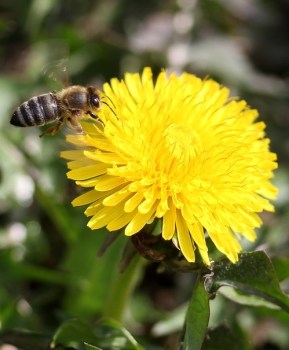
Each dandelion flower is composed of up to a hundred individual florets, each one packed with needed nectar and pollen before later emerging flowers and plants bloom and are available.  Dandelions are one of the earliest and best food sources for bees and pollinators each Spring.  They count on dandelions for survival.


Not only honeybees feast on the flowers but also bumblebees, hoverflies, beetles, and butterflies.  Later, goldfinches, house sparrows, and others eat the seeds while raising babies in the nests.

For us, young dandelion leaves make a fine addition to spring salads and are loaded with vitamins and antioxidants, and the flowers (leaving some for the honeybees and wildlife) have been made into Dandelion Wine for ages.  Just be sure the plants have not been treated with chemicals or lawn fertilizers for food safety.


So, if it is necessary to mow the grass, please consider raising the height of the cutting blades to safely pass over the dandelion flowers for the first month or so. It makes mowing thick spring grass easier, anyway. And then sit back with your iced tea on the porch to enjoy the parade of honeybees, butterflies, and other visitors to the dandelion flowers in your yard, confident that you are helping both them and the environment.


And if a well-intentioned neighbor makes a comment, just bring them up to speed about why it is so important to simply leave the dandelions be in early springtime, for the sake of the honeybees and pollinators. And us.

Cross-pollination helps at least a third of the world’s food crops and 90% of wild plants to survive.  Without bees to pollinate and spread seeds, many plants, including major food crops that we ourselves depend upon for survival, would die off.  And that is why early spring dandelions are so important.
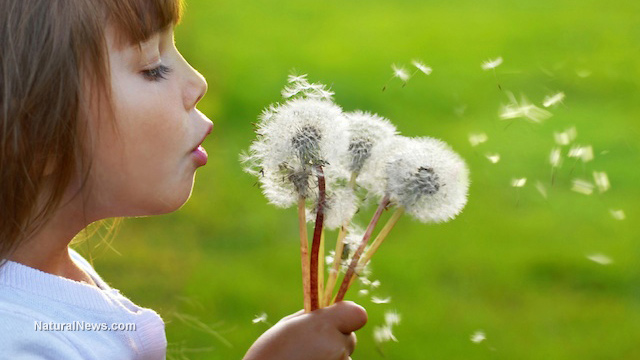
Some have stated that if honeybees disappeared from the Earth, humans would inevitably follow four years later due to lack of food supplies. If letting the dandelions grow in early springtime helps the bees survive and keeps the grocery shelves stocked, we are all for that.

Besides, I haven’t met the Mother yet who doesn’t delight in a freshly-picked dandelion bouquet from her four-year-old in the Spring.

And, if the dandelions are all mowed down, pulled out, and tossed away — how could we ever hope to make a wish?


Speaking of dandelion bouquets and making wishes, if you have small children or grandchildren, check out the delightful little children’s book “Why Dandelions Grow” by Nita Marie Clark available on Amazon.

Told in verse with colorful illustrations, the book tells about how dandelions came to be (they seemed to be an afterthought, you know), and is very instructive for youngsters on both dandelions and bees, along with the importance of dandelions to the survival of bees in early springtime.

Little Red Bear and I always advocate teaching children about Nature and its importance, beginning at the earliest age, so they will become involved, learn to appreciate, and care about taking care of and preserving it for the future.  That’s the Little Red Bear way.


Working together we can do our best with Mother Nature to help the bees and other pollinators.

Thanks always for stopping by to visit with us, and please feel free to share this important message with family and friends!

My story friend, Little Red Bear, and I hope you will join us in the “Bee Friends” club and simply sitting back to watch the dandelions grow, confident in knowing that you are doing something positive and a ‘good thing’ for the environment and Mother Nature.  — Jim   (and Red!)

If you enjoyed this feature, you may also like → “Happy Hummer Season! Welcoming, Helping, and Attracting Hummingbirds In Your Neighborhood” 


Think Globally — Act Locally — Tomorrow Begins With You TODAY!

Children + Nature + Outdoors = Happy, Healthy, Balanced Kids


Meet Little Red Bear & His Friends —  “Once Upon A Time In A Very Special Woods . . . .”


Old-fashioned, Family-friendly Stories and Fun for All Ages! 
About an Uncommonly Special Bear and His Friends.

                 “Those who contemplate the beauty of the earth find reserves of strength                   that will endure as long as life lasts.” – Rachel Carson 


This is a purposefully non-monetized, ad-free site to be able to offer the most enjoyable reading and viewing experience for everyone, with all content freely shared, and generates no income to offset the costs of maintaining and operating. If you enjoy your visits and time with us, Join our new Patron Community today. Patrons help my friend Little Red Bear and me to continue this as an ad-free site,  dedicated solely to entertainment and educational purposes.

Because together we can do so much!


“How doth the little busy bee, Improve each shining hour,
And gather honey all the day, From every opening flower!”

 – Isaac Watts, ‘Divine and Moral Songs for Children’ 


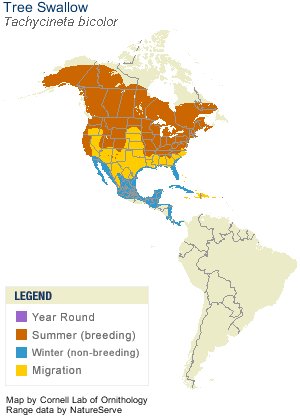
Getting to Know — Tree Swallows

Tree Swallows are among my favorite birds, always delighting in observing their aerial acrobatics in fast pursuit of insects, rapidly twisting and turning thru the air dashing here, there, and everywhere on late summer afternoons and evenings.

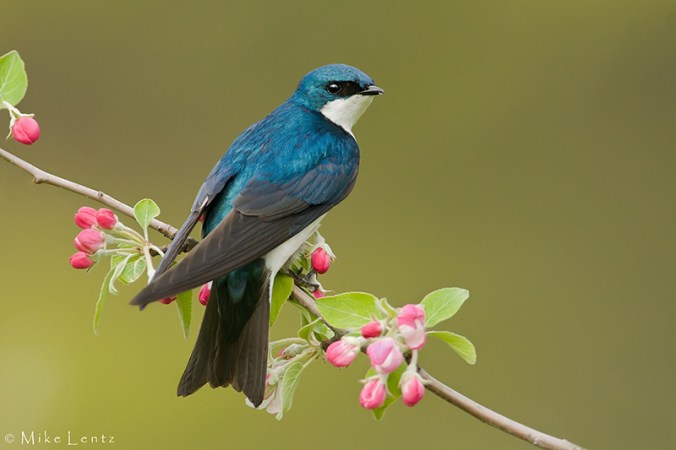
The Tree Swallow (tachycineta bicolor) is one of the most beautiful of the swallow family, with deep-blue, iridescent backs and clean white fronts.  With their steely, bluish-green feathers flashing in the sunlight, Tree Swallows make a most striking appearance and display as they chase thru the air in pursuit of insect food for their families.

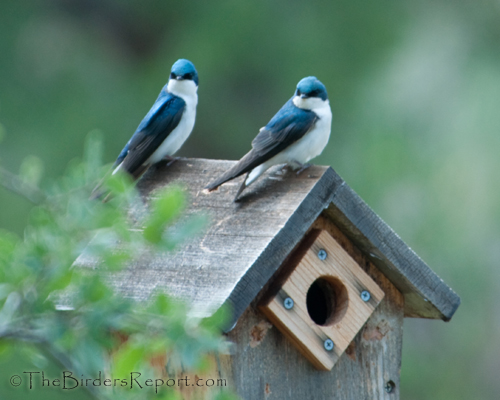
Tree Swallows do not build open, free-form nests of dead grass, leaves, sticks and twigs like many birds, but rather only nest inside cavities, such as old woodpecker holes in trees.  With such natural places in limited supply, nesting sites like these are scarce and at a premium in the spring, on a first-come, first-served basis, with intense competition with everyone looking for a home in which to raise a family.  But fortunately, Tree Swallows also adapt readily to nesting boxes.

You can help the Tree Swallows in your neighborhood by putting out nesting boxes in your backyard.  The birds are a great addition to a backyard or field and will reward you, as many birds and bats do, by regularly patrolling and keeping insects under control and at bay all summer long.

The average adult Tree Swallow consumes 2,000 insects each day during the 45 day nesting period, while also catching approximately 6,000 insects per day to feed to their nestlings over their twenty day stay in the nestbox. Overall, this adds up to about 300,000 insects per family over the 45 day span. Since most of their hunting takes place under a height of 39 feet, that is potentially a lot of insects not pestering you in the backyard over the summer.

That is a good return on the purchase, or for a few boards and time invested in building a nest box. And then you and your family will also be able to enjoy observing these beautiful birds going about their business darting and dashing thru the air and raising their young thru the whole season.

For more information on Tree Swallows, please visit the Tree Swallow Nesting Project and Building Nesting Boxes for some easy how-to guides.

Thanks as always for visiting.  If you have stories or experience with these beautiful birds or helping them with nest boxes at your home, please feel free to share with us in the comments.  —  Jim (and Red!)

Family Times — Together Times — The Best Times!

Children + Nature + Outdoors = Happy, Healthy Balanced Kids


Old-fashioned, Family-friendly Stories and Fun for All Ages and Fitness Levels!
About an Uncommonly Special Bear and His Friends.