Getting to Know — Tree Swallows

Tree Swallows are among my favorite birds, always delighting in observing their aerial acrobatics in fast pursuit of insects, rapidly twisting and turning thru the air dashing here, there, and everywhere on late summer afternoons and evenings.

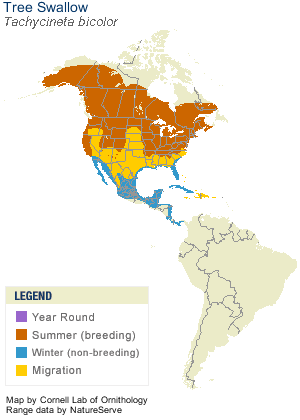
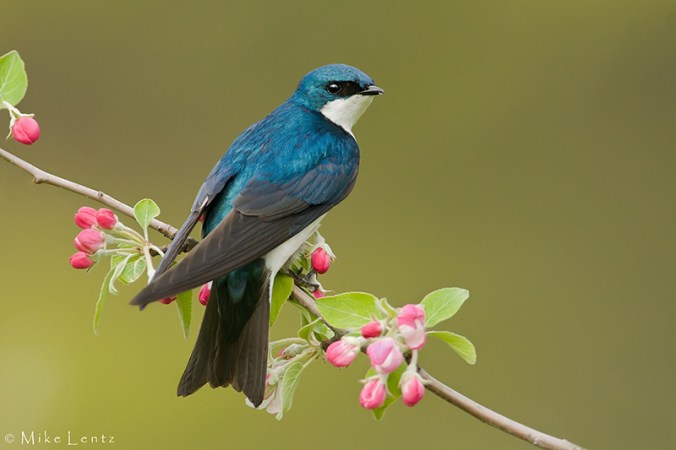
The Tree Swallow (tachycineta bicolor) is one of the most beautiful of the swallow family, with deep-blue, iridescent backs and clean white fronts.  With their steely, bluish-green feathers flashing in the sunlight, Tree Swallows make a most striking appearance and display as they chase thru the air in pursuit of insect food for their families.

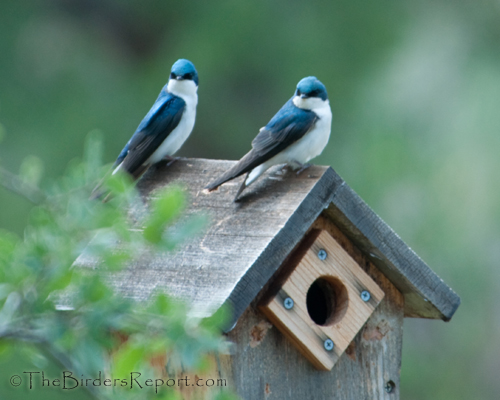
Tree Swallows do not build open, free-form nests of dead grass, leaves, sticks and twigs like many birds, but rather only nest inside cavities, such as old woodpecker holes in trees.  With such natural places in limited supply, nesting sites like these are scarce and at a premium in the spring, on a first-come, first-served basis, with intense competition with everyone looking for a home in which to raise a family.  But fortunately, Tree Swallows also adapt readily to nesting boxes.

You can help the Tree Swallows in your neighborhood by putting out nesting boxes in your backyard.  The birds are a great addition to a backyard or field and will reward you, as many birds and bats do, by regularly patrolling and keeping insects under control and at bay all summer long.

The average adult Tree Swallow consumes 2,000 insects each day during the 45 day nesting period, while also catching approximately 6,000 insects per day to feed to their nestlings over their twenty day stay in the nestbox. Overall, this adds up to about 300,000 insects per family over the 45 day span. Since most of their hunting takes place under a height of 39 feet, that is potentially a lot of insects not pestering you in the backyard over the summer.

That is a good return on the purchase, or for a few boards and time invested in building a nest box. And then you and your family will also be able to enjoy observing these beautiful birds going about their business darting and dashing thru the air and raising their young thru the whole season.

For more information on Tree Swallows, please visit the Tree Swallow Nesting Project and Building Nesting Boxes for some easy how-to guides.

Thanks as always for visiting.  If you have stories or experience with these beautiful birds or helping them with nest boxes at your home, please feel free to share with us in the comments.  —  Jim (and Red!)

Family Times — Together Times — The Best Times!

Children + Nature + Outdoors = Happy, Healthy Balanced Kids


Old-fashioned, Family-friendly Stories and Fun for All Ages and Fitness Levels!
About an Uncommonly Special Bear and His Friends.


On Fly Fishing — Teach a Bear to Tie a Fly (And You Will Have Accomplished Something!)

Right off the bat, I must admit that the title may be a bit optimistic and premature, because I haven’t accomplished anything quite yet teaching Little Red Bear about tying flies and fly fishing.  But we’ll get back to that in a minute.

One of my favorite uncles, my mother’s youngest brother, was a first class fly fisherman in the day.  One of his best friends was a conservation officer with the Missouri Department of Conservation at the time, and they would spend every chance they got fly fishing the Ozarks streams. Like my mother, he had grown up in the country and was all about nature and the outdoors.  He had served in the Pacific on Iwo Jima and Okinawa among others in WWII not too many years before, and I always figured maybe the peacefulness of fly fishing is what may have so appealed to him after it all.

Uncle Paul firmly maintained that anyone could catch a fish if they hooked up a worm, used bait and fed them, but it was a true challenge and art to catch a fish on a lure that you had made yourself.  So he taught me how to make and tie my own flies and to fly fish as a boy.  He reassured me that the hungrier I got, the better I would get at making them.

I don’t know whose idea it was that I should learn how to tie flies at the age of nine, my mother’s or my uncle’s (it certainly wasn’t my father’s because he was a city kid, thru and thru), but there I was sitting at his kitchen table one Saturday morning learning all about the different kinds of flies and bugs to imitate. Shiny Mylar strips, tinsels, miniature corks, colored wires, hooks of all sizes, chenille stems, horse hairs, bits of assorted furs, spools of thread, and tools and miniature vices I had never seen before all spread out on the table before me.

And all sorts of wondrous feathers — peacock eye feathers, guinea fowl, pheasant, grouse, quail, marabou, ostrich, ducks, roosters, chickens and others.  Feathers from all over the world from birds I had only seen and read about in Encyclopedias!  All a small boy’s imagination could hope for and a whole new world suddenly opened.

As it turned out, fly fishing is the only kind of fishing I ever really enjoyed, to tell the truth.  And now steadfastly agree with my mentor.  Tossing a worm-baited hook into the water is not only lacking in challenge, but also an insult to the intelligence of the fish.  And since they spend so much time in schools, they do tend to take it rather personally.

There is just something about fly fishing.  The excitement and sudden rush of spotting a flash of silver under the water in the distance.  Working and playing out the fly line, back and forth, back and forth in a relaxing zen-like rhythm imitating soft lapping waves along the shoreline, the heavy line artfully arched over your head.  Cast out and land the lure in exactly the right spot where you just saw a riffle on the water, widening circlets across the way. Being at the water’s edge with the songbirds in the background while water ripples around you.  A turtle pops up to say ‘Good morning!’  and forest critters edge cautiously to the shoreline for a drink. Frogs croak their greetings as red-winged blackbirds cheer you on from the nearby reeds. Simply — magical. Nature speaks to you, if you listen. For myself, I just could never find that same joy in any other type of fishing.

I would spend hours on summer afternoons, just as Uncle Paul showed me, fly rod in hand in the backyard practicing to drop a fly inside a hula hoop target laid on the ground at the back of the yard. Eventually the larger hula hoop was replaced with a smaller metal bucket. I always look back on all that, together with the time my uncle spent with me infusing his love of the outdoors and respect for wildlife, as probably where my life-long love of nature and conservation got its start at an early age.  We never know at what precise moment the stars may align and how a few minutes spent with a child may influence their whole life to come.  And there’s a lesson there in itself.

We would visit my uncle’s home regularly thru the year on Saturday mornings, me in the kitchen learning to tie flies at the kitchen table with Uncle Paul, working side by side each of us with our own vise and every time a different type; while my mother visited with Aunt Laura in the living room. Wrapping and making the Wooly Bugger Worm was always my favorite.

It was Uncle Paul who gave me my first hunk of beeswax and taught me to always wax the sewing thread to keep it from tangling while tying the flies.  A trick I still use today when hand sewing teddy bears and things.

Some of the little tools, grips, vices, supplies and books used back then are still with me today.  We made frequent trips to visit the Culver Lures store on Missouri Avenue in south St. Louis at the time. A somewhat dark little store because the two smallish front windows were cluttered with merchandise, with a white wooden store front and wooden floors too, as I recall, overflowing with every fly tying and rod making item imaginable.  Stand at the counter, tell the man smoking the stubby cigar what I needed and he would go find it and ring it all up on the cash register.  Hand over the cash and away we’d go to make more lures. The store is long gone now and remodeled into a condo. A different time.

Used to have an honest-to-goodness fisherman’s straw hat with flies stuck in all over it, too. Don’t know where that might have went over the years, sadly.  I suspect my mother may have pricked her finger on a hook dusting it one too many times when I was away at college and it was shown the door.  But just a guess.  No one ever seemed to recall its whereabouts or fate later, whenever queried.

flies-3

It turns out Uncle Paul was right — there are few thrills in life to compare to catching and landing a fish on a lure that you have handmade yourself.  Marriage and the birth of children are certainly at the top, but that first fish is right up there on the list, too!

And that all brings me to Little Red Bear.  Being an avid fisherman himself with his assortment of bamboo and stick poles and always up for a challenge, Little Red Bear now wants me to teach him how to make his own lures and teach him how to fly fish.

Red has always been a “throw out the bait and wait” type, as he puts it.  Not my thing, as I said.  So I can readily see his wanting to move up the fishing ladder, so to speak.  The only problem is, with those big bear paws of his, I’m not sure that I’m up to the challenge of teaching him.  Showing him how to make biscuits is one thing, and admittedly his are better than mine now (although I still make the best cornbread). But Little Red Bear sitting and tying teeny little fishing flies?  Not so sure.

Still, I’ve yet to see Little Red Bear not accomplish something he sets his mind to, so we’ll see.  There was that time at Perch Lake when he hauled that giant, cantankerous and ill-tempered . . . . .   Well, I really should let you read and enjoy that ‘Sir Snapsalot’ story for yourself.  He even tells folk how to make their own bamboo fishing poles in that one!  Red’s famous for them in these parts.

In the meantime, I wonder what Uncle Paul would think now about the time he spent with a young nephew years ago, teaching him how to tie flies and fish, and who grew up to later write stories about conservation and an uncommonly special bear and his friends in the Ozarks Mountain Country that we visited and fished together ourselves? I like to think he might enjoy them. Time is never wasted when spending it with a child.

Thanks as always for visiting.  I will keep you posted, and we’ll see how this fly tying adventure goes with Little Red Bear, I suppose.  I can’t say ‘no’ to someone looking to learn and try something new.  Even if it seems as though it may be a mighty challenge along the way.  — Jim  (and Red!)

Family Times — Together Times — The Best Times!

~ Children Learn To Read on the Laps of Their Parents ~

Old-fashioned, Family-friendly Stories and Fun for All Ages and Fitness Levels!
About an Uncommonly Special Bear and His Friends.


Back To Work With Little Red Bear — “The Second Holler Over!”

Hey, y’all.  Thought it might be time for a progress update on the next collection of Little Red Bear stories, to bring everyone up to date on what’s going on behind the scenes as we are into the new year now.  With the the holiday season concluded, we are back at work writing the next collection of Little Red Bear adventures for you — “The Adventures of Little Red Bear: The Second Holler Over!”

Bobo and Lily have returned from their Christmas visit with black bear relatives in the Smoky Mountains now, and Red has rounded up Cinnamon Charlie, Albuquerque, Swinestein, “Howdy!”, Stillwater, Bayou Bill and the others back from their holiday vacation trips, as well. Indian John and Aunt Ivy have been dropping by daily, anxious to get back to work on the stories. Even Farmer Turner is here, this being his slower time of year during the winter months until spring planting season arrives.

And naturally, everyone’s favorite little red squirrel, Rusty the Fairydiddle, is back after his co-starring role in the “Pine Holler Christmas” story adventure, with Little Red Bear and Cinnamon Charlie.
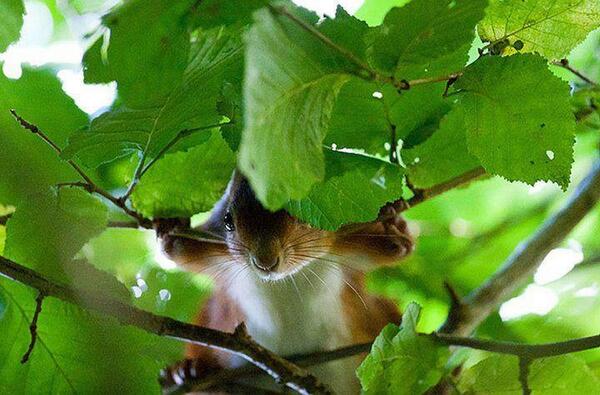
Rusty the Fairydiddle, Red Squirrel Reporter on the Job!

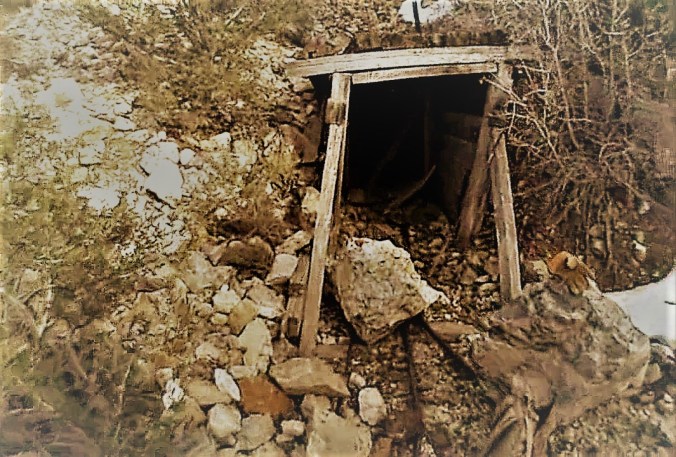
The old prospector Packsaddle Pete is back too, with another adventure in mind. That may be a hard sell to the rest of the group since some of  us remain a little nervous hearing things at night, and still looking back over our shoulders following that “Broken Hill Mine” episode in the first story collection.  But he keeps going on about treasure maps and clues to Jesse James’ lost treasure buried around the area.  I don’t know.  We’ll have to see about that one.
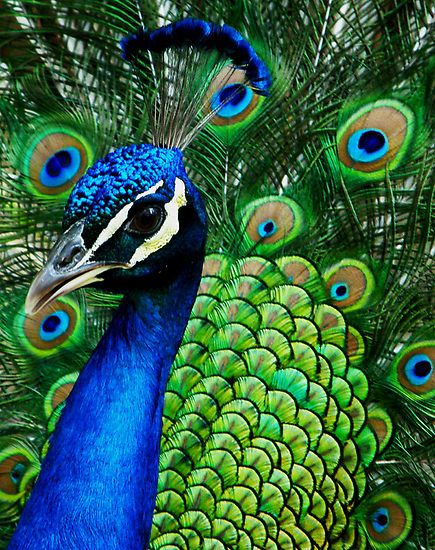
Interviews for prospective new story characters are nearly concluded, with only a gopher, a skink, a second interview with a hedgehog, and a rather persnickety peacock remaining.  And, that really is meant to be ‘skink’ there, for those of you who thought that might be a typo.  We have an opening for a Five-lined Skink (also called a Blue-tailed Skink here in Missouri) in a coming story.  All of the available skunk character positions have already been filled.

Neither Little Red Bear nor I can figure out why peacocks seem so intent on being included in rollicking adventure stories set in the backwoods of the Ozarks Mountain Country.  We had peacocks lined up and applying for roles in the first collection, as well.

This new fellow has even gone so far as to declare that he could perfectly play the role of either a hummingbird or a woodpecker, but my leg only stretches so far.  Sometimes it appears peacocks are merely showing off.  See for yourself from the job application headshot photo he submitted to see what you think.  Do you really see him hovering  in place over a flower like a hummingbird, or grasping the bark while drilling a hole in the trunk of a sugarberry tree?

More suited for the red carpet in Hollywood than a backwoods action/adventure story perhaps, but we’ll interview him anyway. Maybe some other role might pop up for him. Who knows, it might turn into one of those cases where he simply plays himself.
And then we still have that troubling interview with a persistent mountain lion to deal with.  Admittedly, Red and I kept rescheduling that meeting over and over again the past few months hoping the mountain lion would cancel all together and just go away, but he seems determined to get into the stories. I suppose we are going to have to finally sit down with him to do the interview or risk incurring the wrath of the ‘Silly Story Characters Guild’.

No one is really excited about the prospect of an unpredictable mountain lion roaming around the woods. But our attorney, Bob the Badger, is already occupied trying to extend the beaver twins contracts, Flap and Slap.  The beavers are represented by a new agent, Reggie the Wood Rat, trying to make his mark and attract new clients.  And the bees are angry and buzzing about something again, so Badger Bob is busy attending to that matter for us, too. Seems like that stuff never ends sometimes.

So, we will interview the mountain lion, not to cause Bob the Badger anymore unnecessary work.  Might call Bobo to come sit in on that one with us.  Just in case.  I already asked Stillwater, but as you may remember from “The Wildwood Jamboree” story,  he doesn’t generally like to interfere or draw attention to himself so preferred to remain undetected on the sidelines.

The last interview we had been planning is with a human character who keeps calling on the phone saying he is lost and unable to find the place.  After the fifth “I’m lost” call and reschedule, Little Red Bear finally decided to go out to search for the guy himself and lead him in for the interview.  Bobo suggested we just sit and wait to follow the circling buzzards.  He can be that way sometimes.  The fellow’s name is ‘Woods’ something or other, if memory serves me correctly.  Hoping he will show up eventually.

So, except for the last few remaining interviews, all the character slots have been filled, with several new colorful story characters assembled and eager to get to work.  Some of them you may have already met.  Early arrivals already introduced in the “Pine Holler Christmas” story include Littleberry Bedford (the new farmer recently moved into the abandoned Longenecker homestead over by Buffalo Crossing) and his family, old Cooter (the leader of the Hoppers Holler Raccoon Platoon), Floyd the House Mouse, Aunt Alma Mason, Myra Cookson and her ‘Pie Pantry & Goodies Shoppe’ over in Butterfield, Doc Adams, and — Goat.

Others new to the stories include an honest-to-goodness old mountain man given to telling tall tales, a far-from-home moose, a worn out old hound dog, a Native American couple searching for a new home, more problematic pigs, dashing ducks, a bothersome buzzard, a pair of owl brothers setting up to compete with the ‘Squirrelly World’ local newspaper, a performing circus bear (as opposed to Lily and Bobo, who are both retired, as you may recall), a frolicking and unconventional family of woodland bunnies, a Little Red Bear “mini-mini-me wannabe”, and others.

There is also an aged possum who has taken up residence in a pear tree behind Red’s cabin on Honey Hill.  He spends all day hanging upside down by his tail, despite Little Red Bear reminding him that possums “really ain’t supposed to do that”.  But he persists.  With good reason, he says.  Although he hasn’t told us what that reason is yet.
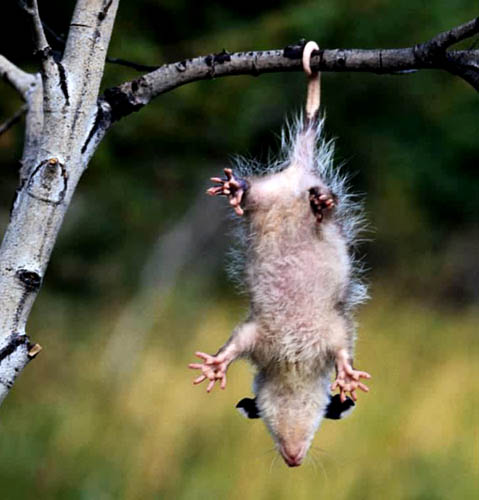
If you recall, there was that expansion work going on over at Bobo and Lily’s cabin in the first stories.  Just a brief mention, but I always wondered myself what that was all about.  Did you?  Bobo and Lily never said.

No collection of Little Red Bear adventures would be complete without some old steam locomotives and trains huffing, chuffing and puffing along. Another circus train, perhaps? There were those circus trains so talked about in the “Crossing the Two Forks” story in the first collection.  Could there be another?  As we learned, traveling circuses are very popular in the small towns, so suppose it could be possible another might be passing thru sometime.

There may be some old steamboats and paddlewheels coming into view around the bend, too.  Or is that just the wind whistling thru the pines?  Little Red Bear is adamant that he hears steamboat whistles coming from the big river, but when he looks nothing is there.  So, what could that be about?  These stories do take place in the land of Mark Twain, after all.

And of course, Little Red Bear and Cinnamon Charlie are always on the lookout for honey.  And as we know from the very first “The Rescue of Little Red Bear” story, that in and of itself can be precarious at times.

Little Red Bear and Cinnamon Charlie have both been working hard to learn ‘Pig’ ever since Swinestein came on the scene in “The Storm” story.  But every language has its own varied dialects, so with more new pigs maybe on the way, I’m hoping that is not another issue for them.  Only time will tell on that, I suppose.

Speaking of Cinnamon Charlie, he’s going to be going into his third year now when young’uns start to venture out on their own a bit more, approaching those “teen” years for a bear, and you never know what that may lead to.

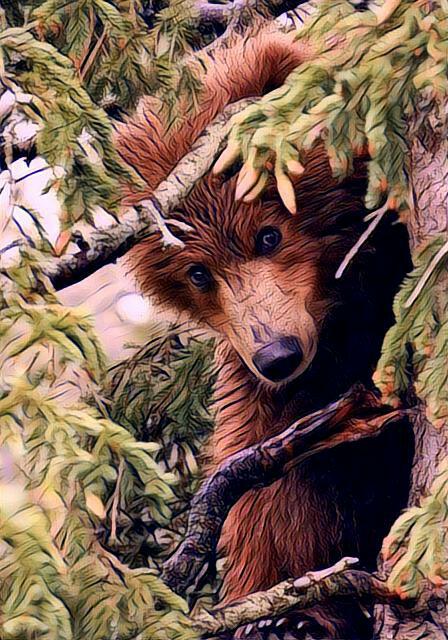
And, not to worry you but suppose you should know, there is a rumour going around the backwoods that there is a giant, hulking and brawny brown bear on his way with an old score to settle with Little Red Bear.  Red is not the smallest, but certainly not the largest of bears either.

That is a little worrisome, given that Red is the main character and they are his stories, after all.  Can’t have anything untoward happen to the main character.  But as merely the writer, I honestly don’t have control over everything, dealing with wildlife with a mind of their own in the stories, so that is a concern.  Must see how that confrontation plays out if it comes to pass.  I’m hoping it’s just a baseless rumour.  Probably started in ‘Squirrelly World’.  But, one never knows I suppose, so best to be on the lookout for potential trouble.  We’ll have the medics standing by, just to be safe.

Also, potentially troublesome, word is going around that the weasels have been busy recruiting a “hired gun” of sorts to come in and deal with Albuquerque, the red fox Sheriff.  According to gossip chatter, it’s a notorious and nasty coyote from out west in Colorado.  That would certainly be a mismatch and could be messy. Sounds like the weasels aren’t going away any time soon and the little sheriff may have his paws full going forward.

There are a few other things happening too, that I probably shouldn’t mention yet, not to keep you awake at night worrying.  Just remember the lessons we learned in the “Sir Snapsalot” story and to never venture into Witches Holler, especially after midnight.

And it would probably be best to ignore the ‘Squirrelly World’ newspaper reviews and steer clear of the buzzards’ new roadside café, and you’ll most likely be fine.  Their ‘Raw Bar’ truly is what it says, although the freshness has recently been called into question.

As you can see, a lot of work to do now to keep new characters occupied and sort out these rumours and such.

If you have not yet read the first set of stories, “The Adventures of Little Red Bear: The First Holler!”, there is still time to catch up because we are going to be very busy here for a while getting the next collection ready for you – “The Adventures of Little Red Bear: The Second Holler Over!” 

As the stories and characters do kind of build one after the other, we always recommend starting at the very beginning for the most fun and entertainment.  “The First Holler!” is available in both Print and eReader versions on Amazon to get you started, and is always Free on Kindle Unlimited.

Thanks as always for stopping by for a visit.  We’ll keep you updated as work progresses and things develop over the coming weeks.

If you’re looking for us, we’ll all be over yonder under the chestnut tree working on the stories.  If you don’t know where ‘over yonder’ is, just ask the possum hanging from the pear tree.  He’ll point you the way.  — Jim (and Red!)

Family Times — Together Times — The Best Times!
Old-fashioned, Family-friendly Stories and Fun for All Ages and Fitness Levels!
About an Uncommonly Special Bear and His Friends.

“The Adventures of Little Red Bear” Determined To Be ‘Sound Investment’

In order to cover all bases for his fans, Little Red Bear had an official Cost/Benefit analysis of “The Adventures of Little Red Bear: The First Holler!” performed by his trusted accountant and financial advisor, Angus McNutt, senior partner of the firm “McNutt and McGillicutty CCC” ( Country Crop Counters) over in Slippery Slide, and the results of the study are in.

For the paperback, at 64,254 words, the reader receives over 4,961 words per dollar invested. For the Kindle and eReader version, a reader receives over 21,781 words per dollar. And of course, the book is Free for anyone with Kindle Unlimited. Taking into account that all words used are original text in copyrighted format with the Library of Congress, it is quite clearly a bargain at any price.

In addition, bearing in mind the fact that words enrich the brain and lessons learned about nature, life, kindness and simply having fun remain with a person forever, it was clear that any of the versions far exceed any value received in television and other forms of entertainment, where “any benefit potentially received is fleeting and transitory”, as Mr. McNutt stated in his report.

It should be noted that the Preface, Frontispiece, Dedication, Artwork and such were not included in Mr. McNutt’s calculations, which would have the effect of making the Cost:Benefit ratio even higher for a reader.

It was Angus McNutt’s conclusion then that “’The Adventures of Little Red Bear’ short story collection is both a wise and sound long-term financial investment.”  Just in case anyone was on the fence concerning issues of that sort before investing in the book.

“The Adventures of Little Red Bear” Short Story Collections on Amazon.  Old-fashioned, Family-friendly Storytelling and Fun for both the Young and the Young-at-Heart. Positive Themes of Friendship, Kindness, Helping Others and Mother Nature.  With a healthy dash of oldfangled, belly laugh humor and fun.

Join us for an Adventure in the Beautiful Ozarks Mountain Country, and stop by for some biscuits and honey! —  Jim   (and Red!)

Angus McNutt, of "McNutt and McGillicutty Country Crop Counters"

Angus McNutt, of “McNutt and McGillicutty CCC”

Old-fashioned, Family-friendly Stories and Fun for All Ages and Fitness Levels!
About an Uncommonly Special Bear and His Friends.

Birds of Prey– What’s the Hurry?

We most often think as the spring months as being the nesting season for birds.  And it is, for the Cardinals, Sparrows, Robins, Finches and such.  But not for the raptors, birds of prey.  Young raptors, because they are much larger, take a much longer time to grow up and need a head start on the season. So raptors nest in winter.

Remember the images of the nesting Eagles dutifully tending their nest and eggs covered over in the snow?  It takes very dedicated parents to go thru an ordeal like that.  Why the rush?  Why start nesting so early before the weather has changed for the better, we wonder?  Most other birds wait until April or later to arrive at their summer breeding grounds and start to build nests.

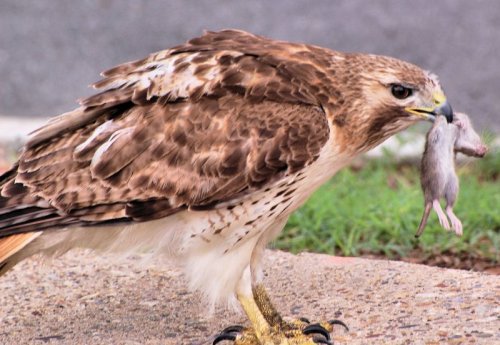
Turns out, there’s a very good reason.  It’s all about rodent and other prey animal population control and giving the baby birds of prey an easier start in life.  It takes a long time for large raptors to grow big enough to be independent and hunt on their own.  An early start in the nest allows them the required time to grow and develop, while also insuring that when they are fledged and on their own, there will be a plentiful supply of prey animal babies emerging from their nests and running about at the same time to help make the raptors’ initial hunting forays a little easier and more successful.  Nevertheless, 60% to 70% of Red-tailed Hawks, Owls and other raptors do not survive their first year.  Life is hard for young raptors still trying to figure it out, so being ready early gives them the best chance of survival, while also helping to keep the world from being overrun by mice and other voles.

So while the other birds and small animals are just getting started with nest building and babies now, the raptors are already well on their way to being able to greet them when they emerge later.  The early bird gets the, ummm– baby mouse shall we say.  Birds of Prey have a very important role to play in population control and the grand scheme of things as Mother Nature designed, and early nesting gives them the needed head start to make it all work.

Thanks as always for dropping in to visit! — Jim (and Red!)

Red-tailed Hawk with Mouse

Red-tailed Hawk with Mouse

“The Adventures of Little Red Bear” Short Stories Available on Amazon

Old-fashioned Storytelling About An Uncommonly Special Bear and His Friends!

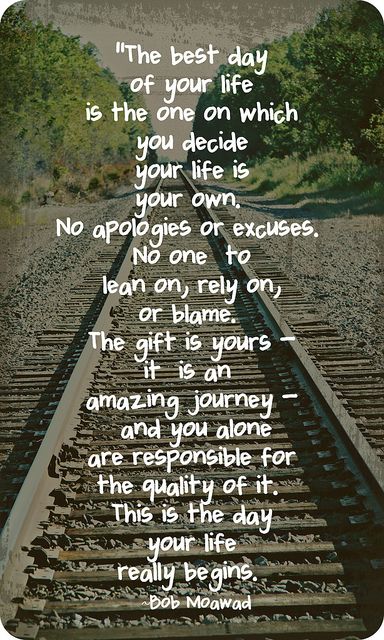
The Best Day of Your Life? — The Day Your Life Begins!

This positive motivational message brought to you today by “The Adventures of Little Red Bear” Short Story Collections, the “Margaret Monarch Plant Wildflowers for Wildlife Association”, and by the “Irresponsible Actions and Happiness Institute” — proud sponsors of independent thought and happy living everywhere.

Partial funding provided by “The Bobo and Lily Bears Foundation for Higher Nature Awareness and Appreciation”, by the “Expose Kids to Dirt and Nature Movement” located in Good Hope, and by the “‘One Day Just Ain’t Enough Recognition’ Grumpy Groundhog Group.”

Funding to support this site provided by “Old Glory Bears & Raggedy Dolls,” maker of collector teddy bears, dolls and fine quality accessories worldwide.

And by dedicated home readers like you.  Thanks as always for visiting and reading along!  —  Jim (and Red!)

Quote- Bob Moawad

Quote- Bob Moawad

“The Adventures of Little Red Bear” Short Stories on Amazon. 

Old-fashioned, Family-friendly Stories about an Uncommonly Special Bear and his Friends.  Fun for All Ages and Fitness Levels!