Critter Tales — A Possum’s Tale of a Tail

From the critters near home . . . . to the wildlands beyond.

Critter Tales are small, gentle stories — meant to be read in a few quiet minutes, enjoyed with a smile, and written and shared simply for the fun of it.

Critter Tales — A Possum’s Tale of a Tail

Most possums are perfectly content to get where they are going in the usual possum fashion.

A little walking. A little sniffing. A pause to investigate something beneath a leaf.

This possum was not.

He had discovered something remarkable about his tail.

If he curled it beneath himself, settled back just so, and gave a little push —

Boing!

Up he went.

The first time, he landed in a blackberry bush.

The second time, he landed beside it.

By Thursday, he could clear it altogether.

After that, there was very little living with him.

Boing! Boing! Boing!

He bounced over roots. He bounced over puddles. He bounced over a fallen log that everybody else had been walking around quite satisfactorily for years.

“Still going the long way?” he called to his neighbors.

“We like the long way,” said one.

“There are beetles,” said another.

But Possum was already over the next rise.

Boing!

He rather liked making an entrance.

He liked making an exit, too.

Sometimes he came back just to make another.

One fine morning, he found Turtle walking down the dusty road beside the woods.

Turtle had started after breakfast. He was going to the creek, and he expected to arrive when he got there.

Possum landed beside him.

“Good morning! Where are you headed?”

“The creek.”

Possum looked down the road.

Then he looked at Turtle.

“Today?”

“That is my intention.”

“Well, watch this!”

Possum settled onto his coiled tail.

Boing!

Over Turtle he sailed.

He landed ahead, turned around, and bounced back.

Boing!

Turtle continued walking.

“Nothing to it!” Possum announced.

“There seems to be quite a lot of up and down,” said Turtle.

“That is the beauty of it.”

“If you say so.”

Possum bounced over him again.

Boing!

“Must be tiresome, carrying your house everywhere.”

“It saves going back for it.”

Possum considered that for half a second.

Then he bounced backward.

Boing!

“Can you do this?”

“No.”

“Or this?”

Boing-boing!

“No.”

Possum grinned.

Turtle stepped around a small stone.

“Can you do that?” he asked.

“Do what?”

“Let a fellow walk to the creek.”

Possum laughed so hard that his next bounce came out crooked.

He landed in the ditch.

Flump.

Turtle stopped.

“You all right?”

“Of course.”

Possum emerged with a dry leaf on his head.

“I meant to do that.”

Turtle looked at the leaf.

Then he resumed his journey.

Now, Possum might have gone on about his business.

He might have found a shady place to rest, or something good beneath a log, or an audience that had not heard about his tail.

Instead, he noticed a low branch reaching over the road.

And beneath that branch walked Turtle.

Possum’s ears perked up.

He had bounced over Turtle.

He had bounced over logs.

But over Turtle and a branch?

That would be something.

“Watch this one!” he called.

Turtle stopped again.

Possum wound his tail into its tightest coil.

He crouched.

He wiggled.

He gave one tremendous push.

BOI-OI-OING!

For a glorious moment, everything went beautifully.

He rose above Turtle.

He rose above the branch.

He rose high enough to see a crow sitting in the next tree.

The crow looked surprised.

Possum looked pleased.

Then he began coming down.

His tail slipped through a fork in the branches.

Its tip caught.

The rest of it followed.

Fwirrrp!

Possum swung once.

Twice.

And stopped.

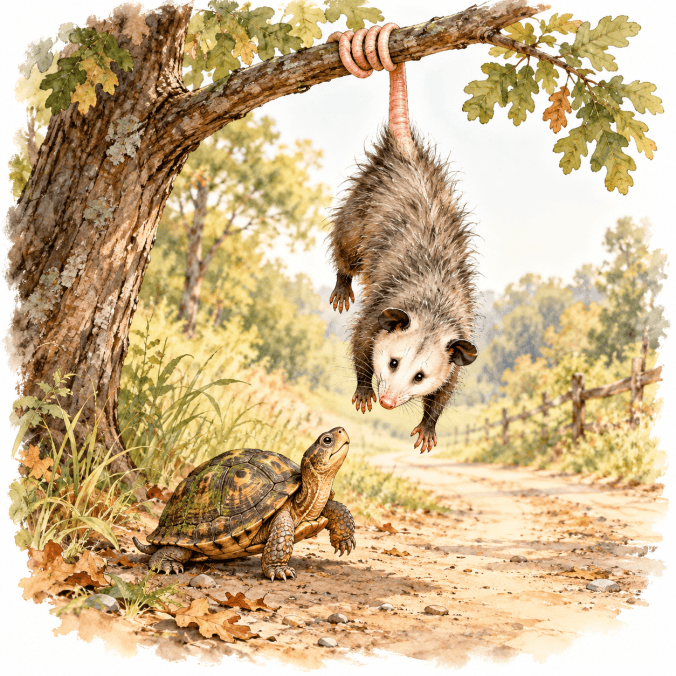
There he hung, upside down above the road, his magnificent tail wound snugly around the branch.

One dry leaf drifted past his nose.

Possum watched it land.

Then he tried a small experimental bounce.

Twang.

Up went his nose.

Down came his nose.

He tried harder.

TWANG.

Same result.

Below him, Turtle looked up.

“Going somewhere?”

“I was.”

“I see.”

Possum reached toward the branch. His paws fell short.

He twisted left.

His tail tightened.

He twisted right.

His tail tightened some more.

Finally, he hung still.

“Turtle?”

“Yes?”

“I appear to have a small difficulty.”

Turtle studied the coils above him.

“Several, from here.”

“Could you perhaps fetch somebody?”

“I could.”

Possum glanced down the long road.

He glanced at Turtle’s short legs.

Turtle noticed.

“Or,” he said, “you could give me a moment.”

He walked beneath the branch, turned carefully, and planted all four feet in the dust.

“Put your front paws on my shell.”

Possum stretched.

His claws brushed the top.

“A little nearer?”

Turtle moved.

“There.”

With his paws resting on Turtle’s broad shell, Possum could push himself upward just enough to loosen the pull on his tail.

For the first time since his grand departure, something gave.

“It’s working!”

He wriggled excitedly.

Twang!

“Easy,” said Turtle.

Possum settled back onto the shell.

“Right.”

“Take one turn loose.”

Possum curled his body upward, reached, and worked the tip of his tail back around the branch.

One loop unwound.

Then he hurried.

Two loops tightened.

Turtle waited.

Possum sighed.

“One turn at a time?”

“One turn at a time.”

It was slow work.

There was no bouncing in it whatsoever.

Possum loosened a coil, paused, and loosened another. Turtle stood beneath him as steadily as an old stump.

At last, the final loop slipped free.

Possum slid sideways over Turtle’s shell and landed in the dust.

Poff.

For a while, he sat without saying anything.

Then he examined his tail.

He stretched it.

He curled it.

He laid it carefully beside himself.

“Thank you,” he said.

“You’re welcome.”

Turtle lifted one foot.

“Creek’s this way.”

Possum got up and walked beside him.

They passed the blackberry bush.

They passed the fallen log.

A beetle crossed the road, and they waited while it did.

After a while, Possum glanced at Turtle.

“Would you mind if I bounced just a little?”

“Alongside,” said Turtle.

And down the road they went.

Step. Step.

Boing.

Step. Step.

Boing.
A note about images — Original artwork throughout The Front Porch has been created from my concepts and creative direction with the assistance of AI.  

Why do I write these? Aw, I don’t know. Just thought it might make you smile.
Critter Tales — “The Bright & Shiny Fuss”

From the critters near home . . . . to the wildlands beyond.

Critter Tales are small, gentle stories — meant to be read in a few quiet minutes, enjoyed with a smile, and written and shared simply for the fun of it.

His morning began as most crow mornings in Honey Hill Country did —
with a stretch that felt longer than necessary,
a short flight over three fields and two fences,
and a satisfying early visit to Farmer Turner’s cornfield.

After that, he returned to his usual oak branch to observe the countryside,
because that is what crows do.
They observe.
They notice.
They remember.

That was when he saw the shine.
Not just any shine.
“The” shine.

Down by the roadside, a picnic blanket lay spread in the grass.
A young man and woman sat nearby, occupied with the sort of business that causes humans to forget small but important things on a picnic blanketed sunny day.
Set down to the side, for only a moment and catching the sun just so,
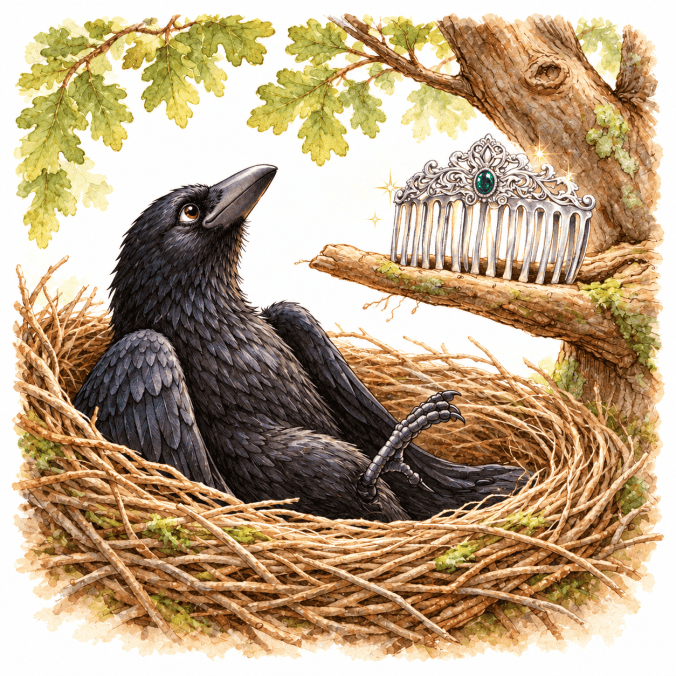
was a Silver Hair Comb.

It glimmered brightly in the sunlight — catching the light in a way that felt entirely unnecessary, the shine sliding along its silver teeth in a way the crow found beguiling and difficult to ignore.

The crow did not hesitate.

He swooped —
He swiped —
and immediately discovered that the comb had opinions of its own about being suddenly airborne.

It twisted in the air.
Caught the breeze in a totally wrong way.
Tugged at his grip and clanked softly against a metal fence post as he passed.

As he flew, the wind caught the comb just right, and its teeth let out a thin, reedy whistle —
a sound the crow did not like at all.
The annoying whistle made him sound like a songbird.
Something a crow is most definitely not.

There was a brief and undignified wobble.
He veered.
He swerved.
He corrected.
He veered again.
He swerved again.
He sheared off his intended path.

But a crow is nothing if not determined, and after several momentary struggles over three fields and two fences, he carried it home.

Back at his nest, he chose the best wall —
the one where the afternoon light lingered longest —
and mounted the comb carefully between two sturdy branches.

He stepped back to admire it, folding his wings as comfortably as a crow ever could,
one leg tucked, head tilted.

It was, he thought, a very fine thing.
A very shiny thing . . . .
And it was his.
All his.

He admired it and thought then to himself in a Crowsian rhyme —
“Now it’s all mine,
This very fine shine.
To admire when I dine,
By my shiny comb shrine.”

He was proud of his heist.
And felt it looked nice.
There on his wall,
When friends came to call.

The trouble, as it can, began the next morning.

The rising sun struck the comb at precisely the wrong angle,
and not seeking permission flashed straight into his eyes,
waking him from a pleasant dream involving corn, a sleeping scarecrow,
and uninterrupted peace while he feasted in the field.

But then the shine. In his eyes. Oh, that shine!
He blinked.
He squawked once.
He glared at the comb.
He shook a disapproving wing at its misbehaving.

But that was only the beginning.

By midmorning, others had noticed the shine.
Far and wide, they’d noticed the shine.

A pair of squirrels arrived first — polite and hopeful — asking to borrow the comb for a moment.
“Just a moment, please,” they implored.

Then came raccoons, who took longer than necessary
and admired themselves far too much in its reflection.

Soon a line formed along the branch, orderly at first,
then less so, as tempers rose and patience wore thin between hopeful visitors.

The comb chimed softly in the breeze.
It flashed.
It gleamed for all to see.

It beckoned.

Now and then, when the wind shifted just so, the comb answered with a faint whistle —
sharp and far-reaching,
adding sound to an already noisy visitor affair.

Before long, mother possums appeared,
each with a tidy row of babies clinging along her back.

The babies carried on as little ones will —
squeaking, squirming,
reaching for the comb at all the wrong times.

One slipped and had to be scooped back into place.
Another tried to chew on the comb
and was gently scolded.

The line grew longer.
And then longer still.

It stretched down the branch,
around the trunk,
around the trunk again,
onto the ground below,
and on out into the meadow.

There were disagreements.
There were accusations.
Someone tried to skip ahead.
Someone else refused to give the comb back on time.

A pair of chipmunks argued over who would get the extra acorn,
the one shining so noticeably in their reflection.

The crow watched from his perch,
his pride slowly giving way to unease.

By afternoon, a steady rain had begun to fall.
Yet the line did not shorten.
It grew.

When a porcupine waddled out of the bushes
and took his place at the end of the line,
now across the meadow,
the crow felt his feathered hackles rise.

He stared.
He turned away.
He paused.
And turned back to stare again.
Rain drops rolled off his beak.

He paced along the branch.
He glared at the comb.
He looked down at the line,
which showed no sign of shortening
and every sign of still growing longer.

The porcupine did not hurry.
He did not speak.
He merely looked up expectantly,
his quills catching the raindrops
in a way that suggested this was, to him,
an entirely reasonable request.

The crow looked at the porcupine.
He looked at the comb.
And then back at the porcupine.
Then once more at the comb.

And that was that.

The crow took the comb down,
gripped it firmly with his black crow feet,
and launched himself into the wet sky.

The wind tugged hard.
The rain soaked through his feathers.
More than once, the comb threatened to slip —
and as he flew, its teeth whistled sharply,
thin and accusing,
until even the sound itself felt like more fuss and guilt than he could bear.

Five miles is a long way in the rain.

When he finally returned to his nest,
soaked thru and tired,
the comb was gone.

His nest was quiet again.
The light was gentle.
The disquieting line dispersed.
The fuss had ended.

Unburdened, he shook out his feathers
and settled onto his branch,
wings heavy with rainwater —
yet feeling ever the lighter nonetheless.

For crows, you see, remember people.
And faces.
And places.

Places where things were found.
Places where then to return.

But to put it more simply —

Crows know.

A note about images — Original artwork throughout The Front Porch has been created from my concepts and creative direction with the assistance of AI.  

Why do I write these? Aw, I don’t know. Just thought it might make you smile.


Critter Tales — “The Fence Post Carrot”

From the critters near home . . . to the wildlands beyond.

Critter Tales are small, gentle stories — meant to be read in a few quiet minutes, enjoyed with a smile, and written and shared simply for the fun of it.

The two brothers were not looking for anything in particular that afternoon.

They were doing what bunny brothers often do on mild days — wandering along the roadside, stopping now and then to inspect a pebble, a bent leaf, or a place where something interesting might have happened earlier and could possibly happen again.

That was when the younger brother stopped so suddenly the older one nearly walked straight into him.

They both stared.

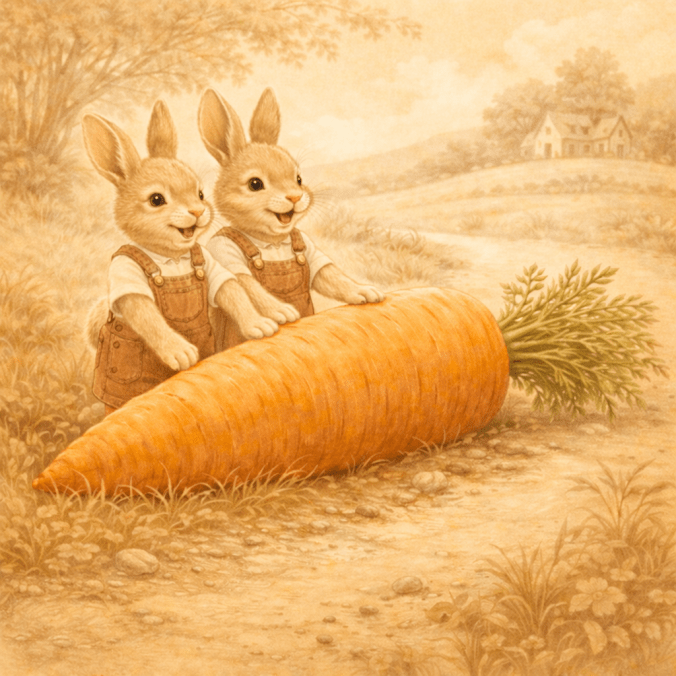
Lying just off the road, half in the grass and half in the dust, was a carrot.

Not a carrot carrot.

A carrot the size of a fence post.

It was long and thick and sun-warmed, its orange skin dulled with soil, its green top snapped short as if it had once belonged to a wagonload of respectable vegetables that had not expected to lose a member along the way.

The brothers walked slowly around it.

They stood beside it.

They placed a paw on it, just to be sure.

“It’s real,” said the younger one.

“It’s ours,” said the older one, immediately and with confidence.

The only problem was getting it home.

They tried first to drag it.

They braced their feet, leaned back, and pulled with all the seriousness such a carrot deserved. The carrot did not move. It merely sat there, unimpressed and unmoved, as though it had been waiting for this moment and was quite prepared to wait longer.

They tried lifting one end.

That end rose exactly as far as the other end sank, and the carrot pivoted neatly back into place, landing with a thump that rattled their paws.

They rested, catching their breath.

“Maybe if we roll it,” said the younger brother.

This seemed reasonable.

The carrot was round, after all. Mostly.

They pushed.

The carrot rolled.

Not forward.

It rolled sideways, drifting lazily toward the road, as though it had somewhere else to be.

They scrambled to stop it, wrestling it back into the grass before it could embarrass them in front of any passing wagons.

They tried again, this time from the other side.

The carrot rolled the opposite direction, wobbling, curving, and clearly unwilling to be guided in a straight line.

“It doesn’t listen,” the younger brother said.

“It’s shaped wrong,” said the older one.

They studied it closely then — the thick top, the narrowing point, the subtle curve that promised cooperation and delivered betrayal.

They attempted to lever it with a stick.

The stick snapped.

They attempted to roll it while running alongside, paws scrambling, ears flapping.

The carrot rolled faster than expected, slower than hoped, and then gently pinned them both in the grass until they agreed to let go.

Eventually, they sat down beside it.

The afternoon was quiet. A breeze stirred the grass. The carrot lay peacefully between them, as though nothing at all had happened.

Their house sat below them on the hillside — not far, really, when one looked at it that way.

The younger brother tilted his head.

“What if,” he said slowly, “we don’t take it up to the house?”

The older brother followed his gaze.

The hill sloped gently downward, straight toward their front wall.

They looked at the carrot.

They looked at the hill.

They smiled.

Getting it started was easy.

Stopping it was not.

The carrot tipped, rolled, hesitated, and then gathered confidence, wobbling its way downhill with growing enthusiasm. It veered left. It corrected. It veered right. The brothers ran alongside, shouting helpful suggestions that the carrot ignored entirely.

The curve took over.

The carrot picked its own path.

The brothers watched, helpless and hopeful, as it rolled faster, straighter, and with increasing purpose — directly toward their house.

There was a sound.

A solid, unmistakable WHUMP against the wall.

Silence followed.

Then the front door flew open.

Their mother rushed out, apron askew, eyes wide — ready for disaster.

She stopped.

She stared.

Leaning neatly against the wall, as if it had always belonged there, was a carrot the size of a fence post.

The brothers stood very still.

Then their mother laughed.

She laughed the way one does when something is too unexpected to be annoying and too useful to be ignored.

“Well,” she said happily, “that’s carrot soup for a month.”

The brothers sat down in the grass, dusty and pleased.

The carrot did not move again.

It had arrived.

Pen-and-ink illustrations created with the assistance of AI and lovingly styled for Little Red Bear Land.

Why do I write these? Aw, I don’t know. Just thought it might make you smile.