New Writing Boots for Little Red Bear!

When it is time for Little Red Bear and I to sit down and get busy on his story adventures, I put on my writing boots to get to work.  So the title may be a tad misleading.  Little Red Bear does not wear boots, actually.  Overalls and a straw hat a good bit of the time, but no boots.   Surprisingly, they just don’t make them for bears.  The width is the biggest problem for them it seems.  The boots are for me.  I was referring to Red’s stories — “The Adventures of Little Red Bear” and their writing, of course.  It may be these new writing boots, not quite broken in yet that may have caused a little confusion with the title there, and apologize for that.

Little Red Bear and I have begun serious writing work on the next collection of Little Red Bear adventures, so I figured a new pair of Writing Boots was in order, having pretty much worn out three good pairs traipsing over the mountains and thru the hollers writing the first set of stories.  What do you think?  They are a pair of Justin’s Sorrel Apache boots.  Let’s take them for a little Test Write, shall we?

New Writing Boots- Justin Sorrel Apache Boots

New Writing Boots- Justin Sorrel Apache Boots

“Little Red Bear worked his way slowly up the hillside, crouching low behind bushes trying to remain unnoticed by the bees, busily at work on their hive at the crest of the hill.  He stopped to pause momentarily behind a large, flowering Honeysuckle Bush.  For you and I, the scents of honey wafting on the summer breeze in the direction of Little Red Bear would be undetectable.  But being a bear, he knew exactly where the hive was located, along with the size of the hive and amount of sweet, gooey honey stored inside.  Within an ounce or so anyway, he figured.

“Little Red Bear carefully wrapped his paws around his famed honey whacking stick, getting everything into position before rushing at the beehive.  “Three big steps, whack the hive, grab the honey and dash back home,” he thought to himself.

“All worked out in his mind, Little Red Bear bolted from behind the honeysuckle bush and raced towards the beehive.  Whack!  Just as planned and catching the bees totally by surprise, the beehive crashed to the ground.  But instead of splitting open as they normally do, it began to roll and tumbled over and over down the hillside.  Instantly, Geronimo and Cochise chased after the bouncing beehive.”

Geronimo!  Cochise!  Wait!  Who?  What?  Where did Geronimo and Cochise come from?!?   Must be the new Sorrel Apache writing boots!  Apparently, they’re not quite broken in yet.  I’ll keep working on it.   But I wonder if they might stick around to appear in a story?  We’ll have a talk with them and see.  Just never know who might pop in here.   We had a weathered old mountain man wander in thru the door this morning!   Stay tuned.  Regardless, it looks like there’s still more work to do getting these new writing boots broken in and ready for the next story collection, though.  I’ll get back to work on it.

In the meantime, thanks as always for stopping by for a visit!  Hope you like the new boots.  —  Jim (and Red!)

Sleeping Brown Bear, Pinterest Natilonal Geographic Society, uncredited

“The Adventures of Little Red Bear” Available on Amazon in Kindle and Print.

About An Uncommonly Special Bear and His Friends!

Entertaining Stories for the Young and the Young-at-Heart

Order Your Copy Today!

Now Entering the Ring– Little Red Bear!

As you may recall, we discussed which genres and book categories to list “The Adventures of Little Red Bear” in a few weeks ago. If you missed it, here is a link to the original post→ Lost in Quandary Without a Compass.

After a good deal of  follow-up discussion and being allowed two categories in which to enter, we decided one would be “Juvenile→Fiction→Animals→Bears.”

From the very beginning, the stories have been written with children in mind as well as adults, so the first selection of “Juvenile” seemed like a no-brainer.  Although Red certifies that all of the adventures really did take place exactly as described, we were required to list the book in “Fiction”, lacking photographic proof or evidence to back up his assertions.  The next step was easy, as the stories feature a good number and wide variety of wildlife, domestic farm animals, birds and such, so “Animals” seemed straightforward enough.

But then we came to the next grouping to narrow it down even further.  With it being “The Adventures of Little Red Bear” there was clearly only one choice– “Bears.” Simple enough– right?

But here’s the rub.  We then realized that stepping into that ring would put us in direct competition with not only one, but two heavyweight champions in the field.  Titans of the literary world– Winnie the Pooh and Paddington Bear! And they’re both that cute and cuddly teddy bear, golden brown color, to boot.

But we just don’t see any viable alternative. It’s not like Red is afraid of them or anything, as he is a real bear and not a cartoon drawing or stuffed teddy bear, after all.  He just always tries to peacefully avoid confrontation whenever possible.  An admirable trait to be sure. Nevertheless, don’t let their cuteness fool you.  Pooh and Paddington are rock stars in the field.  Literally– movie stars!  These two fluffy ruffians dominate their category and squish competitors like a blueberry on a walking path without even breaking stride!

It would basically be starting over, but I asked Red if he would like me to recast him as a chipmunk or squirrel, to maybe compete against Chip and Dale or Rocky instead. But as he pointed out, we had already signed on Scritch the Chipmunk and Rusty the Fairydiddle for the second collection of stories and Red didn’t want to put them out of work, just to take their place.  He’s a nice guy like that.  And too, it would be incredibly difficult for a chipmunk or squirrel to pull off some of the feats in the stories which Red did as himself– a bear.  So it looks like we’re committed to the “Bears” category.  No other choice, really.

But I’ll admit it.  I am a little worried.  I know that Winnie the Pooh is all about his honey, and so is Little Red Bear.  I just hope there’s enough honey to go around for everyone.  But Paddington is into marmalade, so that shouldn’t be an issue, as long as he stays on the jammy side of the tracks. They are all really good sorts though, so I’m sure they’ll share and work it out.  I hope.

There is one notable thing that separates Red from the others. He is a real bear and these are real bear stories with real bear action. Or as close as they can be given that he is so uncommonly special– walking on two legs, talking and wearing overalls and a straw hat as he does.

So, just to be safe, a word of caution is probably in order — these are not your mother’s Winnie the Pooh, picture book style, cuddly teddy bear stories.  Just sayin’.  There are a few honest-to-goodness, real backwoods varmints  and perils in these stories.

Also, before I forget, Red wants me to remind you that “The Adventures of Little Red Bear” short stories collection will be released next Tuesday, June 23rd for Kindle and eReaders, and may be preordered on Amazon.  Paperback print copies of the book are available for immediate shipment and delivery right now!  And if you’re not sure how the preorder process works, you just hit the preorder button on the Amazon site, they don’t bill you until the actual book is downloaded on the 23rd, and magical elves work to install “The Adventures of Little Red Bear” automatically into your Kindle or other device overnight while you sleep.  Couldn’t be easier, and that way we don’t run the risk of forgetting to go back and order it and avoid having to wait in long queues backed up behind the inevitable crowds on the actual release day on Tuesday.  You can be comfortably enjoying the stories at home with a cup of tea and cookies while the late-comers are anxiously waiting in line!

And, one last thing–  as a favor– if you happen to come across Pooh or Paddington strolling about anytime, please let them know that Red’s not looking to dethrone anybody or take anyone’s title belt.  If they could just give us a wee bit of space to pitch our little book and tent, maybe on the outskirts of the forest in their kingdom, we’d be much obliged.

Thanks as always for the visit and reading along!  —  Jim (and Red!)

Order Your Copy of “The Adventures of Little Red Bear” Today!

Available for Kindle and eReaders and in Paperback

"Little Red Bear"-- Story Research in a Tree

“Little Red Bear”– Story Research in a Tree

Breaking All The Rules With Little Red Bear!

Bending, breaking and shattering rules today.  Careful where you step, they’re everywhere. Breaking one of my own right off the bat — I do not write about writing. Most importantly, I do not feel qualified to offer advice about writing. So, I don’t. And secondly, I found that when I am writing about writing or talking about writing, I am not actually writing.  Stories, that is. And that’s what we do here.

But today is an exception, focusing on the writing specifically of the Little Red Bear stories. Keep your wallet in your pocket, there is no advice for sale here today. If there is any disquietude or anxieties concerning “The Adventures of Little Red Bear” with regard to breaking writing rules, I thought it might be a good idea to just talk about it all up front so no one is shocked, surprised or gets their feelings hurt when they get into the backwoods with the book.

“The Adventures of Little Red Bear” is a collection of six short stories featuring, as you probably guessed– my very good friend Little Red Bear. Or “Red”, as he is known by close friends. And when accompanying him on an adventure that will surely include you too, of course. Red enjoys meeting and making new friends. Just please don’t ask Red or I to follow a bunch of rules set down by other folks about writing our own stories.

Getting to it then, this is about the writing of the stories, so I’m just going to lay it out there– we don’t care. About following others’ rules, that is. The myriad rules, suggestions, pronouncements, advice and fads put out from so many sources about the mechanics of writing. To me, it seems like storytelling, the real art and heart of the matter, has been set to the side nowadays in discussions focused more on process.

Character building. Story arc. Simple Steps to Write a Bestseller. Style. Popular genres that sell. Story length. Story detail. Pinch points. Character action beats. Target and write to your market. Point of view. Story structure. Terrific hooks. Four ways to cut unnecessary. Creating unbearable tension. Story conflict. Conflict resolution. Eliminate backstory. Build up your protagonist. Ace your climactic moment. Prevent your protagonist from being boring. Golden rules to follow for a good plot. A great start sells the book! It’s all about the ending! Epic plot fails. Crafting a dynamic antagonist in three easy steps.

Pronouncements and others’ rules about how writing should be done. Formulaic, mechanical writing by the numbers. Follow this list and check mark your way to success! We appreciate that so many take the time to offer their advice and suggestions, but feel that is what works for them, and not necessarily for us here in the backwoods.

It calls to mind the old gold rush days. The vast majority of the actual miners went broke and never made a dime. It was all the shopkeepers, merchants and those supplying goods, services and equipment to the miners who made off like bandits and struck it rich. With so many new writers mining the literary gold fields today, well . . . . it just brought that to mind is all.  It’s a wonder how Poe, Hemingway, Twain, Faulkner, Hawthorne, Melville, Thoreau and others all made it without the “simple-easy-step” plans to follow.

Rules by their very nature and purpose are confining and intended to ensure conformity to a standard, legislating and enforcing boundaries, and in the case of the arts, with the risk of restricting creativity and expression. I consider creative writing to be an art form, and it’s only by pushing the boundaries that creative growth is achieved. If we all do the same thing in the same way where’s the fun, excitement, creativity and expression in that?

So I don’t follow or feel encumbered by others’ writing rules or formulas for success. Neither does Little Red Bear. But of course, he is a bear after all, accustomed to freedom and making up his own rules as he goes along. I suppose some of that strident independence must have rubbed off on me. We’re simply telling his stories for fun here. Not planning on entering any “Examples of Great Literature Contests”, or any other for that matter. Mark Twain and Ernest Hemingway can relax, with their reputations secure.  We openly listen to all suggestions, but are pretty selective and particular about what we pick up and put into the shopping cart.

Quote- Art and Boundaries

The Oxford Comma debate, for example. Some strongly advocate using it, or suffer being misunderstood. Others, just as notable, say do not use it. If I think a comma helps the reader understand a section better, or a comma helps set the pace of conversation or storytelling in a more realistic way, I will use one. If not, I don’t. I don’t feel obligated either way. My laptop is a comma safe zone. The Oxford Comma debate? Don’t care. (On a separate note, I am a noted squisher of colons, however. Can’t really explain, just don’t like them. Think the feeling is probably mutual, because they don’t come around to visit very often.)

“The pace of the story must be dynamically structured to hold the reader’s attention.” Here’s the deal on that one. I’m willing to bet six acorns and a pinecone that whoever said that never wrote a story with a bear sitting next to them. If Little Red Bear wants to take time out from the story action to stop for a few paragraphs and talk about a wildflower or explain how to make a bamboo fishing pole or extoll on the beautiful song from a Wood Thrush, I’m not going to be the one who tells him he cannot do it. Generally of a very benign and gentle nature, Red does outweigh me– by over 500 pounds. We wrestled for fun once. Let’s just say it was a lot more fun for him, and leave it go at that for now. Someone else’s advice about “story pace” is not going to be the reason I wrestle him again. Just sayin’.

They are Red’s adventures after all, I’m merely typing them into the keyboard as he relates them to me. Honestly, if it weren’t for his overly large bear paws making typing on a laptop or writing with a normal sized pencil so frustratingly difficult for him, he wouldn’t even need me around. He talks. I type. It’s a job.

“Alliteration is out of style.” Hogwash. I like alliteration and think it makes it more fun for young readers. And again, we’re dealing with the feelings of story characters, and some are fairly sensitive. I am not going to be the one to tell Bitterroot Bob, Packsaddle Pete or Bobo the Balancing Black Bear that they have to change their names because someone else doesn’t want us using alliteration in the backwoods anymore because it’s not trendy. Nope. I’m not going to be the one to hurt their feelings or chase good characters out of a story. So I don’t care what anyone thinks about alliteration. Not even a tiddly bit.  And as an added note, Bobo is even bigger than Red, and not quite as well-dispositioned. So there’s that, too.

Bear- Shakesbear 3 without verse

“The story must build to a climax, and then end right there, not drag on. Avoid irrelevant endings!” Personally, I think the people advocating that one were probably watching Peter Jackson’s final “Lord of the Rings” movie, “The Return of the King”, and had to go to the restroom very badly. I myself was in that predicament, wondering how many endings the movie was going to have and taking odds from those around me on whether the movie would end or my bladder burst first. In case I needed to cover hospital bills. But I made it thru the seven or eight endings okay and didn’t go make a new writing rule about it afterwards. There were a lot of storylines and themes that needed to be tidied up at the end and I understood that. I simply learned not to take a soda or water bottle with me into a Peter Jackson film next time.

After an action-packed, nail-biting climax, sometimes it’s best to take a moment and catch your breath. And for younger readers, slow it down a step to let them catch up to a message now and again. And if it’s a scary story, like the time when Red and the others went into the Broken Hill Mine, it can be good for us all to put a little space between the climax and pillow, if you know what I mean. So once again– “Build to a climax and end it!” Nope.  Don’t care about that rule, either.

“Never use the word ‘very’.” And about forty more like ‘somewhat’, ‘really’, ‘behind’ and others. I just used the word ‘very’ in a preceding paragraph. Did you trip over it, fall and hurt yourself? If one has to go to the restroom ‘badly’, it’s uncomfortable. If one needs to go the restroom ‘very badly’, chances are there’s a lot of jiggling, crossing of legs and theater seat bouncing going on. There’s a difference. If I think the story is told better with ‘very’ or any other newly prohibited word, I will use it. Could we find a five dollar word to take the place of ‘very badly’? Sure. But I am neither trying to impress anyone with my vocabulary nor wanting to send readers scrambling for a dictionary every two pages. What the rule makers think? It’s a chance we’ll take.

And while we’re talking about it, what did ‘very’ do to upset people so? It’s a nice, hardworking, little four letter word that as far as we know, never harmed anyone. Dutifully serving to make the word following more enhanced. Sounds noble to me. I can think of a number of other four letter words that will never, ever see their way onto a page in one of Little Red Bear’s stories, yet folks seem to have no issue freely tossing those around. Foul language must have a stronger lobby at the writer’s guild.

“Character back story doesn’t matter, don’t bore your reader with it.” I don’t think it’s important for us all to know what a particular character had for lunch the previous day either, unless it’s an important part of the story to explain the insufferable heartburn or infirmities they may be experiencing. Roadkill can have that effect sometimes. But if their behavior and actions are influenced by events from their past, I think that’s something you should know about. So another– don’t care.

Dog - Sick as a Dog, In Bed-- Pinterest uncredited

“Do not use adverbs.” I like adverbs. Always have. They are modifiers for verbs. If nouns are allowed adjectives, why should verbs be shortchanged? As the name implies– adverbs add to the meaning of accompanying verbs. “He whispered” is supposed to be better than “He spoke quietly.” To me, they are not the same thing. If Scritch the Chipmunk whispers into Little Red Bear’s ear, no one else is going to hear him. If he speaks quietly to Little Red Bear, chances are  a sneaky weasel hiding in the brush is going to overhear what he is saying and that could greatly impact the story. So, like commas, adverbs have a welcoming home here. Sneaky weasels, not so much.

“Do not burden your reader with great detail. Tell them only what is critical to the story. Avoid unnecessary filler!” This is a corollary to the “bare bones” literary structure style. “Just the facts, ma’am, nothing but the facts. Move the plot forward. Move along now. Nothing to see here.”

I always enjoyed watching ‘Dragnet’ with Sergeant Joe Friday, but even as a kid thought his manner a bit brusque. Little Red Bear’s stories are about adventures with his numerous friends, both critters and humans, in the beautiful and scenic Ozarks Mountain Country. Inherently, a good deal to do about nature, taking your time, relaxing and enjoying the journey and quality of life. It’s not about a race to the finish, increasingly brought about by the electronic age and decreasing attention spans as everyone keeps one eye on the clock these days and the other on a web screen. Incessant visual stimulation with instant fulfillment and gratification. It is getting increasingly difficult to not only get someone’s attention, but also try to hold it for more than a few seconds. That’s why blog posts are supposed to be short, because they say — people do not have the time or attention span to read long works anymore. That’s what the experts say, not us. Red and I decided that’s a race and competition we’re just not even going to try to compete in. Little Red Bear’s adventures are old-fashioned stories and we are not going to strip away enriching sensory detail, or turbo-charge them so they run faster around the track.

I was heavily influenced by William Faulkner’s writing early on, famous for his long and sometimes run-on sentences. And we’re dealing with a loveable, but long-winded bear who tends to ramble on when telling his stories. So please be advised and cautioned upon entering.  On the one hand, we have — “Red and friends looked for honey.” Short, snappy, to the point. Bare bones. Tells you all you need to know about the action. “See Spot run.”

On the other hand, we have– “Little Red Bear and his friends,traveling around the southern end of Big Bend Mountain in search of honey after depleting their pantry following a breakfast of hot country buttermilk biscuits and tea, strolled leisurely next to a softly babbling brook, soothing streams of cold spring water gently washing and rippling past smoothed-over pink, grey and moss-covered river rocks, a Red-winged Blackbird calling from rustling cattails at the stream edge on a cool spring morning with a bit of wind-blown mist in the air as the sun struggled to peek from behind greying clouds while still managing to intermittently spotlight the sheen of a rainbow trout, patiently and hopefully stalking a newly-emerged Mayfly at the water’s edge.”

I cut that off for brevity just then as merely an example, not even describing the enchanting blackbird for you, but Red and I both agree that we would be remiss not telling you about how beautiful it was that day by simply telling you they went looking for honey–  period. And we didn’t even touch on the sweet smell of Honeysuckle vines perfuming the air as the morning breezes whiffed past, or the pink and white dogwoods beginning to blossom and flower on the hillside, gently sloping as it does until blending seamlessly into the Sweet Clover meadow below with its yellow, glistening dew-tipped flower tops stretching to reach the morning sunlight, waving and undulating back and forth caressed by the wafting breezes along the edge of Pickleberry Creek as it winds its way around granite boulders overhung with wild lilacs in bloom and past the thicket of Mountain Laurels at the end of Persimmon Holler.

Ozarks- Wild lilacs by stream. Barbara Woodall.

Image courtesy of Barbara Taylor Woodall, author of “It’s Not My Mountain Anymore”

We advertise these stories as “old-fashioned storytelling” and we put it right on the back cover for all to see, so readers have some idea of what they are about to get into. Little Red Bear wants you to know what he and his friends are seeing, feeling, tasting, hearing and smelling, and to be as close to being there with him in the Ozarks Mountains as you can be reading a book. If that’s too much detail in the story for the ‘hurry-uppers’ nowadays, well, Red suggests they wait for the CliffsNotes version, and  I’m just not willing to wrestle him over it. If you’re looking for a fast race to the finish, check out NASCAR. Red’s stories are written at what we describe as “Country Comfortable” speed, a lower gear setting which we feel to be much better on reader mileage. We take our time, do things a little slower here, and tend to average more words to the period.

I respect Edgar Allan Poe, the short story master, a great deal. In his essay, “The Philosophy of Composition”, he stated that a short story should be read in one sitting, one to two hours. Some now say a contemporary short story can range from 1,000 – 20,000 words. Others say, hold on– if it’s over 7,500 words or more it’s no longer a short story– it’s a “novelette.”

By that new standard, technically only one of Red’s six adventures is a short story then, and even that one is a close call, with the rest all being novelettes, and a couple almost reaching novella status! (One story goes all the way to 14,000 words– almost two stories!  Red wore out my fingers on that one.)  I suppose  you should know that, about the lengths and all, because we’re not describing the book as “A Collection of Novelettes.” That’s silly, and Red thinks it makes him sound like a sissy, so not going to do it. We’re sticking with Edgar Allan Poe on this one– Short Story Adventures. Some longer than others.

Although Brooks the Badger, our esteemed attorney, does make the strong argument that readers may think they are getting more bang for the buck by describing them as novelettes as opposed to short stories, thereby increasing their perceived shelf value and market appeal. A valid point perhaps, but still not going to do it. We never started these stories to win any sales contests or awards.  They’re Short Stories. End of discussion.

Now, we don’t want to leave you with the wrong impression, that we’re a bit cavalier regarding the writing process. On the contrary, Little Red Bear and I care a great deal about his stories and have worked tirelessly to relate them to you as close to how his adventures actually took place and happened in the best way we can.  We just tend to focus a little more on the storytelling and less on the mechanics of doing it. And we truly hope you like them. (That ‘truly’ there is another on the “do not use anymore” list. But then again, so is “there.” And “that” come to think of it, too.  There are probably a number of uneasy words filled with trepidation in the dictionary these days.) We’re just not overly concerned about how the rule makers and grammar police feel about it. I suppose if they really (another “do not use” word) feel bothered by it all, then they can come wrestle the bear themselves. He’ll be waiting. Red’s always up for a good tussle. Just not going to be with me again. Not over someone else’s rules, anyway.

Thanks as always for reading and following along, and please know we’re just trying our very best here for you. (There’s that pesky “very” word again. Hope you didn’t hurt yourself.)  “The Adventures of Little Red Bear” will be released for Kindle on June 23rd and is available for Pre-order on Amazon right now. Paperback versions are available immediately.

It’s a fun and entertaining collection of old-fashioned, family-friendly, nature-oriented Short Story Adventures with themes of positivity, kindness, family values and helping others. Told with a little tongue-in-cheek humor here and there.  Featuring my very good friend, Little Red Bear. And his backwoods friends.  Both critters and human folk.  Suitable for General Audiences and entertaining for all ages.  But you probably get all that by now.

Thanks so much for stopping by!  — Jim (and Red!)

Order Your Copy Today!

Bear with Flower- Pinterest-  Found on coffeelovinmom.tumblr dot com

Lost in Quandary Without a Compass

The dictionary, or at least my handy-dandy little online reference source, defines “Quandary” as – “noun, plural quandaries– a state of perplexity or uncertainty, especially as to what to do; dilemma.”

And there it is. That is where I am with the very soon to be released “Adventures of Little Red Bear” stories. Lost in “Quandary” without a compass. Don’t know the zip code for map finder, but think it’s just on the outskirts of “Perplexed.”

As I write this, magical little helper elves are furiously working to format the finished text of “The Adventures of Little Red Bear– The First Holler!” Preparing the collection of short story adventures for publication, fitting it into all the whatsits and whatnots for Amazon, while also designing a cover. But soon they will be finished and it will be ready to publish.

And there’s the dilemma– What genre to list the book in? What age groups might be interested in reading a novel length collection of short stories about a bear in the woods? How to categorize it? Basically– which virtual shelf to put it on so potentially interested folks may find it?

Reading- Boy in Bookcase

To be honest, I have no idea at present where to go with this. Apparently my writing muse doesn’t either, because she is being totally silent on the matter.

“The Adventures of Little Bear” stories were not written for or towards any target market or group in particular, probably breaking rule number one of the “Writing for Success” guidelines. But I don’t lose any sleep over that, because I make no secret about not following anyone else’s “rules.” And I’m too old to be overly concerned with building a “long term following and career.” Whatever.

I wrote the stories that were in my head as the characters revealed them to me because it was fun. It’s what I would rather be doing than most anything else right now. Who might be interested in them, what “target markets” or “demographics” never entered into it or influenced anything.

“Ready.      Fire!      Aim.”

As the stories turned out, they are probably not really wee kiddie type stories, certainly not on a “See Spot run” level. For comparison, Little Red Bear is about as close to Winnie the Pooh as a Grizzly Bear is to a Hedgehog. Not sure middle grade children would be interested, focusing more on becoming teens and such. As for young adults, probably no way to distract from fantasy and paranormal genres, lacking a heavy dose of either in the stories, and having no werewolves, walking dead or dragons either.

Suggested keywords to be included in descriptions in the Children’s Categories include such notable buzzers as sword, sorcery, magic, dragon, quest, adventure, detective, action, sleuth, spy, terrorist (believe it or not), secret agent, superhero, extraterrestrial, and time travel. The closest Little Red Bear comes to any of those is maybe an “Action Adventure Superhero”. In a bearskin. In the backwoods. Is there a category for that?

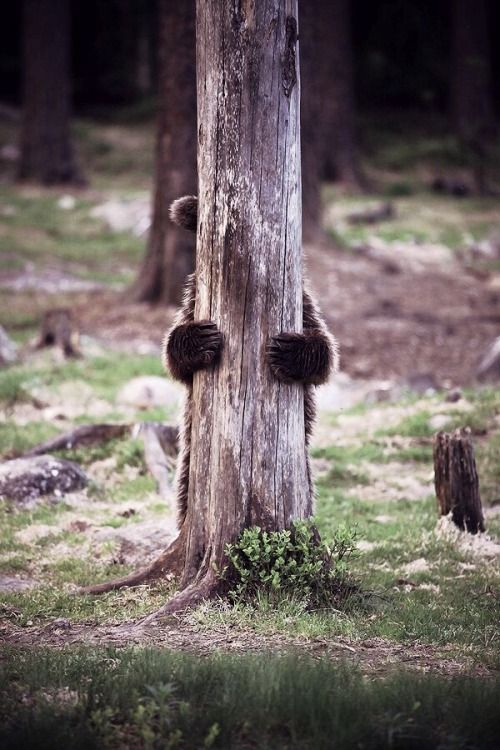
Bear- Peek a Boo- Pinterest

And that’s just talking about the Children’s age group. How then to also classify it? It’s not exactly a true-to-life “Nature” story book, featuring a fictional bear and characters. It’s much more fiction and made up than “Historical.” It is kind of “Action/Adventure”, but it features a backwoods bear, not Jason Bourne, Indiana Jones or Ironman.

The stories are set roughly in the early 1900’s, but not truly correct enough or concerned with historical details to be considered a “Period” piece. We are working on a story involving petty larceny for the next collection, but there is none of that tomfoolery or goings-on in the first set of stories so they do not fit “Crime Drama”.

The stories are set in the scenic Ozarks Mountain Country, but feature way too many made-up names and locations to be considered for the “Travel” or “Geography” categories. There is a good deal of useful nature information presented, but talking animals immediately kick it out of the “Science” category.

The word “love” is mentioned exactly once in over 65,000 words, so it surely cannot be considered a “Romance” work. And there’s no way a backwoods bear will compete with spicy Romance literature set amidst exotic locales to command attention from the romance seekers, anyway.

“Erotic?”     Mmmm —  No.

To the best I recall, there is no mention whatever about stars, the universe, aliens or time travel. So “Science Fiction” is off the list as well. There are some weak attempts at humor, but not the main focus or enough to qualify the stories as a “Comedy.”

So you can see the dilemma— where to list “The Adventures of Little Red Bear” when it is ready for release soon? The stories are simply about an uncommonly special bear and his friends in the backwoods mountain country. Boring themes like kindness, sharing, being good neighbors and appreciating the wildflowers, nature and such. Is that the stuff of “Superheroes?”

Maybe we just invented a new genre—“Fun Stories About Nothing In Particular”—but really don’t think I have enough sway with the Amazon folks to bring that about. Perhaps J. R. R. Tolkien or George R. R. Martin could. I am merely James R. Milson. Maybe I should consider adding another “R.” for a bit more literary clout.

Peanuts- Charlie Brown deep in thought

But it really doesn’t matter all that much. We don’t measure “Success” in dollar signs. Success for us is if the stories help brighten a few people’s days, and maybe a few kids learn to appreciate nature a little more. Hopefully, we have not set unrealistically high sales expectations for the book– again, sales not being the reason the stories were written in the first place. I went out on a limb a while ago and told Red if we hit a dozen sales or get a five star review, whichever happens first, we’ll celebrate with a pizza, and we’re both good with that.

But now thinking about it, not having a foggy clue where to classify or categorize the book for interested folks to even find it, we may have to peddle them on the street corner and in front of grocery stores to reach that lofty dozen sales number. It’s a good thing warmer spring weather is on the way. I may have overreached with that dozen sales goal, it maybe being an unrealistic, off the top of the head number considering the classification conundrum. Perhaps some kind-hearted person will rescue us with a good review, but not hanging my hat on that one, having only the one middle “R.” in my name as it is.

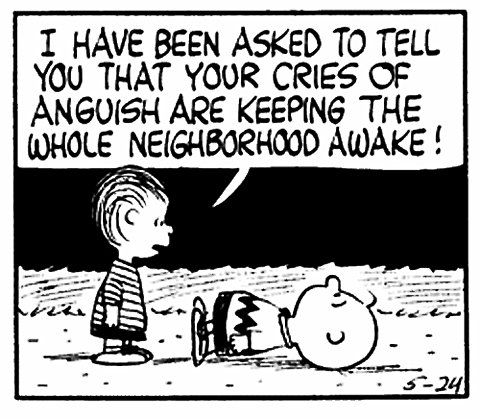
Peanuts- Charlie Brown- Anguish

I suppose if neither happens, if we don’t reach the high one dozen sales goal or receive the generosity of a five star review either, we’re okay with that too, really. Because we both know eventually we’re just going to go out and get a pizza anyway just to celebrate all the work in getting the book prepared to begin with. It’s really just a matter of timing and the accomplishment we’re toasting and lifting our Coke glasses to in the end.

So either way, however we categorize “The Adventures of Little Red Bear”, the writing trail ends at a pizza joint for Little Red Bear and me. And we both know our pizza categories very well.

In the meantime, we’re going to keep trying to figure this all out. Thanks as always for reading and following! – Jim (and Red!)

On Rabbitbrush, Ripples, Sheriffs and Such

Had a terrific weekend of writing.  I had an idea for a story in my head for several months but it never went anywhere, very unusual for me because I am a “pantser” in approach mostly, just sitting down and writing from start to finish from an initial story concept or character name, without a lot of forethought or planning.  I had the initial story idea, which is usually enough, but it never developed.  After sitting down the other day with the story idea once again, the light suddenly went on and it entered that magical land where the story writes itself.  Very happy with it, delighted actually, and wish I could share the story now with you.  But it is to be included in the upcoming “Adventures of Little Red Bear” collection so we will all have to wait just a little longer.

Work then started on another new story late last night.  So today I am working on what quite possibly could be the final story in the collection, and writing about Rabbitbrush, a featured element in the story.  Love the stuff.  To me, it is beautiful.   It is a plant native to arid regions in the North American West and Southwest, and thrives in coarse, alkaline soil common to desert environments.

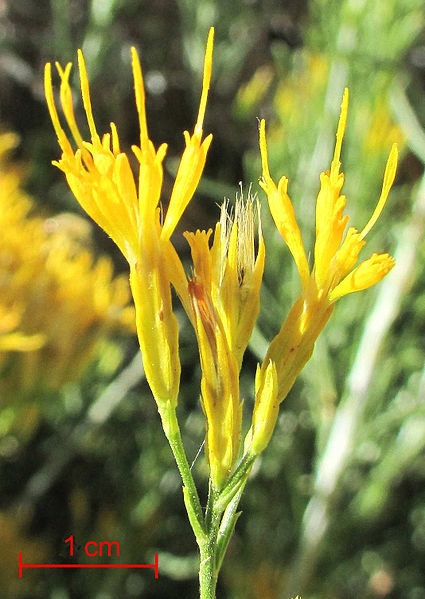
Detail of Rabbitbrush Flower Head (Image Courtesy of Wikipedia)

Detail of Rabbitbrush Flower Head
(Image Courtesy of Wikipedia)

Rabbitbrush is an important food source for wildlife, especially during winter months.  The Zuni people of the Southwest used the plant’s blossoms to make a yellow dye, and stems for baskets.  Rabbitbrush is gaining popularity now as an ornamental plant in areas where water conservation is a growing concern.  In the wild, it is often found in unmanaged range lands, along roadways and in abandoned fields.

Also known as Rubber Rabbitbrush for its uses as a source of rubber dating back to 1904, it is a shrubby perennial growing in sizes ranging from 12 to 90 inches tall.  It’s flower heads are comprised of five small, yellow tubular flowers appearing in clusters.  The flexible stems are rubbery (hence the name) and its leaves a greenish-grey in color with a felt-like covering.

Rabbitbrush- Chrysothamnus nauseosus (Photo credit- Wikipedia)

Rabbitbrush- Chrysothamnus nauseosus
(Photo credit- Wikipedia)

Having seen Rabbitbrush before in travels to the Southwest but not knowing what it was, I learned more about it from beautiful photos shared over a year ago by a great friend, the award-winning author Kathleen Creighton in California. That is how I met her, actually.  She shared the photos online, I commented, she replied, and without hesitation granted me permission to use her photos.  Kathleen then contacted and put me in touch with others to provide me with more information on the plant.  A conversation struck up and we have been talking and great friends ever since.  And now I am including it in a Little Red Bear story.  It’s wonderful how it all works when one is open and receptive to meeting new people.  More of that Sending Out Ripples notion.

But, it has taken me a year to get the Rabbitbrush into a story, and I have stacked up a pile somewhere north of 1,000 story ideas and features since then.  I will have to live to the age of Moses and Methuselah to get them all into stories.  Since that is probably unlikely, I better pick up the pace it seems.

And in case you are wondering– “How does an arid desert plant find its way into a story about Little Red Bear and friends based in the Ozarks Mountains in the Southern Midwest?”  Well, guess you will have to wait for the upcoming collection of stories to find that one out.  But here’s a hint– There’s a new sheriff in town!

Wishing everyone a great day and positive start to the New Year!  Break time is over and Little Red Bear is calling me back to writing so I need to go.  Thanks for visiting! — Jim (and Red!)

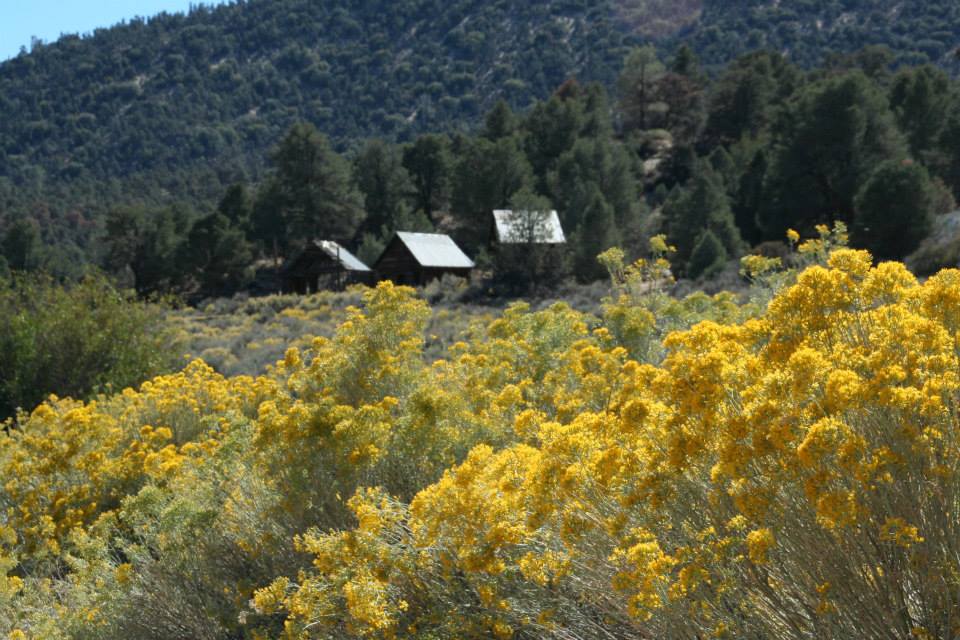
Rabbitbrush, California Farm- October, 2013. (Photo by Kathleen Creighton Fuchs)

Rabbitbrush, California Farm- October, 2013.
(Photo by Kathleen Creighton Fuchs)

Advance Warning on a New Writing Project!

A story character entered my brain a few years ago, and then went to the back and took a Rip Van Winkle nap.  He awoke quite unexpectedly last night right as I was beginning to make dinner, demanding that I start writing about him– right now!  But instead of a little story, he is adamant about being featured in a poem.  Ugh!

I began working on it last night until the wee hours, and have been writing on the new project almost non-stop since I woke up this morning, finishing cold oatmeal while continuing to work away at it.  This one may take a while.

I don’t usually talk about my writing process because I am admittedly only an amateur at it and far from qualified to give advice, but in a nutshell here it is.  Given my old woodcarving and sculpture background, I use the same process starting with a new dictionary, like a block of wood, and then hack and carve at it, removing odd words and everything that isn’t a story.  So poems are even harder, finding and saving rhymes amongst the shreds and slivers.  Boy do the bits and pages fly when I get going!  I only imagine that’s how properly trained writers go about it as well.  Do all the bards search thru shards, burning time to find a rhyme?

Searching for a Rhyme

Searching for a Rhyme

I have to stop now for a while to rest my mallet arm, and then resharpen my tools for more writing work tonight.  I feel like Charles Dickens has taken up residence in my brain along with the story character.  Is there an aspirin for that?

Much too early to go into what it’s about because this is going to take a while and we’re only getting started.  So please be patient as the character, Mr. Dickens and I get things sorted out.  I suppose if Mark Twain pops in for a visit we would have enough folks for a few hands of poker in odd moments.  The next image is a hint.  It involves– a lamp.  Whoa.  Hope I haven’t said too much.

So, trying to be responsible.  Giving advance warning.  Looks like there may be poetry coming down the road.  Might want to take your loved ones to higher ground and seek shelter.

Lamp in the Fog

Lamp in the Fog