And the Quiet Idea That Made It Possible
There are certain things that sit so plainly on a shelf, one might pass them by without a second thought.
A small tin, for instance.
Nothing remarkable in its appearance — no flourish, no fuss — merely a label, a lid, and the promise of something warm inside.
And yet, now and again, a closer look reveals that even the simplest things carry a story worth telling.
In the closing years of the last century, a company began offering what was then considered a rather fine and hearty dish — Beefsteak Tomato Soup.
By all accounts, it was a very good soup. Filling, flavourful, and welcome on the table.
But like most foods of that time, it came with its share of inconveniences — its weight, for one, made the cost of transport high, along with the need to prepare it fully before it ever reached the home.
Then, in 1897, someone had a different sort of idea.
Not louder. Not grander.
Just . . . . better, in a practical way.
A chemist by the name of Dr. John T. Dorrance developed a method of condensing soup — removing much of the water content before it was sealed in its tin.
What this meant, in practical terms, was rather remarkable:
Smaller tins
Lower cost to ship
Longer keeping
And the ability for families to prepare a warm meal simply by adding water or milk at home.
It was not merely a new product — it was an all together new way of thinking about food on the household table.
A smaller tin meant less cost, so more could be carried.
A lower price meant more could afford it.
A simpler preparation meant less time at the stove after a work-filled day, and more time at the table.
And before long, what was once a new and occasional thing became part of everyday life.
By these early years of the new century — including our own Gazette year of 1904 — such tins were beginning to appear more regularly on the shelves of mercantiles and general stores, often for around ten cents apiece.
A modest price at the time.
But one that placed a warm, dependable meal within easy reach.
There is something worth noticing in that.
Not every improvement arrives with great fanfare.
Some come quietly — set down on a wooden shelf, waiting to be tried.
And once tried, they have a way of staying.
You may notice something familiar on the shelves in this week’s “Hearth & Holler Gazette.”
And should you do so, you will now know a little more of the story behind it.
‘Til next time then, and hoping to see you on Saturday . . . .
— Jim (and Red!)

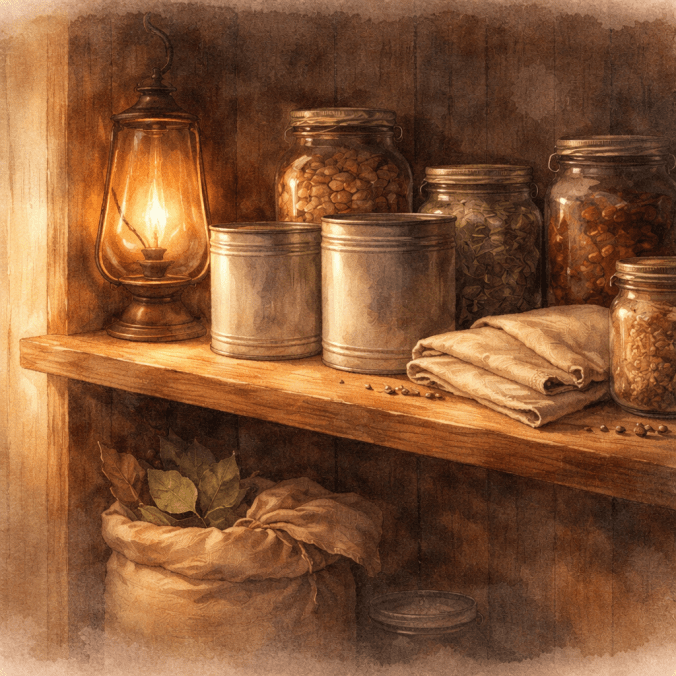
P.S. from Little Red Bear —After a long day roaming the hills up and down in search of honey, a warm supper that asks only for water, a pot, and a little good sense sounds to me like one of mankind’s better ideas.
Pen-and-ink illustrations created with the assistance of AI and lovingly styled for Little Red Bear Land.


 James Milson - The Writing Pages
Thanks for visiting with us, Frank! We often overlook simple things, never thinking about the huge impact they have had on not only our lives, but also the world. Cheers, my friend! 🤠 🐻 ❤️
LikeLike
So interesting and thank goodness for Dr. John T. Dorrance, right?
Thanks for sharing, James and Little Red Bear!
LikeLiked by 1 person
Thank you for visiting with us and for your kind comments, Rosie! It is amazing the impact Dr. Dorrance had on our lives, isn’t it? Best wishes always! 🤠 🐻 ❤️
LikeLike
An object, such as a tin, has value and utility. Though simple and unpretentious, its content is flavorful and delicious. A very visual and descriptive story. Thank you, James and Red.
LikeLiked by 1 person