WELL NOW, THAT’S INTERESTING . . . .
Discovering the Curious Corners of Honey Hill Country with Clarence “Clary” Moss

“The World Comes Down Our Road”
Clarence “Clary” Moss firmly believes every town, road, and front porch has a story waiting to be discovered.
With a curious eye and an appreciation for the unusual, he explores the people, traditions, oddities, and local legends that make Honey Hill Country endlessly fascinating.
By Clarence “Clary” Moss
I went to the depot to ask about progress.
The station agent told me to stand back from the edge of the platform.
This seemed a sensible beginning.
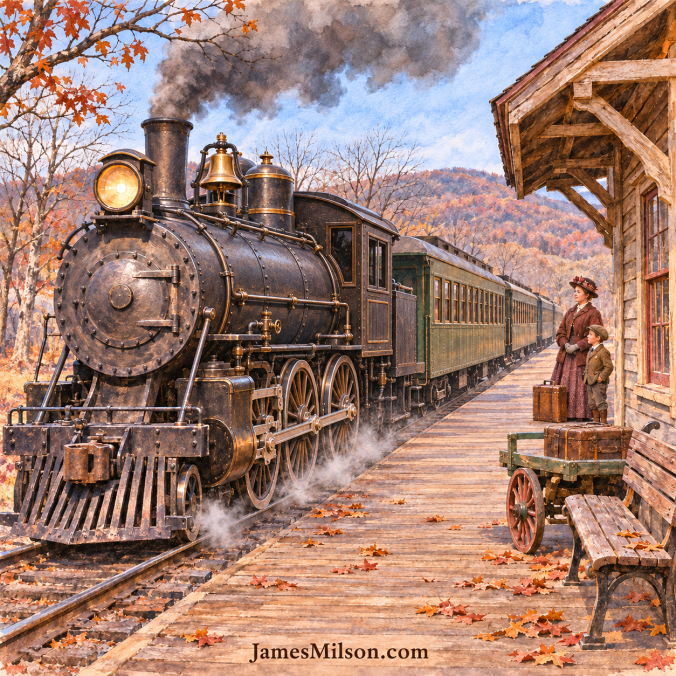
A whistle blew up the track, long and loud enough to interrupt every conversation on the platform. Beyond the bend came the growing rumble of wheels, followed by the heavy, rhythmic pounding of the locomotive.
The platform trembled beneath my boots. A window rattled in the depot behind me.
Then the engine came into view, its bell ringing, smoke rolling above it, and its great driving rods working beside the wheels. Steam hissed around the machinery as the brakes took hold. Couplings clanked down the line of cars, and a warm breath of coal smoke swept across the platform.
I stood back another step.
The St. Louis, Iron Mountain & Southern Railway had arrived with passengers, baggage, and the morning’s mail.
It had also made certain that everybody knew it.
I watched a woman step down with a small boy and a hatbox. A traveling man followed with two cases. Farther along the platform, a sack of mail changed hands.
That was what I had come to see.
A letter is a small thing to entrust to so much machinery.
Somebody folds a sheet of paper, slips it into an envelope, writes a name on the front, and sends it away. After that come sorting tables, railway cars, connecting trains, post offices, and the final stretch of road to somebody’s house.
All because one person has something to tell another.
The agent watched me watching the mail.
“Expecting a letter?”
“No. Wondering how it gets here.”
“That depends on where it started.”
I took out my notebook.
He looked at it.
“This may take longer than I thought,” he sighed.
Inside the depot, he pointed to a diagram on the wall and showed me how our little station belonged to a much larger arrangement.
The rails led toward towns where other lines continued in other directions. A journey could begin on one railroad and finish on another. Freight changed cars. Passengers made connections. Mail traveled onward while the people who had posted it went about their day.
Along the Iron Mountain and its connecting lines, goods and people moved between southeastern Missouri, St. Louis, and places much farther away.
For a household beyond the hills, the railway could bring a needed tool, a visiting relative, or news from someone who had moved away.
“What surprises me,” I said, “is how much work a letter gets done while its writer is asleep.”
The agent nodded.
“Some of it gets sorted while the train is moving.”
I looked toward the tracks.
“Sorted?”
“In the railway post office cars. Clerks work aboard them.”
I considered writing a legible address while being carried around a bend, then imagined sorting other people’s addresses under the same conditions.
“I should put everything in the wrong place,” I uttered.
“You would have a short career,” he replied.
He explained that railway mail clerks learned routes and connections, sorting letters into their proper destinations as the miles passed beneath them.
By the time a train reached an exchange point, mail could already be prepared for the next part of its journey.
I had been admiring the locomotive.
I began developing considerable respect for the men farther back.
I thanked the agent and left him to his work. Outside, the mail sack was already being carried away from the platform.
I followed it down the street to the local post office, passing a grocer sweeping his doorstep and a woman arranging apples beneath her shop window.
At the post office, the mail’s journey grew smaller in scale.
Here were shelves, familiar names, and questions about which household a letter belonged to. Beyond the counter, a rural carrier was preparing to leave.
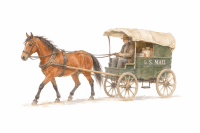
Outside stood his little covered mail wagon, its narrow body painted dark green, with U.S. MAIL lettered along the side. A canvas roof sheltered the seat and the mail carried behind it. One sturdy bay horse waited between the shafts, resting a hind foot.
I introduced myself and asked whether I might accompany him for part of his route.
He glanced at the space beside his seat.
“Provided you can talk while we travel,” he said.
“I have been accused of that.”
“Then climb up.”
I stepped onto the wagon’s iron footrest and settled beside him. He gathered the lines, the bay lifted its resting foot, and we left town with letters, newspapers, and a few small mailed items tucked securely aboard.
The road carried us between harvested fields and into a valley where bare branches let the sunlight through. At the first roadside mailbox, the carrier drew up close enough to reach it from his seat.
A letter went in. Another came out.
A flag was lowered.
Then we continued.
Before rural delivery reached a neighborhood, he explained, collecting the mail usually meant somebody making a trip to the post office or arranging for another person to bring it back.
On a busy farm, that trip could wait.
In bad weather, it could wait longer.
“Now you make the journey for everybody,” I commented.
“Everybody on my route.”
There were still households beyond the reach of such service. A line on a map, whether railway or rural mail route, did not immediately connect every hollow and hillside.
Roads mattered. So did bridges, distances, and the practical business of getting a horse through in February.
We came to a rough stretch, and I caught the side of the seat.
The carrier glanced over.
“That part goes in your article, too.”
“It may be difficult to leave out.”
At another box, he collected an envelope beside a carefully counted payment for stamps.
A little farther along, a farmer waited by his gate for a newspaper.
“Anything from my brother?” he asked.
“Not today.”
The farmer nodded, tucked the paper under his arm, and asked after a neighbor farther up the road.
The carrier answered briefly before we moved on.
“You carry a fair amount besides letters,” I said.
“People like to know how people are.”
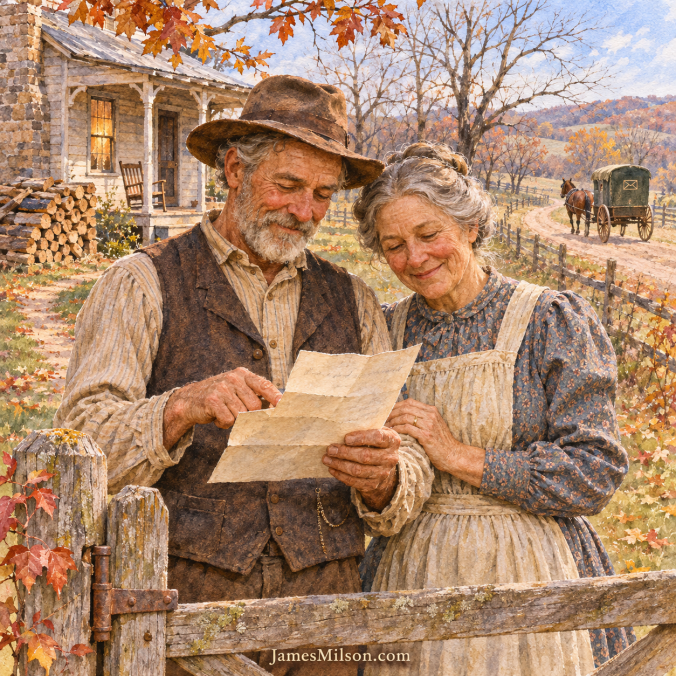
Near a farmhouse with wood stacked beside the porch, a woman came down the path as we stopped.
The carrier handed her an envelope.
She looked at the writing and smiled before opening it.
“From our daughter.”
We waited while she read the first few lines.
Then she looked up.
“They’re coming for Thanksgiving.”
She read a little more.
“All of them.”
From the porch, her husband called, “Good news?”
“We’ll need the other table!”
He came down the steps.
She handed him the letter.
The carrier gathered his lines.
I thanked him for the ride and climbed down. Town lay within a comfortable walk, and I had enough in my notebook to keep me occupied on the way.
As the mail wagon continued along its route, I turned toward town. Before I had gone more than a few steps, I heard the woman telling her husband which beds they could make ready.
I glanced back toward the gate.
He was still beside her, holding the letter. His finger rested on a line about the children.
Then he smiled and read that part aloud once more.
I had set out that morning thinking about expanding railways, stronger bridges, faster connections, and the clever work of sorting mail aboard a moving train.
I had found all of it interesting.
But the sentence I wrote at the bottom of my notes came from a farmhouse porch.
We’ll need the other table.
Somewhere, a daughter had sat down to write. A train had carried her words across the miles. A succession of working hands had seen them safely along.
And now, down a country road in Honey Hill Country, somebody knew how many places to set.
Original artwork throughout The Front Porch has been created from my concepts and creative direction with the assistance of AI.