THROUGH THE GARDEN GATE
Visiting the Gardens of Honey Hill Country with Maggie Greenleaf
“When the Flowers Have Gone, the Berries Take Their Turn”
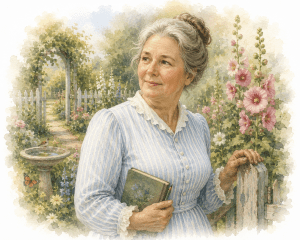
Maggie Greenleaf has a habit of noticing the things others sometimes walk past — a butterfly resting on a blossom, a toad beneath a flowerpot, the scent of lilacs on a spring breeze, or a friendly conversation beside a garden gate.
Through the Garden Gate invites readers to visit the gardens of Honey Hill Country and the people who lovingly care for them.
Through the Garden Gate with Maggie Greenleaf
I nearly walked past the gate.
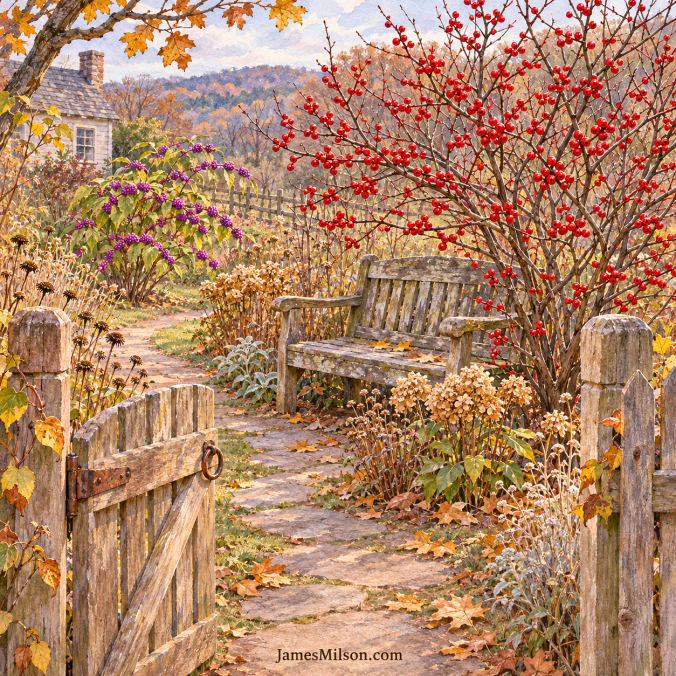
The flower beds beyond it had settled into November browns, and a few fallen leaves traveled along the path ahead of me. Where the zinnias had stood, seed heads nodded on dry stems. The roses had finished their grand performances, and the garden’s wooden bench wore a scattered covering of gold.
Then I saw the red.
Beyond the bench, a shrub stood with its branches full of bright berries, each one catching a little of the afternoon light.
I stopped.
From somewhere behind the shrub came a voice.
“I wondered how far you would get before you noticed.”
My neighbor, Mrs. Nell Foster, stepped into view carrying an empty basket.
“Not another step,” I told her.
She smiled.
“Come along, Maggie. The flowers have had their turn. Let me show you who comes next.”
The shrub was Winterberry Holly.
I had expected holly to wear glossy green leaves through the cold months. This one had let its leaves fall, leaving the red fruit plainly visible along the branches.
Without foliage to crowd them, the berries looked brighter still.
“She likes this damp corner,” my neighbor said. “I tried to choose a place that suited her.”
A smaller winterberry grew nearby, with no berries at all.
“That one has a job, too,” she explained. “The female plants bear the fruit, but they need a male winterberry flowering at the same time nearby. You cannot judge the whole arrangement by who wears the prettiest branches.”
I wrote that down.
It seemed useful information for gardeners, with possible applications elsewhere.
We followed the path toward a sunnier part of the garden. There, arching stems held tight clusters of purple berries.
I bent closer.
They were such an unexpected color that I might have believed somebody had come out with a paintbrush.
“American Beautyberry,” she said.
“A sensible name.”
“One of the better ones.”
The little fruits gathered around the stems in rounded bunches, some nearly violet, others with a rosy purple glow. A few remaining leaves hung above them.
My neighbor told me the birds helped themselves, and that the display lasted according to the weather and the appetites of her visitors.
“I enjoy it while it is here,” she said. “I would be disappointed if I planted supper for the birds and nobody came to eat.”
That seemed a fair way to look at a berry garden.
A gardener might spend months hoping flowers would last. Here, some of the pleasure came from seeing the berries disappear.
Along the outer fence grew a lower, looser thicket.
Its berries were smaller, pinkish red, and gathered close along the stems.
“Buckbrush,” I said.
“Or Coralberry, when it is receiving company.”
I laughed. I had passed shrubs like these along country fences without giving them much thought. Here, with room to arch naturally, they made a handsome border between the tended garden and the rough ground beyond.
Their fruit often lingered well into Winter. The branching stems also gave small creatures somewhere to shelter.
“They do spread,” my neighbor added. “I would not squeeze them into a little flower bed and expect them to stay politely in the middle.”
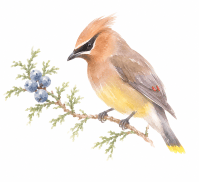
Beyond the fence stood an Eastern Red Cedar, its green branches carrying small, dusty blue fruits.
A Cedar Waxwing perched near the top. Another arrived, then another.
We lowered our voices, although the birds seemed more interested in the cedar than in our conversation.
Those little blue “berries,” my neighbor reminded me, were really fleshy cones. The birds appeared quite willing to overlook the distinction.
I watched one reach carefully along a twig.
“Cedar Waxwings love those little blue berry-like cones,” my neighbor explained. “In fact, that’s actually how the bird got its name. They will often strip an Eastern Red Cedar clean of them during the fall and winter.”
Red, purple, coral pink, and blue. I had come expecting the last of a garden and found a whole other season of color.
Mrs. Foster rested her basket on the bench.
“People ask what they should plant,” she said. “First, I ask where they mean to put it.”
We looked back toward the damp corner, then across the sunnier ground. Each planting had space to grow, and the shrubs stood where we could enjoy them from the path or the house.
There were places to perch, places to hide, and fruit that would be ready at different times.
No one shrub had been asked to do everything.
Near the gate, I paused again beside the Winterberry.
“It would make a beautiful Thanksgiving arrangement.”
“A few branches would,” she agreed. “I leave most for the birds.”
Then she added something worth remembering.
“Bird food is not always people food, Maggie. Those holly berries can make people and pets ill.”
Pretty berries invite curious fingers, especially little ones. Knowing a plant’s name and whether its fruit is safe matters far more than how tempting it looks. These were berries to admire and leave for their intended visitors.
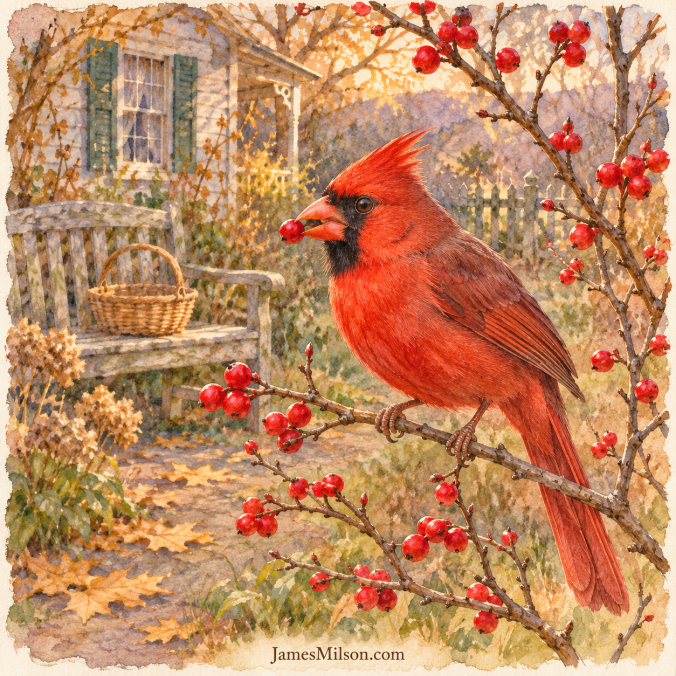
As we talked, a Northern Cardinal landed in the shrub.
We fell quiet.
He steadied himself, turned his head, and selected a berry.
My neighbor picked up her empty basket.
“I came out to gather a few things for the table,” she whispered.
We watched him reach for another.
“But I see somebody has already begun.”
Walking home, I thought about the flowers I would be choosing when the seed catalogs arrived. There would certainly be room for them.
I also began considering the view from my kitchen window, the damp place beyond the fence, and what might grow beside it.
Something bright to look at on a grey afternoon.
Something with branches enough for shelter.
Something that could keep a small visitor fed when the flower beds were quiet.
I had a little planning to do before Spring.
Behind me, the Cardinal remained in the Winterberry, helping himself to November.
Original artwork throughout The Front Porch has been created from my concepts and creative direction with the assistance of AI.