WHERE FOLKS GATHER
Celebrating Community in Honey Hill Country with Lillian Harper

“The Matter of the Blue Ribbon”
Lillian Harper rarely misses an opportunity to attend a gathering, celebration, fair, or special event.
From strawberry festivals and town picnics to holiday celebrations and community traditions, she delights in bringing readers along to experience the people, stories, and memories that bring neighbors together.
By Lillian Harper
The boxes were anonymous.
This was explained to me twice before I had removed my gloves, which suggested that somebody considered it important.
At the schoolhouse door, a young woman carrying a parcel wrapped in cream paper paused beside a young man who had apparently found something fascinating about the coat hooks.
“Blue,” she said quietly.
He nodded.
“The narrow ribbon.”
He nodded again.
I proceeded inside without troubling either of them for further information.
November had brought a brisk evening, and the schoolhouse windows shone warmly across the yard. Wagons stood along the fence, horses shifted beneath their blankets, and arriving families carried enough conversation through the doorway to keep the room lively before the entertainment began.
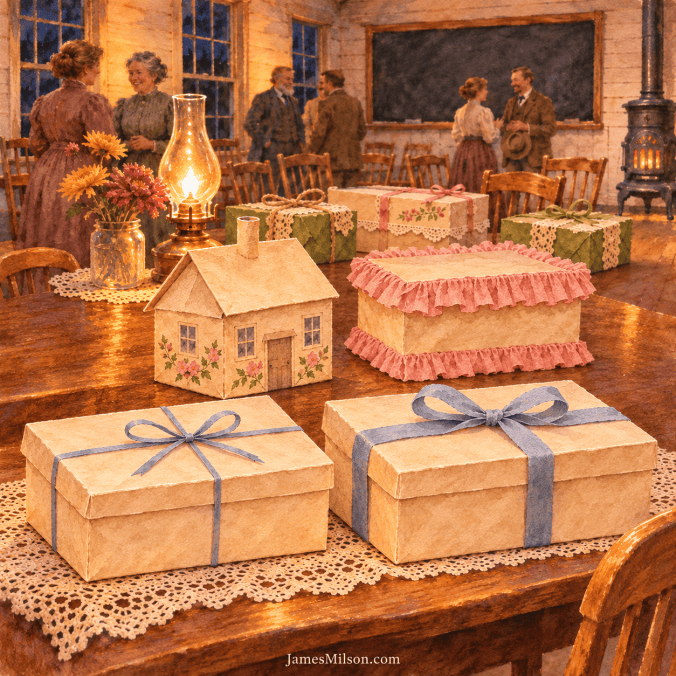
Inside, the desks had been moved aside. Lamps were lit, the stove was doing its part, and a long table at the front held the evening’s chief attractions.
There were boxes trimmed with ribbon, folded paper, bows, and carefully arranged scraps of lace. One had been fashioned to resemble a little house. Another wore so much pink trimming that I wondered whether its supper contents had room to breathe.
Each box contained a meal intended for two.
The boxes would be auctioned, with the successful bidder sharing supper with the woman who had prepared his purchase. The proceeds were to buy books for the school.
It was a practical arrangement. The books would benefit from everybody’s generosity, while the bidding benefited from several kinds of interest.
Near the front, the teacher was setting out a few worn volumes to show what needed replacing.
“Some have been mended more than once,” she told me.
One geography had a cover held together with a strip of cloth.
I opened it carefully.
“That one has traveled farther than most of us,” she said.
Across the room, somebody called for another chair. A small boy was sent to fetch it and returned carrying a stool.
“Somebody short can have this,” he announced.
His mother found him a useful task elsewhere.
Before the auction, the children gave a short recitation. A girl sang, accompanied by a woman who had brought her music and discovered that the school’s out-of-tune piano did not entirely agree with it.
They reached a comfortable understanding by the second verse.
Then the auctioneer stepped forward, rubbed his hands, and surveyed the table.
“Ladies and gentlemen, we are here for the benefit of education.”
Several people applauded.
“Some of you gentlemen may learn something before the evening’s over.”
He lifted the little house.
A chimney had been made from rolled paper. Its roof was tied securely with string.
“Who will start the bidding on this fine property? Supper included.”
The first bids came readily.
Behind me, an older gentleman leaned toward his wife.
“Is that yours?”
“You’ll find out if you buy it.”
“I thought you used the green paper.”
“I thought you were paying attention.”
He entered the bidding.
The little house went to somebody else.
His wife watched it pass with an expression I could not interpret. Her husband appeared to be studying the remaining boxes more carefully.
As each purchase was settled, its maker stepped forward. There were blushes, laughter, a few satisfied smiles, and one surprised husband who had successfully bought his own supper.
“Good,” his wife said. “You can carry it for a change.”
The young man from the coat hooks stood near the side wall, watching the table.
His intended box was easy enough to identify.

Unfortunately, there were now two with blue ribbons.
One was narrow.
The other, from a distance, was not particularly broad.
I noticed him glance toward the young woman. She looked at the boxes, then at him, and made a very small motion with her fingers.
He leaned forward.
She repeated it.
A lady beside her asked whether something was wrong with her glove.
“Nothing at all,” she replied softly.
The auctioneer lifted a cream-colored box with a blue bow.
Our young man bid immediately.
So did his friend.
And then came another bid from the far side of the room.
The young woman became very still.
The friend bid again, looking pleased with his contribution to education.
Our young man answered.
As did the man with the soft voice on the other side of the room.
From the back came an encouraging voice.
“Think of the children!” he urged.
“I am,” said the bidder’s friend. He raised his bid another time.
The auctioneer inspected the ribbon with sudden interest.
“Fine bow on this one. Somebody took particular care.”
The young woman closed her eyes briefly.
There are moments when a society correspondent is grateful for a notebook. It gives her somewhere respectable to look.
The young man bid again.
As did his friend.
And the man with the soft voice.
In the end, after a few more rounds of spirited bidding, the auctioneer called, “Sold!” Our young man stepped forward to collect his prize.
And so did an elderly widow from the second row.
She looked delighted.
He looked toward the young woman.
The young woman looked toward the other blue ribbon.
His friend discovered an urgent need to examine the stove, trying to stifle a chuckle.
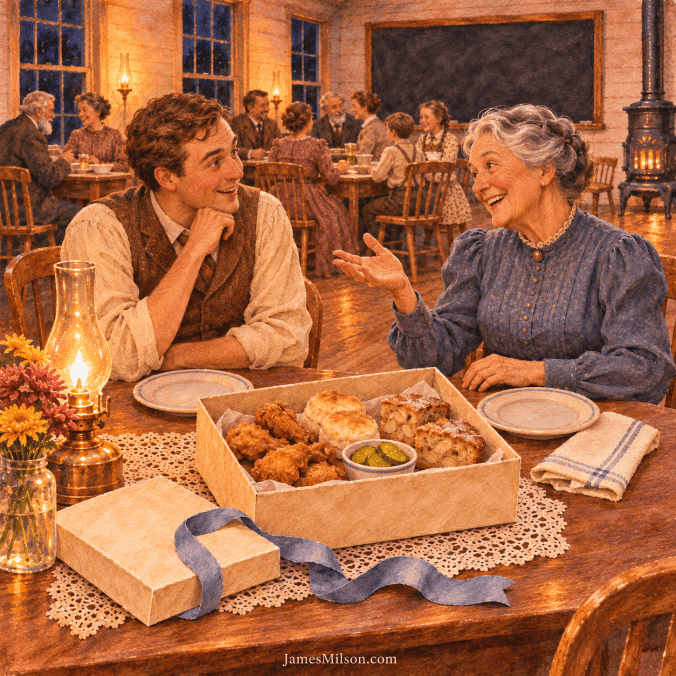
“Well,” the widow said, taking the young man’s arm, “I hope you like fried chicken.”
“Yes, ma’am. I surely do.”
“And apple cake.”
His expression improved.
“Very much, ma’am.”
“Then we shall manage,” she replied.
The other cream-colored box came up a few minutes later.
This time, the young woman’s father bought it.
“For my own protection and peace,” he explained. “I know what went into this one.”
By the time the last box was sold, the room was full of people making places for one another. Paper was unfolded, napkins spread, and the fine uncertainty of the auction gave way to the familiar business of passing pickles and finding somewhere to set a cup.
There were ham biscuits, chicken, potato salad, green beans, slices of cake and pie, and little parcels opened with considerable anticipation.
Children circulated hopefully.
Married couples settled beside neighbors. Younger people found conversation either easier or more difficult than they had expected.
The widow and her surprised supper companion appeared to be getting along splendidly.
She was telling him about a box supper she remembered from years before.
“Did the fellow get the wrong box?” he asked.
“No,” she said. “He knew exactly which one he wanted.”
The young man nodded in understanding.
Across the room, the teacher and two helpers counted the proceeds.
There would be new books for the schoolchildren.
The geography book with the cloth binding could finally retire.
When I put on my gloves to leave, the young woman with the narrow blue ribbon was standing near the door.
Her intended supper companion approached, carrying an apple-cake crumb on his cuff.
“I am sorry,” he said.
“You should be. I explained the ribbon,” she said, sounding slightly miffed.
“There were two,” he tried to explain.
“I noticed.”
He glanced toward the room.
“She’s very pleasant, though,” he offered, gesturing toward his supper companion.
“Yes. She is,” the young lady agreed.
“And she saved you a piece of cake,” he added.
That helped.
Outside, the November air felt sharper after the warm room. Families were gathering their wraps, calling children, and making arrangements to see one another at Thanksgiving.
Behind me, I heard the young man ask whether he might walk the young woman to her family’s wagon.
She allowed that he might.
I understand they discussed ribbons along the way.
For the record, the boxes were anonymous.
The ribbon had been intended to be less discreet.
Original artwork throughout The Front Porch has been created from my concepts and creative direction with the assistance of AI.