HEART OF THE HOLLER
Neighborly Visits with Abigail “Abby” Whitcombe
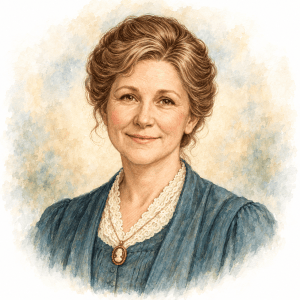
“A Place at the Table”
Abigail “Abby” Whitcombe finds the heart of Honey Hill Country in the ways its neighbors care for one another. She notices the tired parent, the small hand looking for someone to hold, and the simple opportunity to turn an ordinary afternoon into something worth remembering.
Join her each month for visits and outings filled with friendship, thoughtful gestures, and the everyday kindnesses that help a community feel like home.
“Small Kindnesses Have a Way of Traveling”
Heart of the Holler
By Abby
We counted the chairs three times on Thanksgiving morning in Patchtown and got a different number each time. On the third count, somebody thought to look in the kitchen. Two chairs were holding up a board with pies cooling on it, and a third was out by the door with a woman sitting on it, catching potato peelings in her apron.
“You can count mine,” she said. “You just can’t have it yet.”
We had put out word that anybody who wanted or needed a Thanksgiving dinner could come to the Town Hall. That was easy enough to say while there was still a week to find the plates. By Thursday morning I had a pencil behind my ear, a list in my pocket, and a woman asking me where I wanted a pan of cornbread so hot she had brought it over wrapped in her ironing cloth.
“Anywhere you can set it down,” I told her.
She looked around. “That’s what I was afraid you’d say.”
We cleared an end of the kitchen table for her. She shook out the cloth, folded it over her arm, and asked what else needed doing. Just then a boy came to the door with a covered bowl. He said his grandmother had sent the beans and wanted him to bring the bowl straight back.
“Can she do without it till after dinner?” I asked.
He considered that. “I could go ask.”
“Ask her if she’ll come with you when you come back,” I said. “Tell her there’ll be a dinner waiting, and it saves another trip back for the bowl.”
He went off at a run. About the time we found a spoon big enough for the beans, there he was again, walking this time, with his grandmother holding on to his arm. She had put on a good hat and was coming at her own pace. The woman at the door finished peeling the last potato, tipped it into the pan, and stood up.
“You can have my chair now,” she told the boy’s grandmother. “I was just keeping it warm till you got here.”
The boy took her coat. Before he got back from hanging it up, she had asked for a knife and begun cutting the cornbread. She cut the corner pieces a little smaller so there would be more of them. She said she knew how people were about corners.
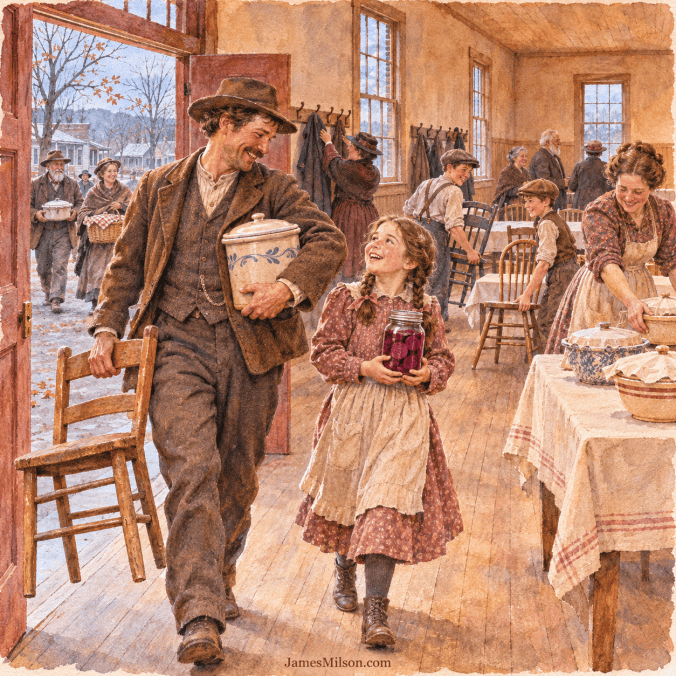
After that there was scarcely time for the door to shut. A man came in with a crock of stewed apples tucked under his arm and two chairs hooked together in his other hand. His daughter followed with a jar of pickled beets, calling to him to mind the crock every time he turned. Someone brought a dish of baked sweet potatoes with a little syrup still bubbling at the edges. Then came a covered platter of sliced ham, a basket of rolls, and a blue bowl of cranberry sauce that had traveled three streets in somebody’s Sunday shawl.
Out in the hall, two boys were setting the chairs in rows facing the place where the town clerk usually sat. They had got them beautifully straight before anybody thought to tell them we meant to eat. They took it well. One went for the long bench, and the other began turning the chairs around, calling out which ones had a loose rung as if he were announcing them at a town meeting.
We set the long bench beside the table nearest the wall, with room at either end for the children to climb in. We kept the aisle clear so folks had room to get to their seats. There was a low cane chair from somebody’s kitchen and a high-backed one from a front parlor. They ended up side by side, and a man who had come in to get warm tried them both before deciding the kitchen chair suited him better.
The turkey came in last, carried between two women who had roasted it in one oven while the dressing baked across the street in another. They called for a clear way through, and for the first time all morning everyone knew exactly where to stand. I held the door with my elbow while they went by. The smell of sage followed them clear down the hall.
By then the windows had fogged at the corners, and there were coats hanging two deep on the pegs. The boy came back to ask where he and his grandmother were supposed to sit. I looked at my list. I had written down who was bringing the coffee and who had lent the big roasting pan. I’d made myself a note to see that a dinner went up the hill to a man who couldn’t get out that day. I hadn’t written anybody’s name beside a chair.
“Wherever you and your grandmother would like,” I told him.
He went back for her. I put the pencil in my pocket, took the first basket of rolls out to the long table, and told everybody dinner was ready.
The boy and his grandmother chose two places near the end of the long table, where she could see the door. He tucked her hat under his own chair and warned the man next to him to mind where he put his feet. It was her good hat, he explained. She wore it to funerals and anywhere she expected to have pie.
“Mostly for pie, if I have my choice,” his grandmother said.
Across from them sat Mrs. Bell, who had brought the cranberry sauce. She was still wearing the Sunday shawl she’d wrapped the bowl in, though she had turned the stained corner under. Beside her was a young mother with a baby asleep against her shoulder. The mother had just got one arm out of her coat and was considering how to get out of the other when Mrs. Bell held out her hands.
“Would you like me to take the coat or the baby?”
“The coat, if you can manage it. I just got him settled.”
Mrs. Bell eased the sleeve off a little at a time. The baby worked his mouth twice in his sleep, and everyone close enough to see him held still until he stopped.
At the other table, the man who had tried both chairs had settled into the low cane one. His name was Mr. Pike. He lived by himself over the harness shop and had come early because his room was cold. By the time he took his seat, he’d tightened two loose chair rungs and shown one of the boys how to fold his coat over the back of a chair so the sleeves stayed clear of the floor. He was still wearing his own.
“Are you warm enough over here?” I asked him.
“Getting there,” he said. “I’ve got the stove on one side of me and the ham on the other.”
A man came in with his two daughters and stopped just inside the door to ask if there was still room. He had been doing odd jobs since the place down the creek where he had worked let several men go. The boy with the grandmother looked down the table, then got up and pulled his chair in close beside hers.
“There’s room here,” he said. “I can get chairs.”
There was one empty chair at the end. He fetched two more, and the older girl helped him work them past the others.
“Mama’s over at my aunt’s today,” she told him as they carried the chairs around the table. “There’s a new baby, and Auntie says he sleeps beautifully as long as nobody puts him down.”
Their father took the place at the end where he could get up without asking anybody to move. He started to tell me he wished he’d had something to bring, but before he got very far his youngest asked if he would show her how to unfold the napkin without dropping the spoon that somebody had tucked inside it. He put his own napkin on the table and showed her.
When the last chairs had quit scraping, Mrs. Ada Mercer stood up near the stove. Ada had spoken for the Cooperative League of Willing Hands when we asked to use the Town Hall, and she’d been the one keeping track of which kitchens had room in their ovens. She had a scrap of paper in her hand. I knew it was the back of the list we’d used for the roasting pans because I could see my own writing through it.
“The League thanks everybody who lent us something today,” she said. “If you lent us a dish, we’ll do our best to get it back to you. If you lent us a chair and it’s better than the one you’ve got at home, speak to me privately.”
That got a laugh, and she folded up the paper.
“We’re glad you came. Before we eat, let’s take a moment to be thankful for the food and for the company. I’ve heard from several people this week that they were especially looking forward to the company.”
We bowed our heads. Somewhere down the table a child whispered, “Is it time yet?” His grandmother whispered back, “Just about.”
Then Ada sat down, and a dozen people asked at once which way the dishes ought to go. They went every which way for the first minute or two. The ham made it clear to the end of one table before the mustard had left the other, and Mr. Pike tipped the basket toward a little girl so she could see all the rolls and choose one for herself. She looked them over carefully and took the smallest.
“Is that all you want?” he asked.
“For now,” she said. “I want to see what else is coming.”
The little girl kept her roll on the edge of her plate until she had seen what came around. She took turkey and a spoonful of sweet potatoes, thought it over, and asked for some beans. Then she tore the roll in two and used one half to go after the juice the beans had left. Mr. Pike saw what she was doing and set the basket where she could reach it without asking.
I was on my way back to the kitchen for more gravy when the boy’s grandmother touched my sleeve.
“Abby, where’s your plate?”
I told her I’d get to it directly.
“You said that when I asked you about a plate ten minutes ago.”
I hadn’t realized she’d asked me twice. The boy went after the gravy, and his grandmother drew her chair a little closer to his so I could sit beside her. Somebody set a plate in front of me. The turkey was still hot, and the cornbread had just enough of the browned edge on it to make me suspect she’d put that piece by herself.
Across the table, the baby had waked and was studying Mrs. Bell’s shawl. He took a bit of the fringe in his fist and held on while she drank her coffee. His mother made a move to free it, but Mrs. Bell said he could have the loan of it awhile. She could reach her pie perfectly well from where she was.
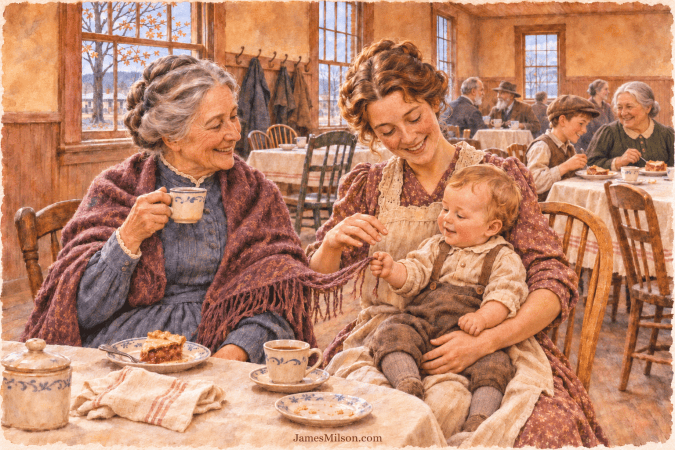
Once the coffee went around, the man who had come in with his daughters pulled his chair over to talk to Mr. Pike. They’d both hauled stone for the same job one Summer, and they got to arguing over which of them had driven the mule that used to stop at every patch of shade. The older girl listened to both accounts and said it sounded like a sensible mule. Her father laughed so hard he had to put down his coffee. I’d heard him speak only a handful of words before that, and I could hear him clear down the table now.
By then both chairs that had held up the pies in the kitchen were in use. One had gone to a woman who slipped in after dinner had started. She’d waited at her window until she saw somebody she knew coming down the street and then put on her coat and followed. She stayed to finish her coffee long after the person she’d followed had gone home.
Ada had set aside a dinner for Mr. Talley, who lived up the hill and hadn’t been able to get out. We wrapped the covered plate in a clean towel and set it in a basket with a piece of apple pie. The boy who’d brought the beans offered to carry it. His grandmother told him to wait while she found her hat.
“You don’t have to go all that way,” he said. “I know his house.”
“So do I,” she said. “I thought I’d go have a word with him.”
She tucked the empty bean bowl under her arm. The boy held the basket level as they went out, taking the steps one at a time. He’d come down those same steps at a run that morning.
We washed the dishes in water heated on the kitchen stove and laid the spoons out on a towel to dry. One woman claimed a platter by the chip on its underside. Somebody else went home with a pie plate and came back five minutes later because hers had a blue rim. Ada found the right one under a stack of saucers and wrapped it in the ironing cloth. As soon as she did, a voice from the doorway said, “Well, there’s my cloth.”
The boys asked if they ought to count the chairs again. I told them they could if they wanted to, but the numbers would be changing as fast as people carried them home. Just then I saw Mr. Pike sitting by the stove, his coat folded over the back of his chair, the sleeves well clear of the floor. The man who’d come with his daughters was still beside him. They’d settled the question of the mule and gone on to something else.
I took the boys into the kitchen and let those two keep their chairs awhile longer.
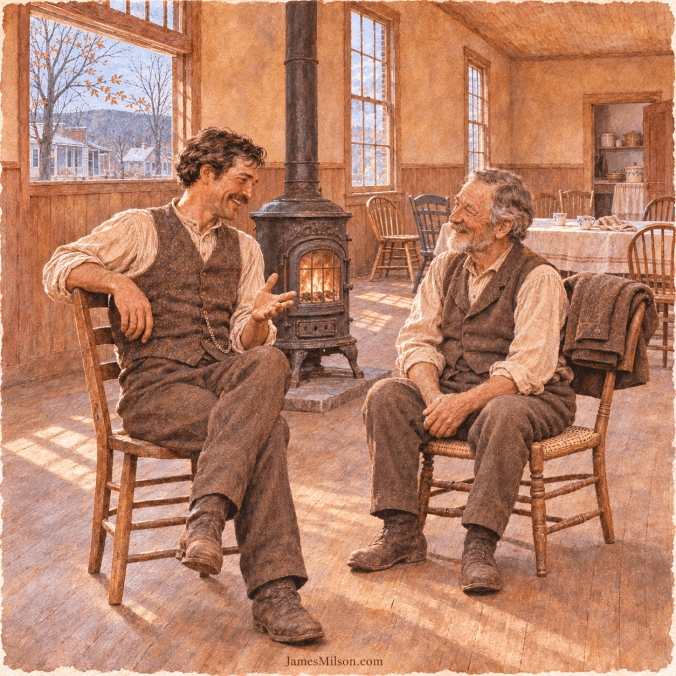
Original artwork throughout The Front Porch has been created from my concepts and creative direction with the assistance of AI.