MEANWHILE, AROUND HONEY HILL COUNTRY . . . .
Along the Roads with Ennis Greenlea
“A Little Help with the Harvest”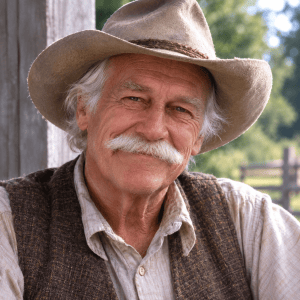
Ennis Greenlea travels the roads of Honey Hill Country with his mules, Buck and Jenny, hauling what needs hauling and noticing what needs doing. His work brings him to farms, shops, kitchens, and doorsteps, where a delivery often becomes a visit and a little extra help can make somebody’s day easier.
Join him each month for the people, places, and unexpected kindnesses found along a working neighbor’s route.
By the time Buck and Jenny turned onto Cider Mill Road, I could smell the apples.
There were apples in baskets beneath the shed, apples arriving by wagon, and apples waiting in a pile that appeared to be growing faster than the one beside it was shrinking.
Hiram Tesereau stepped into the broad doorway of The Old Cider Mill.
“Knew that wagon before I saw who was driving it,” he called. “Tell me you’ve come for these empty barrels.”
“I have.”
“Good. That’ll make room for more apples.”
He looked over his shoulder.
“Though I couldn’t say where we’ll put those.”
October can do that to a man. He spends half the year hoping for a good harvest, then stands in the middle of it wondering how he will get through before supper.
I pulled clear of the entrance and saw to Buck and Jenny before climbing down.
“Where do you need me?”
Hiram pointed toward the sorting tables.
I rolled up my sleeves.
Hiram’s father had started the mill decades before. Hiram had grown up around the work, and by now he could discuss apples while his broad hands sorted them almost without looking.
He did look, though. Nothing spoiled got past him.
We sorted and washed the fruit, then carried it to the grinder. Outside, the horse supplying its power kept a steady pace. Inside, the machinery crushed the apples into pulp for the press.
Hiram checked the next pressing and turned the screw. Soon cider was running into the clean receiving vessel.
The mill smelled of fresh-cut apple and damp wood. Wagon wheels crunched through leaves outside, and conversation came through the open doors along with the next customer.
A fellow beside the sorting table held up a handsome apple.
“Why not make the whole batch from these?”
Hiram smiled beneath his neatly trimmed moustache.
“There’s no such thing as one perfect cider apple. Takes a few different sorts to make a proper jug.”
He picked up another.
“Some bring sweetness. Some bring a little tartness. You want them getting along together.”
“I haul people like that sometimes,” I said.
“Do they?”
“Usually by the time we get there.”
A woman waiting for her order watched the cloudy amber stream.
“Now, Hiram, what makes that cider instead of apple juice?”
“It is apple juice,” he said. “Fresh sweet cider is what we call it coming from the press, with fine bits of apple still in it. Filter those out, and you get the clear sort of apple juice.”
“So the cloudiness belongs?”
“Certainly does.”
He reached for another clean vessel.
“Names get used differently from place to place. But when somebody comes here for a jug of sweet cider, I know what they’re after.”
By the time we finished the next load, there was room beside the sorting table again.
Hiram surveyed the floor.
“Well. Look at that.”
“Best enjoy it.”
Another wagon was coming through the gate.
Before I could load my barrels, he poured me a cup of cider.
“Here. You’ve helped make enough of it.”
It was sweet, pleasantly tart, and full of apple flavor. I stood by the doorway and enjoyed it while Hiram filled two jugs for Joanelle’s in Butterfield.
Myrtle Mae Meadowbloom was meeting Agnes Ovenburn there to make a Spiced Apple Cider Cake. I had been given to understand that arriving without the cider would put me in poor standing with several people whose goodwill I valued.
Hiram carried the jugs out with me.
Then he went back for two sound little apples.
“For Buck and Jenny,” he said.
I cut them into pieces and let the pair enjoy their share before we started.
Hiram leaned a hand against the wagon.
“Come back when you have more time.”
I looked toward the next load.
“You going to have any?”
“Ask me in January.”
We met Willow Meadows and her riders where the road widened beside a fence.
They were visitors from St. Louis, out to see the Autumn hills. Judging by their expressions, the hills were meeting expectations.
One gentleman wore a fine new hat, a new shirt, and enough fresh leather to suggest that Horseman’s Row had enjoyed a prosperous morning.
Willow was explaining something as we approached. When I drew up, she smiled.
“Here is Ennis himself.”
I tipped my hat.
“Hope I haven’t interrupted anything complimentary.”
“I was telling them you carry things all over Honey Hill Country.”
“Most things. Some people require a little persuading.”
“What are you hauling today?” one rider asked.
“Empty barrels, a few orders, fresh cider, and whatever turns up between here and Butterfield.”
“Does something usually turn up?”
“Usually just after I’ve tied everything down.”
That pleased the gentleman in the new hat.
Willow asked about the road ahead, and I told her where a recent wash had left loose stones along the edge.
Then they rode on toward the bright sumac, and Buck and Jenny returned to their own occupation.
Farther along, Henry Calder hailed me at the turn toward Old Mill Road.
“Heading to see the miller,” he said. “Hoping to catch him with a little time to talk.”
“In October?”
“I’m prepared to listen while he works.”
“That ought to improve your chances.”
He went toward Old Copper Creek Mill, and I continued to my next stop.
At Bramble’s Sorghum Mill & Molasses Works, steam rose above the covered boiling area.
A wagonload of long, stripped cane stood waiting near the mill. Beyond the yard were the fields where Elijah Bramble grew his own crop, though he processed cane for neighboring farmers as well.
Everybody called him Lige.
I found him beside the long evaporating pan, skimmer in hand. He was broad through the shoulders, with a short greying beard and the weathered face of a man who had spent years working outdoors.
“Brought your containers,” I said.
“Good.”
He watched the boiling juice a moment longer before looking up.
“Set them over there, would you?”
At the mill, a mule walked steadily around the sweep, turning the heavy iron rollers. A worker fed prepared stalks through them. Greenish juice ran into a vessel below, and flattened cane emerged on the other side.
Lige followed my glance.
“Been a good crop. Now we have to get it through.”
I unloaded his containers and began carrying bundles of prepared cane closer to the worker feeding the mill.
It saved the fellow a walk each time he needed another armful. Soon we had a useful stack within reach.
Afterward, I brought firewood to the boiling shed.
The furnace warmed my face while the October breeze cooled my back. Steam drifted beneath the roof, carrying a sweet, grassy smell that grew richer nearer the finishing syrup.
Lige skimmed the surface and lifted his tool to watch the liquid run from it.
“Ready?” I asked.
“Getting there.”
I set down another armload.
“Could give it a little more fire.”
He glanced at me.
“You can hurry a mule a little. You can hurry a fire a little. But you can’t hurry good sorghum.”
I left the fire to him.
A boy watching from clear of the work area asked why the sign said molasses when Lige had called it syrup.
“Sorghum molasses is what folks around here call it,” Lige said. “We make it by boiling down the juice from that cane. Different from sugarcane molasses.”
The boy considered this.
“Still goes on biscuits?”
“Very well.”
That settled the important part.
When the batch was finished and drawn off, Lige brought a little warm syrup to the table where someone had left a covered basket of biscuits.
He handed me one on a plate.
“For the hauling.”
“I came to do some of that anyway.”
“You did some extra.”
He spooned amber syrup over the opened biscuit.
I sat on the bench long enough to do it justice.
Lige joined me for a moment. We watched the yard while the next work went forward.
“Good?” he asked.
I nodded.
He looked pleased.
There was no need to explain further.
At Joanelle’s, Agnes Ovenburn opened the door before I had both feet on the ground.
“Ennis. Have you brought our cider?”
“Two jugs.”
“Excellent.”
Myrtle Mae appeared behind her.
“Did you have any difficulty finding it?”
“Finding it was easy. Leaving took a little longer.”
I carried the crate inside and set it where Agnes directed. The worktable was ready, and Myrtle Mae was studying the preparations with close attention.
“How soon do you suppose there’ll be cake?” I asked.
Agnes looked at the jugs, then at me.
“Some time after we begin.”
“That seems reasonable.”
Myrtle Mae followed me to the door.
“We’ll save you a slice.”
“I’d appreciate that.”
“Mind you come back for it.”
Outside, Buck and Jenny waited in the afternoon light. I checked their harness and climbed onto the seat.
Hiram had sent us away with cider and apples. Lige had found me a place on the bench and a biscuit worth sitting down for. Now there was a slice of cake in my future, provided I remembered to collect it.
I generally remember cake.
Jenny shifted in the traces.
“Yes,” I told her. “Still a few stops.”
I gathered the lines, and we started down the street.
Behind us, Myrtle Mae called once more.
“Ennis! We mean it about that slice!”
I raised a hand.
So did I.
Original artwork throughout The Front Porch has been created from my concepts and creative direction with the assistance of AI.