Wilder Tales — “The Zebra Who Was Always There”

From the critters near home . . . to the wildlands beyond.

Wilder Tales are small, gentle stories — meant to be read in a few quiet minutes, enjoyed with a smile, and written and shared simply for the pleasure of observing animals a little less settled, and the wider, wilder world they move through.

Having walked with the herd for as long as anyone could remember, the zebra moved once again along the same paths worn smooth by many hooves, stopping where the grass was sweetest and the ground held just enough firmness under foot. There was nothing unusual in the way the herd traveled together — the same easy spacing, the same unspoken understanding of when to pause and when to go on. In the bright, open light of the plain, the zebra’s stripes appeared as they always had, clean and familiar, and no one gave them more thought than the passing breeze or the sky overhead.

Slipping behind a drifting cloud, as it sometimes did, softening the sharp edges of the plain and drawing colors closer together, the sun withdrew for a moment. The air cooled just a little, and shadows loosened their hold on the ground. In that gentler half-light, the stripes on the zebras no longer looked quite the same — not changed, exactly, but revealed differently, as though the sun’s brightness had been doing more work than anyone realized.

At the edge of the plain, where grass rose tall enough to keep secrets, a lioness lay watching. This herd was familiar to her — their number, their movement, the way they held together — but in the softened light her gaze settled longer than usual on one place among them. She did not move, did not crouch or advance. She only watched, with a stillness that carried weight.

Somewhere within the herd, a zebra lifted its head, not in alarm, but in response to a feeling as old as grass and sky — the sense of being watched. That lifting of the head passed lightly from one to another, a ripple rather than a signal, until several pairs of eyes turned, almost without knowing why, toward the tall grass at the edge of the plain. They did not see the lioness at first. They felt her attention before they discerned her shape.

One zebra, standing slightly apart only by the length of a step, followed the lioness’s gaze a moment longer than the others. It was not curiosity exactly, nor fear, but something closer to alignment — the sense of looking where one is being looked through. In the softened light, with shadows loosening and edges no longer sharp, that zebra saw itself reflected faintly in the lioness’s attention, as though singled out without having been chosen.

Only then did the difference appear, and even so it did not announce itself. In the half-light, where shadow softened contrast and the sun no longer flattened every surface into certainty, the zebra’s stripes were no longer quite the same black they had always seemed. Along the curve of the shoulder and down the long slope of the flank, a deeper hue emerged — muted, dusty, almost mistaken for shade at first, until it held. Purple, quiet and undeniable, as though it had always been there, waiting for the light to step aside.

The zebra did not move. There was no reason to. The grass was the same beneathfoot, the air unchanged, the herd still close enough to feel without looking. Yet something had shifted all the same. A space opened — not in distance, but in attention — as though a line had been drawn that no one meant to draw, simply by noticing.

One by one, other zebras began to see it too. Not all at once, and not with any agreement. A glance held a moment longer. A head tilted. A pause where there had never been one before. The purple did not grow brighter. It did not spread. It simply remained — unchanged — but newly noticed, now named in the mind even if no one spoke of the difference aloud.

Just as quietly as that awareness had arrived, it began to do its work.

And that work began with something so small it might not have been noticed at all, had anyone been watching for it. When the herd shifted to graze, a familiar space was left unfilled — no more than the length of a shoulder, perhaps — and no one stepped into it. The line adjusted around the absence without comment, the way water moves around a stone.

The purple-striped zebra remained where it had always stood, neither closer nor farther away than before. Yet when the herd moved again, the gap moved with them, keeping its quiet place. Nothing had been said. Nothing had been decided. Still, the shape of togetherness had changed, altered not by action, but by hesitation.

At the edge of the plain, the lioness watched on, her attention unbroken. Waiting. The herd, occupied with its own subtle rearranging, did not notice how much more clearly she could see them now.

The change came all at once.

At the sight of the lioness shifting her weight, lowering her head, the herd’s scattered attention snapped back into alignment. Instinct moved faster than thought. Bodies turned. Hooves thundered against the ground as the line folded inward, closing the space that should never have been left open.

The purple-striped zebra found itself no longer alone at the edge of anything. Warmth pressed in from both sides, familiar and firm. A flank brushed its own. A shoulder settled where the gap had been. The herd did not pause to consider what they were doing or why. They simply remembered how to be together.

Faced with a wall of movement and sound, the lioness halted. She watched for a moment longer, measuring the cost, then eased back into the tall grass, the opportunity gone.

Only after the danger passed did the herd settle again, its collective breath evening. Their shape returned to what it had always been. The purple-striped zebra stood exactly where it always had — no closer to the center than before, no farther away — and the grass beneathfoot felt the same as it always had.

Nothing had changed about the zebra.

Something had changed about the herd.
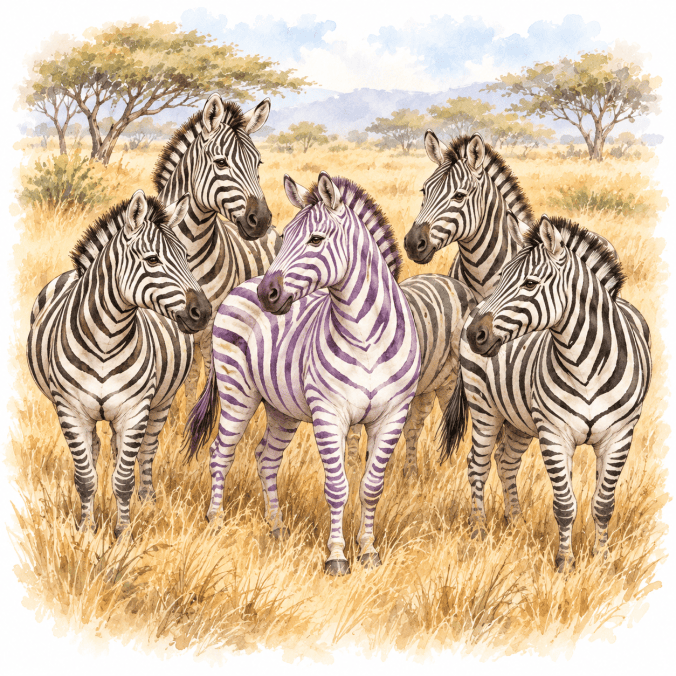
Original artwork throughout The Front Porch has been created from my concepts and creative direction with the assistance of AI.  


Why do I write these? Aw, I don’t know. Just thought it might make you smile.
 

Fresh Ink & Hot Coffee — Tomorrow, It Begins

A quiet word before Saturday morning arrives  . . . .

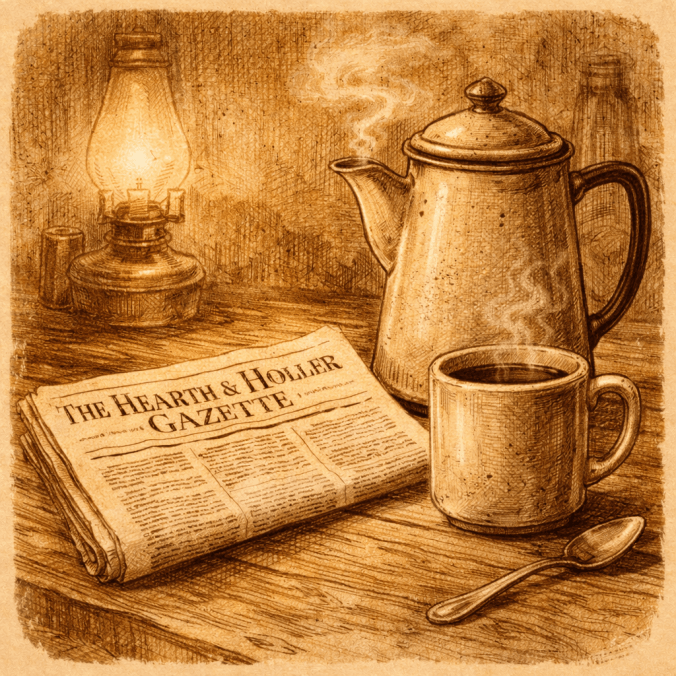
The press is warming, the quill has been freshly dipped, and in this neck of the woods the air smells faintly of biscuits and printer’s ink.

By lamplight, Little Red Bear is checking the final lines, pages stacked neat and waiting. Rusty and Percy are chasing down the last good headline, and somewhere nearby a kettle is whistling — the patient kind that knows its moment is almost here.

The very first issue of The Hearth & Holler Gazette is ready to roll — full of neighbourly news, small-town happenings, a little laughter, and a bit of country comfort to carry with you.

Tomorrow is the day.
The Gazette arrives.
Are you ready?

— Jim  (and Red!

A small note for new readers:
Receiving The Hearth & Holler Gazette is as simple as being registered for this blog. There is nothing more to do.

Something New Is on the Way

An invitation, quietly extended.

Over the past several weeks, I have mentioned a new project taking shape just over the hill — something written carefully, assembled slowly, and meant to be read at ease.

With the first issue now nearly ready to be set before you, it felt right to let the editor speak for herself.

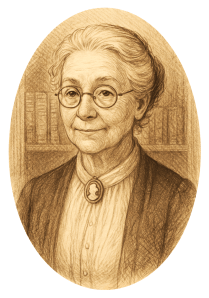
🖋 A Note from Clara Thimblewick, Editor

For some time now, a small staff has been at work — gathering items of interest, setting type, sharing a pot of coffee, and preparing a paper meant to be read slowly and kept close at hand.

We have taken care to make it worthy of your time.

The Hearth & Holler Gazette was created for readers who still find pleasure in neighborly news, in small observations, and in stories that do not hurry you along.

It is not meant to be exhaustive.
It is not meant to be loud.
It is meant to feel familiar.

If you care to join us, we would be glad to have you.

The first issue will be set before you this Saturday.

— Clara Thimblewick, Editor

Before we close, one small thing for clarity.

The Hearth & Holler Gazette is a make-believe newspaper from a make-believe place in Little Red Bear’s Honey Hill Country, staffed by characters who do not exist anywhere outside these pages.

The things they practice, however, most certainly do.

Kindness.
Compassion.
Looking out for one another.
Stopping long enough to notice.

Those are as real as it gets — and what it is all about.

If this sounds like something you might enjoy, the first issue will be waiting for you this Saturday.

We hope you will join us.

— Jim  (and Red!)

A small note for new readers:
Receiving The Hearth & Holler Gazette is as simple as being registered for this blog. There is nothing more to do.

Why Small Stories Last

Why the Little Things Stay With Us

Small stories. Small moments. Small actions that reverberate through the years, often in ways we never fully realise at the time.

My own writing life — if one can call it that — began in the fourth grade, with a teacher named Mrs. Drew. I do not recall her first name, if I ever knew it at all. Back then, adults were simply Mr., Mrs., or Miss, and that seemed sufficient. (You need not bother doing the arithmetic — I am seventy-six.)

One afternoon near the end of the school day, Mrs. Drew propped a landscape painting against the blackboard for all of us to see. Our assignment was simple enough — write a short story inspired by the scene in the painting. It showed a family in a wagon, travelling along a dirt road that wound through woods and farmland, headed somewhere beyond the frame.

We began writing in class and were sent home to finish. A few days later, Mrs. Drew returned our papers, handing them back one by one. All except mine. Mine, she kept.

When she finally explained why, it was because she intended to read it aloud to the class. And when I eventually received it back, there at the top of the page were words I have never forgotten:

“A++      Jim — You will be a writer someday.”

I was painfully shy at the time. I did not know what to do with such encouragement. But I carried it with me — quietly, steadily — for the rest of my life.

There are moments like that — small at the time, almost unnoticed — that stay with us long after louder things have passed. They do not announce themselves. They do not demand attention. And yet, years later, they are often the ones we remember most clearly.

Perhaps it is because they arrive without agenda. Or because they involve people rather than events. Or because they ask nothing of us except that we notice.

Continue reading →

Porch Notes From Little Red Bear

Hey, folks —

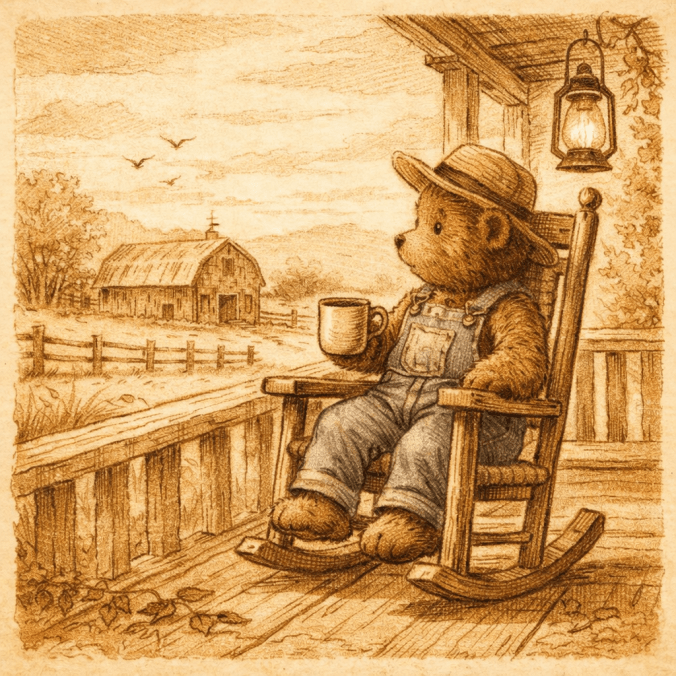
Jim is up to his ears with work on the Gazette right now, so asked me to fill in for him today. And I’ve got a few minutes so thought – “Sure. Why not?” Hope you don’t mind.

Farmer Turner dropped by earlier for no particular reason. That’s what folks do around these parts. Stopping by to visit. Just bein’ neighborly, is all.

As usual, we got to talkin’ about the weather. Lately it’s been like riding a seesaw. We seem to go from way above normal one day to way below normal the next. We set a record for both a record all-time high temperature and another record 62-degree temperature drop all in the same day last week. From 80F to 18F. I started the morning in my overalls and ended up wearing three different coats by the end of the day, each one heavier than the one before. I hear the birds down south are flyin’ in circles, not knowing whether to migrate back up north or stay put where they are. They can’t figure it out either, it seems.

Anyway, that’s what Farmer Turner and I were talking about — the weather. I will say, if ever you feel like talking about the weather with someone, just go find yourself a farmer. Farmers love talking about the weather. For them, it’s not just small talk, of course. It’s an important discussion about crop yields, planting schedules, and their very survival. Weather determines a farmer’s livelihood, after all.

Well, I see Aunt Ivy coming up the way, probably coming to trade some cookies for some of the fresh herbs we still have growin’ alongside the cabin. So, I’ll be going now. She may need my help gettin’ to some of the herbs. That, and I don’t want Jim spottin’ her coming and dashin’ out the door to beat me to any fresh cookies.

‘Til next time then.

— Little Red Bear (and Jim!)

If you’d like to spend a little more time in Little Red Bear’s world, Jim has gathered some of the stories and books together on his Author’s Page. You’re always welcome to stop by.

Once A Week, and Close To Home

How a paper told you what happened — and reminded you who lived nearby

There was a time when the paper did not arrive every morning.

It came once a week — sometimes folded neatly, sometimes creased and softened by many hands — and it usually ended up on the kitchen table, beside a coffee cup or under a pair of reading glasses. You did not rush through it. There was no need to. It would still be there after supper, and often the next day, and sometimes the day after that alongside the easy chair or rocker.

Before you reached the end of the first page, you had already seen names you knew.

Someone had a new baby. Someone else was celebrating a long-awaited anniversary. There would be a church supper on Saturday, a school program midweek, and a notice about a lost dog that everyone hoped would turn up before the next issue came out. Someone’s daughter had been mentioned for her playing at the spring recital, and the high school team had won on Friday night. And sometimes — quietly, respectfully — there would be a name you recognized for a different reason, and the house would grow a little still as you read.

Those small-town papers were not trying to impress anyone.

They did not shout. They did not hurry. They did not pretend that every day was historic. What they did, instead, was tell people what mattered right here — the kind of news that lived just down the road, in their own streets, their own schools, and their own kitchens. Who needed help, who was being celebrated, who would be missed, and what the coming days might hold. News and events close enough to touch, and familiar enough to care about.

They gave ordinary lives a place to be seen.

A person did not have to be famous to appear in print. You only had to belong. A spelling-bee ribbon, a new porch, a good harvest, a bad winter — all of it counted. The paper did something quiet but important: it slowed time just enough for people to recognize one another and remember that they belonged to the same place.

Somewhere along the way, those kinds of papers grew thinner — or quieter — or disappeared altogether.

It did not happen all at once, and it did not come with ceremony. One week there was a paper, and then one week there wasn’t. Or there was one, but it felt different. Faster. Louder. Less familiar. And without anyone quite meaning for it to happen, a small and steady way of keeping track of one another slipped out of reach.

This winter, I found myself missing that kind of paper.

Not the headlines — but the notices. Not the urgency — but the presence. Not the noise — but the quiet. Not the crowd — but the community.

The kind of paper that does not hurry, does not shout, and does not forget the small things. The kind that assumes you will sit with it awhile, maybe pass it across the table, maybe read a bit aloud.

So, missing all that, I decided to create one.

Not to recreate the past exactly — but to borrow its patience. To gather stories the way they used to be gathered. To leave room for observations, oddments, wanderings, and the sorts of things that never make headlines but somehow make up a life.

There are always stories circulating around a town, after all — if someone is willing to go looking for them. Some are found by a roving squirrel reporter with a knack for being in the wrong place at the right time. Others are sniffed out by a good-natured news hound who never missed the scent of a good story.

If this feels familiar, that is no accident.

Some things were worth keeping. And we’re in Little Red Bear’s “Honey Hill Country,” after all.

— Jim  (and Red!)

In the days ahead, I will be sharing more of the people and small happenings that make a paper like this feel alive — the kinds of names and notices that once filled the margins and gave a town its own sense of place and to know itself a little better.

There’s more to come — not all at once, and not in a hurry.

P.S. from Little Red Bear —
Little Red Bear says if a paper feels close to home, it probably is. It tells you what happened and reminds you who lives nearby.

Pen-and-ink illustrations created with the assistance of AI and lovingly styled for Little Red Bear Land.