Welcome back to the Front Porch.
You have probably heard the old saying, “A picture is worth a thousand words.”
I’ve been thinking lately that sometimes a picture does something else. More than that.
Sometimes it tells you where to find the words.
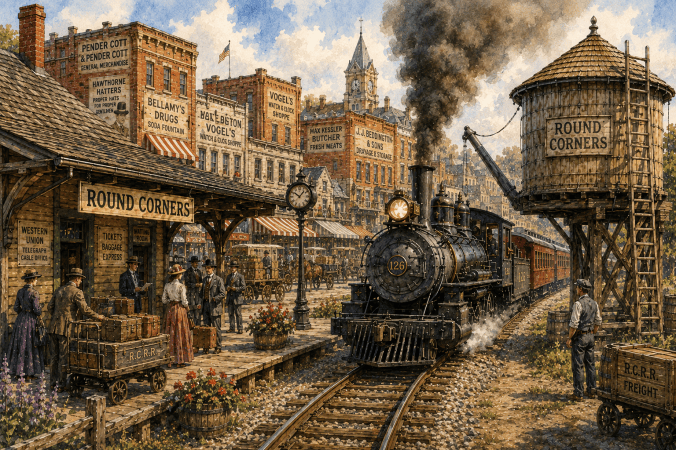
That thought came back to me recently while working on something you may never think much about when looking at a finished illustration . . . . Just what should a steam locomotive arriving at a small Ozarks town in 1904 actually look like?
Seems like a simple enough question, doesn’t it?
Put a locomotive on some railroad tracks, add a station, maybe a few people standing around, and there you go. Well — apparently — that isn’t how things work around here.
Because once I started looking more closely at the trains that would have traveled through Honey Hill Country at the beginning of the twentieth century, one question led to another. And another. And another . . . . And then another.
Before long, I was looking into steam locomotives and passenger cars, freight cars and railroad crossings, station platforms and loading areas, horse-drawn wagons and mule teams, and the wooden water tanks that stood alongside railroad tracks all across the country.
All of this, mind you, because I wanted to create a true-to-the-period image of a train.
Funny thing is, I had been down this road before — although the first time, there wasn’t a train anywhere in sight.
Did you know that back in the day a steam locomotive could use somewhere around 30 to 100 gallons of water for every mile it traveled, depending on its size, the work it was doing, and the conditions it was working under?
I didn’t. And that’s a lot of water.
Or did you know that railroad water stations might be located only ten to twenty miles apart all along a line, giving locomotives plenty of opportunity to replenish their water supplies and not risk running out, only to be stranded dead on the tracks between water towers if they did?
I didn’t know that, either. And that is a lot of railroad water tanks.
So suddenly those big wooden water tanks standing beside old railroad stations weren’t merely picturesque things to put into an illustration. They had a very important job to do and needed to be located correctly in an image. A steam locomotive needed water to make steam, and without steam, it wasn’t going anywhere.
That seemed enough, but then I learned that a locomotive tender of the period might carry 2,000 to 5,000 gallons of water.
Now, water weighs a little more than eight pounds per gallon. Do the arithmetic on that and we are talking about roughly eight to twenty-one tons of water being hauled behind the locomotive. Just water. Only the water.
Then add to that the weight of the tender itself, the piles of coal it also carried for the firebox, the locomotive, and all the passenger cars — or perhaps twenty to forty loaded freight cars — following along behind.
And remember that we’re not talking about running across billiard-table-flat country, either. This is the Ozarks. Honey Hill Country. We have hills. Lots of them. And mountains. No longer towering like the Rocky Mountains, but big enough to have to go around, over, or through.
At some point, “Let’s put a water tank beside the station” had become “Exactly how many tons of water are we hauling around these hills?” and “How many feet away from the locomotive and tracks would a water tower really be?” (Eight to ten feet from the centerline of the tracks if you’re curious.)
And this, you see, is how afternoons disappear.
And this is also how the world of Little Red Bear’s Honey Hill Country continues to develop and grow.

The more we worked on the railroad scenes, the more the world around them began filling itself in.
A locomotive traveling through the hills became a freight train winding through the countryside.
That led to a farmer and his mule team waiting patiently at a railroad crossing.
That led to a rural railroad station.
And then we came into the bustling town of Round Corners.
The little rural railroad stop we started with didn’t seem right anymore. Round Corners is one of the larger and busier towns in Honey Hill Country, so its station needed to look like it properly belonged there.
And then the town began growing around it — more buildings, loading areas, wagons, people going about their business, and a proper railroad water tank. Of course, a proper railroad water tank. Eight to ten feet from the center of the tracks, if you please.
And the locomotive? It finally came around a curve behind the water tank and headed into the station in Round Corners.
And that was when something familiar happened. I started wondering about the people in the picture . . . .
Who was waiting at the station?
Who was getting off the train?
Where were those wagons going?
What was in those freight cars?
And what might happen five minutes after the scene we’re looking at?
Sometimes a story creates a picture. And sometimes a picture looks back at me and says,
“You know, there ought to be a story here.”

Come to think of it, pictures have been doing that to me for a very long time.
I have forgotten most of the teachers and instructors I have had over the years. But there are a few we remember over time, don’t we? One or two even more so. Those one or two who made a lasting impression or changed your life along the way somehow.
One of my most memorable was my fourth-grade teacher, Mrs. Drew. We never knew teachers by their first names back then. She was simply Mrs. Drew.
One afternoon, with about an hour remaining in the school day, Mrs. Drew picked up a large oil painting and placed it on the rail beneath the chalkboard, leaning and balancing it there so everyone in the classroom could view it. I can still see that painting in my mind today.
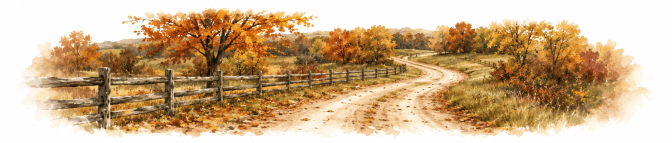
It was clearly Autumn because the leaves had changed, and there was a family traveling in a horse-drawn wagon along a country road. The golden hour before sundown. Woods and trees lined the left side. On the right, wooden fences bordered an open farm field. And the wagon was rounding a bend in the road, coming toward us.
Our assignment was simple. Write a story about the picture. Anything we wanted. Whatever we saw in that painting, whatever we imagined might be happening there, we were to create and write a story around it.
We started writing that afternoon, and our homework was to finish the story that evening and bring it back to turn in the next morning.
The following week, Mrs. Drew returned our papers.
One by one, everybody got their story back with a grade written at the top.
Except me.
For a moment, I wondered where mine was. I knew I had turned it in.
Then Mrs. Drew picked up my paper from her desk. She told the class how much she had enjoyed the story and how exceptional she thought it was, and then proceeded to read it aloud to the class.
When she finished, the bell rang and everyone began gathering books and papers to go home. Mrs. Drew came over to my desk, patted me on the shoulder, and told me again how much she had enjoyed what I had written.
After she walked away, I put the story into my binder. And that’s when I saw what she had written at the top . . . . a large A++ in red ink. And beneath it . . . .
“Jim — this was wonderful. You will be a writer someday!”
That was the start.
A country painting.
An assignment.
A few encouraging words written in red ink.
And, for a fourth-grade boy, a newfound confidence and something of a mission not to let Mrs. Drew down.

All these years later, pictures are still an ever-present source of inspiration for me. I still find myself looking at pictures and wondering about the stories hiding inside them.
Only now, instead of a horse-drawn wagon coming around a bend in a country road, I am looking at a steam locomotive coming around a bend into Round Corners, curving around a water tank properly set beside the track.
And I’m asking the same questions.
Who is going somewhere?
Who is coming home?
What happened just before this moment?
And what happens next?
The tools have changed considerably since fourth grade. So have I. But perhaps the process hasn’t changed very much at all. A picture catches my attention. I begin wondering and asking questions. One question leads to another, and before long, there is a story forming in my mind.
Somewhere along the way, I have learned something else about creating the Little Red Bear stories, the new “Hearth & Holler” monthly magazine, and the world of Honey Hill Country they all call home.
I have realized that readers do not need to know everything I discover and learn.
But I do.
Because every little thing I learn helps make the world beneath the stories a little more solid. It helps me understand why the water tank is standing where it is beside the tracks, why the farmer and his mule team are waiting where they are, why the station looks the way it does, and what might reasonably happen there on an ordinary afternoon in 1904.
And every once in a while, one of those pictures gives something back.
Another question.
Another character.
Another place.
Another story.
A picture of a family farm wagon coming around a bend in a country road began it many years ago. Now it is a locomotive coming around another bend into the town of Round Corners. And somewhere between those two pictures lies a lifetime of stories.
Mrs. Drew told a fourth-grade boy that he would be a writer someday. Someday arrived. And I am still doing my best not to let her down.
Till next time then —
Jim (and Red!)
A Little Red Bear P.S.
In case you’re wondering about Chewy’s new railroad outfit, I am pleased to report that he has just been appointed the official Insect Crossing Guard at Willow Bend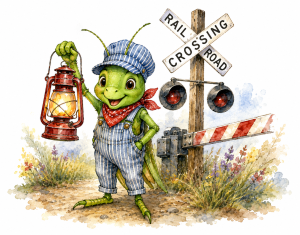 Junction.
His responsibilities include watching for grasshoppers, crickets, caterpillars, and other small travelers needing to cross the tracks safely.
Chewy takes his new position very seriously.
He has an engineer’s cap, striped overalls, a red bandana, and his very own railroad lantern.
What he does not have yet is a train schedule.
We’re working on that.
— Red 🐾
Images have been created for this piece with the assistance of AI . . . lovingly prepared and styled for Honey Hill Country and the world of Little Red Bear.