Welcome back to the Front Porch, friends.
Have you ever noticed how much faster time seems to move as we get older?
When I was a boy, waiting for Christmas seemed to take approximately three years. Summer vacation seemed to last forever. Until we got to the middle of August and started back-to-school shopping and reality set in, of course. Birthdays took their sweet time getting around to us. And school days could occasionally demonstrate an impressive ability to stop the clock altogether.
Now?
January arrives, I turn around twice, and somebody is talking about Labor Day.
Same clocks. Same sixty minutes in an hour. Same twenty-four hours in a day.
So what happened?
Let’s talk about that. Because maybe the clock isn’t the only thing that determines how long a day feels.

I came across an interesting thought recently that compared our experience of time to water moving through a river.
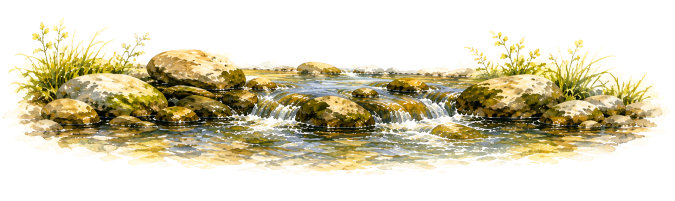
Imagine a river flowing through a broad, shallow stretch. The water moves along, but on its journey it touches rocks and stones, curls around them, tumbles over some, forms little eddies behind others, catches the sunlight, and continues downstream. It never stops, but it slows and touches things along the way, creating impressions and ripples.
Now imagine that same water being forced through a narrow channel. It runs deeper and faster, pressing between steep banks, sweeping past whatever lies along the edges, churning and rushing through on its way to somewhere else. There are fewer rocks to tumble over, fewer little pools and eddies, fewer places where the water seems to linger even for a moment. It just keeps moving.
Same river.
Same water.
But a very different journey.
And that got me wondering whether some of our days might be like that, too.
Maybe what we need isn’t always more time.
Maybe sometimes we simply need a broader kind of day.
Not another hour added to the clock, but more life noticed within the hours already there.
Not necessarily doing more.
Experiencing more of the day we’re already given.

Perhaps childhood offers us a clue.
Why did those childhood summers seem so wonderfully long?
Part of the answer may be that when we’re young, almost everything is new enough to make an impression.
Think about a child’s first trip to the zoo . . . .
An elephant isn’t simply an elephant. It is enormous. It moves differently from anything you’ve ever seen. It makes sounds you’ve never heard.
And good heavens, does it ever smell like an elephant.
A first roasted marshmallow isn’t simply something to eat. There is the stick in your hand, the heat of the fire against your face, the smell of woodsmoke, the serious business of trying not to burn the marshmallow, and the almost inevitable discovery that you have burned it anyway.
There is the first time you sit on a horse and feel that enormous animal moving beneath you. The smell of the horse and leather saddle. The coarse mane beneath your fingers. The creak of the leather.
There is the sound of a train whistle carrying through the evening from somewhere far away.
First snowfall.
First lightning bug.
First fish.
First day of school.
First time seeing the ocean.
Childhood days are crowded with points of contact. New tastes. New sounds. New smells. New textures. New places. New experiences. Little impressions everywhere.
Maybe that’s one reason an ordinary summer afternoon from sixty years ago can remain vivid in our memory while whole months from three years ago have almost disappeared.
We remember that day at the zoo. We remember how the elephant smelled.
Ask me what I had for lunch yesterday and you may need to give me a minute. Maybe two.
Of course, we cannot make everything new again. Nor would we want to. But perhaps we don’t have to.
Things were easier to notice when they were new.
Can we notice them now even though they aren’t?
Familiar doesn’t have to mean invisible.
Somewhere along the way, familiarity becomes wonderfully useful. We don’t need to rediscover how a coffee cup works every morning.
But perhaps sometimes too much of life gets filed away under “Nothing New Here — Nothing New o See.”
Coffee becomes coffee.
Breakfast becomes breakfast.
The tree outside the window becomes the same old tree outside the window.
The cardinal at the feeder becomes just another cardinal.
The familiar voice on the telephone becomes a voice we’ve heard a thousand times.
Tuesday becomes Tuesday.
But none of those things has stopped being worth noticing.
We’ve simply grown so accustomed to them that sometimes we stop seeing them.
We don’t need to make them new again. Maybe we just need to notice them again.
Maybe there is something to be said for feeling the warmth of that coffee cup in our hands again.
For hearing the bird outside instead of merely registering that a bird is making noise.
For noticing how the light falls differently across the room late in the afternoon.
For actually tasting the first bite of supper.
For stopping halfway to the mailbox because something is blooming.
For looking up when the evening sky suddenly decides to put on a show.
None of those things is remarkable. Except that, in its own small way, every one of them is. That is the extraordinary thing about ordinary life.
And when we think about it, most of life is ordinary.
The birthdays, weddings, graduations, vacations, promotions, new houses, great adventures, and other milestones matter enormously. And they should.
But they are scattered here and there. Between them are thousands upon thousands of ordinary mornings, ordinary afternoons, and ordinary Tuesdays. That is where most of our living happens.
And perhaps that is where a broader kind of day begins, as well.
We often talk about getting through the day.
I’ve said it myself. Many times. But lately I have been wondering about that expression.
Getting through the day makes it sound almost like a hallway between yesterday and tomorrow — something we need to hurry through on our way to somewhere else.
But what if a day is less like a hallway and more like a house we’ve been given to live in for twenty-four hours?
There are windows to look through.
Rooms to linger in.
Voices to listen to.
Morning light entering from one direction and evening light leaving through another.
Rain may tap against the roof.
Someone may knock at the door.
Something good may be cooking in the kitchen.
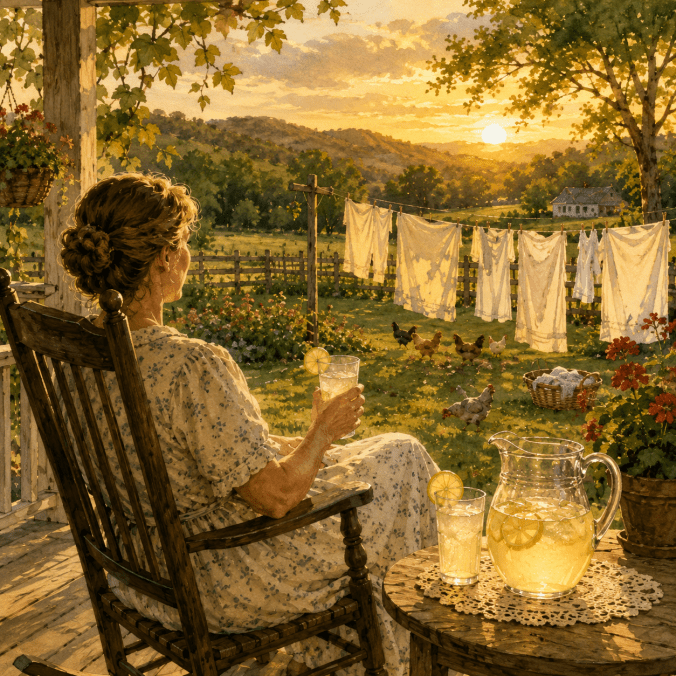
There may even be a comfortable chair somewhere with our name on it.
We can hurry from room to room, always reaching for the next doorknob. Or we can inhabit the place while we’re there. That doesn’t mean we accomplish nothing. It doesn’t mean we stop making plans, working toward goals, or looking forward to tomorrow. And living in the moment doesn’t mean forgetting yesterday or refusing to plan for tomorrow.
It simply means not overlooking today while we’re doing both.
There is a difference between passing through a place and having lived there.
Maybe the same is true of a day.
And rushing through our days isn’t something that happens only as we grow older.
Young lives can become narrow and fast-moving, too.
Finish school.
Get the job.
Earn the promotion.
Buy the house.
Reach the goal.
Achieve the next thing.
And then the next-new-thing after that.
There is nothing wrong with goals. There is nothing wrong with wanting something better or working hard to reach it. But it is awfully easy to spend today reaching toward tomorrow.
There is always another when —
When I finish this.
When things settle down.
When I have more time.
When the kids are older.
When I retire.
When summer gets here.
When it finally cools off.
Meanwhile, Tuesday is happening.
And Tuesday counts.
So maybe the measure of Tuesday isn’t only how much we accomplished.
There may be a simpler question —
Were we there for it?
Did something make an impression? Did we make contact with our own life?
Not necessarily some grand experience worth recording for posterity.
Maybe we laughed with somebody.
Maybe the first sip of coffee was particularly good.
Maybe a hummingbird stopped outside the window.
Maybe we noticed the rain against the windowpane.
Maybe we heard an old song that reminded us of someone.
Maybe the dog did something ridiculous.
Maybe nothing happened at all. And for ten wonderful minutes we simply sat quietly and watched clouds move across the sky.
All those little points of contact give a day texture.
And perhaps, when enough of them collect, they give us something else.
Memories.
Not every day needs to become unforgettable. That would be exhausting.
But perhaps there can be enough little impressions left behind that when the day is finished, some part of us can say —
I was there.
I remember that.
I lived that day.
None of us can stop the clock. Nor can we stop the river. The water keeps moving downstream, just as the hours continue moving toward tomorrow. And I’m not sure I would want it any other way.
But perhaps now and then we can let the river run a little broader . . . .
Let it touch a few more rocks along the way.
Notice the sunlight on the water, catching the ripples and riffles around the rocks.
Listen to the birds along the bank.
Feel the warmth of the cup in our hands.
Look up.
Listen.
Taste.
Laugh.
Remember.
Not because someone told us we should. Not because we’re trying to turn living into another assignment or measured goal to complete.
Simply because this is our life. And it is happening now.
We don’t always need more hours in the day. Maybe sometimes we just need to more fully inhabit the hours already there.
To experience more of the day we’re already given.
To make it a little richer.
A little wider.
A broader kind of day.
Till next time then —
Jim (and Red!)
A Little Red Bear P.S.
Chewy says he doesn’t understand why folks need reminding to slow down and notice things. He spent most of yesterday sitting on a warm rock, watching clouds and chewing a particularly good blade of Orchardgrass.
According to Chewy, Tuesday went just fine.
— Red 🐾
Images have been created for this piece with the assistance of AI . . . lovingly prepared and styled for Honey Hill Country and the world of Little Red Bear.



Very nice, James. Time is different for everyone, right?
Thanks for sharing,
Rosie
LikeLiked by 1 person
Thank you so much, Rosie! And thanks for visiting with us. And so true, time really is different and seems to move at different speeds for everyone. “Some people live a lifetime in a minute.” — Al Pacino in “Scent of a Woman.” Best wishes always! 🤠 🐻 ❤️
LikeLiked by 1 person