From the critters near home . . . . to the wildlands beyond.

Critter Tales are small, gentle stories — meant to be read in a few quiet minutes, enjoyed with a smile, and written and shared simply for the fun of it.
His morning began as most crow mornings in Honey Hill Country did —
with a stretch that felt longer than necessary,
a short flight over three fields and two fences,
and a satisfying early visit to Farmer Turner’s cornfield.
After that, he returned to his usual oak branch to observe the countryside,
because that is what crows do.
They observe.
They notice.
They remember.
That was when he saw the shine.
Not just any shine.
“The” shine.
Down by the roadside, a picnic blanket lay spread in the grass.
A young man and woman sat nearby, occupied with the sort of business that causes humans to forget small but important things on a picnic blanketed sunny day.
Set down to the side, for only a moment and catching the sun just so,
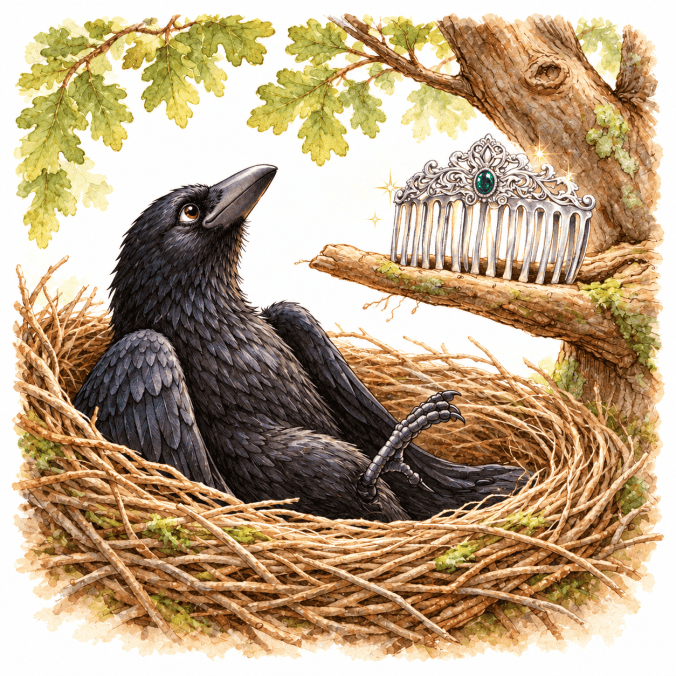
was a Silver Hair Comb.
It glimmered brightly in the sunlight — catching the light in a way that felt entirely unnecessary, the shine sliding along its silver teeth in a way the crow found beguiling and difficult to ignore.
The crow did not hesitate.
He swooped —
He swiped —
and immediately discovered that the comb had opinions of its own about being suddenly airborne.
It twisted in the air.
Caught the breeze in a totally wrong way.
Tugged at his grip and clanked softly against a metal fence post as he passed.
As he flew, the wind caught the comb just right, and its teeth let out a thin, reedy whistle —
a sound the crow did not like at all.
The annoying whistle made him sound like a songbird.
Something a crow is most definitely not.
There was a brief and undignified wobble.
He veered.
He swerved.
He corrected.
He veered again.
He swerved again.
He sheared off his intended path.
But a crow is nothing if not determined, and after several momentary struggles over three fields and two fences, he carried it home.
Back at his nest, he chose the best wall —
the one where the afternoon light lingered longest —
and mounted the comb carefully between two sturdy branches.
He stepped back to admire it, folding his wings as comfortably as a crow ever could,
one leg tucked, head tilted.
It was, he thought, a very fine thing.
A very shiny thing . . . .
And it was his.
All his.
He admired it and thought then to himself in a Crowsian rhyme —
“Now it’s all mine,
This very fine shine.
To admire when I dine,
By my shiny comb shrine.”
He was proud of his heist.
And felt it looked nice.
There on his wall,
When friends came to call.
The trouble, as it can, began the next morning.
The rising sun struck the comb at precisely the wrong angle,
and not seeking permission flashed straight into his eyes,
waking him from a pleasant dream involving corn, a sleeping scarecrow,
and uninterrupted peace while he feasted in the field.
But then the shine. In his eyes. Oh, that shine!
He blinked.
He squawked once.
He glared at the comb.
He shook a disapproving wing at its misbehaving.
But that was only the beginning.
By midmorning, others had noticed the shine.
Far and wide, they’d noticed the shine.
A pair of squirrels arrived first — polite and hopeful — asking to borrow the comb for a moment.
“Just a moment, please,” they implored.
Then came raccoons, who took longer than necessary
and admired themselves far too much in its reflection.
Soon a line formed along the branch, orderly at first,
then less so, as tempers rose and patience wore thin between hopeful visitors.
The comb chimed softly in the breeze.
It flashed.
It gleamed for all to see.
It beckoned.
Now and then, when the wind shifted just so, the comb answered with a faint whistle —
sharp and far-reaching,
adding sound to an already noisy visitor affair.
Before long, mother possums appeared,
each with a tidy row of babies clinging along her back.
The babies carried on as little ones will —
squeaking, squirming,
reaching for the comb at all the wrong times.
One slipped and had to be scooped back into place.
Another tried to chew on the comb
and was gently scolded.
The line grew longer.
And then longer still.
It stretched down the branch,
around the trunk,
around the trunk again,
onto the ground below,
and on out into the meadow.
There were disagreements.
There were accusations.
Someone tried to skip ahead.
Someone else refused to give the comb back on time.
A pair of chipmunks argued over who would get the extra acorn,
the one shining so noticeably in their reflection.
The crow watched from his perch,
his pride slowly giving way to unease.
By afternoon, a steady rain had begun to fall.
Yet the line did not shorten.
It grew.
When a porcupine waddled out of the bushes
and took his place at the end of the line,
now across the meadow,
the crow felt his feathered hackles rise.
He stared.
He turned away.
He paused.
And turned back to stare again.
Rain drops rolled off his beak.
He paced along the branch.
He glared at the comb.
He looked down at the line,
which showed no sign of shortening
and every sign of still growing longer.
The porcupine did not hurry.
He did not speak.
He merely looked up expectantly,
his quills catching the raindrops
in a way that suggested this was, to him,
an entirely reasonable request.
The crow looked at the porcupine.
He looked at the comb.
And then back at the porcupine.
Then once more at the comb.
And that was that.
The crow took the comb down,
gripped it firmly with his black crow feet,
and launched himself into the wet sky.
The wind tugged hard.
The rain soaked through his feathers.
More than once, the comb threatened to slip —
and as he flew, its teeth whistled sharply,
thin and accusing,
until even the sound itself felt like more fuss and guilt than he could bear.
Five miles is a long way in the rain.
When he finally returned to his nest,
soaked thru and tired,
the comb was gone.
His nest was quiet again.
The light was gentle.
The disquieting line dispersed.
The fuss had ended.
Unburdened, he shook out his feathers
and settled onto his branch,
wings heavy with rainwater —
yet feeling ever the lighter nonetheless.
For crows, you see, remember people.
And faces.
And places.
Places where things were found.
Places where then to return.
But to put it more simply —
Crows know.
A note about images — Original artwork throughout The Front Porch has been created from my concepts and creative direction with the assistance of AI.
Why do I write these? Aw, I don’t know. Just thought it might make you smile.