Wilder Tales — “A Giraffe In A Hurry”

From the critters near home . . . . to the wildlands beyond.

Wilder Tales are small, gentle stories — meant to be read in a few quiet minutes, enjoyed with a smile, and written and shared simply for the pleasure of observing animals a little less settled, and the wider, wilder world they move through.

Nobody could remember exactly who spotted the tree first.

It might have been one of the older giraffes, the kind who noticed things quietly and mentioned them only after being certain. Or it might have been a younger one, hesitant and unsure, keeping it to themself. But once the breeze shifted, word traveled fast thru the herd.

That tantalizing breeze carried with it the clean, green scent of new leaves — the kind that made every giraffe lift their head and take notice.

And such a fine tree it was — broad-limbed, leafy, and standing just far enough away in the distance to feel like a small victory once reached, its newly sprouted leaves tender and bright, bursting with a green, juicy sweetness no giraffe could ignore.

Most of the herd set off at an easy pace, necks swaying gently, steps unhurried. Leaves, after all, were not known for running away. All things in time.

One giraffe, however, had other ideas.

He decided that if he took the narrow path — the one that dipped beneath a few low-hanging branches — he could arrive first, select the most tasty branch, plant his hooves, and begin munching before anyone else even came into view. The thought pleased him greatly.

He lowered his head, picked up speed, and slipped beneath the trees.

Now, it should be said that giraffes are tall for a reason — to reach the highest leaves other grazers cannot — and not, as it turns out, to go rushing about.

As he ran, he turned his head slightly to see how close the others were behind him.

That was when it happened.

BAM!

The sound echoed just enough to make the birds pause and reconsider their opinions of giraffes altogether.

The branch did not move.
The giraffe did.

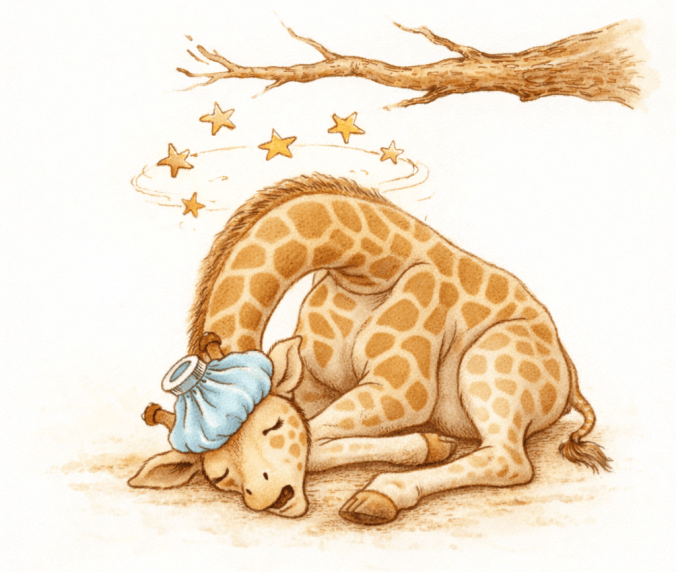
He sat down hard, legs folding beneath him in a way legs were never meant to fold, stars swirling somewhere near the clouds. When the dizziness settled, he remained exactly where he was, eyes crossed just enough to be concerning.

Someone fetched the large blue ice pack — the one normally reserved for enthusiastic antelope mishaps — and placed it carefully atop his head.

It took a while.

Eventually, it stayed.

The herd arrived shortly after, calm as ever. They passed him by one at a time, unhurried, on their way toward the tree that had started all the trouble.

No one laughed.

One giraffe tilted her head and said, kindly,
“Well… you did get here first.”

The concussed giraffe with the headache sighed, adjusting the ice pack with one careful hoof.

“Yes,” he said. “But I cannot recommend the route.”

They stood together for a time, leaves rustling softly in the distance, the sun warming backs and branches alike. After a while, the headache eased. The ice pack slid off and landed with a gentle thump at his feet.

He rose slowly, and after a few measured steps joined the others. He proceeded then to eat at the same unhurried pace as everyone else.

The leaves tasted just as good.

Maybe better.


Images have been created for this piece with the assistance of AI . . . .  lovingly prepared and styled for Honey Hill Country and the world of Little Red Bear.

Why do I write these? Aw, I don’t know. Just thought it might make you smile.
 

Critter Tales — “The Fence Post Carrot”

From the critters near home . . . to the wildlands beyond.

Critter Tales are small, gentle stories — meant to be read in a few quiet minutes, enjoyed with a smile, and written and shared simply for the fun of it.

The two brothers were not looking for anything in particular that afternoon.

They were doing what bunny brothers often do on mild days — wandering along the roadside, stopping now and then to inspect a pebble, a bent leaf, or a place where something interesting might have happened earlier and could possibly happen again.

That was when the younger brother stopped so suddenly the older one nearly walked straight into him.

They both stared.

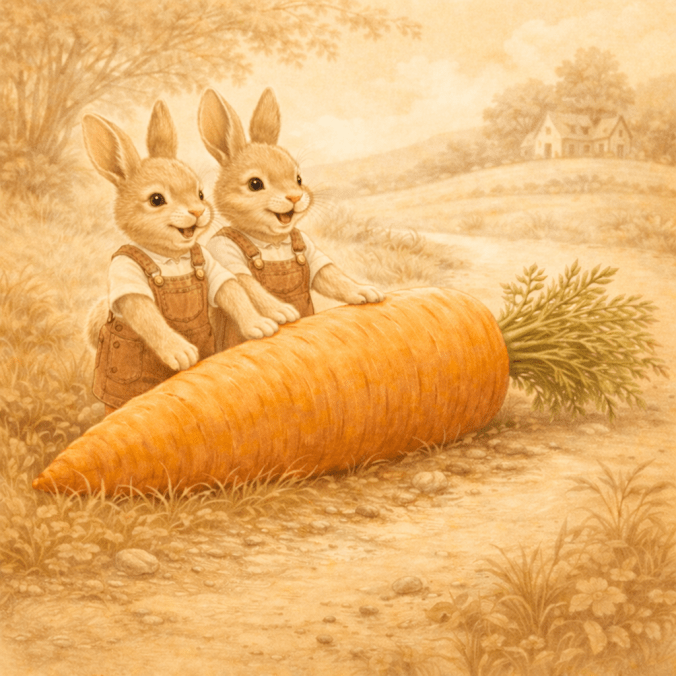
Lying just off the road, half in the grass and half in the dust, was a carrot.

Not a carrot carrot.

A carrot the size of a fence post.

It was long and thick and sun-warmed, its orange skin dulled with soil, its green top snapped short as if it had once belonged to a wagonload of respectable vegetables that had not expected to lose a member along the way.

The brothers walked slowly around it.

They stood beside it.

They placed a paw on it, just to be sure.

“It’s real,” said the younger one.

“It’s ours,” said the older one, immediately and with confidence.

The only problem was getting it home.

They tried first to drag it.

They braced their feet, leaned back, and pulled with all the seriousness such a carrot deserved. The carrot did not move. It merely sat there, unimpressed and unmoved, as though it had been waiting for this moment and was quite prepared to wait longer.

They tried lifting one end.

That end rose exactly as far as the other end sank, and the carrot pivoted neatly back into place, landing with a thump that rattled their paws.

They rested, catching their breath.

“Maybe if we roll it,” said the younger brother.

This seemed reasonable.

The carrot was round, after all. Mostly.

They pushed.

The carrot rolled.

Not forward.

It rolled sideways, drifting lazily toward the road, as though it had somewhere else to be.

They scrambled to stop it, wrestling it back into the grass before it could embarrass them in front of any passing wagons.

They tried again, this time from the other side.

The carrot rolled the opposite direction, wobbling, curving, and clearly unwilling to be guided in a straight line.

“It doesn’t listen,” the younger brother said.

“It’s shaped wrong,” said the older one.

They studied it closely then — the thick top, the narrowing point, the subtle curve that promised cooperation and delivered betrayal.

They attempted to lever it with a stick.

The stick snapped.

They attempted to roll it while running alongside, paws scrambling, ears flapping.

The carrot rolled faster than expected, slower than hoped, and then gently pinned them both in the grass until they agreed to let go.

Eventually, they sat down beside it.

The afternoon was quiet. A breeze stirred the grass. The carrot lay peacefully between them, as though nothing at all had happened.

Their house sat below them on the hillside — not far, really, when one looked at it that way.

The younger brother tilted his head.

“What if,” he said slowly, “we don’t take it up to the house?”

The older brother followed his gaze.

The hill sloped gently downward, straight toward their front wall.

They looked at the carrot.

They looked at the hill.

They smiled.

Getting it started was easy.

Stopping it was not.

The carrot tipped, rolled, hesitated, and then gathered confidence, wobbling its way downhill with growing enthusiasm. It veered left. It corrected. It veered right. The brothers ran alongside, shouting helpful suggestions that the carrot ignored entirely.

The curve took over.

The carrot picked its own path.

The brothers watched, helpless and hopeful, as it rolled faster, straighter, and with increasing purpose — directly toward their house.

There was a sound.

A solid, unmistakable WHUMP against the wall.

Silence followed.

Then the front door flew open.

Their mother rushed out, apron askew, eyes wide — ready for disaster.

She stopped.

She stared.

Leaning neatly against the wall, as if it had always belonged there, was a carrot the size of a fence post.

The brothers stood very still.

Then their mother laughed.

She laughed the way one does when something is too unexpected to be annoying and too useful to be ignored.

“Well,” she said happily, “that’s carrot soup for a month.”

The brothers sat down in the grass, dusty and pleased.

The carrot did not move again.

It had arrived.

Pen-and-ink illustrations created with the assistance of AI and lovingly styled for Little Red Bear Land.

Why do I write these? Aw, I don’t know. Just thought it might make you smile.