FIELD NOTES FROM HONEY HILL
Along Fence Rows & Woodland Paths with Silas Thorne

“The Morning the Fields Turned Silver”
Silas Thorne believes nature always has a story to tell for those willing to slow down and listen.
From hummingbirds and wildflowers to changing seasons, woodland creatures, and quiet mornings along the creek, he invites readers to discover the beauty, wonder, and small surprises waiting just beyond the doorstep.
By Silas Thorne
The Honey Locust outside my window has been bare for more than a week.
Every Spring, it keeps me waiting. The other trees begin putting out leaves, the hills turn green, and still it stands there looking as though Winter might have been too much for it.
I study the branches. I look for buds. I begin wondering whether I ought to ask somebody who knows more about trees.
Then, when it is good and ready, out come the leaves.
Come Autumn, however, it wastes very little time. A few golden days, a little wind, and off they go, as if the whole lot were in a hurry to get someplace else.
For a tree that takes so long getting dressed, it is remarkably quick about undressing.
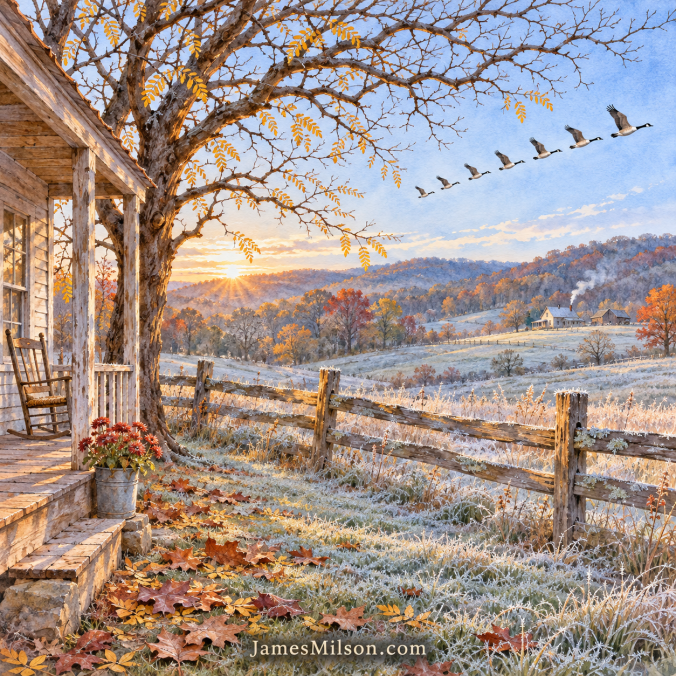
This morning, its empty branches stood against a pale sky, and the field beyond the fence had turned silver.
Our first proper frost had arrived.
I put on my coat, found my hat, and stepped outside.
The porch boards were cold beneath my boots. Along the railing, frost lay in a thin white seam, and every nailhead wore a little cap. My breath drifted ahead of me while I stood deciding whether I should have brought my gloves.
I went back for them.
There is a particular pleasure in a November morning, but I see no reason to enjoy it with numb fingers.
Beyond the steps, fallen leaves rested in the grass, their curled edges traced with white. An Oak leaf held a whole little country of frost along its veins. Beside it, a spider’s web stretched between two dry stems, so finely outlined that I could see every thread.
I had walked past those stems yesterday without noticing a thing.
Near the hedge, a Carolina Wren worked its way through the tangled branches. It paused, gave me a brisk scolding, and disappeared into the brown leaves gathered underneath.
Somewhere down the road, an axe struck wood.
The sound carried cleanly through the cold air. A moment later came another stroke, followed by the small tumble of a split piece joining the pile. Woodsmoke drifted above a neighboring chimney, rising straight for a little way before spreading toward the creek.
I had reached the gate when I heard the geese.
At first, there was only that distant calling. I stopped with one hand on the latch and looked across the sky.
Then they came into view.
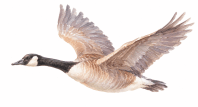
Canada Geese, flying high above the field, their long V opening toward the south.
The lines shifted as they traveled. One bird slipped a little out of place, another closed the space, and all the while their voices passed overhead.
I raised a hand.
“Goodbye, then.”
They answered at considerable length.
I have known neighbors to leave after supper with less discussion.
Their calling faded beyond the ridge, and I stood listening until I could hear the axe again.
With the Honey Locust bare, I could see a nest tucked into a fork I had scarcely noticed all Summer. A little cup of grass and twigs, high above the ground. For months, leaves had sheltered it from my eyes.
Now there it was, with a patch of blue showing through the branches behind it.
I wondered how many mornings I had passed beneath while somebody up there was busy raising a family.
Along the fence, a few berries still clung to the shrubs. A Northern Cardinal moved among them, bright enough to catch my eye from halfway across the field. It settled on a twig, studied its breakfast, and went about the business of the morning.
I followed the fence toward the rise.
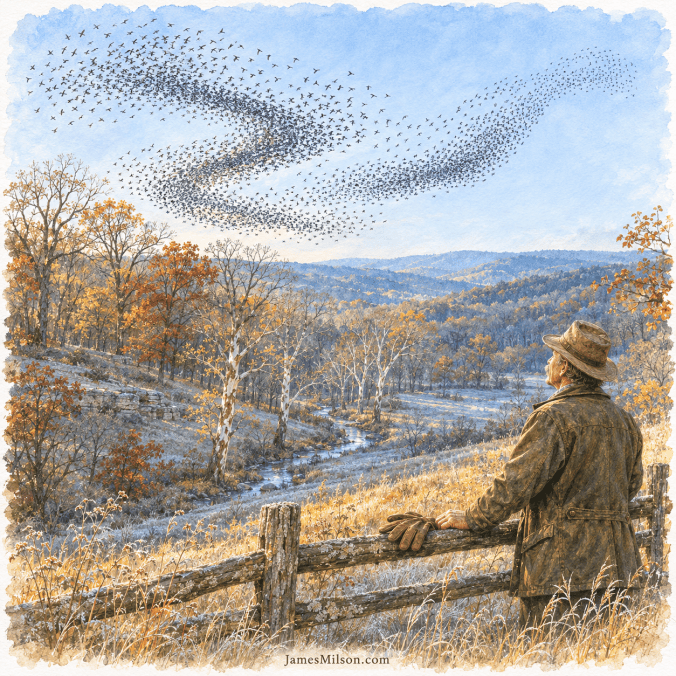
From there, the valley lay open. Patches of russet and gold remained on the hillsides, with bare grey branches showing between them. The Sycamores along the creek stood pale against the darker woods. In the low places, frost lingered thickly where the sun had yet to reach.
Farther off, above a stand of trees, a dark shape gathered in the air.
For a moment, I took it for smoke.
Then it turned.
Starlings.
More than I could begin to count.
The flock drew together into a dark ribbon, swept sideways, and opened into a broad, wavering sheet. Sunlight passed through the thinning edges. Before I could settle my eyes on the shape, it folded again.
I stood still.
They swooped toward the trees, rose, twisted, and flowed across the sky like living clouds. One moment, the flock was dense and dark. The next, it stretched into wispy, almost transparent ribbons, with blue sky showing through.
I tried following a single bird.
That lasted about as long as trying to follow one drop of water over the milldam.
There seemed scarcely time for one bird to turn before its neighbors turned with it. The movement traveled through the flock until thousands of wings had made another shape, and then another.
My gloves rested against the top fence rail. I had forgotten to put them on.
Down the road, a wagon rattled around the bend.
The driver lifted a hand, and I returned the greeting. A small child sat bundled beside him, with a covered basket wedged between their boots.
“Taking this over to Grandma’s,” the child called.
“For Thanksgiving,” the driver added.
The child leaned forward.
“We’re going back for the pie!”
“That sounds like a trip worth making,” I said.
They continued toward the crossing, the child turning to watch the birds until the wagon carried them out of sight.
By then, the starlings were settling into the distant trees. The great flowing cloud narrowed, broke into smaller streams, and poured down among the branches.
A few stragglers hurried after the others.
Then the sky was empty.
I stayed a little longer.
Sunlight had reached the field below me. The silver was disappearing from the grass, and drops of water shone along the fence. Somewhere behind the hedge, the wren began singing with an enthusiasm that seemed quite large for the bird responsible.
I put on my gloves and started home.
There would be plenty to do before Thanksgiving. Wood to bring in. An extra chair to fetch. Somebody would remember an errand, and somebody else would discover that the dish they wanted was on the highest shelf.
But this morning, I had stood beside a silver field and watched thousands of birds turn together above the valley.
I was glad I had gone out.
At the porch, a small breeze stirred the Honey Locust’s fallen leaves and sent them skittering around my boots.
Still in a hurry, apparently.
I opened the door and went in to put the kettle on.
Original artwork throughout The Front Porch has been created from my concepts and creative direction with the assistance of AI.