COME WITH ME . . . .
Strolling Through Honey Hill Country with Willow Meadows

“Over the River and Through the Woods”
Willow Meadows invites readers to experience Honey Hill Country one step at a time through its trails, towns, waterways, and hidden places. She believes the journey is often just as important as the destination and rarely passes a scenic overlook, garden gate, or interesting story without stopping to investigate.
Join her each month as she explores the landscapes, histories, people, and stories that make the region unique.
By Willow Meadows
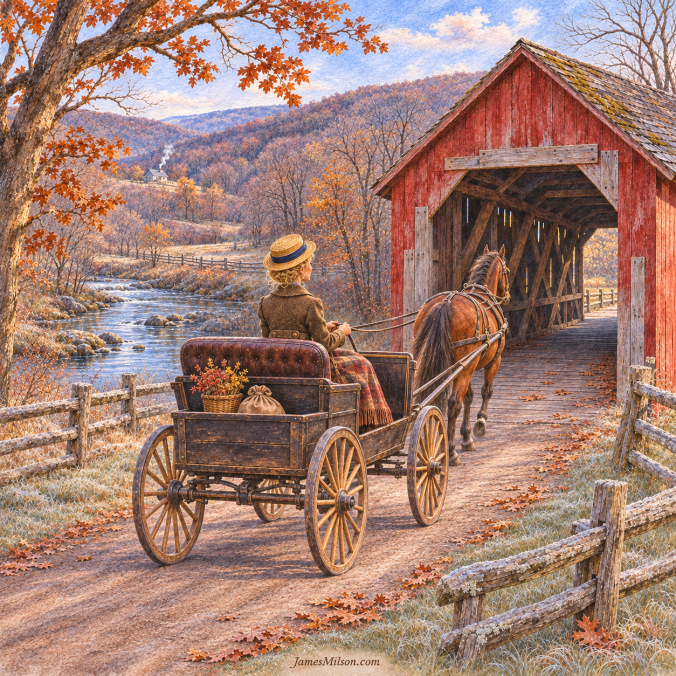
I was out of Butterfield on Thanksgiving morning before I gave much thought to the two instructions Ma had sent me. The first was to take my time and mind the road. The second was to be there while the rolls were hot.
I tucked the lap robe a little closer and let the horse settle the matter.
There was a pecan pie under the buggy seat, wedged in with my bag and a folded towel so it would have to work at coming loose. I had picked it up the afternoon before at Myra Cookson’s Pie Pantry & Goodies Shoppe in Butterfield. Myra told me that Myrtle Mae Meadowbloom had helped make it, and that the pecans had come in with Ennis Greenlea. She lifted the cloth to let me see what I was taking home. The pecans at the very edge had gone a fine dark brown where the filling bubbled up around them. I bought the pie chiefly for the family, though it was just as well there was no fork under the buggy seat.
Beside it stood a little jar of sorghum I had bought from Emery and Nettie Watson at the Butterfield Farmers Market. Ma had said to bring myself. I knew she meant it, but she had also been known to cut a hot roll in two and put sorghum on both halves so there would be no disappointment when she got to the bottom one.
I had scarcely left the last houses behind when I began to sing.
Over the river and through the woods,
To grandmother’s house we go . . . .
My horse tipped an ear back at me. I took that for encouragement and went on, though we were short a sleigh and there was scarcely enough white on the ground to dust a biscuit. When we were little, my older sister Miriam and I used to sing that song from the back of the wagon. We knew different words to the middle of it and each sang hers a little louder whenever we came to a disagreement. Pa once asked us if we knew any songs about going home quietly. We said we would think about it, and I believe we let him have as much as half a mile.
Along Split Rail Road, the low places still held their frost. The sun had reached the tops of the fence rails, and every so often a drop fell from one into the brown grass. Where cattle had stood close to the fence, their breath hung in the air a little while after they had moved away. I passed a place where somebody had been splitting oak. The fresh faces of the wood were pale in the sunlight, and I could smell the chips from the road. A Carolina Wren called from a brush pile with the conviction that anything worth saying ought to be said three times.
Farther along, a man in a wagon raised a mitten to me. Beside him sat a little girl holding a covered dish in both hands. She gave me a solemn nod, as one traveler entrusted with something important to another. I wondered how far the dish had come and whether she had been allowed to help make whatever was in it. When I was about her size, Ma let me put the top crust on an apple pie. I cut so many little windows for the steam that Pa said he could see what he was getting from clear across the kitchen.
Most of the leaves were down by then, though a few of the young oaks still held theirs. The wind came through them as I went down into the Kettle Creek valley, and it found its way up my sleeves, too. I sang the part about the wind and the cold nose, with rather more feeling than I had given the first verse. Singing did little for my nose, but it warmed me to hear the old words out there where there was nobody to tell me I had got them wrong.
When I was a girl, Pa told me the first people to call it Kettle Creek thought the wooded hills curved around the valley like the sides of a great iron kettle. I used to look for the place where the handle ought to be. That morning, with cookstove smoke rising beyond the trees from nearby homes, I found myself looking for the lid. I caught the scent of woodsmoke before I could see the first house. Somebody down in the valley was getting an early start on dinner. It put me in mind of Ma lifting the stove lid with one hand and holding the floury corner of her apron out of the way with the other.
I could see Kettle Creek Covered Bridge through the trunks before I came to it, a weathered barn red. Newer, unpainted boards at the ends had already weathered grey, and there were leaves caught where the road met the planks. The hoofbeats changed as we went under the roof. On the road I had scarcely been aware of them. Inside, each hoofbeat sounded separately, with the creek running underneath and a little rattle from the buggy beneath me. I started to sing again, softly this time, and the bridge gave me back enough of my own voice that for a second I could almost hear Miriam coming in on her part.
Over the river and through the woods,
Trot fast, my dapple gray!
Spring over the ground,
Like a hunting hound!
For this is Thanksgiving Day.
When we came out on the far side, the sun was suddenly bright enough to make me blink. We went along through the woods a little farther, past a hollow where the leaves lay deep enough to cover the stones, and presently I caught a glimpse of the rooftops of Stormy Hill. I had been content with our pace all the way from Butterfield. Now it seemed to me we were taking an awfully long time over the last little bit. I sang another verse.
Over the river and through the woods,
And straight through the barnyard gate.
We seem to go extremely slow
It is so hard to wait!
My horse knew where to turn as well as I did and took the turn at precisely the pace he had intended all along.
Dandy saw me first. Our big, rough-coated black-and-white collie came across the yard barking, made a wide circle around the horse, and ran up to the porch to tell the household. Finding nobody had come out in the time he considered reasonable, he ran back to me. He had known me long enough to recognize the buggy and knew me a good deal too well to suppose there was any real need to let me get both feet on the ground before he said hello.
My older brother Caleb was out a moment later. He took the reins while I stepped down and said, “How many stops between here and Butterfield?”
“None.”
“How many nearly stops?”
I was still counting when Dandy put his head under my hand and settled the order in which I was to greet the family.
Pa was on the porch by then. He looked at me a moment and smiled. “There you are,” he said, and reached for my bag. That was about as much speech as Pa ever needed for a homecoming. He noticed I was carrying the pie with both hands and came back down a step to open the door for me.
I could smell the turkey the moment the door opened, and the sweet potatoes with butter and brown sugar, and that good smell a loaf of bread gives off when somebody cuts it while it is still warm. Coming in from the cold, I could feel the kitchen heat on my face before I had my coat off. Miriam was there in the passage to take the pie. By the time I had undone the top button of my coat, she had told me that her little girl had lost a tooth, that Caleb’s youngest had found it, and that there was some dispute over which of them deserved a reward.
“Where’d he find it?”
“In the girl’s own hand,” Miriam said. “He’s still quite put out that we won’t pay him.”
Ma came through with a pan of rolls, put it down long enough to hug me, and asked if I had eaten anything since leaving Butterfield. She put a roll in my hand while I was still answering. One side had pulled away where it had baked up against its neighbor, and that soft place was where the butter went first. I stood there in my coat eating it while Ma went back for the gravy and Miriam told me the rest of the tooth story. All the way over I had been thinking I would have a great deal to tell them when I got there. For a minute or two it was enough to stand in the passage and listen.
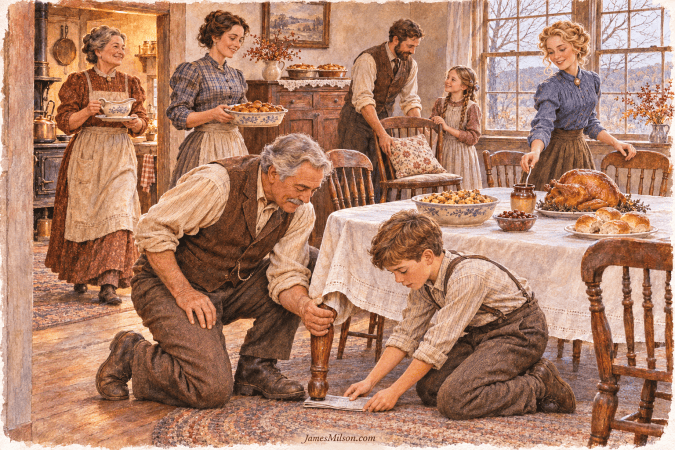
Caleb’s wife was in the kitchen lifting the sweet potatoes into a serving dish, with one of her children close by hoping there might be a little of the buttery brown sugar left in the pan. Miriam’s husband was bringing in chairs. He put one at the corner for their daughter with a pillow on the seat so she could reach the table without sitting on her feet. I took the Watsons’ sorghum out of my bag, and Ma sent me to fetch a spoon for it. By the time I came back, Caleb’s oldest had tried to steady the table with a folded piece of newspaper, and Pa was down on one knee holding the leg up so the child could get the fold in just right.
My younger brother Joe came in just as we were sitting down, with cold ears and a great interest in how I had found the road conditions on the way over. He said he might ride back with me. I told him I meant to leave while there was still plenty of daylight and asked whether he meant to ride home again after dark.
He gave that some thought. “Well,” he said, “we’ll see when I wake up from a nap.”
Pa waited until the children had settled and we had all bowed our heads. He gave thanks for the food, for the hands that had prepared it, and for those who were spending Thanksgiving farther from home than they wished. I thought of my youngest sister, Ruth. She and her husband lived too far away to make the trip that year. I had been looking forward to hearing her letter ever since Ma wrote to say it had come. Ruth had always sat between Joe and me when we were young, where she could keep an eye on what both of us were getting.
Then Ma asked who wanted the first of the cornbread dressing, and three people answered at once.
Pa carved the turkey, and by the time the good brown pieces from the outside had found their way around the table, the gravy had traveled in both directions and come back to Ma with barely enough in the boat to cover a spoon. There were mashed potatoes, green beans cooked with salt pork, and those sweet potatoes I had smelled at the door, sticky where the brown sugar had cooked down around the edges. Caleb passed me the cranberries just as I was reaching for the pickled peaches. I took a little of both. Ma had put up the peaches when the weather was so hot she had opened both kitchen windows while she worked. I remembered helping her that afternoon, and how the vinegar and cloves had carried clear out to the porch.
When the bread came around, Pa took the heel of the loaf, as he generally did. The children had already gone for the soft middle slices. Pa buttered his right out to the corners, turned it crust side down, and used it to catch the last of his giblet gravy. He has always said the heel is the only piece built to do that job properly. I put a little sorghum on my second roll. A drop escaped onto my plate, and I went after it with the last bite while Ma pretended to be occupied with her potatoes.
Joe told me the story he had been saving. He had been out by the woodpile the previous week when he heard a knock at the back door. He let Dandy in, and about ten minutes later he heard the same knock and let him out. By the third time he went around the corner of the house to see who was doing it. Dandy was standing sideways at the door with a short stick in his mouth. Every time he turned his head, the end of the stick knocked against the lower panel. Joe said he had spent two days teaching the dog to knock before it occurred to him which of them was being trained.
I had noticed a stick beside the back step when I went to fetch the spoon. I looked down at Dandy, who was lying under Joe’s chair with his eyes shut. The tip of his tail went over once.
After dinner we brought out the pies. Ma had made pumpkin and apple, and I set Myra’s pecan pie alongside them. Miriam poured coffee for the grown folks and sweet cider for the children. Caleb took a modest piece of pumpkin, then asked if anybody had yet ascertained how the pecan turned out. Ma handed him the knife. I had a piece of pumpkin myself and thought of the way Miriam and I used to put all the breath we had left into the last lines of the song.
Hurrah for the fun! Is the pudding done?
Hurrah for the pumpkin pie!
I hummed a little of it. Miriam picked it up right where I left off, and her daughter wanted to know how we had both come to know a song about pie.
“We’ve had years of practice,” Miriam said.
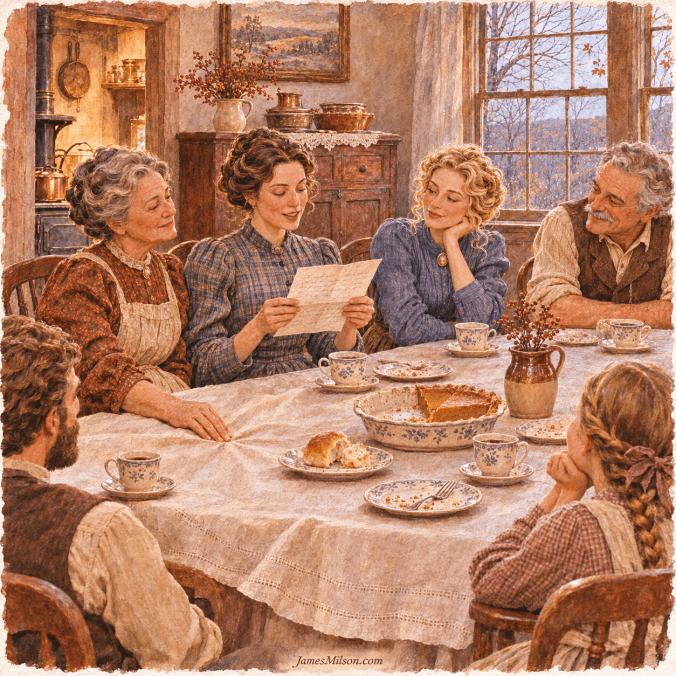
It was then that Ma brought out Ruth’s letter. She had folded it back into its envelope so often that Miriam had to take some care getting it out. Ruth wanted to know whether Pa still took the heel of the loaf. She hoped somebody would have a second helping of dressing on her account. Caleb said he had anticipated her wishes and done just that. Then Miriam came to a little passage Ruth had put in just for Ma, and her voice slowed down.
“Ma, do you remember the year I couldn’t go with the others to fetch the cousins because I had such a bad cough? I cried when I heard them singing as the wagon went off. You brought the bread board over by the stove and let me make the little rolls right there in my chair. I thought you needed me to do it. I was grown before it came to me that you’d moved the whole business across the kitchen so I could help. I made those little rolls Sunday morning. I still make them just the size you showed me.”
Ma kept her eyes on the tablecloth, smoothing a crease with the side of her hand. When Miriam finished, Ma asked her to read that part again.
“I remember,” Ma said then. “She had flour clear down to the toes of her stockings. I couldn’t see how she’d managed it sitting still.”
“She never did manage sitting still,” said Pa.
Miriam said she remembered coming in from the cold and finding the little rolls lined up on a plate. She had thought Ma made them small because there were so many children that year. Joe said he remembered being told to take one, but took two on the understanding that together they made an ordinary roll. That set the children laughing. Ma reached for the letter when Miriam had finished and smoothed it out on the table. I could see that she was reading those few lines for herself again.
Later, while we were clearing the table, Ma wrapped a few pieces of maple candy in paper for Ruth. Ruth had always liked the little uneven pieces from the edge of the pan. Ma had put those by before she set out the dish. She asked if I would tell Ruth they were coming, and I said I would. Then she fetched a clean towel and sent me home with enough rolls to make a good breakfast of the sorghum, if I could contrive to leave any of them until morning.
I had gone to Stormy Hill looking forward to all the things I remembered about Thanksgiving at home. I had forgotten how much of the pleasure was in hearing what had happened since I was last there. A tooth had come out. Joe had a story he had been saving for me. Ruth had written a few lines that Ma wanted to hear twice, and now, when I thought of those little rolls, I could see the bread board across Ruth’s knees and her stocking toes all white with flour. By the time the plates were put away, I was already thinking what I would tell her when I wrote back.
I would tell her that Pa took the heel of the loaf as usual, and that Caleb had looked after the dressing. I would tell her how glad we were to hear from her, and that Miriam still knew where to come in on the song. And I would tell her that after everybody moved away from the table, Dandy went straight to her old place and looked underneath.
She used to slip him a bit of her roll. It seems I was not the only one who remembered.
Original artwork throughout The Front Porch has been created from my concepts and creative direction with the assistance of AI.